

May
The Comprehensive Estate and Legacy Planning Guide for 2026
What if your greatest financial achievement became the primary source of your family’s deepest division? You’ve spent decades building a portfolio that reflects your dedication and vision, yet the concern that tax liabilities or unprepared heirs might diminish that impact is a heavy burden to carry. This estate and legacy planning guide addresses those anxieties for individuals who view wealth not just as a balance sheet, but as a vessel for their personal values. You deserve a strategy that feels as intentional and polished as the life you’ve built.
We’ll provide the sophisticated framework required to protect your assets and ensure your vision endures for generations. You’ll master the strategies needed to navigate the permanent $15 million federal exemption while learning to minimize probate exposure, manage state-specific inheritance taxes in regions like Pennsylvania or New Jersey, and leverage the latest SECURE 2.0 Roth catch-up provisions. This journey transforms asset distribution into a structured legacy of upward progression and shared success.
Key Takeaways
- Distinguish between the mechanical distribution of assets and the intentional preservation of personal values through visionary legacy planning.
- Utilize this estate and legacy planning guide to navigate the 2026 tax landscape, including the permanent $15 million federal exemption and state-level liabilities.
- Bridge the gap between wealth accumulation and stewardship by implementing mentorship frameworks that prepare heirs for the complexities of significant inheritance.
- Synthesize your legacy objectives with a structured retirement income strategy to ensure your financial assets remain perfectly aligned with your personal vision.
- Establish a centralized oversight model to coordinate your professional advisors, ensuring every tactical intervention serves your overarching multi-generational roadmap.
The Architecture of an Enduring Legacy: Defining Your Vision
True wealth is rarely a static figure on a ledger. It’s a dynamic force that, when channeled correctly, creates a lasting impact far beyond your own lifetime. Many high-net-worth individuals mistake the completion of a will for the fulfillment of their responsibilities. This estate and legacy planning guide challenges that transactional mindset. We view wealth as a tool for organizational evolution within the family, where financial assets serve as the foundation for a much larger narrative of personal values and shared success.
As we move through 2026, the strategic landscape has shifted significantly. With the federal estate tax exemption now permanently established at $15 million per individual, the technical pressure of immediate tax avoidance has lessened for some. This creates a unique opportunity to focus on the qualitative aspects of your wealth: control, asset protection, and family governance. To better understand the foundational elements of this process, watch this helpful video:
Estate Planning vs. Legacy Planning
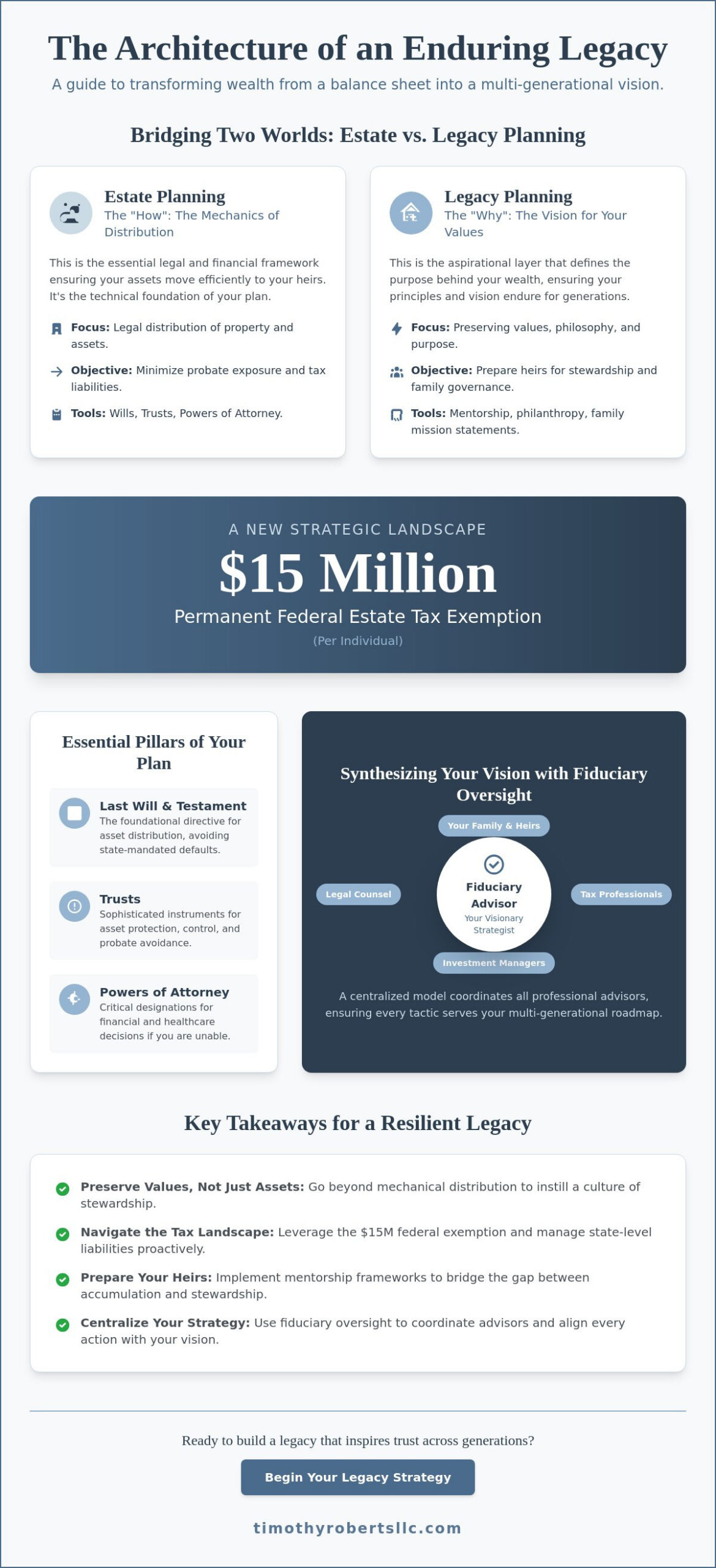
It’s helpful to view your strategy through two distinct lenses. To understand the functional layer, one might ask, What is Estate Planning? This layer focuses on the legal distribution of property, utilizing instruments like trusts and powers of attorney to ensure assets move efficiently. It’s the essential plumbing of your financial house. Legacy planning, however, is the aspirational layer. It focuses on the “why” behind the wealth. This includes philanthropy, family mentorship, and the cultivation of a culture that values stewardship over consumption. A sophisticated plan requires the seamless integration of both layers, ensuring that your financial rigor supports your creative vision.
The Fiduciary Standard in Legacy Design
Crafting a multi-generational roadmap isn’t a one-time event; it’s a journey of upward progression. This is why a fiduciary advisor is essential. Unlike a transactional service, a fiduciary partner provides objective, client-first strategic guidance that balances intellectual curiosity with financial discipline. We act as visionary strategists, helping you bridge the gap between individual goals and structured corporate capabilities. By establishing a baseline for long-term stability through professional oversight, we ensure your plan remains resilient against the uncertainties of the future. This collaborative approach turns a complex problem into a polished, intentional solution that inspires trust across generations.
Constructing the Framework: Essential Pillars of Your Estate Plan
A vision without a structure remains merely a dream. Within the context of high-net-worth preservation, that structure must be an airtight framework of legal and financial instruments. This estate and legacy planning guide moves beyond generic, off-the-shelf forms to explore how specific pillars support your broader life goals. We believe every legal intervention should be a carefully crafted solution, designed with the same precision as a custom-built residence. A fragmented approach often leads to unintended tax liabilities or family conflict; a unified strategy ensures your personal attention and high-level expertise go hand in hand.
Meticulous balance is the hallmark of a visionary strategist. You must weigh the need for short-term control over your assets against the necessity for long-term flexibility as laws and family dynamics evolve. By treating development as a journey rather than a simple transaction, you can build a resilient foundation that protects your wealth while honoring your personal vision. This requires moving away from superficial document collection toward a narrative of partnership and shared success.
The Core Legal Instruments
The foundation begins with the Last Will and Testament. It’s your primary directive, ensuring your assets are distributed according to your specific intent rather than state-mandated defaults. However, a will is only the first layer. Sophisticated plans often utilize trusts to achieve a balance between functionality and asset protection. Revocable trusts offer the ability to adjust strategies as your life evolves, while irrevocable trusts provide robust protection and potential tax advantages. Finally, Powers of Attorney and Advance Directives are non-negotiable. They ensure your affairs are managed with dignity and professional stability should you become unable to direct them yourself.
A Step-by-Step Strategic Checklist
Effective planning isn’t a single event. It’s a continuous process of upward progression. To move from vision to execution, follow this structured roadmap:
- Inventory all global assets and liabilities to create a comprehensive financial statement that serves as your baseline.
- Review and update beneficiary designations on retirement accounts and insurance policies to ensure they align with your current wishes.
- Coordinate your legal documents with your broader wealth management strategy to ensure your investments and legacy goals are perfectly aligned.
- Establish a schedule for periodic reviews, particularly as the 2026 tax landscape introduces new opportunities for Roth catch-up contributions and state-specific tax shifts.
Avoiding a fragmented approach requires a centralized partner who understands how these pieces fit together. When your legal framework mirrors your personal vision, you gain the confidence that your next generation is truly prepared for stewardship. If you’re ready to transition from basic distribution to a structured legacy, exploring professional Estate & Legacy Planning can provide the clarity you need to move forward with confidence.
Strategic Asset Preservation: Navigating Taxes and Trusts
Wealth grows through precision. While the federal exemption of $15 million per individual provides a generous ceiling, the nuances of state level inheritance taxes and capital gains require a more granular approach to preservation. This estate and legacy planning guide views tax mitigation not as a seasonal obligation, but as a continuous catalyst for wealth evolution. By integrating strategic tax advising into your broader framework, you ensure that every dollar is positioned to support your multi-generational vision rather than being eroded by avoidable liabilities.
Sophisticated asset preservation requires a shift from reactive filing to proactive intervention. We treat the tax code as a structural map, identifying opportunities to shield assets from double taxation and legislative shifts. This disciplined approach moves beyond the surface level, seeking out the intersection of financial functionality and long term growth. It’s a journey of upward progression where your financial assets are meticulously aligned with your personal values.
Trusts as Interventions for Wealth Evolution
Trusts serve as the primary vehicles for sophisticated legacy design. A Charitable Remainder Trust (CRT) allows you to balance your philanthropic goals with personal income needs, providing a rhythmic flow of revenue while supporting causes that matter to you. For those looking across eras, Generation Skipping Trusts protect wealth from being taxed at each successive transfer, ensuring the core of your estate remains intact for your grandchildren. To master these structures, you must understand the “ABCs” of the trust lexicon. The Grantor is the visionary who creates the trust; the Trustee is the reliable advisor who manages the assets; and the Beneficiaries are the heirs who receive the intended impact of your life’s work.
Minimizing the Tax Erosion of Your Estate
Managing the tax impact on your estate involves navigating the complexities of capital gains and the “step up” in basis at death. This strategy allows heirs to inherit assets at their current market value, potentially eliminating the tax burden on decades of appreciation. It’s also vital to account for state level realities, as 12 states currently impose their own estate taxes and five states maintain inheritance taxes, with rates in Pennsylvania reaching as high as 15% for certain beneficiaries. Proactive tax mitigation preserves 20-30% more of the estate over time. By accounting for these variables today, you transform a complex liability into a stable foundation for the future. This deliberate pacing ensures that your transition from wealth builder to wealth steward is both seamless and successful.
The Multi-Generational Transition: Preparing Heirs for Stewardship
A sophisticated tax structure is only as resilient as the individuals who inherit it. While previous sections of this estate and legacy planning guide analyzed the technical pillars of asset preservation, the true success of a legacy depends on the preparation of the rising generation. Wealth transfer often fails not due to legal oversights, but because of a lack of mentorship and transparent communication. We believe that bridging the gap between your individual creative vision and the structured capabilities of your heirs is a strategic necessity. It’s a journey of upward progression that requires a shift from viewing inheritance as a single transaction to seeing it as a lifelong partnership.
Trust is built through intentionality. When family members understand the “why” behind the wealth, they’re more likely to respect the “how” of its management. This synthesis of the personal and professional creates a human-led identity that distinguishes your family’s success from anonymous corporate entities. By treating development as a shared journey, you ensure that your assets continue to reflect your personal attention and high-level expertise long after the initial transfer occurs.
Starting the Legacy Conversation
Introducing complex financial concepts to your heirs requires a blend of calm confidence and strategic rigor. You should define family goals and expectations well before any significant wealth transfer takes place. This creates a baseline of professional stability and organizational evolution. One effective method is utilizing education funding strategies as a practical tool for teaching financial responsibility. By involving children or grandchildren in the mechanics of funding their own academic pursuits, you provide a tangible introduction to the concepts of investment, growth, and stewardship.
Preparing Heirs for Wealth Stewardship
Wealth readiness is a measure of an heir’s financial literacy and emotional maturity. It’s not enough to simply hand over a portfolio; you must provide the mentorship required to manage it. Creating a family mission statement is a powerful intervention that guides future philanthropic and investment decisions, ensuring they align with your original vision. In this process, the advisor serves as a neutral mediator, helping to navigate complex family dynamics with intellectual curiosity and business-minded rigor. This collaborative approach ensures the next generation is prepared to lead with the same passion you brought to building your estate. To begin crafting your family’s multi-generational roadmap, consider a partnership through our dedicated Estate & Legacy Planning services.
Synthesizing Your Vision: The Role of Fiduciary Oversight
A strategic vision requires a master conductor. You’ve established the legal framework, optimized for 2026 tax realities, and initiated the mentorship of your heirs. Now, you must synthesize these interventions into a cohesive operational model that reflects your unique identity. This estate and legacy planning guide emphasizes that success isn’t found in isolated documents, but in the deliberate coordination of your financial life. A centralized fiduciary partner acts as this coordinator, bridging the gap between specialized legal, tax, and investment professionals to ensure no detail is overlooked. This deliberate pacing reinforces the idea that we take the time to solve complex problems rather than rushing to generic conclusions.
Depth ensures durability. Without professional oversight, even the most robust legacy plans can drift out of alignment with your daily financial realities. It’s essential to integrate your long term goals with a comprehensive retirement income strategy. This integration prevents the common pitfall where estate preservation inadvertently compromises your current lifestyle or liquidity. By viewing your wealth through a single, strategic lens, you transform a collection of assets into a resilient engine for upward progression. It’s a journey of partnership that moves away from aggressive sales toward a narrative of shared success.
The Intersection of Aesthetics and Functionality
A polished financial roadmap is a reflection of the rigor you’ve applied to your life’s work. It’s not a static monument, but a living document that must evolve alongside your personal vision and the shifting legislative environment of the late 2020s. Our approach prioritizes the tangible impact of specialized interventions over generic solutions. This focus on personal attention ensures that as your family grows or tax laws shift, your plan remains an accurate expression of your values. It’s the intersection of aesthetics and functionality, where a well crafted plan feels as intentional as a high end gallery or a professional consultancy.
Next Steps in Your Strategic Evolution
The journey toward a lasting legacy begins with a rigorous assessment of your current position. We recommend conducting a “stress test” on your existing plan to identify potential friction points in light of the $15 million federal exemption and state specific mandates. Gather your current trusts, beneficiary designations, and financial statements for a professional fiduciary review. This intellectual curiosity is the first step toward true peace of mind. When you’re ready to elevate your strategy, schedule a consultation for comprehensive estate and legacy planning. Together, we’ll ensure your success inspires trust for generations to come.
Securing Your Multi-Generational Roadmap
Legacy planning is an act of creative vision that requires a foundation of financial rigor. This estate and legacy planning guide has detailed how to move beyond simple asset distribution to create a structured journey of upward progression. By synthesizing tax preservation with intentional heir mentorship, you ensure your wealth remains a tool for family evolution. You’ve mastered the balance between the technical $15 million federal exemption and the qualitative needs of your unique culture. It’s a journey that transforms complex liabilities into a polished narrative of success.
Achieving this level of depth requires a partner who values customization. Our fiduciary advisors bring over 25 years of specialized experience to every intervention. We provide the comprehensive wealth and tax integration necessary for long term stability. We specialize in crafting personalized strategies tailored to your unique family vision. Partner with a fiduciary to craft your strategic legacy today. You’ve built a life of significance; now ensure your assets endure with the same clarity you brought to their creation.
Frequently Asked Questions
What is the difference between a will and a trust in a legacy plan?
A will serves as your primary directive for asset distribution through the probate court system; a trust provides immediate control and privacy by bypasssing that public process. While a will is the functional layer of your plan, a trust acts as a strategic intervention for wealth evolution. This combination allows for a seamless transition that protects your family’s privacy and minimizes administrative delays after your passing.
How can I minimize estate taxes for my heirs in 2026?
You can minimize liabilities by leveraging the 2026 federal exemption of $15 million per individual and utilizing the $19,000 annual gift tax exclusion per recipient. This estate and legacy planning guide emphasizes the importance of coordinating these federal limits with state specific requirements, as jurisdictions like Pennsylvania impose inheritance taxes as high as 15%. Proactive tax advising ensures you utilize every available mechanism to shield your assets from erosion.
When is the right time to start legacy planning with my family?
The ideal time to begin is as soon as you transition from wealth accumulation to wealth stewardship. Legacy planning isn’t a single event but a journey of upward progression that should involve your heirs early through mentorship. Starting now allows you to align your financial assets with your personal vision while your family culture is still being actively shaped and refined.
Can I change my estate plan if my financial situation or family goals evolve?
Your plan should remain a living document that evolves alongside your creative vision and changing legislative landscapes. Significant life events, such as a shift in your investment portfolio or the arrival of a new generation, require a professional review to ensure your strategy remains resilient. We treat legacy development as a continuous partnership rather than a static, one time transaction.
What happens to my digital assets and social media accounts in my estate plan?
Digital assets must be explicitly cataloged within your framework to ensure your heirs can access and manage your online footprint. This includes intellectual property, cryptocurrency, and sentimental digital storage. Without specific authorizations, service providers may restrict access based on privacy laws. This can cause a permanent loss of both financial value and personal history if not addressed with professional stability.
How do I choose the right trustee or executor for my estate?
You should select a trustee or executor who demonstrates a blend of business minded rigor and deep personal integrity. This individual or institution must be capable of managing complex financial functionality while remaining faithful to your aspirational goals. Many families choose a professional fiduciary partner to provide objective oversight and maintain calm confidence during emotional transitions.
Is legacy planning only for high-net-worth individuals?
Legacy planning is essential for anyone who values the intentional preservation of their personal vision. While high net worth individuals face unique federal tax hurdles, state level exemptions are often much lower, such as Oregon’s $1 million threshold. Utilizing an estate and legacy planning guide helps individuals at various wealth levels avoid the pitfalls of probate and ensure their values endure for generations.
How does a fiduciary advisor coordinate with my estate attorney?
A fiduciary advisor serves as the strategic architect who integrates your investment portfolio and tax planning with the legal instruments drafted by your attorney. This partnership ensures that your financial assets and legal directives move in perfect synchronization toward your long term goals. The fiduciary provides the centralized oversight necessary to coordinate multiple professional experts into a single, polished roadmap.

