

Oct
How to Build Confidence in Your Investment Strategy
A market drop after you invest doesn’t automatically mean your strategy is wrong. Learning how to build confidence in your investment strategy starts with understanding why you chose it, how it supports your goals and risk tolerance, and what you’ll do when markets fall. Building your knowledge, diversifying, and beginning with a manageable investment can make a plan easier to follow.
A sudden decline can still feel unsettling, especially when your money is newly invested. Rather than rushing into a decision, revisit your goals and the reasoning behind your choices before deciding whether anything needs to change.
This article explains how continued learning can strengthen your decisions, how diversification can help balance a portfolio, and how investing smaller amounts can offer a more measured start. It also covers practical ways to respond to a market drop, so your strategy reflects your circumstances rather than short-term emotions.
Key Takeaways
- Build investment knowledge steadily, focusing on how each choice relates to your goals, time horizon, and comfort with risk.
- Review how your investments are spread across different assets, and consider whether the mix still reflects your intended balance.
- If markets fall, pause before changing course and revisit the reasons behind your plan rather than reacting to short-term movement.
- Start with an amount that feels manageable and use consistent contributions to develop a steadier investing routine.
1. Ongoing financial education
Build confidence through a steady learning routine, not a stream of market headlines. Set aside 10 minutes a week to study one concept, such as stocks, bonds, mutual funds, or compound interest. Then connect it to a decision in your financial plan: which goal it supports, when you may need the money, and how much fluctuation you can tolerate. This keeps education practical and relevant to your circumstances.
Start with your objectives and comfort with risk. According to the SEC, investors should define their financial goals and risk tolerance before making investment decisions. A house down payment needed in two years may call for safer assets than retirement savings intended for a longer horizon. If retirement is 30 years away, estimate the yearly investment needed for your desired nest egg, then review whether that amount fits your income and priorities.
Learning can also address confidence gaps. Equitable research found that 52% of women feel less financially confident than men. In a 2022 study, Bank of America found that 94% of women expected to be personally responsible for their finances at some point, while 28% felt empowered to act. Building knowledge one decision at a time can help turn responsibility into informed action.
Life changes can make this learning especially useful. A new job may affect your income and retirement-plan choices; marriage, caregiving, or approaching retirement may shift your priorities. When circumstances change, revisit your goals, available cash, and risk tolerance before adjusting your investments. Your financial plan should reflect your life now, not just earlier assumptions.
If investment decisions feel overwhelming, consider working with a fiduciary financial advisor who is legally bound to act in your best interest. Ask how a proposed investment works, what its potential downsides are, and how it fits your goals. An advisor can explain the reasoning behind a plan while helping you stay involved in decisions. The aim is to understand your choices and remain engaged as markets change.
2. Diversification
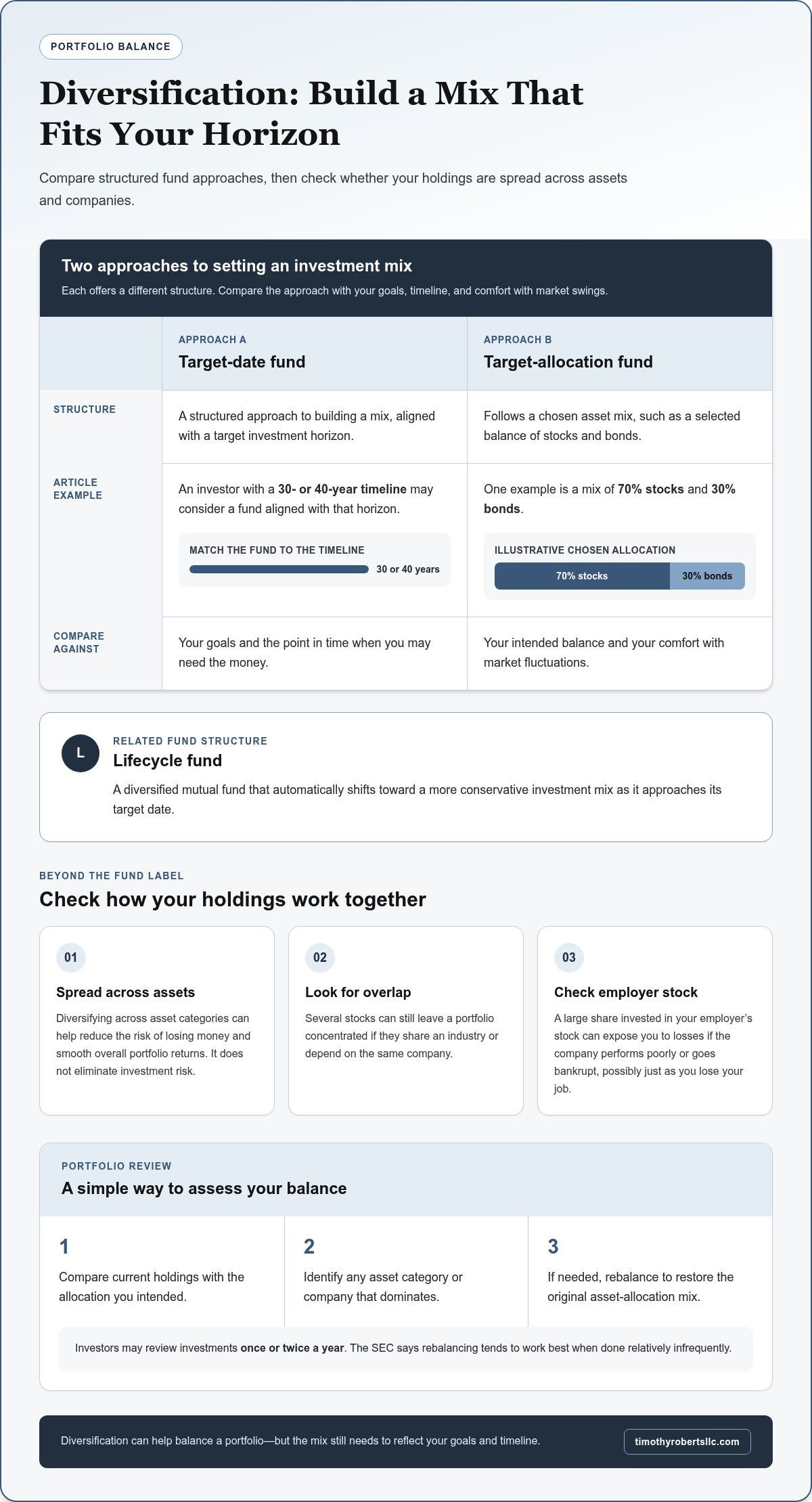
Diversification means spreading investments across asset categories and holdings rather than concentrating them in one place. The SEC says diversification across asset categories can help reduce the risk of losing money and smooth a portfolio’s overall returns. It doesn’t eliminate investment risk, but it may limit how much one weak area affects the whole portfolio. Consider how stocks, bonds, and other assets work together instead of judging each holding on its own. For investors who include residential rental real estate in their asset mix, firms like E&S Property Management can assist in managing the operational demands of physical properties.
Target-date and target-allocation funds offer structured approaches to building a mix. An investor with a 30- or 40-year timeline may consider a target-date fund aligned with that horizon. A target-allocation fund, by contrast, follows a chosen mix, such as 70% stocks and 30% bonds. A lifecycle fund is a diversified mutual fund that automatically shifts toward a more conservative investment mix as it approaches its target date. Compare the fund’s approach with your goals, timeline, and comfort with market swings.
Look beyond the number of holdings. Several individual stocks may still leave a portfolio concentrated if they share an industry or depend on the same company. The SEC warns that holding a large share of your investments in your employer’s stock can expose you to losses if the company performs poorly or goes bankrupt, possibly just as you lose your job. Consider this overlap when reviewing workplace investments alongside your other assets.
To assess balance, compare your current holdings with the allocation you intended, then identify any category or company that dominates. Investors may review investments once or twice a year to see whether the portfolio still matches its initial allocations. The SEC describes rebalancing as restoring a portfolio to its original asset-allocation mix and says it tends to work best when done relatively infrequently. For a broader view of how investments fit into wealth goals, explore wealth management.
3. What should I do if the market drops right after I invest?
First, pause before selling. Compare the decline with your original goal, investment timeline, and portfolio mix. If your reason for investing still holds, a short-term drop alone may not justify changing your strategy. Money you’ll need soon has a different role from retirement investments intended to grow over time.
To avoid emotional decisions, set a simple routine: review your plan at planned intervals, automate recurring contributions if they fit your budget, and limit market-news checks that prompt impulsive reactions. The SEC describes dollar-cost averaging as investing the same amount regularly over a long period, buying more when prices are low and less when they’re high. Consistency can help you focus on your process rather than daily price movements.
In the United States, fees depend on the account and investments. Costs may include transaction charges or mutual fund expenses. Tax treatment depends on the account type and investment activity, and rules vary among taxable accounts, IRAs, and employer plans. These differences affect what you can contribute, withdraw, or owe, so understand the terms before you act.
During a downturn, write down why you own each investment and what conditions would justify changing it. Then separate market updates from decisions: choose a set time to review reliable information, and avoid trading in response to every headline. The SEC advises investors to take their time, ask questions, and check investment claims with an unbiased source. Be cautious of claims that a recovery is guaranteed.
History offers context, not a forecast. Across the 26 bull markets since 1877, stock market values rose by a median of 87%, and those markets lasted a median of 42 months. Those figures describe past bull markets, not a timetable for recovery after any particular decline. Keep your investing decisions connected to your goals, not a prediction that markets will follow the same path.
4. Building confidence by investing small amounts
A modest initial investment can help you learn how a strategy feels in practice. Before investing, write down your goal, time horizon, and intended allocation. Choose an amount that fits your budget, then notice how price changes affect your reactions. This experience can show whether your plan feels manageable without making every market move seem like a major decision.
You can try out a strategy before investing by tracking a hypothetical portfolio. Record what you would buy, why you chose it, and how its value changes. Compare the results with your original goal and allocation, while remembering that simulated decisions don’t replicate the emotions of investing real savings. When you’re ready to invest, begin with a manageable amount and review whether the experience matches your expectations.
Small contributions also make it easier to understand compounding. In a hypothetical example, $100 earning a 10% annual return would grow to $110 after one year and $121 after a second year at the same return. Actual investment returns vary, but the example shows how growth can build on earlier growth over time. Interest and returns matter, yet consistency and time are also important parts of the process.
Keep the first steps deliberate. Set a recurring contribution that leaves room for essential expenses, and note whether you can maintain it through changing market conditions. One investment example began with a position equal to 1% of the portfolio, illustrating how an investor might limit initial exposure while learning. Use each review to assess the investment’s role, the allocation, and your comfort with potential losses. For guidance aligning those decisions with your broader goals, explore investment portfolio management.
Timothy Roberts & Associates: Retirement Income Planning
Timothy Roberts & Associates can help when market uncertainty raises questions about how your investments support future income and retirement goals. Retirement Income Planning connects investment decisions with the income you may need later, while Investment Portfolio Management considers how your portfolio is structured around your objectives and risk tolerance.
This support may be useful as you approach retirement, reconsider your investment approach, or coordinate portfolio decisions with estate priorities. Estate & Legacy Planning and Risk Management & Insurance Analysis can also connect long-term wealth decisions with your broader plan. The aim is a considered strategy that reflects your circumstances, rather than a reaction to every market shift.
Contact Timothy Roberts & Associates to discuss how retirement and investment planning can support your goals.
Make your next investment decision with purpose
Confidence grows when every decision has a clear role in supporting the life you want your money to help make possible. Learning how to build confidence in your investment strategy means creating a thoughtful framework for decisions as your priorities evolve. Start by identifying the decision that feels least clear, then connect it to your future income, retirement plans, and wider financial priorities.
Timothy Roberts & Associates, LLC can help align these priorities through Retirement Income Planning, Investment Portfolio Management, and Estate & Legacy Planning. A conversation can clarify what matters now and how your financial decisions may support it over time. This kind of considered review can help you build confidence in your investment strategy as your goals change.
Contact Timothy Roberts & Associates, LLC to explore a considered next step. Keep moving forward with a strategy grounded in your goals and built to reflect the person you’re becoming.
Frequently Asked Questions
What should I do if the market drops right after I invest?
If the market drops after you invest, first consider whether you’ll need the money soon or whether it remains invested for a long-term goal. Review whether a life change, cash needs, or a shift in the investment’s underlying outlook has affected your original reasoning. If only prices have changed, don’t treat the decline itself as proof that your initial decision was unsound.
What is an investment strategy and how do you define clear financial goals?
An investment strategy connects your financial goals with decisions about what to invest in, how much risk to take, and when you may need the money. Make goals specific by naming their purpose, such as funding education or retirement, then identify the resources and time horizon involved. Separating goals helps distinguish money for near-term needs from investments intended for future priorities.
How do you assess your risk tolerance and investment time horizon?
Assess your risk tolerance by considering both your financial ability to absorb losses and your emotional comfort with fluctuations. Ask how a decline could affect essential spending, planned withdrawals, and your ability to stay invested. Your time horizon is when you expect to use the money. A goal that’s approaching may leave less time to recover from a downturn than a more distant goal.
How do you build a diversified portfolio across asset classes?
Start by mapping your holdings across broad asset categories, then look for concentration in a company, industry, or investment type. Funds can hold many securities, but review what they own because different funds may overlap. Compare your combined portfolio with your goals and risk tolerance, not just one account at a time. The SEC says diversification across asset categories can help smooth overall portfolio returns.
How can you evaluate investments using evidence rather than market hype?
Before acting on a popular claim, write down what the investment owns, how it may generate returns, and what could cause losses. Compare those details with your goals and current holdings. The SEC advises investors to take their time, ask questions, and check investment claims with an unbiased source. Urgency, bold forecasts, and promises of easy gains are reasons to examine the evidence carefully.
What are the historical returns and risks of common investments like stocks and bonds?
Historical returns vary depending on the period measured, so compare investments over the same timeframes and consider both average results and severe declines. Stocks can fluctuate with company and market conditions; bonds carry risks such as changing interest rates and borrower credit quality. The SEC notes that stocks and bonds can lose some or all of the money invested. Past performance alone doesn’t determine future results.
