

Jul
Inherited IRA Rules in Michigan: A Strategic Guide for 2026
A sudden inheritance should be a catalyst for growth, yet for many, it becomes a source of profound tax anxiety. If you’ve recently become the beneficiary of an account, you’re likely realizing that the inherited ira rules michigan families must navigate in 2026 are more restrictive than ever before. The days of the lifetime “stretch” are largely gone, replaced by a rigid ten-year window that can push you into a higher tax bracket if managed without a deliberate strategy.
It’s natural to feel concerned about the 25% penalty for missed distributions or the impact of Michigan’s 4.25% flat income tax on your new assets. We understand that your priority is preserving the integrity of your family legacy while remaining in full compliance with evolving federal mandates. This guide offers a clear timeline for your distributions and expert strategies to minimize the state and federal tax impact on your wealth. We’ll explore how to balance annual withdrawals with the SECURE Act’s requirements, providing the peace of mind that comes from a meticulously crafted financial plan.
Key Takeaways
- Decipher the structural shifts introduced by SECURE 2.0 that have condensed the traditional inheritance timeline for most beneficiaries.
- Identify your specific beneficiary classification to determine if you are eligible for exemptions from the mandatory 10-year distribution window.
- Navigate the specific inherited ira rules michigan applies to distributions, including the 4.25% flat tax and available state-level deductions.
- Implement proactive “bracket topping” strategies to mitigate the impact of the 2026 TCJA sunset and rising federal tax rates.
- Learn how a fiduciary partnership provides the specialized tax advising necessary to transform a complex inheritance into a preserved family legacy.
The Evolution of Inherited IRA Rules in Michigan for 2026
The landscape of legacy transfer underwent a tectonic shift with the passage of the SECURE Act and its successor, SECURE 2.0. These legislative movements effectively dismantled the “stretch IRA” for most non-spouse beneficiaries, replacing a lifetime of tax-deferred growth with a compressed ten-year distribution window. An inherited Individual Retirement Account (IRA) is a specialized financial vehicle established upon the death of the original owner; it is designed to facilitate the transfer of retirement savings while adhering to specific Required Minimum Distribution (RMD) protocols. Understanding the inherited ira rules michigan residents must follow in 2026 requires more than a casual glance at IRS tables. It demands a synthesis of federal mandates and state-level nuances that protect your wealth from aggressive erosion.
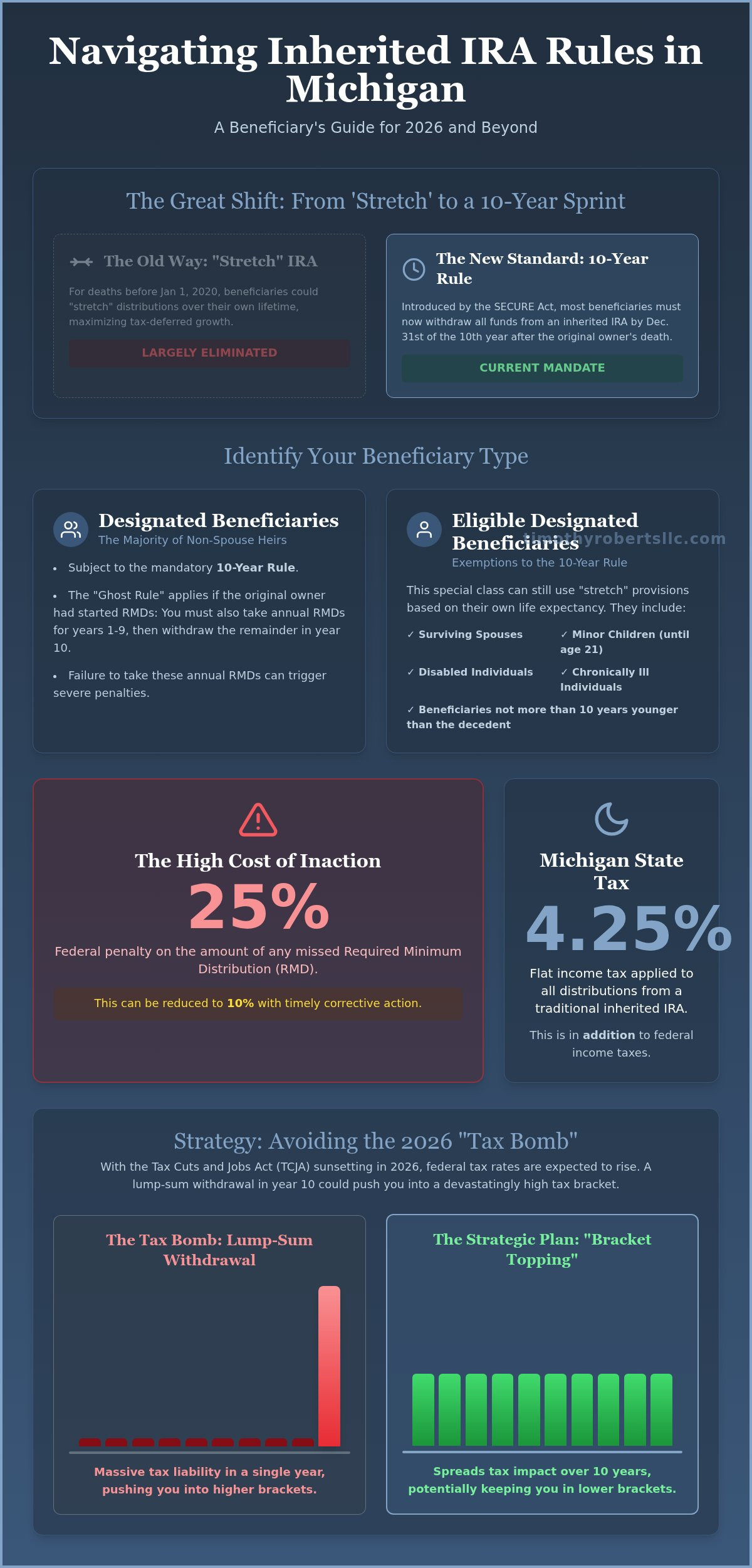
In the 2026 fiscal environment, simple compliance is no longer a sufficient benchmark for high-net-worth families. With the impending sunset of the Tax Cuts and Jobs Act (TCJA) provisions, federal tax brackets are poised to revert to higher levels, making the timing of your distributions a critical variable in legacy preservation. For Michigan beneficiaries, this means managing a flat 4.25% state income tax alongside potentially higher federal obligations. A passive approach to these assets often results in a “tax bomb” where a decade of deferred taxes culminates in a massive, high-bracket liability in year ten.
Federal Framework vs. Michigan Application
While federal law sets the tempo for how quickly an account must be liquidated, Michigan state law dictates the ultimate cost of those withdrawals. The date of the original owner’s death is the primary pivot point for your strategy. Assets inherited from an owner who passed away before January 1, 2020, may still qualify for the older, more lenient “stretch” rules. However, for those inheriting in 2026, the ten-year rule is the standard. A fiduciary advisor provides the necessary intervention here, bridging the gap between IRS mandates and the Michigan Department of Treasury’s specific reporting requirements. This dual-layered regulation requires a steady, logical flow of distributions rather than a frantic, last-minute liquidation.
Key Deadlines for Michigan Beneficiaries
Precision in timing is the hallmark of a sophisticated wealth strategy. Beneficiaries must remain vigilant regarding the following milestones:
- December 31st: This is the annual deadline for taking RMDs if the original owner had already reached their Required Beginning Date.
- The Ten-Year Anniversary: The entire account balance must be distributed by December 31st of the tenth year following the owner’s death.
- State Reporting: Distributions must be accurately reflected on Michigan income tax filings to leverage available retirement income deductions.
In 2026, the Required Beginning Date is defined as April 1st of the calendar year following the year the original account owner reaches age 73. Failing to meet these deadlines triggers federal penalties as high as 25%, a cost that can be mitigated to 10% only through timely corrective action.
Navigating the 10-Year Rule and Beneficiary Classifications
Identification of your beneficiary status is the first step in mastering inherited ira rules michigan for the 2026 tax year. The SECURE Act mandates that most non-spouse beneficiaries, classified as Designated Beneficiaries, must fully distribute the account by the end of the tenth year following the owner’s death. This isn’t just a suggestion; it’s a rigid deadline with significant fiscal consequences. These inherited ira rules michigan residents face are designed to accelerate tax revenue, making your distribution strategy the only defense against over-taxation.
If the original owner had already begun taking Required Minimum Distributions, the “Ghost Rule” applies. This requires you to continue taking annual RMDs during years one through nine of that ten-year period. Citing IRS Publication 590-B provides the necessary technical framework for these calculations. Failing to meet these annual obligations results in a staggering 25% excise tax on the amount that should’ve been withdrawn, though proactive correction can reduce this to 10%.
Eligible Designated Beneficiaries (EDBs)
Specific categories of individuals, known as Eligible Designated Beneficiaries, enjoy a reprieve from the standard ten-year mandate. Surviving spouses retain the most flexibility, often choosing to treat the IRA as their own. Minor children of the decedent also receive a temporary exemption. However, unlike some surface-level advice suggests, this isn’t permanent. Once the child reaches the age of majority, the ten-year clock begins its countdown. For disabled or chronically ill beneficiaries, specialized legacy planning is essential to preserve the “stretch” and ensure the assets provide long-term support without jeopardizing government benefits.
The 10-Year Rule Strategy
Strategic distribution is an exercise in bracket management. Waiting until year ten to empty the account is frequently a catastrophic tax error, especially for high-income earners in Michigan. Distributing the assets over the full decade allows you to smooth out your tax liability, preventing a massive spike that could push you into the highest federal tax bracket. This proactive approach is a hallmark of sophisticated estate planning in Farmington Hills, where we align your inheritance with your broader financial goals. Ensuring your own beneficiary designations are current is equally vital to prevent future complications for your heirs. A personalized consultation with a fiduciary advisor at Timothy Roberts & Associates, LLC can help you architect a distribution schedule that prioritizes tax efficiency over simple compliance.
Michigan Tax Implications for Inherited Retirement Accounts
While federal mandates dictate the timing of your withdrawals, the Michigan Department of Treasury determines how much of that wealth actually stays in your pocket. Michigan maintains a flat income tax rate of 4.25% for 2026. This rate applies directly to distributions from traditional inherited IRAs, as these are viewed as ordinary income at the state level. Understanding the inherited ira rules michigan enforces is vital because the state doesn’t levy a separate inheritance or estate tax; instead, it captures revenue through the income tax on your required distributions. This distinction makes the state income tax return your primary battleground for wealth preservation.
Reporting requirements can be deceptively complex. Traditional IRA distributions are generally included in your Michigan adjusted gross income, but they aren’t always taxed in their entirety. Pitfalls often arise when beneficiaries fail to distinguish between the federal taxable amount and the state-specific exemptions. Accuracy in these filings is paramount to avoid audits or penalties from the Michigan Department of Treasury, which remains vigilant in monitoring retirement income reporting for 2026.
Exemptions and Deductions for Michigan Residents
Michigan offers a significant retirement income deduction that can shield a portion of your inheritance from the state’s reach. For the 2026 tax year, single filers may deduct up to $64,040 of qualifying retirement income, while joint filers can deduct up to $128,080. The effectiveness of this deduction often hinges on the beneficiary’s age and the specific classification of the account. Calculating the tax-free portion requires a meticulous review of IRS Publication 590-B alongside Michigan’s specific Tier-based deduction system. Engaging in proactive tax advising ensures you don’t overlook these state-level nuances. Many beneficiaries mistakenly assume all distributions are fully taxable, failing to leverage the 2026 deduction caps that are designed to provide relief to Michigan residents.
Roth IRA Inheritance in Michigan
Roth assets represent the pinnacle of tax-efficient legacy planning in Michigan. If the original owner satisfied the five-year holding period, qualified distributions remain entirely tax-free at both the federal and state levels. This makes the Roth IRA a powerful tool for transferring wealth without triggering the 4.25% state income tax. While Michigan generally exempts the principal of an inherited Roth IRA from income tax, the earnings are only tax-free if the original owner met the five-year holding period requirement. This “5-Year Rule” is a common pitfall; distributions taken too early can lead to taxable earnings that complicate your state-level reporting. We view Roth assets not just as accounts, but as carefully crafted interventions for multi-generational growth.
Strategic Distribution: Avoiding the 2026 ‘Tax Bomb’
The 2026 fiscal year represents a critical juncture for Michigan families managing inherited wealth. With the scheduled sunset of the Tax Cuts and Jobs Act (TCJA) provisions at the end of 2025, federal income tax brackets are poised to revert to higher, pre-2018 levels. This shift creates a potential “tax bomb” for beneficiaries who haven’t yet planned their exit strategy. When you layer the Michigan flat tax of 4.25% onto rising federal obligations, the erosion of your inheritance can accelerate rapidly. Mastering the inherited ira rules michigan residents face in this environment requires a proactive “bracket topping” approach, where distributions are taken intentionally to lock in current rates before the window of opportunity closes.
Sophisticated planning also accounts for secondary costs that often catch beneficiaries off guard. For those approaching or currently in retirement, large distributions can trigger the Income Related Monthly Adjustment Amount (IRMAA). This surcharge significantly increases Medicare Part B and D premiums based on your Adjusted Gross Income from two years prior. A poorly timed distribution in 2026 could inadvertently double your healthcare costs by 2028. For exceptionally large accounts, we may explore high-level interventions like Charitable Lead Trusts to provide an immediate tax deduction while preserving the principal for future generations.
Coordinating with Personal Income
Effective wealth preservation is an exercise in meticulous mapping. We align your inherited distributions against your peak earning years to ensure you aren’t inadvertently pushed into a punitive tax tier. The “fill the bracket” strategy is a tactical, year-by-year intervention where we calculate the exact dollar amount you can withdraw without crossing into the next federal threshold. By integrating investment portfolio management, we can often harvest capital losses to offset the ordinary income generated by your IRA, maintaining a steady and logical flow of assets. This coordination prevents the frantic, high-tax liquidations that often occur in the final years of the ten-year window.
Legacy and Multi-Generational Planning
Legacy planning requires a vision that extends beyond the immediate decade. It’s vital to understand the role of successor beneficiaries; if the original beneficiary passes away, the new heir doesn’t receive a fresh ten-year clock. They simply inherit the remaining time on the original countdown. We often utilize specialized trusts to exert control over these assets, ensuring the inheritance serves as a structured foundation for your family’s future. Aligning these accounts with your comprehensive retirement income planning ensures that your inherited wealth works in harmony with your personal goals. To architect a distribution schedule that shields your legacy from the 2026 tax shift, consider a strategic consultation with Timothy Roberts & Associates, LLC.
Integrating Inherited Assets into a Fiduciary Wealth Strategy
Deciphering the inherited ira rules michigan beneficiaries must follow is only the first stage of wealth preservation. The second, more critical stage is the selection of a partner to oversee the execution of your strategy. A transactional broker often views an inherited account as a simple entry on a balance sheet, focusing on the mechanics of the transfer rather than the long-term tax implications. In contrast, a fiduciary advisor acts as a visionary strategist, treating your inheritance as a specialized component of a broader, multi-generational evolution. At Timothy Roberts & Associates, LLC, we don’t offer off-the-shelf solutions; we craft personalized interventions that align your new assets with your existing wealth structure.
For surviving spouses, the decision between a spousal rollover and maintaining an inherited IRA account is a high-stakes strategic analysis. A rollover allows you to treat the assets as your own, deferring RMDs until you reach your own Required Beginning Date, which is essential for continued tax-deferred growth. However, if you’re under age 59½ and require immediate access to liquidity, keeping the assets in an inherited account allows for penalty-free distributions. This choice requires a blend of creative passion for your family’s future and business-minded rigor to ensure you don’t trigger unnecessary federal or Michigan state taxes. We help you navigate these inherited ira rules michigan residents must weigh carefully before making a permanent election.
The Fiduciary Advantage
The “Best Interest” standard is non-negotiable when managing complex legacies. A fiduciary partnership ensures that every withdrawal and investment choice is filtered through a lens of total coordination. We synchronize your tax advising with your estate and legacy planning, creating a steady, logical rhythm that replaces anxiety with calm confidence. This integrated approach prevents the fragmentation that often occurs when a tax professional and a financial advisor operate in silos, ensuring your 2026 roadmap remains cohesive and intentional. Our firm’s 25 years of experience in Michigan financial services provides the professional stability required for such delicate transitions.
Building Your 2026 Financial Roadmap
Your next step is a comprehensive legacy audit to prepare for the 2026 tax landscape. We help you integrate your inherited IRA into your long-term retirement goals, ensuring that every dollar serves a specific purpose in your upward progression. This roadmap isn’t just about compliance; it’s about aspirational growth and the protection of your family’s hard-earned assets. Requesting a strategic portfolio review allows us to analyze your specific beneficiary status and distribution requirements before the TCJA sunset. To begin this journey and secure your financial legacy, contact Timothy Roberts & Associates, LLC today to schedule your consultation. We are ready to serve as your high-end partner for organizational evolution and long-term wealth management.
Architecting Your Multi-Generational Legacy
Mastering the current inherited ira rules michigan families must follow is a journey that requires both foresight and technical precision. We’ve explored how the intersection of the SECURE Act’s ten-year mandate and Michigan’s specific income tax exemptions creates a complex landscape for beneficiaries. Successfully navigating this environment means moving beyond simple compliance to embrace a strategy that anticipates the 2026 tax sunset and rising federal rates. It’s about ensuring your inheritance serves as a foundation for growth rather than a source of fiscal stress.
The path to wealth preservation is rarely linear. It demands a partner who provides institutional-grade expertise with the boutique personal attention your family deserves. At Timothy Roberts & Associates, our fiduciary advisors draw on over 25 years of experience in Michigan financial services to deliver comprehensive, tax-integrated wealth management. We don’t just manage accounts; we solve complex problems through carefully crafted interventions that prioritize your long-term stability. Secure your legacy with a strategic retirement income plan from Timothy Roberts & Associates and step into the future with confidence.
Frequently Asked Questions
What is the 10-year rule for inherited IRAs in Michigan for 2026?
Most non-spouse beneficiaries must fully deplete the inherited account by December 31 of the tenth year following the original owner’s death. This mandate, established by the SECURE Act, eliminated the “stretch” provision for most heirs, requiring a more compressed distribution timeline. While the account continues to grow tax-deferred during this decade, the finality of the ten-year window necessitates a strategic approach to avoid a massive tax liability in the final year.
Are inherited IRA distributions subject to Michigan state income tax?
Yes, distributions from traditional inherited IRAs are taxed at Michigan’s flat income tax rate of 4.25% for 2026. These withdrawals are treated as ordinary income at the state level. However, Michigan provides specific retirement income deductions that can shield a portion of this income, provided the beneficiary meets certain age and filing requirements. Mastering the inherited ira rules michigan enforces is essential for maximizing your net inheritance and preserving your family legacy.
Can I roll an inherited IRA into my own existing IRA account?
Only a surviving spouse has the legal authority to roll an inherited IRA into their own existing retirement account. Non-spouse beneficiaries, such as children or siblings, must maintain the assets in a separate “Inherited IRA” or “Beneficiary IRA” account. Attempting to co-mingle these assets into your personal IRA can result in the entire balance being treated as a taxable distribution, triggering immediate federal and state tax obligations.
What happens if I miss a required minimum distribution (RMD) on an inherited account?
Missing a Required Minimum Distribution results in a federal excise tax equal to 25% of the amount that should’ve been withdrawn. If the error is corrected within a specific two-year window, this penalty may be reduced to 10%. Because these penalties are aggressive, we prioritize year-round tax monitoring to ensure our clients remain in full fiduciary compliance with evolving IRS mandates and deadlines.
Are there exceptions to the 10-year rule for disabled beneficiaries in Michigan?
Yes, disabled or chronically ill individuals are classified as Eligible Designated Beneficiaries and are exempt from the ten-year liquidation rule. These beneficiaries may still utilize the “stretch” strategy, taking distributions over their own life expectancy. This exception allows for a steady, logical flow of assets that can support long-term care needs without the fiscal pressure of a compressed ten-year timeline.
How does the 2026 tax bracket change affect my inherited IRA strategy?
The scheduled sunset of the Tax Cuts and Jobs Act at the end of 2025 means federal tax brackets will likely revert to higher, pre-2018 levels in 2026. This shift makes the timing of your withdrawals critical. A sophisticated strategy for inherited ira rules michigan residents involves “bracket topping,” where you take larger distributions now to lock in current rates before they rise, preventing a more punitive tax hit in the future.
Do I have to pay the 10% early withdrawal penalty on an inherited IRA?
No, distributions from an inherited IRA are not subject to the 10% early withdrawal penalty, regardless of the beneficiary’s age. This is a rare instance where the IRS allows access to retirement funds before age 59½ without a surcharge. It’s important to remember that while the 10% penalty is waived, the distributions are still subject to ordinary income tax at both federal and state levels.
Can I name a trust as the beneficiary of my IRA to avoid Michigan probate?
You can name a trust as your IRA beneficiary to bypass the Michigan probate process and exert greater control over the flow of assets. However, the trust must be meticulously drafted as a “see-through” or “conduit” trust to satisfy IRS regulations. Without this specific legal architecture, the IRS may require the account to be emptied within five years rather than ten, significantly accelerating the tax burden on your heirs.
