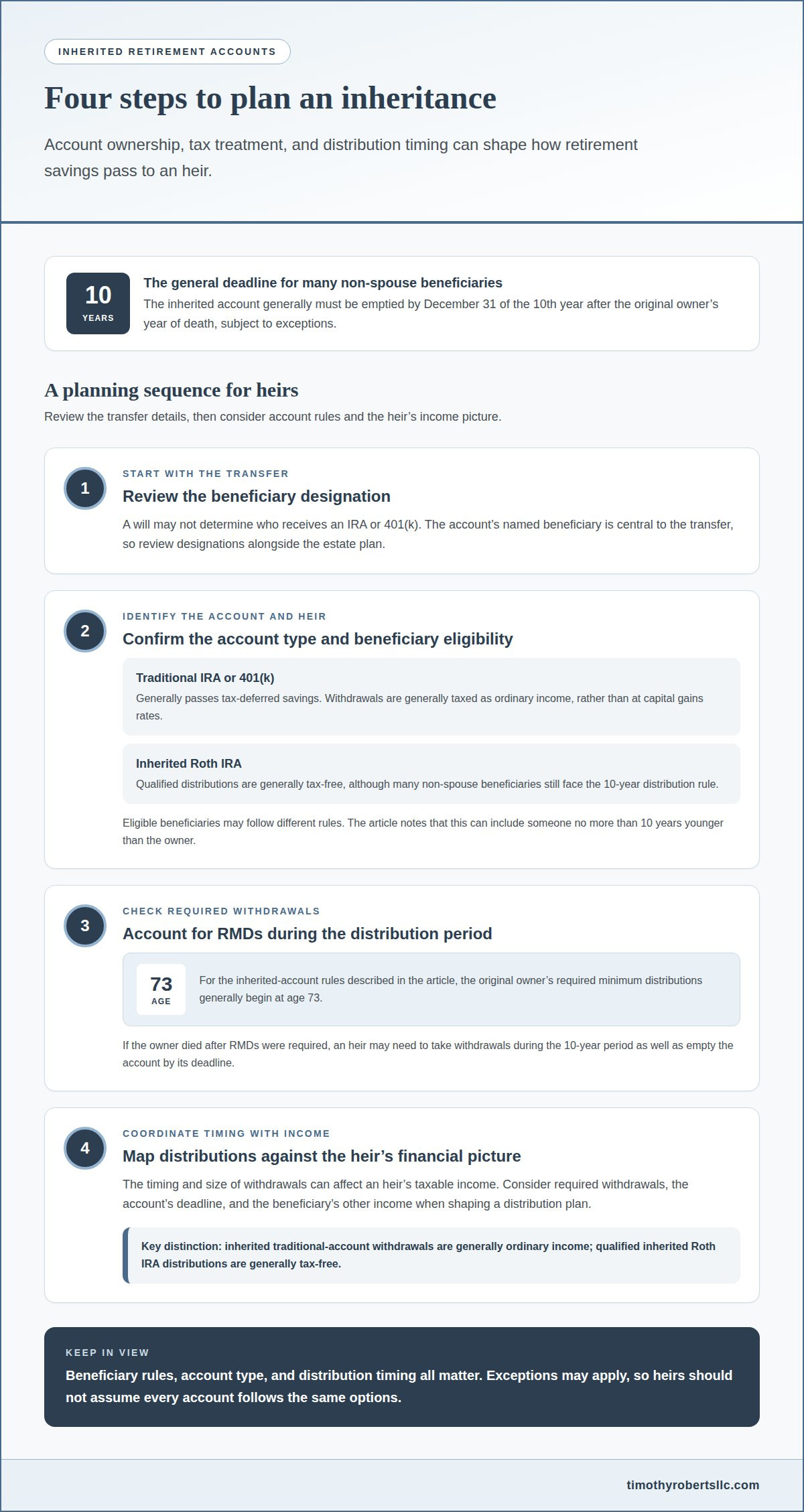
An inheritance doesn’t mean you need to invest everything at once. Knowing what to do when you inherit a large sum of money starts with pausing major spending, identifying any account deadlines and deciding when you may need the funds. For non-spouse beneficiaries, inherited 401(k)s generally must be emptied within 10 years of the account owner’s death, subject to exceptions, according to the Internal Revenue Service.
It’s natural to want a clear plan before making consequential choices. Start by setting aside an emergency fund that covers 3-6 months of living expenses, then match investment choices to the time horizon for each goal. This guide explains how to pace decisions, where financial, tax and estate professionals can help, and how to shape an inheritance plan around both near-term security and long-term growth.
Key Takeaways
- Give yourself room to make deliberate choices instead of rushing into major purchases or investments.
- Coordinate financial, tax, and estate guidance to understand how inherited assets fit your broader plan.
- Separate money you may need soon from funds intended for longer-term goals.
- Choose an investment approach that reflects when you expect to use the money and the level of risk you can accept.
1. Working with financial, tax, and estate professionals
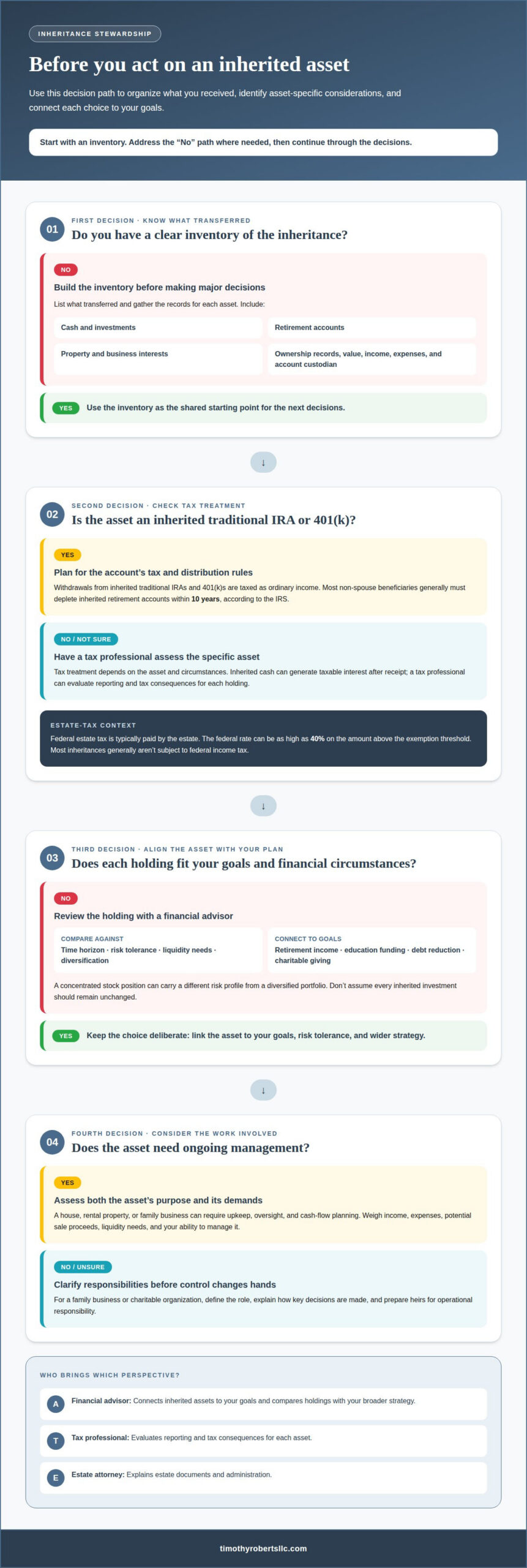
First, secure the inheritance and pause major spending or investment decisions. Gather estate documents, account statements, property records, and details of any debts or deadlines. A fiduciary financial advisor can review your finances, clarify short- and long-term goals, and help fit the inheritance into your broader plan. Bring in tax and estate professionals early if the inheritance includes retirement accounts, real estate, or a complex estate.
In 2026, the U.S. federal gift and estate tax exemption is $15 million per individual, according to the Internal Revenue Service. The portion of an estate above the available federal gift and estate tax exemption may be subject to a 40% tax, according to the Internal Revenue Service. These rules concern the estate, not a personal tax bill automatically owed by every heir. When required, estate tax returns are generally due nine months after death, according to the Internal Revenue Service.
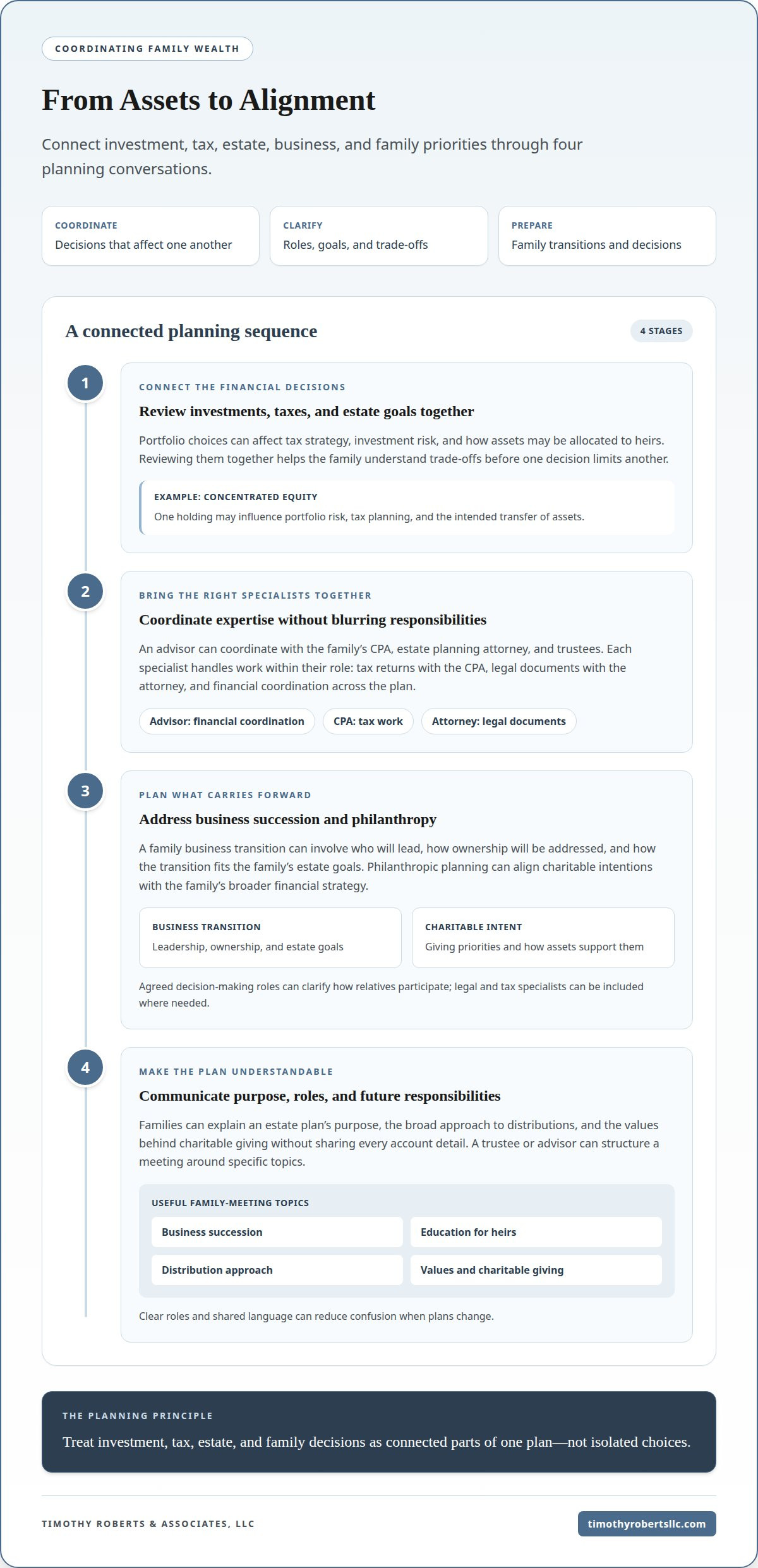
Coordinate advice around the estate’s records and timeline. A tax professional can identify questions related to inherited accounts or a later sale. A financial advisor can map available funds to immediate needs and longer-term goals. An estate attorney can explain ownership documents and estate administration. In some cases, an executor may choose an alternative valuation date six months after the date of death, according to the Internal Revenue Service. That valuation can matter when assessing inherited assets.
Inherited real estate calls for a separate review. The property’s cost basis is generally stepped up to its fair market value on the original owner’s date of death. If you later sell for more than that basis, the difference may create capital gains. Before deciding whether to keep or sell the property, account for ownership costs such as property taxes, insurance, maintenance, and shared expenses. Confirm who holds title and who is responsible for bills during estate administration.
Build a clear financial picture before assigning the inheritance to goals. List cash, investments, property, income, debts, and planned expenses. Then separate near-term needs from longer-term goals, such as retirement or education. A written plan gives each professional a defined question to address and helps you decide which assets to preserve, sell, or invest.
2. Building an emergency fund
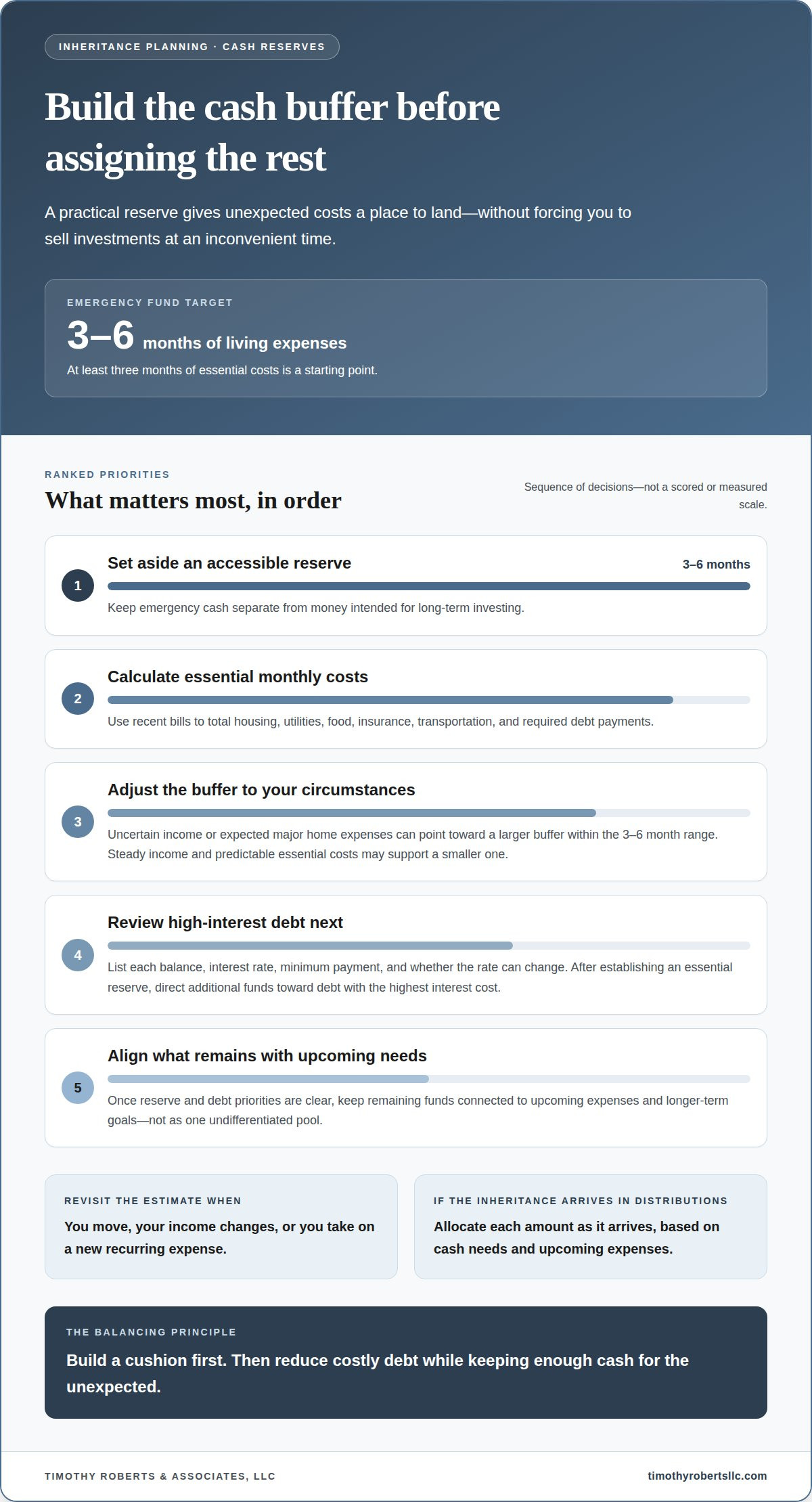
Set aside cash for unexpected expenses before assigning the full inheritance to other goals. A practical emergency fund covers 3-6 months of living expenses, with at least three months of essential costs as a starting point. Add housing, utilities, food, insurance, transportation, and required debt payments to estimate your monthly essentials. Use your own recent bills rather than a general spending estimate.
Keep this reserve accessible and separate from money intended for long-term investing. It can cover disruptions such as a job change, urgent home repair, or medical bill without forcing you to sell investments at an inconvenient time. If the inheritance arrives in distributions, allocate each amount as it arrives based on your cash needs and upcoming expenses.
Next, review high-interest debt alongside your savings target. List each balance, its interest rate, minimum payment, and whether the rate can change. Paying down expensive debt can reduce future interest, but using every available dollar leaves no cushion for an unexpected bill. A balanced approach is to establish an essential reserve first, then direct additional funds toward the debt with the highest interest cost.
For example, if your income is uncertain or you expect major home expenses, prioritize a larger cash buffer within the 3-6 month range. If income is steady and essential costs are predictable, you may choose to focus sooner on reducing high-interest debt. Revisit the calculation after a move, income change, or new recurring expense. These decisions can feel emotional after an inheritance, so use a written spending plan to make each choice deliberate.
Once the reserve and debt priorities are clear, keep the remaining funds aligned with upcoming needs rather than treating the inheritance as one pool. Retirement income planning can help connect cash reserves with future income needs.
3. When to Make Financial Decisions After Inheritance?
Separate decisions with deadlines from choices you can take time to shape. Inherited retirement accounts need particular attention because distribution schedules depend on the account type and beneficiary. Non-spouse beneficiaries generally need to empty an inherited 401(k) within 10 years of the account owner’s death, subject to exceptions, according to the Internal Revenue Service. Don’t treat that deadline as permission to postpone every distribution decision.
Nonspouse beneficiaries generally must start required minimum distributions from an inherited retirement account by December 31 of the year after the owner’s death, according to the Internal Revenue Service. For account owners, the required beginning age for required minimum distributions is currently 73, according to the Internal Revenue Service. These are distinct rules: identify whether you inherited an account and which schedule applies before moving or withdrawing funds. A tax professional can help assess the account terms and potential tax effects.
Once deadlines are mapped, connect remaining savings to specific goals. A home purchase may call for accessible funds; education costs may follow a different schedule; retirement assets may serve a longer-term purpose. Write down the amount and timing for each goal, then decide how much of the inheritance to reserve for it. Include existing income, planned expenses, and any credit card balance in your review.
Protect inherited money by organizing account statements and estate records, limiting access to account credentials, and avoiding rushed transfers. Be cautious of unsolicited calls, messages, or payment requests that create urgency or promise exceptional returns. Verify unexpected requests using contact details you already have for the relevant institution, not details in the message. Don’t share passwords or account codes with someone who contacts you unexpectedly.
A measured sequence helps: address account deadlines first, then assign available funds to housing, education, and retirement goals. Revisit the plan when your income, family needs, or goal dates change, and keep records of distributions for tax preparation.
4. Choose investments based on time horizon
Assign each inherited dollar a purpose and a date before investing. A goal within 1-3 years has a short horizon, so prioritize access and stability over aggressive growth. A home down payment planned soon, for example, shouldn’t depend on selling volatile assets at the right moment. Keep the investment choice tied to when the money is needed, not simply to the size of the inheritance.
For goals 3-10 years away, a medium-term approach can balance potential growth with the need to preserve funds. Consider how much the goal date can shift and whether other income or savings could cover a shortfall. Money earmarked for a home renovation or later education costs may need a different mix than funds set aside for retirement. Each goal is its own investment subject.
For goals more than 10 years away, growth-oriented assets such as stocks or equity ETFs may be appropriate. Broad market index funds and passive ETFs can provide diversified exposure, typically with lower fees. Diversification spreads investments across a range of holdings, rather than concentrating the inheritance in one company or asset. It doesn’t remove investment risk, so align the mix with your ability to tolerate changes in value.
Before choosing assets, review tax implications, account ownership, and how inherited investments fit your estate plan. Selling an inherited asset can have different tax consequences than holding it, and the cost basis matters when calculating a potential gain. A fiduciary financial advisor can help coordinate investment decisions with your timeline, cash needs, and risk tolerance. Avoid building a portfolio around a market prediction or a single appealing investment.
Write down each goal, its expected timing, and the funds assigned to it. Then review the plan when a goal moves or your circumstances change. Develop an investment strategy for your time horizon with support tailored to your inherited assets and priorities.
Timothy Roberts & Associates
Timothy Roberts & Associates, LLC can help turn an inheritance into a coordinated financial plan. Consider working with the firm when balancing immediate cash needs, inherited investments, retirement goals, and decisions about preserving wealth for your family.
Through Financial Planning and Wealth & Investment Management, the firm can help align assets with your goals, time horizon, and risk tolerance. Estate & Trust Planning can connect the inheritance with your broader plans for preserving wealth and supporting loved ones. A conversation can focus on what you inherited, upcoming deadlines, and the goals you want the money to serve.
If you’d like fiduciary guidance shaping a plan for your inheritance, contact Timothy Roberts & Associates, LLC.
Give Your Inheritance a Lasting Purpose
A thoughtful answer to what to do when you inherit a large sum of money begins with deciding what you want it to make possible. That vision may evolve as family needs, work, and priorities shift. Treat your plan as a living framework: record the purpose behind major decisions, revisit those intentions when circumstances change, and make sure each choice supports the life you’re building.
The next step doesn’t need to be a sweeping move. A focused conversation can help bring your priorities into view and shape a path that reflects your goals. Discuss your inheritance plan with Timothy Roberts & Associates, LLC and consider how the decisions ahead can support your future with intention.
Frequently Asked Questions
How soon do you have to make financial decisions after inheritance?
There isn’t one deadline for every inheritance decision. Knowing what to do when you inherit a large sum of money starts with separating required account actions from choices you can make over time. Identify the account type, beneficiary status, and any notices first. Then prioritize dated obligations over discretionary decisions. Timing depends on the asset and its rules, not simply on the size of the inheritance.
What is an inheritance?
An inheritance is money or property transferred to someone after another person dies. It may come through a will, trust, beneficiary designation, or estate distribution. For example, a beneficiary might receive cash, securities, a home, or an interest in a family business. The transfer method matters because it can affect when you gain control and what records you need to keep.
How long should you wait before making major financial decisions after an inheritance?
There’s no universal waiting period, but you may choose to pause major spending for about three months while assessing your priorities. Use that time to clarify which funds are accessible, which goals matter most, and whether any account deadlines apply. A pause is a planning choice, not a legal requirement. Avoid delaying decisions tied to an account’s distribution schedule.
How are inheritances taxed in the United States, including federal and state inheritance taxes?
Tax treatment depends on the estate, the asset, and applicable state rules. Federal estate tax is assessed against the estate, while inheritance tax, where imposed, is the heir’s responsibility. Some states and the District of Columbia impose estate taxes under their own rules. Distinguish tax paid by an estate from tax assessed directly on a beneficiary before estimating what you may receive.
Do beneficiaries owe taxes on inherited cash, investments, real estate, or retirement accounts?
Tax consequences vary by asset and what you do with it. Cash, an investment sale, rental income from property, and withdrawals from a retirement account can raise different tax questions. For example, selling inherited shares may create a gain or loss based on the applicable cost basis. Keep transfer and account records, and distinguish the inheritance itself from income produced after the transfer.
Should you pay off debt, invest, or save inherited money first?
A useful framework for what to do when you inherit a large sum of money is to match funds to near-term needs, then weigh debt costs against future goals. Paying down high-interest credit card debt can reduce interest charges, while accessible savings can help you avoid borrowing again for an unexpected expense. Invest funds intended for longer-term goals according to their timeline and your risk tolerance. The right sequence depends on your cash needs, debt terms, and priorities.