
Your Social Security benefit represents more than a simple monthly check. It is a sophisticated, inflation-adjusted asset that serves as the strategic foundation for your lifetime financial architecture. For those approaching retirement, the pivotal choice regarding when to take social security michigan often carries a sense of urgency fueled by market volatility and the fear of outliving personal savings. You want a predictable stream of income that honors your years of professional dedication while protecting your lifestyle against future economic shifts.
We understand the anxiety that stems from Michigan’s evolving tax environment and the complexity of federal filing rules. This guide offers a definitive framework for optimizing your benefits, moving beyond generic advice toward a personalized synthesis of tax efficiency and wealth preservation. You will discover how the 2.8% cost-of-living adjustment for 2026 and Michigan’s complete exemption of retirement income create a unique opportunity to enhance your cash flow. We will outline the precise impact of claiming at age 62 versus delaying until age 70, providing the clarity you need to transform a government program into a robust engine for your long-term prosperity.
Key Takeaways
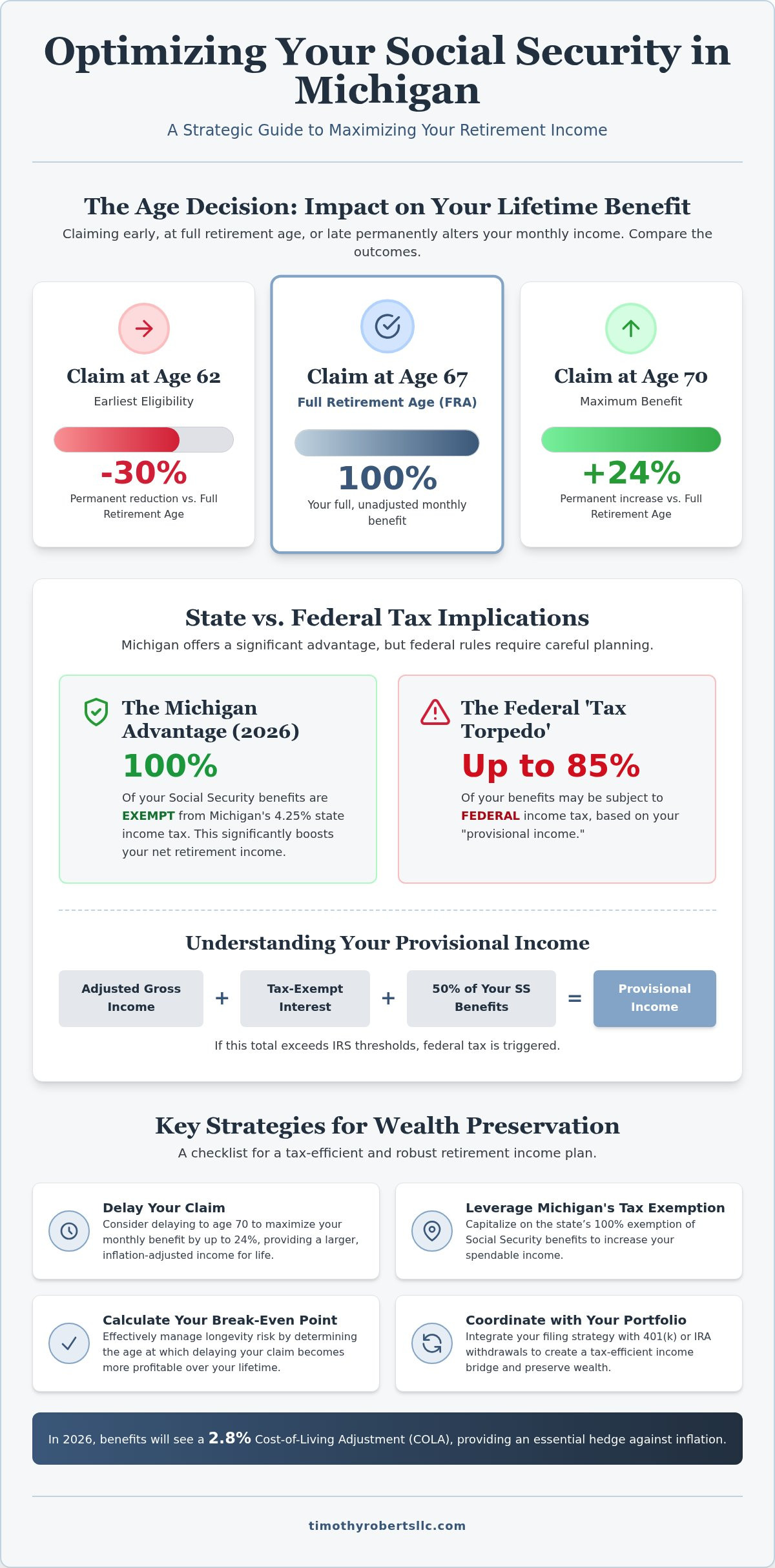
- Evaluate the strategic advantages of delaying your claim to age 70, which can increase your monthly benefit by up to 24% compared to your full retirement age.
- Understand the critical nuances of when to take social security michigan to capitalize on the state’s total exemption of these benefits from income tax in 2026.
- Calculate your break-even point to effectively manage longevity risk and ensure your monthly income stream remains robust for the duration of your life.
- Coordinate your filing strategy with your 401(k) or IRA withdrawals to create a tax-efficient income bridge that preserves your wealth for future legacy goals.
- Shift from generic online estimates to a customized income roadmap that synthesizes your personal financial vision with professional fiduciary rigor.
Understanding Social Security Eligibility and Michigan Tax Rules in 2026
Social Security serves as the foundational floor for your retirement income architecture. It’s the only asset in your portfolio that provides a guaranteed, inflation-adjusted stream of cash flow for life. The Social Security Administration determines your primary insurance amount by analyzing your 35 highest-earning years, adjusted for inflation. For 2026, the cost-of-living adjustment is 2.8%, providing a modest but essential hedge against rising costs. This figure represents the monthly benefit you’re entitled to at your full retirement age, which is 67 for anyone born in 1960 or later.
Determining when to take social security michigan is not a decision to be made in isolation. It requires a sophisticated understanding of how federal benefit calculations intersect with state-specific tax advantages. For those seeking to preserve wealth, the timing of your claim influences not just your monthly check, but the longevity and tax efficiency of your entire portfolio. A deep dive into the mechanics of Social Security in the United States reveals that claiming strategies are among the most impactful levers you can pull to ensure a legacy of financial stability.
To better understand how these benefits integrate into a broader financial strategy, watch this helpful video:
The Michigan Tax Advantage for Retirees
Michigan remains one of the most favorable environments for retirees due to its specific treatment of Social Security. Unlike states that mirror federal taxation rules, Michigan does not tax Social Security benefits at the state level. This policy provides a significant boost to your net income, allowing you to retain more of your hard-earned wealth for lifestyle or legacy purposes. For the 2026 tax year, Michigan residents can exclude 100% of their Social Security benefits from their state taxable income. This exemption, combined with the 4.25% flat income tax rate, creates a sanctuary for those looking to maximize their spendable income in retirement.
Federal Taxation of Benefits: The ‘Tax Torpedo’
While the state level offers relief, federal tax liabilities require rigorous planning. The IRS uses a metric called provisional income to determine how much of your benefit is taxable. This calculation includes your adjusted gross income, tax-exempt interest, and 50% of your Social Security benefits. If this total exceeds specific thresholds, up to 85% of your benefits may be subject to federal income tax. This often creates a tax torpedo, where additional withdrawals from a 401(k) or IRA can inadvertently push you into a higher tax bracket, effectively taxing your Social Security twice. We focus on managing these thresholds through strategic asset location and the intentional timing of withdrawals to shield your income from unnecessary federal erosion.
The Cost of Early Filing: Analyzing the 62 vs. 67 vs. 70 Decision
Deciding when to take social security michigan involves a complex tug-of-war between the desire for immediate liquidity and the mathematical imperative of long-term wealth. Many retirees feel a psychological pull toward claiming as early as possible, often driven by a fear that the system’s rules might shift or a desire to “get their fair share” early. However, this emotional response frequently conflicts with the strategic reality of maximizing lifetime income. Choosing a filing age is not a one-time event; it is a permanent selection of your standard of living for the next thirty years.
Filing at age 62 offers immediate access to cash, yet it comes at a steep price. For those with a Full Retirement Age of 67, claiming five years early results in a permanent 30% reduction in monthly benefits. This isn’t just a temporary haircut. It is a lifetime commitment to a smaller check that may fail to sustain your lifestyle as inflation erodes purchasing power over the coming decades. When you consider that the average monthly benefit in 2026 is $2,071, a 30% reduction represents a significant loss of monthly discretionary capital.
Full Retirement Age (FRA) Explained
Your birth year remains the most critical determinant of your filing timeline. For individuals reaching retirement milestones in 2026, the Social Security Administration defines FRA as 67 for anyone born in 1960 or later. This age serves as the anchor for all benefit calculations. If you choose to continue working in Michigan while drawing benefits before reaching your FRA, the 2026 earnings test applies. Earning more than $24,480 triggers a withholding of $1 for every $2 earned above that limit. This often neutralizes the perceived advantage of early filing for active professionals who aren’t yet ready to fully exit the workforce.
The Power of Delay: Why 70 is Often the Magic Number
Patience yields a remarkable premium within the federal system. For every year you delay past your FRA, your benefit grows by a guaranteed 8% through delayed retirement credits. By waiting until age 70, your monthly check could be roughly 76% higher than it would have been at age 62. This increase acts as a form of longevity insurance that is virtually impossible to replicate through traditional market investments. When you factor in the 2.8% COLA for 2026, the compounding effect on a larger base benefit creates a significantly more resilient income stream. Strategic Retirement Income Planning allows you to bridge the gap between your retirement date and age 70, ensuring you don’t sacrifice long-term security for short-term convenience.
Calculating Your Break-Even Point: Longevity Risk and Spousal Benefits
Determining the optimal moment to claim your benefits requires a shift from monthly cash flow analysis to a cumulative lifetime perspective. The break-even point represents the age at which the total sum of larger, delayed checks finally surpasses the total amount received from smaller, earlier payments. For most Michigan retirees, this intersection typically occurs in the late 70s or early 80s. While the immediate liquidity of an early claim is tempting, the strategic objective is to maximize the total wealth extracted from the system over your entire lifespan. Deciding when to take social security michigan is, at its core, a calculation of your personal break-even horizon.
A common objection to delaying benefits is the uncertainty of lifespan; many ask, “What if I don’t live long enough to break even?” This perspective, while understandable, often ignores the more catastrophic threat of longevity risk. Outliving your assets is a far greater danger to your financial stability than leaving a portion of Social Security on the table. If your life ends earlier than expected, your expenses also cease, and the “lost” benefits are a moot point. However, if you live into your 90s after claiming at 62, you face decades of a permanently reduced income floor that may not support your evolving healthcare or lifestyle needs.
The Longevity Hedge
Planning for a 95 year lifespan is a hallmark of sophisticated wealth management. A maximized Social Security benefit serves as an asymmetric hedge against market downturns, providing a guaranteed, inflation-linked foundation that private investments cannot replicate. The higher-earning spouse should prioritize delaying their claim because their benefit amount establishes the permanent floor for the survivor benefit, protecting the remaining partner for the rest of their life. This ensures that even if other assets are depleted, the household maintains the highest possible guaranteed income stream.
Spousal and Survivor Benefit Coordination
Couples must view their Social Security as a single, integrated asset rather than two independent checks. Your individual filing age can permanently lock in the survivor benefit for your partner, making the decision a shared legacy choice. Strategy often dictates that the lower earner claims earlier to provide immediate cash flow, while the higher earner delays until age 70 to maximize the eventual survivor benefit. This coordination is essential for maintaining a consistent standard of living after the first spouse passes away. Special rules also apply to divorced individuals, who may be eligible for benefits on an ex-spouse’s record if the marriage lasted ten years or more. Whether you are planning for a joint future or managing the complexities of widowhood, aligning these timing decisions with your broader portfolio is the only way to ensure your financial architecture remains resilient.
Strategic Integration: Coordinating Benefits with Your Retirement Portfolio
Effective wealth management requires viewing Social Security as one component of a broader, high-functioning machine. It’s often most advantageous to treat these benefits as the final income stream to activate. By delaying, you aren’t just waiting; you’re allowing your most resilient asset to appreciate at a rate the market rarely guarantees. Deciding when to take social security michigan is a decision that must be synchronized with your Retirement Income Planning to ensure every withdrawal serves a specific purpose in your financial evolution.
The Bridge Strategy
The bridge strategy involves intentionally spending down taxable assets or tax-deferred accounts during the early years of retirement. This approach allows your Social Security benefit to grow by 8% annually through delayed retirement credits. Mathematically, using 4% of a portfolio to “buy” an 8% increase in a lifetime, inflation-adjusted benefit is a superior trade. It reduces your future reliance on volatile market returns while creating a larger income floor. During these gap years, we meticulously manage your cash flow to avoid pushing you into higher tax brackets, maintaining a steady and predictable lifestyle as you evaluate when to take social security michigan to maximize your net wealth.
This period also presents a unique “Roth Conversion Window.” Before Social Security payments begin and Required Minimum Distributions (RMDs) kick in, your taxable income may be at its lowest point. This is the ideal time to convert traditional IRA funds into Roth IRAs, paying taxes at today’s rates to secure tax-free growth and withdrawals for the future. This synthesis of creative vision and business-minded rigor ensures your portfolio remains tax-efficient across multiple decades.
Tax-Efficient Withdrawal Sequences
The order in which you access your accounts significantly impacts the longevity of your wealth. A typical sequence might move from taxable brokerage accounts to tax-deferred IRAs, and finally to tax-free Roth accounts. However, this sequence must be customized to your specific tax profile and anticipated legacy goals. Proper coordination helps mitigate the impact of RMDs, which can otherwise trigger unwanted tax spikes later in retirement. For a deeper look at these mechanics, see our guide on Tax Advising.
Aligning your filing age with your investment portfolio transforms a simple government benefit into a strategic asset. If you’re ready to move beyond generic calculators and design a sophisticated income plan, our team can help you coordinate your retirement strategy for maximum impact.
Designing a Personalized Income Roadmap with Timothy Roberts & Associates, LLC
Generic online calculators provide a superficial glimpse into a complex financial reality. They treat your retirement as a series of isolated data points rather than a cohesive journey. For high-net-worth families, the decision regarding when to take social security michigan requires a more nuanced intervention. The advisors at Timothy Roberts & Associates, LLC move beyond these one-size-fits-all tools. We analyze the intricate interplay between your tax liabilities, market performance, and long-term legacy goals. We act as visionary strategists, crafting a roadmap that transforms a government benefit into a sophisticated pillar of your financial architecture. This process replaces a transactional mindset with a partnership-driven approach, ensuring your wealth undergoes a successful organizational evolution.
The 2026 market conditions demand a higher level of intellectual curiosity and professional stability. Off-the-shelf solutions can’t account for the subtle shifts in federal policy or the specific advantages of Michigan’s tax environment. By partnering with a specialized firm, you gain access to an expert craftsman who understands that financial planning is both an art and a science. We prioritize depth over superficiality, taking the time to understand your unique aspirations before executing a plan that secures your monthly income stream for life. This deliberate pacing reinforces the idea that we take the time to solve complex problems rather than rushing to generic conclusions.
Beyond the Check: A Comprehensive Wealth Strategy
We view Social Security not as a standalone payment, but as a critical asset within your broader Investment Portfolio Management. This integration allows us to optimize your withdrawal sequences and preserve your principal for future generations. As laws and personal goals evolve, we conduct regular plan reviews to adjust your trajectory. This meticulous attention to detail is non-negotiable for those who value quality and high-level expertise. Our role at Timothy Roberts & Associates, LLC is to provide a steady, logical rhythm to your financial life, guiding you from a high-level vision down to the precise practicalities of execution. It feels exclusive yet accessible to those who value quality over volume.
Your Next Steps Toward Financial Elevation
Preparing for your initial consultation is the first step toward upward progression. We recommend gathering your most recent Social Security statements, current investment portfolio details, and recent tax returns. This data allows us to synthesize your individual creative vision with our structured corporate capabilities. The result is a personalized financial roadmap that offers calm confidence in an unpredictable world. You deserve a strategy that’s as intentional and polished as the life you’ve built. To begin this journey of aspirational growth, schedule your strategic retirement review today. We look forward to helping you navigate the complexities of 2026 and beyond.
Mastering Your Retirement Evolution
Your Social Security strategy is more than a simple filing date; it’s a critical component of your wealth’s organizational evolution. By capitalizing on Michigan’s complete tax exemption and the 8% annual delayed credits, you transform a standard benefit into a high-performance engine for lifetime income. Choosing exactly when to take social security michigan requires a synthesis of tax-efficient withdrawal sequences and a deep understanding of longevity risk. This approach ensures your portfolio remains resilient against market volatility while honoring your personal vision for the future.
Navigating these complexities shouldn’t be a solitary endeavor. With over 25 years of wealth management experience, Timothy Roberts & Associates, LLC provides the fiduciary oversight and customized tax-minimization strategies necessary for financial elevation. We move beyond generic calculators to build a roadmap that aligns with your specific legacy goals. It’s time to transition from a transactional mindset to a partnership-driven journey of growth. Request a Personalized Retirement Income Strategy Consultation to secure your predictable monthly stream of income today. Your future self will value the intentionality you exercise now.
Frequently Asked Questions
Is Social Security income taxable in the state of Michigan?
Social Security benefits are fully exempt from state income tax in Michigan for the 2026 tax year. This exclusion applies to all retirees regardless of their total income level or age. While you must still account for potential federal tax liabilities on your benefits, the state’s 4.25% flat tax rate will not apply to your Social Security check. This favorable state policy is a primary factor for many when deciding when to take social security michigan.
What happens to my Social Security if I keep working in Michigan?
If you choose to continue working while receiving benefits before reaching your full retirement age, the 2026 earnings test applies. The Social Security Administration will withhold $1 in benefits for every $2 you earn above the annual limit of $24,480. In the year you reach full retirement age, a higher limit of $65,160 applies. These withheld funds aren’t lost forever; they are used to increase your monthly benefit once you reach full retirement age.
Can I change my mind after I start taking Social Security early?
You have a one-time opportunity to withdraw your benefit application within 12 months of your initial claim. This process requires you to repay every dollar of benefits you and your family have received from the system. If you’ve passed this 12 month window, you can no longer withdraw the application. However, once you reach full retirement age, you can suspend your payments to earn delayed retirement credits until age 70, which increases your future monthly checks.
How much will my Social Security benefit increase if I wait until 70?
Delaying your claim past your full retirement age earns you delayed retirement credits of 8% per year. For individuals with a full retirement age of 67, waiting until age 70 results in a permanent 24% increase in your monthly benefit amount. This guaranteed growth is further enhanced by annual cost-of-living adjustments, such as the 2.8% increase confirmed for 2026. This creates a significantly higher income floor compared to claiming at age 62 or 67.
Does my spouse get Social Security if they never worked?
A spouse who has never worked can receive benefits based on their partner’s work record. They are eligible for up to 50% of the working spouse’s full retirement age benefit amount. To qualify, the non-working spouse must be at least 62 years old, and the working spouse must have already filed for their own benefits. This coordination is a critical component of a comprehensive strategy for couples determining when to take social security michigan together.
What is the ‘Tax Torpedo’ and how do I avoid it?
The tax torpedo occurs when additional income, like 401(k) withdrawals, triggers federal taxation on up to 85% of your Social Security benefits. This can lead to a surprisingly high marginal tax rate on your retirement income. You can avoid this by using proactive tax planning strategies. We often recommend Roth conversions or specific withdrawal sequences to keep your provisional income below federal thresholds, protecting your benefits from unnecessary federal erosion.
How do I calculate my break-even age for Social Security?
Calculating your break-even age involves comparing the total cumulative benefits you would receive by starting at different ages over your lifetime. For most healthy retirees, the total amount received from a larger age 70 check typically surpasses the total amount from a smaller age 62 check around age 80. This calculation must include your personal health history and longevity risk. We use these variables to ensure your filing age supports your long-term financial stability and legacy goals.