What if the best response to a market scare is to pause, not act? Learning how to stop making emotional investment decisions isn’t about ignoring fear or excitement. It’s about setting a clear process before headlines, losses, or a tempting trend put your long-term plan under pressure.
A falling portfolio can make selling feel like relief. A fast-rising investment can make buying feel urgent. Add conflicting opinions and a steady stream of market updates, and even thoughtful investors can lose sight of the goals behind their choices. You don’t need to predict every market move. You do need to decide in advance what should guide a change to your portfolio.
In this guide, you’ll learn to recognize your emotional triggers, build a repeatable decision framework, and assess investment changes against your goals, time horizon, and risk tolerance. A written investing policy can help turn reaction into reflection. Ongoing portfolio monitoring and rebalancing can help keep your strategy connected to the plan you’ve chosen.
Key Takeaways
- Notice the feelings and market events that can pressure you to buy or sell before changing your portfolio.
- Recognize common behavioral biases without treating them as personal failings.
- Compare written investment policies, personal rules, and professional guidance to find a decision structure that fits your needs.
- Use a repeatable process to pause, assess evidence, revisit your plan, and document investment decisions.
- Learn how to stop making emotional investment decisions by connecting portfolio choices to your goals, time horizon, and risk tolerance.
Why Emotional Investment Decisions Happen, and What They Can Disrupt
Emotional investing happens when portfolio choices are driven mainly by feelings or immediate market events rather than by a considered plan. A sudden decline can make selling seem urgent; a fast rise can make buying feel like a chance that won’t come again. Emotions are a normal part of investing, but a strong feeling isn’t, on its own, a reason to change course. Learning how to stop making emotional investment decisions starts with noticing the feeling before acting on it.
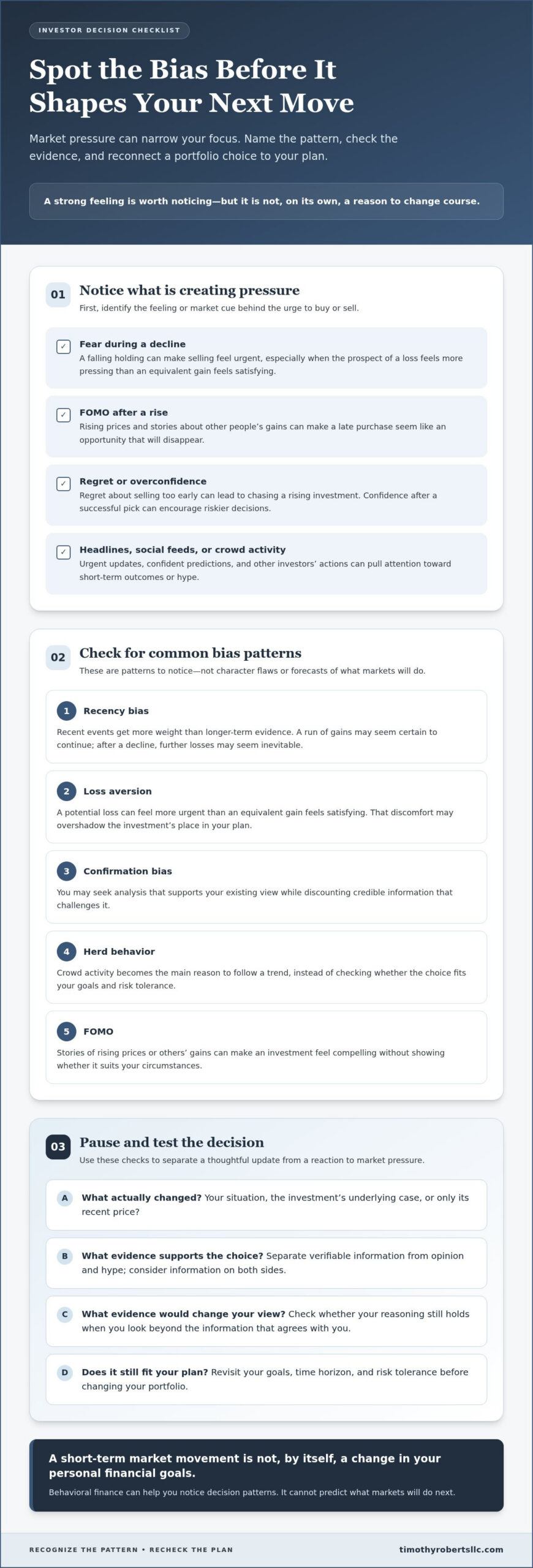
Not every portfolio adjustment is reactive. A change in your goals, time horizon, financial circumstances, or the evidence behind an investment may support a thoughtful revision. Ask what has actually changed: your situation, the investment’s underlying case, or only its recent price. That distinction can help you separate a considered update from a response to market pressure.
For a foundation on how psychology can influence financial choices, explore Behavioral finance. The following video also discusses ways investors can approach emotionally charged decisions.
Which emotions most often influence investment choices?
Fear can make a market decline feel like a threat that requires immediate action. This response is often connected to loss aversion: a loss may feel more urgent than an equivalent gain feels satisfying. An investor who sees a holding fall might sell to avoid further discomfort, without first considering whether the investment still fits the plan.
FOMO, or fear of missing out, can push in the opposite direction. After an asset has risen, stories about people who benefited can make a late purchase feel compelling. Regret can also distort judgment: someone who sold too early may chase a rising investment, while overconfidence after a successful pick may encourage riskier decisions. Recent headlines can intensify these reactions by narrowing attention to short-term outcomes.
How can emotional decisions pull a portfolio off course?
Reactive buying and selling can conflict with the time horizon and purpose of an investment. For example, an investor saving for retirement may respond to a temporary market drop by abandoning an approach designed around long-term needs. Repeated changes can also make it harder to follow a consistent strategy, as each new headline or market swing becomes a reason to reconsider the portfolio.
A short-term market movement is not, by itself, a change in your personal financial goals. Before adjusting investments, consider whether your circumstances or priorities have changed, or whether the impulse is tied to immediate market pressure. That distinction can help connect portfolio decisions to long-term priorities, including retirement income needs, rather than to the emotion of the moment.
How Behavioral Biases Shape Investment Decisions
Behavioral finance examines how psychology can influence financial choices and market behavior. It offers a way to understand how psychological influences shape financial decisions, though people don’t all respond to the same situation in the same way. It can help you notice patterns in your decision-making, but it can’t predict what markets will do next.
Biases aren’t character flaws. They’re patterns that can influence which information feels important, especially when a decision carries uncertainty. Recognizing a pattern creates space to ask whether a choice reflects your objectives and the available evidence, or a mental shortcut that deserves a closer look.
How do loss aversion and recency bias affect investors?
Recency bias gives recent events more weight than longer-term evidence. After a stretch of gains, an investor might assume the trend will continue; after a decline, the same investor might see further losses as inevitable. Loss aversion can compound that response, making the prospect of a decline feel more pressing than the possibility of an equivalent gain.
Hypothetical example: Imagine an investor whose portfolio has fallen after several years of steady growth. The recent decline may dominate their attention, making past performance, time horizon, and original objectives feel less relevant. This isn’t a recommendation to buy or sell. It shows how a recent experience can shape the questions an investor asks and the evidence they may overlook.
What are confirmation bias, herd behavior, and FOMO?
Confirmation bias can lead someone to seek analysis that supports an existing view while discounting credible information that challenges it. Herd behavior appears when crowd activity becomes the main reason to follow a trend, instead of checking whether a decision fits personal goals and risk tolerance.
Social feeds and urgent headlines can intensify FOMO by highlighting rising prices, confident predictions, or stories of others’ gains. That attention can make an investment seem compelling without showing whether it suits your circumstances. Separate verifiable information from opinion and hype. Ask what evidence would change your view, and whether your reasoning still holds when you consider information on both sides.
Understanding these biases can help you examine a decision more deliberately, but it won’t tell you where the market is headed. If you want to connect your investment choices with personal goals and risk tolerance, investment portfolio management can provide guidance shaped around those priorities.
Which Approach Helps You Make Less Emotional Investment Decisions?
The most useful approach is one you can follow consistently and update thoughtfully. A written investment policy, informal personal rules, and professional guidance can each create structure, but they offer different levels of detail and accountability. Consider how much direction you need and what will help you pause before acting on a market impulse.
| Approach | Structure | Flexibility | Accountability | May suit |
|---|---|---|---|---|
| Written investment policy | Records goals, time horizon, risk tolerance, and decision rules | Can be revised when circumstances meaningfully change | Creates a reference you can revisit | Investors who want a detailed, consistent framework |
| Informal personal rules | Uses a few self-defined guidelines | Easy to adapt, but may be less precise | Primarily self-directed | Investors who prefer a simple structure they can maintain |
| Ongoing professional guidance | Connects portfolio choices with broader goals and risk tolerance | Can account for evolving circumstances | Includes a professional perspective and ongoing review | Investors who value support in applying a plan over time |
Can a written investment policy help prevent impulsive decisions?
A written policy acts as a reference point when markets are unsettled. It can summarize what the portfolio is intended to support, how much uncertainty you’re prepared to accept, and what conditions might warrant reviewing an investment. Setting review points in advance makes it easier to assess a decision at a planned time instead of responding to every headline or price movement.
Keep the policy adaptable. A change in your goals, time horizon, income needs, or other important circumstances may justify revisiting its assumptions. The purpose isn’t to follow outdated rules blindly. It’s to make changes deliberately and understand why you’re making them.
When might a financial advisor add accountability?
Professional guidance can help if you find it difficult to translate goals and risk tolerance into consistent portfolio decisions, or if you want an experienced perspective during reviews. A fiduciary advisor can help relate investment choices to the objectives you’ve defined. Investment portfolio management can include ongoing monitoring and rebalancing to help keep the portfolio aligned with its intended strategy as conditions change.
For a structured review process, investment portfolio management guidance can help connect decisions with personal goals and risk tolerance. Choose the level of structure that helps you act consistently while leaving room for reasoned updates.
How to Stop Making Emotional Investment Decisions: A Repeatable Process
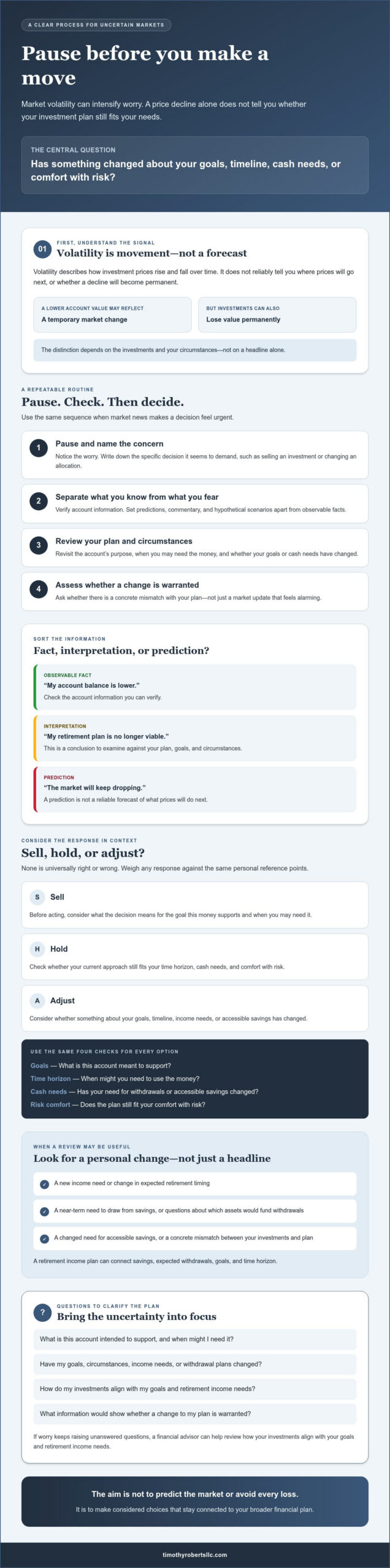
A consistent process can turn an urgent reaction into a decision you can explain. Use these steps whenever a market event or investment concern makes you want to change your portfolio.
- 1. Pause. Before placing a trade, step back and consider whether urgency is driving the decision.
- 2. Name the trigger. Identify the feeling, such as fear, excitement, or regret, and what prompted it. Is it a market headline, a recent portfolio decline, or a conversation?
- 3. Revisit your plan. Compare the proposed change with your written goals, time horizon, and risk tolerance. Ask whether your personal circumstances have changed or whether the market has simply moved.
- 4. Assess the evidence. Separate verified information from forecasts, opinions, and attention-grabbing headlines. Consider evidence both for and against the change, along with what remains uncertain.
- 5. Document your thinking. Write down the decision question, the reasons behind each option, and the trade-offs you see.
- 6. Set a review point. Choose a date to reconsider the question, giving yourself a chance to review it outside the immediate pressure of the moment.
What should you do before acting on a market headline?
Note what the headline actually reports and what it merely predicts. Then ask: Does this change my financial goals, time horizon, or need for money, or does it describe short-term market activity? Record the decision question and return to it at your chosen review time. A pause doesn’t mean ignoring new information; it gives you a chance to assess it in context.
How do you review a proposed portfolio change objectively?
Use a brief decision journal to make your reasoning visible. It can be as simple as this:
- Concern: What am I worried about, and what prompted the concern?
- Supporting evidence: What reliable information supports a change?
- Counterpoints and alternatives: What evidence challenges the idea? What other options could address the concern, and what trade-offs might each involve?
- Plan and review date: How does each option fit my goals, time horizon, and risk tolerance? When will I revisit the decision?
This framework won’t predict market direction. It gives you a disciplined way to examine a choice and notice whether emotion is outweighing evidence. Personalized financial planning can help connect investment decisions with your goals and risk tolerance.
If you’d like support building that process, explore personalized financial planning.
Build Long-Term Investment Confidence With a Plan and Ongoing Review
A financial plan gives investment decisions a wider frame. It can connect portfolio management with retirement income needs, other long-term priorities, and the level of risk that fits your circumstances. That context can help you distinguish a reasoned plan update from a reaction to short-term market noise.
Confidence doesn’t come from knowing what markets will do next. It comes from having a process for checking whether your strategy still reflects your goals and adjusting it when your life or priorities meaningfully change.
How can investment reviews keep decisions aligned with your goals?
Planned reviews create an opportunity to assess progress against your goals and risk tolerance, and to consider whether your circumstances have changed. For someone approaching retirement, a shift in income needs or time horizon may deserve attention. A daily market movement alone may not call for the same response.
Investment portfolio management can include ongoing monitoring and rebalancing to help maintain a strategy as markets and portfolio allocations change. These activities don’t remove investment risk or guarantee results. They provide a structured way to review the portfolio in relation to your plan, rather than trying to forecast each market move. Retirement income planning can also help connect portfolio decisions with future income needs.
What can personalized fiduciary guidance contribute?
A fiduciary advisor can help translate your stated goals and risk tolerance into a considered financial strategy, then revisit that strategy as your needs evolve. Timothy Roberts & Associates, LLC brings more than 25 years of experience to personalized financial planning, investment portfolio management, and retirement income planning. The focus is on connecting decisions to your circumstances, not promising a particular investment outcome.
Coordinating investment and retirement planning can make reviews more relevant to the decisions ahead. Instead of treating a portfolio change in isolation, consider how it relates to income needs, time horizon, and broader priorities. Update the plan when the underlying facts change, and avoid mistaking every market fluctuation for a reason to change direction.
If you’d like to discuss personalized investment and retirement planning, explore planning support tailored to your goals.
Make Your Next Investment Decision With Greater Clarity
Emotions are part of investing, but they don’t have to set the direction. Recognize the trigger, pause before acting, and use a repeatable process to compare a proposed change with your goals, time horizon, and risk tolerance. A written policy and regular reviews can help you distinguish a meaningful change in your circumstances from short-term market noise.
That’s the foundation of how to stop making emotional investment decisions: build a plan you understand and return to it when uncertainty rises. Timothy Roberts & Associates, LLC brings more than 25 years of experience to personalized financial guidance. Its fiduciary advisors tailor strategies to individual goals and risk tolerance, while investment portfolio management includes ongoing monitoring and rebalancing. These practices support a considered approach without promising investment results.
Connect investment choices with your longer-term priorities. Explore personalized investment and retirement planning with Timothy Roberts & Associates, LLC.
Frequently Asked Questions
Why do investors make emotional investment decisions?
Uncertainty can make immediate events feel more important than long-term plans. A falling market may trigger fear of further losses, while a fast-rising investment can create pressure to buy before an opportunity passes. Regret, overconfidence, and repeated exposure to headlines can also narrow attention. Recognizing these human reactions helps distinguish an emotional impulse from a decision grounded in goals and evidence.
How can I stop panic selling when the market falls?
Pause before making a trade and identify what prompted the urge to sell. Review your goals, time horizon, and risk tolerance. Then ask whether your personal circumstances or the investment’s supporting evidence have changed, or whether the concern is mainly a market decline. Writing down the reasons for and against selling can make the trade-offs clearer. This process can help you stop making emotional investment decisions without trying to predict market movements.
Can an investment policy statement help control emotional decisions?
Yes. An investment policy statement can record your goals, time horizon, risk tolerance, and the principles that guide portfolio decisions. It gives you a reference during volatile periods, rather than leaving you to rely only on how the market feels that day. The policy shouldn’t be permanent or inflexible. Revisit it when your goals, financial circumstances, or time horizon meaningfully change, and document why you’re updating it.
What should I do before making an investment decision?
Clarify the decision you’re considering and what triggered it. Separate verified information from forecasts, opinions, and urgent headlines, then compare the proposed change with your goals, time horizon, and risk tolerance. Consider evidence on both sides, the uncertainty involved, and possible alternatives. If the decision feels urgent, record your reasoning and set a time to review it. A deliberate process can help you act from a plan rather than a passing reaction.
Is it ever reasonable to change an investment strategy?
Yes. A strategy may warrant a thoughtful update if your goals, time horizon, income needs, risk tolerance, or other financial circumstances change. New evidence about an investment may also be relevant. Understand what has changed and how the adjustment supports your broader plan. A short-term market movement alone doesn’t necessarily mean your personal priorities have changed, so distinguish new circumstances from temporary market noise.
How often should I review my investment portfolio?
Set review points that fit your financial plan, and revisit the portfolio when a meaningful change in your circumstances calls for it. Reviews can assess progress toward goals, risk tolerance, and whether the portfolio still reflects your intended strategy. They’re not a way to forecast markets or a reason to react to every fluctuation. Ongoing monitoring and rebalancing can support portfolio management, but they don’t eliminate investment risk or guarantee results.
Should I talk to a financial advisor about emotional investing?
Consider speaking with a financial advisor if emotional reactions make it difficult to follow your investment plan or assess potential changes objectively. A fiduciary advisor can help relate portfolio choices to your goals and risk tolerance, and provide a structured perspective during reviews. Timothy Roberts & Associates, LLC brings more than 25 years of experience to personalized financial strategies, including investment portfolio management and retirement income planning. Guidance can support a considered process, not guarantee investment outcomes.