

Sep
How Financial Advisors Help Investors: A Strategic Guide to Wealth Elevation in 2026
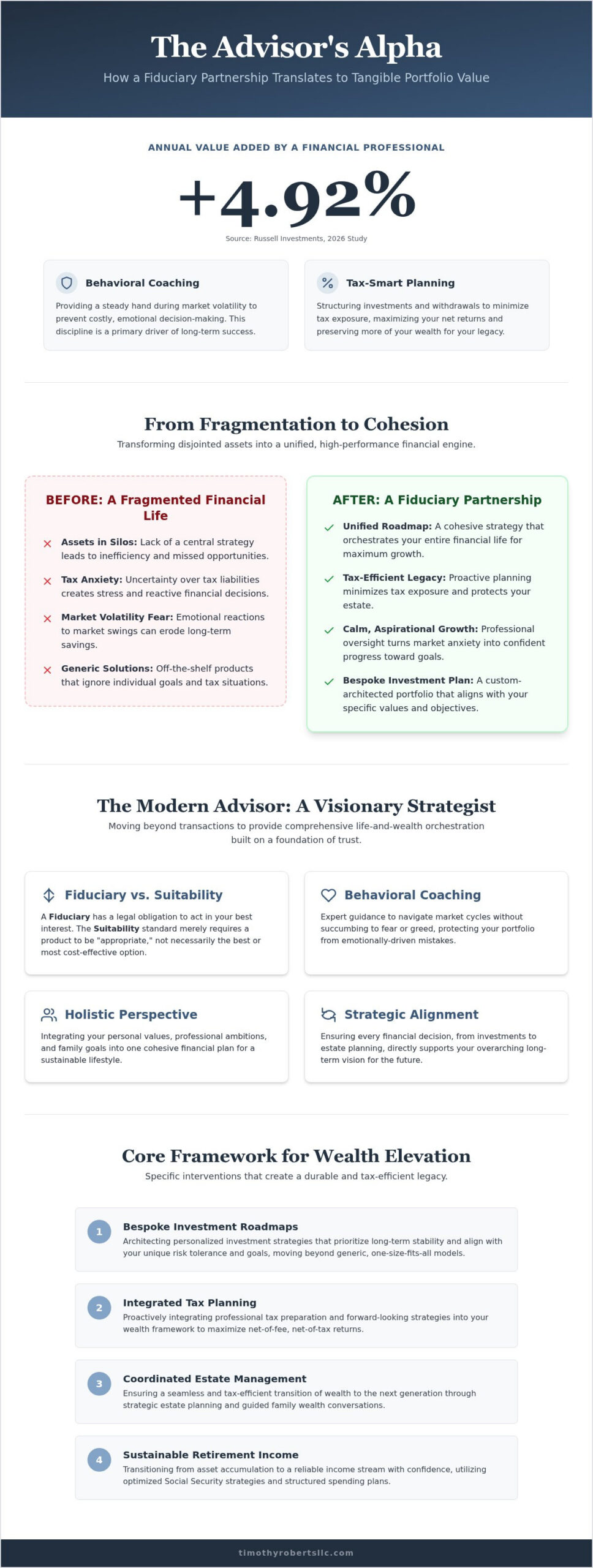
Did you know that a strategic partnership with a financial professional can add approximately 4.92% in annual value to your portfolio? According to a 2026 study from Russell Investments, this gain doesn’t come from chasing market trends. Instead, it’s the result of behavioral coaching and tax-smart planning that illustrates how financial advisors help investors reach their goals. Many people feel the weight of a fragmented financial life where assets sit in silos. You might struggle with a lack of central strategy, causing anxiety over tax liabilities or the fear that market volatility will erode your savings.
Wealth elevation requires precision. We understand that you’re looking for a visionary partner rather than a simple transaction. This guide explores how a sophisticated fiduciary relationship provides a unified roadmap, transforming disjointed assets into a cohesive, tax-efficient legacy. We’ll preview the specific interventions that ensure your retirement income remains sustainable while your tax exposure is minimized. Discover how professional oversight turns market anxiety into calm, aspirational growth for your entire estate.
Key Takeaways
- Move beyond transactional brokerage by partnering with a visionary strategist who orchestrates your entire financial life through a fiduciary lens.
- Understand exactly how financial advisors help investors by architecting bespoke investment roadmaps that prioritize long-term stability over short-term volatility.
- Maximize your net-of-fee returns by integrating professional tax preparation and proactive planning strategies into your broader wealth management framework.
- Ensure a seamless transition of wealth to the next generation through coordinated estate management and strategic family wealth conversations.
- Transition from asset accumulation to a sustainable income stream with confidence, utilizing optimized Social Security strategies and structured spending plans.
The Evolving Role of the Modern Financial Advisor
The landscape of wealth management has undergone a profound transformation. In 2026, the definition of What is a Financial Advisor? has shifted from a transactional broker to a visionary strategist. While the previous decade focused on simple asset allocation, today’s high-net-worth individuals require comprehensive life-and-wealth orchestration. A “DIY” approach often falters because it cannot account for the complex regulatory shifts and nuanced tax laws that define the current year. The true value proposition lies in bridging the gap between your current assets and an aspirational future, turning fragmented pieces into a unified legacy.
The Fiduciary Standard: A Foundation of Trust
At the core of this evolution is the fiduciary standard. This isn’t just a professional preference; it’s a legal obligation to act solely in the client’s best interest. Large institutions often operate under a “suitability” standard, which merely requires that a product be appropriate, even if it isn’t the best or most cost-effective option. Fiduciary oversight provides the objective Investment Portfolio Management necessary to protect your interests. It ensures that every recommendation is made with transparency and business-minded rigor, acting as a safeguard for your capital. This is a primary example of how financial advisors help investors maintain long-term stability.
Moving Beyond Market Performance
Wealth elevation isn’t measured by a single index. While “beating the market” is often discussed, it remains secondary to achieving specific, personalized life outcomes. A modern advisor acts as an expert craftsman, synthesizing your creative vision for the future with structured corporate capabilities. This partnership moves away from aggressive sales tactics toward a narrative of shared success. Understanding how financial advisors help investors involves looking at the intangible benefits that provide clarity during complex times.
- Behavioral coaching: Providing a steady hand during periods of market volatility to prevent emotional decision-making.
- Strategic alignment: Ensuring that every financial move supports your overarching goals rather than isolated gains.
- Holistic perspective: Balancing the personal and professional to create a sustainable lifestyle.
This deliberate pacing reinforces the idea that true wealth isn’t a transaction. It’s a journey of upward progression. By focusing on depth over superficiality, a visionary strategist helps you navigate the practicalities of execution while keeping your high-level vision in focus. It’s about moving from a state of financial fragmentation to one of intentional, polished growth.
Architecting a Fiduciary-Led Investment Strategy
Building a portfolio shouldn’t feel like buying a pre-packaged product. It’s a carefully crafted intervention. A visionary strategist helps you plan for short- and long-term goals by analyzing the intersection of your personal values and market realities. This is a core part of how financial advisors help investors maintain stability in 2026. Rather than chasing the latest trend, we focus on identifying high-quality, diversified vehicles that mitigate idiosyncratic risk. We treat your capital with the same business-minded rigor you applied to earning it.
Using an asset-based management model aligns our incentives directly with your portfolio’s growth. When you succeed, we succeed. This partnership fosters a narrative of shared success, moving away from the commission-driven models of the past. Continuous monitoring and rebalancing are not just administrative tasks; they’re essential maneuvers to ensure your strategic alignment remains intact as market conditions shift. Without these interventions, even the best-laid plans can drift into unintended risk profiles. Our role is to provide the steady, logical guidance required to keep your journey on track.
Customization vs. Off-the-Shelf Solutions
Off-the-shelf “model portfolios” from large institutions often ignore the specific tax nuances of 2026. These generic solutions fail to account for individual tax brackets or unique legacy goals. A personalized financial strategy evolves alongside you, adapting to life changes and shifting regulatory environments. Asset allocation is the primary driver of long-term returns. By focusing on bespoke Investment Portfolio Management, we ensure your capital is positioned for the highest level of efficiency. We look at the aesthetics of your financial life alongside the functionality of the numbers.
Risk Management and Insurance Analysis
Wealth elevation requires a defensive posture against “unseen” risks. Inflation, longevity, and rising healthcare costs can silently erode decades of savings if left unchecked. Integrating Risk Management & Insurance Analysis into your broader plan transforms insurance from a mere expense into a strategic tool for asset protection. This foresight preserves the upward progression of your wealth, ensuring that unexpected events don’t derail your visionary roadmap. We take the time to understand complex problems rather than rushing to generic conclusions. If you’re ready to move beyond fragmented assets, consider how a sophisticated wealth management partnership can elevate your financial future.
The Strategic Integration of Tax Planning and Wealth Management
Tax planning is often treated as a reactive, year-end obligation. This approach misses the strategic depth required for true wealth elevation. In 2026, the intersection of tax compliance and investment management is where the most significant gains are realized. A visionary strategist understands that what you keep is just as important as what you earn. This integrated perspective is a fundamental way how financial advisors help investors protect their net-of-fee returns. It moves away from simple filing toward a narrative of long-term partnership and shared success.
A 2026 study from Russell Investments highlights that tax-smart planning alone can add approximately 1.23% in annual value for clients. This isn’t achieved through basic accounting. It requires carefully crafted interventions throughout the year. By coordinating with professional tax preparation, an advisor ensures that investment decisions aren’t made in a vacuum. They account for the federal income tax brackets, which in 2026 range from 10% to a top rate of 37%, to prevent unnecessary bracket creep during high-income years. This deliberate pacing ensures your capital remains productive rather than being eroded by avoidable liabilities.
Tax-Efficient Asset Location
Proper asset location is an art. It involves determining which assets belong in taxable brokerage accounts and which should reside in tax-advantaged structures. We analyze the specific utility of 401k, 403b, and SEP IRA accounts to maximize your long-term growth potential. Roth conversions and IRA management aren’t just options; they’re strategic tools for long-term tax reduction. This level of customization ensures your portfolio remains efficient across varying market cycles, bridging the gap between your personal vision and corporate capabilities.
Mitigating Capital Gains and Windfall Taxes
High-net-worth individuals often face unique challenges, such as concentrated stock positions or business sale proceeds. Managing these windfalls requires more than just a brokerage account. It demands Strategic Tax Advising to mitigate immediate liabilities. According to the U.S. Bureau of Labor Statistics, financial professionals provide essential guidance on these complex fiscal matters. By leveraging tax-efficient withdrawal strategies, we help you maximize spendable income without triggering avoidable penalties.
- Strategic rebalancing: Selling assets in a way that minimizes capital gains exposure.
- Harvesting losses: Offsetting gains with strategic losses to lower your taxable income.
- Bracket management: Timing withdrawals to stay within lower tax thresholds.
This steady, logical approach reinforces the idea that true wealth management is a journey. It requires a partner who takes the time to understand complex problems rather than rushing to generic conclusions. By treating tax planning as a core component of your roadmap, you ensure your legacy remains robust and your financial life remains unified.
Protecting the Legacy: Estate and Risk Management Frameworks
Legacy isn’t merely a destination; it’s a meticulously crafted narrative that requires expert orchestration. One of the most profound ways how financial advisors help investors is by ensuring that decades of accumulation aren’t dismantled by a lack of structure. Coordinating estate management is about more than just paperwork. It’s about providing a seamless wealth transfer that honors your personal vision while utilizing structured corporate capabilities to protect assets from the delays and costs of probate. This deliberate pacing ensures that your transition is handled with the same rigor used to build your portfolio.
Facilitating “difficult” family conversations is a signature trait of a visionary strategist. We move beyond the numbers to address the emotional complexities of wealth. By acting as a neutral, professional bridge, we help families align their values with their financial roadmap. This includes integrating charitable giving strategies that reflect your legacy goals while providing tangible tax benefits. It’s an intersection of aesthetics and functionality, ensuring your altruism supports your broader wealth elevation plan without compromising your own stability.
Multi-Generational Wealth Transfer
True wealth elevation involves educating the next generation to become responsible stewards of family capital. We view trusts and wills not as static documents, but as strategic interventions designed for long-term legacy protection. Our Estate & Legacy Planning services provide the depth and context needed to ensure your heirs are prepared for the transition. This human-led approach distinguishes a boutique firm from larger, anonymous entities that prioritize volume over personal attention.
Education Funding as a Legacy Tool
Education funding is a core component of a holistic financial plan that creates upward progression for your family. We utilize 529 plans and other specialized vehicles to solve the complex problem of rising tuition costs. It’s essential to balance college savings with your own Retirement Income Planning to avoid the trap of “parental debt.” We take the time to understand these competing priorities, ensuring that your desire to provide for your children doesn’t erode your own sustainable income. Understanding how financial advisors help investors manage these trade-offs is key to maintaining long-term confidence.
If you’re ready to secure your family’s future, our team can help you develop a comprehensive legacy strategy that reflects your unique vision and business-minded rigor.
Orchestrating the Transition to Retirement Income
Transitioning from a decades-long focus on saving to the active distribution of assets is often the most stressful phase of an investor’s journey. A visionary strategist provides the intellectual framework to spend without the paralyzing fear of depletion. This phase illustrates how financial advisors help investors navigate the “sequence of returns” risk. A market downturn in the early years of retirement can disproportionately impact the longevity of a portfolio if withdrawals aren’t managed with precision. By carefully timing distributions and maintaining a strategic cash reserve, we protect your upward progression even when markets are volatile. It’s about moving from a state of accumulation to one of intentional, structured enjoyment of your life’s work.
We determine the optimal Social Security claiming strategy not in isolation, but as an integrated component of your larger wealth elevation plan. This ensures your guaranteed income sources are maximized before tapping into your investment portfolio. Managing the transition requires a blend of creative passion and business-minded rigor to ensure your paycheck remains sustainable regardless of market cycles. We take the time to understand your unique lifestyle needs rather than rushing to generic conclusions.
The Retirement Income Roadmap
Creating a sustainable paycheck requires a logical, three-step orchestration. First, we assess the distinction between essential lifestyle expenses and discretionary aspirational goals. This clarity allows us to prioritize your security. Second, we identify all guaranteed income sources, including Social Security and pensions, to establish a foundational baseline. Finally, we engineer a specific withdrawal rate from your diversified portfolio of brokerage and retirement accounts. This Retirement Income Planning process turns fragmented assets into a reliable, tax-efficient cash flow that mirrors the rhythm of a traditional salary.
Longevity and Healthcare Integration
A modern retirement plan must account for a 30-plus year time horizon, acknowledging the rising costs of healthcare and long-term care interventions. We don’t rely on generic assumptions or off-the-shelf software. Instead, we craft customized interventions that adjust for inflation and shifting medical needs over time. This foresight ensures that your lifestyle remains consistent as you age, preventing the erosion of your legacy by unforeseen costs. In the context of 2026 market expectations, the safe withdrawal rate is defined as the maximum percentage of assets an investor can spend annually while maintaining a high probability that the portfolio will last for the duration of their life. Understanding how financial advisors help investors manage these complex distribution mechanics is the final piece of the wealth elevation puzzle.
Elevating Your Financial Future in 2026 and Beyond
True wealth elevation is a deliberate journey from fragmented assets to a unified, tax-efficient legacy. We’ve explored the critical role of fiduciary oversight in crafting bespoke investment strategies and the necessity of integrating professional tax preparation into your broader financial roadmap. Understanding how financial advisors help investors manage the transition to retirement income ensures that your life’s work provides a sustainable, confident future. This isn’t a simple transaction. It’s a sophisticated partnership built on depth, intellectual curiosity, and business-minded rigor.
Success requires more than just picking stocks; it demands a visionary strategist who can navigate the complex regulatory and tax landscape of 2026. With over 25 years of fiduciary expertise, Timothy Roberts & Associates, LLC specializes in creating personalized roadmaps that synthesize your creative vision with structured corporate capabilities. If you’re ready to move toward a state of intentional growth and long-term stability, we invite you to Schedule a Strategic Wealth Consultation with Timothy Roberts & Associates, LLC. Your journey to a sustainable and meaningful financial legacy starts with a single, strategic step.
Frequently Asked Questions
What is the specific difference between a financial advisor and a wealth manager?
Wealth management is a more comprehensive subset of financial advice. While a financial advisor might focus on specific areas like retirement plans or investment portfolio management, a wealth manager orchestrates a client’s entire financial life. This includes estate planning, tax strategies, and risk management. It’s about moving from isolated transactions to a holistic narrative of upward progression and long-term stability for high-net-worth individuals who require deeply customized interventions.
How much does a financial advisor typically cost in 2026?
Advisory costs generally fall into three categories: asset-based fees, fixed-fee planning, or professional tax preparation fees. Asset-based models typically charge a percentage of the portfolio under management, covering continuous monitoring and fiduciary oversight. Fixed-fee arrangements often apply to specific project-based interventions like creating a comprehensive retirement roadmap. While industry averages exist, the specific fee structure depends on the complexity of your situation and the level of customization required for your wealth elevation.
Can a financial advisor help me with my taxes as well as my investments?
Yes, a specialized firm can integrate professional tax preparation with investment management. This synergy is a key part of how financial advisors help investors maximize their net-of-fee returns. By coordinating tax advising with your portfolio strategy, an advisor can implement year-round planning to minimize liabilities. This approach prevents bracket creep and ensures that every investment decision is evaluated for its tax efficiency before execution, preserving more of your capital for future growth.
What should I look for when choosing a fiduciary financial advisor?
Look for a firm that operates under a fiduciary-first model with a significant industry track record, such as 25 years of experience. A fiduciary is legally obligated to act in your best interest, which provides a layer of protection against the suitability standards used by some large institutions. You should verify their expertise in complex areas like estate and legacy planning. Seek a visionary strategist who offers a blend of creative passion and business-minded rigor.
Is it worth hiring a financial advisor if I already have a 401(k)?
Hiring an advisor is often highly beneficial even if you have a 401(k) because it allows for a unified financial roadmap. While a 401(k) is a valuable tool for accumulation, an advisor orchestrates how that account fits into your broader portfolio, including Roth IRAs and taxable accounts. They provide the behavioral coaching and tax-smart planning that a basic retirement plan lacks. This level of professional intervention turns fragmented savings into a cohesive, sustainable income stream.
How often should I meet with my financial advisor to review my strategy?
Most sophisticated partnerships involve at least one comprehensive annual review, though complex transitions may require quarterly check-ins. These meetings are essential for maintaining strategic alignment as your life evolves or regulatory environments shift. A steady, logical rhythm of communication ensures that your investment roadmap remains relevant. Outside of formal reviews, your advisor should provide continuous monitoring to handle rebalancing or unexpected market movements, keeping your journey toward wealth elevation on a steady and intentional path.
Can an advisor help me manage debt while also saving for retirement?
An advisor can help you balance debt management with retirement funding strategies. This intervention involves analyzing interest rates and tax implications to determine whether to prioritize paying down liabilities or investing for growth. It’s a strategic calculation that avoids parental debt or high-interest traps. By creating a unified roadmap, a visionary strategist ensures that your debt obligations don’t derail the upward progression of your retirement income planning or long-term legacy goals for your family.
What happens to my investment plan if the market becomes highly volatile?
Your investment plan should include built-in risk management and insurance analysis to withstand market turbulence. When volatility occurs, an advisor provides behavioral coaching to prevent emotional decisions that could erode decades of savings. They use rebalancing maneuvers to buy low and maintain your target asset allocation. This disciplined approach is a primary way how financial advisors help investors stay focused on their high-level vision rather than reacting to short-term market noise or economic uncertainty.
