

Sep
Tax-Loss Harvesting Strategies: Optimising Investment Portfolios for Michigan Residents in 2026
Market volatility is often viewed as a threat to your wealth, yet for the disciplined investor, it’s actually a sophisticated tool for structural tax advantage. Implementing advanced tax-loss harvesting strategies michigan residents can rely on transforms these market fluctuations into a deliberate path for upward progression. Most investors accept tax drag as an inevitable cost of success, watching a portion of their portfolio’s potential vanish into state and federal coffers each year. You likely recognize the frustration of seeing realized gains diminished by the complex interplay between federal capital gains rates and Michigan’s 4.25% flat income tax.
We’re here to shift that narrative from passive observation to intentional intervention. You’ll discover a clear framework for identifying harvesting opportunities, managing the nuances of the 61-day wash-sale window, and ensuring your portfolio remains meticulously aligned with your visionary goals. This guide provides the strategic depth needed to offset capital gains and enhance long-term wealth within our specific tax landscape. By the end of this discussion, you’ll have a roadmap to turn a standard year-end chore into a high-level investment strategy for 2026.
Key Takeaways
- Transform market volatility into a structural advantage by using strategic realized losses to neutralize capital gains tax liabilities.
- Navigate the specific interaction between federal capital gains and Michigan’s 4.25% flat tax rate through tailored tax-loss harvesting strategies michigan investors need for 2026.
- Protect your portfolio from IRS scrutiny by mastering the 61-day wash-sale rule and avoiding common pitfalls across all household accounts.
- Integrate rhythmic tax-lot harvesting into a broader wealth management framework to ensure continuous upward progression and refined retirement income planning.
- Establish a disciplined monitoring system that identifies harvesting opportunities in real-time, keeping your investment outcomes aligned with your long-term legacy goals.
Understanding Tax-Loss Harvesting: A Core Strategy for Wealth Preservation
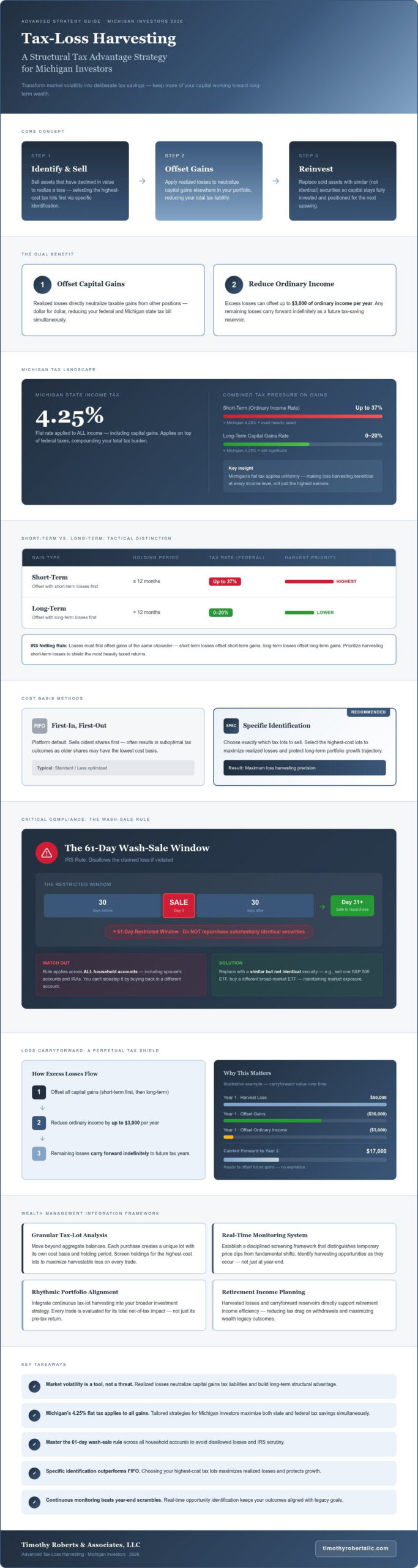
Wealth preservation requires more than just picking winners; it demands a proactive approach to tax efficiency. Tax-loss harvesting is a strategic tool for portfolio optimization that transforms market volatility into a structural advantage. By selling assets that have declined in value, you realize a loss that can be used to neutralize capital gains elsewhere in your portfolio. This isn’t an admission of defeat. It’s a rhythmic intervention designed to keep more of your capital working toward your long-term vision.
The dual benefit of this strategy is particularly compelling for high-net-worth individuals. Beyond simply offsetting gains, you can use excess losses to reduce up to $3,000 of your ordinary income each year. Any remaining losses don’t vanish; they carry forward indefinitely, providing a reservoir of tax-saving potential for future years. Integrating these tax-loss harvesting strategies michigan residents utilize ensures that your state and federal liabilities are managed with the same rigor as your asset allocation.
To better understand this concept, watch this helpful video:
The Role of Cost Basis in Strategic Harvesting
Cost basis serves as the foundation for all tax-efficiency calculations. It represents the original value of an asset, adjusted for dividends or splits, and determines the exact amount of harvestable loss available. While many platforms default to the First-In, First-Out (FIFO) method, sophisticated investors often prefer specific identification. This allows you to select high-cost tax lots for sale, maximizing the realized loss and protecting your portfolio’s long-term growth trajectory.
Short-Term vs. Long-Term Gains: A Tactical Distinction
Precision is vital when matching losses against gains because the IRS requires you to follow a specific netting process. Losses must first offset gains of the same character: short-term losses against short-term gains, and long-term losses against long-term gains. Short-term gains are especially burdensome, as they’re taxed at ordinary income rates reaching up to 37% in 2026. By prioritizing the harvest of short-term losses, you effectively shield your most heavily taxed returns, ensuring your wealth management remains both aesthetically balanced and functionally robust.
The Mechanics of Strategic Harvesting: How to Offset Gains Effectively
Execution is the bridge between a theoretical tax advantage and tangible wealth preservation. It’s not enough to simply sell a declining asset; you must execute the transaction with a rhythmic precision that respects both market timing and regulatory boundaries. For those seeking advanced tax-loss harvesting strategies michigan portfolios require in 2026, the focus shifts from simple liquidation to a sophisticated process of strategic replacement. This ensures that while you’re realizing a loss for tax purposes, your capital remains positioned for the next market upswing.
The process begins with a granular analysis of your holdings, moving beyond aggregate balances to examine individual tax lots. Each purchase of a security creates a unique lot with its own cost basis and holding period. By specifically identifying and selling the lots with the highest cost basis, you maximize the realized loss. This targeted approach is a hallmark of professional investment portfolio management, where every trade is evaluated for its impact on the total net-of-tax return.
Identifying Harvestable Assets in a Volatile Market
Screening for opportunities requires a disciplined framework that distinguishes between temporary price fluctuations and fundamental shifts. We look for assets trading significantly below their purchase price, but we also weigh relative performance. If an entire sector is down, it may present an ideal moment to harvest a loss while maintaining a long-term conviction in that industry. High-level monitoring tools allow for this continuous oversight, capturing opportunities during intra-quarter volatility that might be missed if you only review your accounts in December. This proactive stance transforms market turbulence into a deliberate engine for tax efficiency.
Maintaining Market Exposure Through Strategic Reinvestment
The primary challenge of harvesting is staying invested while avoiding the Wash-Sale Rule. To maintain your target asset allocation, you can utilize “tax-loss swapping.” This involves selling a depreciated security and immediately purchasing a correlated, but not “substantially identical,” alternative. For example, you might sell a broad market index fund and buy a different fund that tracks a similar, yet distinct, benchmark. This strategy allows you to capture the tax benefit without spending a single day out of the market, ensuring your risk profile remains meticulously aligned with your long-term goals.
Successfully navigating these transitions requires a blend of creative investment vision and structured tax capabilities. If you’re ready to evolve your portfolio’s efficiency, a strategic review with the team at Timothy Roberts & Associates can help bridge the gap between your current holdings and your ultimate financial aspirations.
Michigan State Tax Considerations: Navigating the Flat-Tax Landscape
While federal tax savings often command the most attention, Michigan residents operate within a unique fiscal environment that offers a secondary layer of efficiency. Our state’s 4.25% flat income tax rate applies to both ordinary income and capital gains, creating a predictable backdrop for wealth preservation. When you implement tax-loss harvesting strategies michigan investors find that every dollar of realized loss provides a dual benefit. You aren’t just neutralizing federal liabilities; you’re also shielding your income from the state’s flat levy, effectively securing a 4.25% “bonus” on your harvested losses.
Michigan’s tax code generally begins with your federal Adjusted Gross Income (AGI). This means that the $3,000 annual deduction against ordinary income and the full netting of capital gains flow directly into your state return. For high-net-worth individuals, this synergy is vital. It ensures that the creative vision of your investment portfolio is supported by a structured, state-specific tax capability. Managing these carryovers requires meticulous tracking, as Michigan respects the indefinite carryforward of losses, allowing you to build a reservoir of tax offsets for future years.
Federal vs. Michigan Tax Treatment: A Comparative View
The interaction between federal progressive brackets and Michigan’s flat rate requires a nuanced understanding of total tax drag. While federal rates for long-term gains can reach 20% plus the 3.8% Net Investment Income Tax, the Michigan portion remains a steady constant. This predictability allows for more precise modeling of net-of-tax returns.
| Tax Category (2026) | Federal Rate | Michigan Rate |
|---|---|---|
| Short-Term Capital Gains | 10% – 37% | 4.25% (Flat) |
| Long-Term Capital Gains | 0%, 15%, or 20% | 4.25% (Flat) |
| Ordinary Income Offset | Up to $3,000 | Full flow-through from AGI |
Michigan-Specific Reporting Requirements
Consistency between your federal Schedule D and your Michigan 1040 is the cornerstone of regulatory compliance. Errors in reporting realized losses or carryovers can trigger unnecessary inquiries and disrupt your long-term wealth trajectory. Leveraging strategic tax advising ensures that your state filings mirror your federal strategy with absolute precision. This integrated approach bridges the gap between individual investment decisions and corporate-level tax preparation, providing a seamless experience for those who value both aesthetics and functionality in their financial planning.
Avoiding Common Pitfalls: The Wash-Sale Rule and Regulatory Compliance
The IRS maintains a rigorous standard for what constitutes a legitimate tax loss, and failing to respect these boundaries can transform a strategic advantage into a costly oversight. To successfully implement tax-loss harvesting strategies michigan residents must respect the 61-day window. This regulatory period encompasses the 30 days prior to the sale, the actual day of the transaction, and the 30 days following it. If you purchase a “substantially identical” security within this specific timeframe, the loss is disallowed for the current tax year. Instead, that loss is added to the cost basis of the newly purchased shares, deferring your tax benefit and complicating your long-term tracking.
One of the most frequent triggers for an accidental wash sale is the automatic dividend reinvestment setting. A small, automated purchase of shares in a declining position can inadvertently violate the 61-day window, nullifying a significant realized loss you intended to harvest. This underscores the necessity of a highly structured approach where every automated setting is audited for compliance. Managing these nuances requires more than just a periodic review; it demands a rhythmic, asset-based monitoring system that anticipates these triggers before they disrupt your wealth strategy.
Navigating the “Substantially Identical” Standard
The definition of “substantially identical” remains a nuanced area of tax law that requires professional interpretation. While selling a stock in one technology company to buy another in the same sector is generally acceptable, replacing one S&P 500 index fund with another from a different provider can be a gray area. The IRS views a security as substantially identical if it is not significantly different in its essential characteristics and potential for profit or loss. Most sophisticated strategies involve switching to an ETF that tracks a different, but highly correlated, index. This allows you to maintain sector exposure while ensuring the loss remains harvestable under current 2026 regulations.
Coordination Across Spousal and Retirement Accounts
Compliance is not limited to a single brokerage account. The IRS applies the wash-sale rule to your entire household, including your spouse’s accounts and your own individual retirement accounts (IRAs). A common error involves selling a security at a loss in a taxable brokerage account while simultaneously purchasing it within a Roth IRA. This specific maneuver is particularly damaging. Because the disallowed loss cannot be added to the basis of the IRA holding, the tax benefit is effectively lost forever. Successful execution requires a panoramic view of all family assets, treating the household as a single, integrated portfolio where every move is coordinated for maximum efficiency.
To ensure your portfolio is managed with this level of precision and regulatory rigor, consider the specialized wealth management expertise of Timothy Roberts & Associates.
Integrating Tax Strategies into a Sophisticated Wealth Management Framework
Tax-loss harvesting shouldn’t exist in a vacuum. It’s most effective when woven into the very fabric of your financial life, serving as a rhythmic thread in a larger tapestry of wealth management. While many view these interventions as a year-end obligation, the most successful investors treat them as a continuous, year-round discipline. This synthesis of aesthetic portfolio design and functional tax efficiency ensures that your investments don’t just grow; they grow with a structural resilience that minimizes the drag of state and federal liabilities.
By viewing tax-loss harvesting strategies michigan residents utilize as a core component of retirement income planning, you create a powerful engine for long-term wealth. Realized losses today act as a reservoir of tax-saving potential for tomorrow, allowing for more flexible distributions during your retirement years. This transition from transactional trades to a holistic advisory partnership is what separates a standard brokerage account from a truly optimized wealth strategy.
Rhythmic Rebalancing: The Strategic Heart of Wealth Management
Waiting until December to scan for losses is a reactive approach that often misses the most significant opportunities. Market dips occur throughout the year, often presenting brief windows to harvest “tax alpha” that disappears once the market recovers. Fiduciary oversight ensures that your portfolio is monitored with a steady, logical rhythm, identifying unrealized losses during intra-quarter volatility. This proactive management contributes to the upward progression of your net worth, turning temporary downturns into permanent tax advantages that compound over time.
Partnering with a Visionary Strategist
The true value of a specialized firm lies in the ability to bridge individual creative vision with structured corporate capabilities. Moving away from a simple “tax preparation” mindset toward proactive “tax planning” allows you to anticipate challenges before they arise. An advisor who functions as both an expert craftsman and a reliable business advisor provides the personal attention required to solve complex problems. This level of coordination transforms your financial journey from a series of disjointed transactions into a deliberate, results-driven narrative of shared success.
We invite you to experience a higher level of financial coordination where tax efficiency and investment growth are expertly aligned. By integrating these strategies into a comprehensive framework, you ensure that every decision is intentional and every outcome is optimized for your legacy.
Advancing Your Wealth Strategy with Intentional Tax Efficiency
Achieving a high-performance portfolio requires more than simply capturing market gains; it demands a rhythmic, disciplined approach to minimizing tax drag. By mastering the 61-day wash-sale window and leveraging the unique synergy between federal regulations and Michigan’s 4.25% flat tax rate, you transform temporary market downturns into permanent structural advantages. These tax-loss harvesting strategies michigan residents utilize in 2026 serve as a bridge between individual creative vision and the structured rigor of professional wealth management.
Your journey toward upward progression deserves a partner who understands the intersection of aesthetics and functionality in financial planning. With over 25 years of experience, our fiduciary advisors provide integrated tax and investment management solutions that move beyond off-the-shelf products. We invite you to Request a Strategic Tax and Portfolio Review to discover how a personalized financial roadmap can elevate your wealth preservation. Let’s work together to ensure your portfolio remains a resilient vehicle for your long-term legacy and aspirational growth.
Frequently Asked Questions
What is the wash-sale rule and how does it affect Michigan investors?
The wash-sale rule is a 61-day regulatory window that disallows a tax loss if you purchase a substantially identical security within 30 days before or after the sale. For those utilizing tax-loss harvesting strategies michigan residents must track these trades across all household accounts. Violations don’t eliminate the loss but instead add it to the cost basis of the new asset; this effectively defers your tax advantage until that position is eventually liquidated.
Can I use tax losses to offset my Michigan state income tax?
Yes, your realized investment losses directly reduce your Michigan state tax liability. Because Michigan’s 4.25% flat income tax rate is based on your federal Adjusted Gross Income, any losses used to offset gains or ordinary income on your federal return flow through to your state filing. This creates a secondary layer of efficiency, effectively granting you a 4.25% state tax savings on every dollar of harvested loss you successfully claim.
How much capital loss can I deduct against my ordinary income in 2026?
For the 2026 tax year, you can deduct up to $3,000 of net capital losses against your ordinary income, such as wages or interest. If your total capital losses exceed your total capital gains for the year, this $3,000 deduction serves as a valuable tool for reducing your overall taxable exposure. Any excess loss beyond this threshold doesn’t vanish; it remains a structural asset that carries forward to offset future gains.
Does tax-loss harvesting make sense for my Roth IRA?
Tax-loss harvesting is generally ineffective within a Roth IRA because these accounts are already tax-advantaged. Since gains within a Roth are not taxed and losses are not deductible, selling an asset at a loss provides no immediate tax benefit. However, you must be careful not to trigger a wash sale by purchasing a security in your Roth IRA that you recently sold for a loss in a taxable brokerage account.
What happens to my harvested losses if I don’t have enough gains to offset them?
If your realized losses exceed your gains, the IRS allows you to use the excess to offset up to $3,000 of ordinary income. Any remaining balance is carried forward indefinitely to future tax years. This carryforward functions as a strategic reserve, allowing you to neutralize future capital gains as your portfolio progresses. It’s a vital component of long-term wealth management, ensuring that current market volatility supports your future tax efficiency.
Is it possible to harvest losses in a mutual fund and immediately buy an ETF?
It is possible to sell a mutual fund at a loss and immediately purchase an ETF, provided the two are not substantially identical. This often involves selecting an ETF that tracks a different index or has a distinct management style. This maneuver allows you to maintain your target market exposure while capturing the tax benefit. Professional oversight is recommended to ensure the replacement asset doesn’t inadvertently trigger a wash-sale violation.
How does Michigan handle capital loss carryforwards from previous years?
Michigan’s tax code aligns with federal treatment regarding capital loss carryforwards. Since the state tax calculation begins with your federal Adjusted Gross Income, any carryforward loss used on your federal return automatically reduces your Michigan taxable income. This consistency simplifies your long-term planning, allowing you to build a multi-year strategy that respects both the state’s 4.25% flat rate and federal progressive tax brackets without redundant reporting.
Can I perform tax-loss harvesting in my 401(k) or 403(b)?
You cannot perform tax-loss harvesting within a 401(k) or 403(b) because these are tax-deferred retirement vehicles. Transactions within these accounts, such as selling a fund at a loss, do not trigger a taxable event or a deductible loss. Tax-loss harvesting is a strategy reserved for taxable brokerage accounts where realized gains and losses are subject to annual reporting. In your 401(k), the focus remains on long-term asset allocation rather than immediate tax lot management.
