

Sep
Inheritance Planning: A Strategic Guide to Wealth Preservation and Legacy in 2026
What if the most significant threat to your family’s future isn’t a market downturn, but the friction of an uncoordinated legacy? You’ve spent decades building a portfolio that reflects your values and your hard work. It’s natural to feel a sense of unease when considering how that wealth will transition to the next generation. Between the $15 million federal exemption threshold and the nuances of local probate, inheritance planning detroit requires more than just a set of documents. It demands a visionary strategy that aligns your financial architecture with your personal philosophy.
You deserve a clear roadmap for wealth transfer that prioritizes tax efficiency and the preservation of family stability. This guide offers a strategic framework designed to minimize the tax impact on your heirs while ensuring they’re prepared to steward their inheritance. We’ll explore how to navigate the 2026 landscape with a system that transforms wealth from a transaction into a lasting legacy. You’ll gain insights into the integration of tax-efficient investment strategies, the realities of probate costs, and the strategic coordination of your estate to provide true peace of mind.
Key Takeaways
- Shift your perspective from a transactional transfer of assets to a visionary strategy for the long-term evolution of family wealth.
- Identify the essential elements of a high-end strategy, including the synthesis of asset-based investment management and estate coordination.
- Master the complexities of the 2026 tax environment through proactive inheritance planning detroit to minimize the tax impact on your heirs.
- Follow a structured five-step audit to align your financial architecture with your family’s core values and legacy goals.
- Recognize why a fiduciary partnership is vital for navigating the ongoing evolution of multi-generational wealth and adapting to legislative shifts.
The Strategic Importance of Comprehensive Inheritance Planning
True wealth is more than a balance sheet; it’s the architecture of a future you won’t personally see. Effective comprehensive inheritance planning acts as a visionary strategy for wealth preservation, ensuring that your life’s work fuels your family’s growth rather than becoming a source of administrative burden. In the context of 2026, where legislative shifts and economic complexities are the norm, inheritance planning detroit requires a nuanced approach that transcends mere asset transfer. It’s about creating a narrative of partnership and shared success across generations.
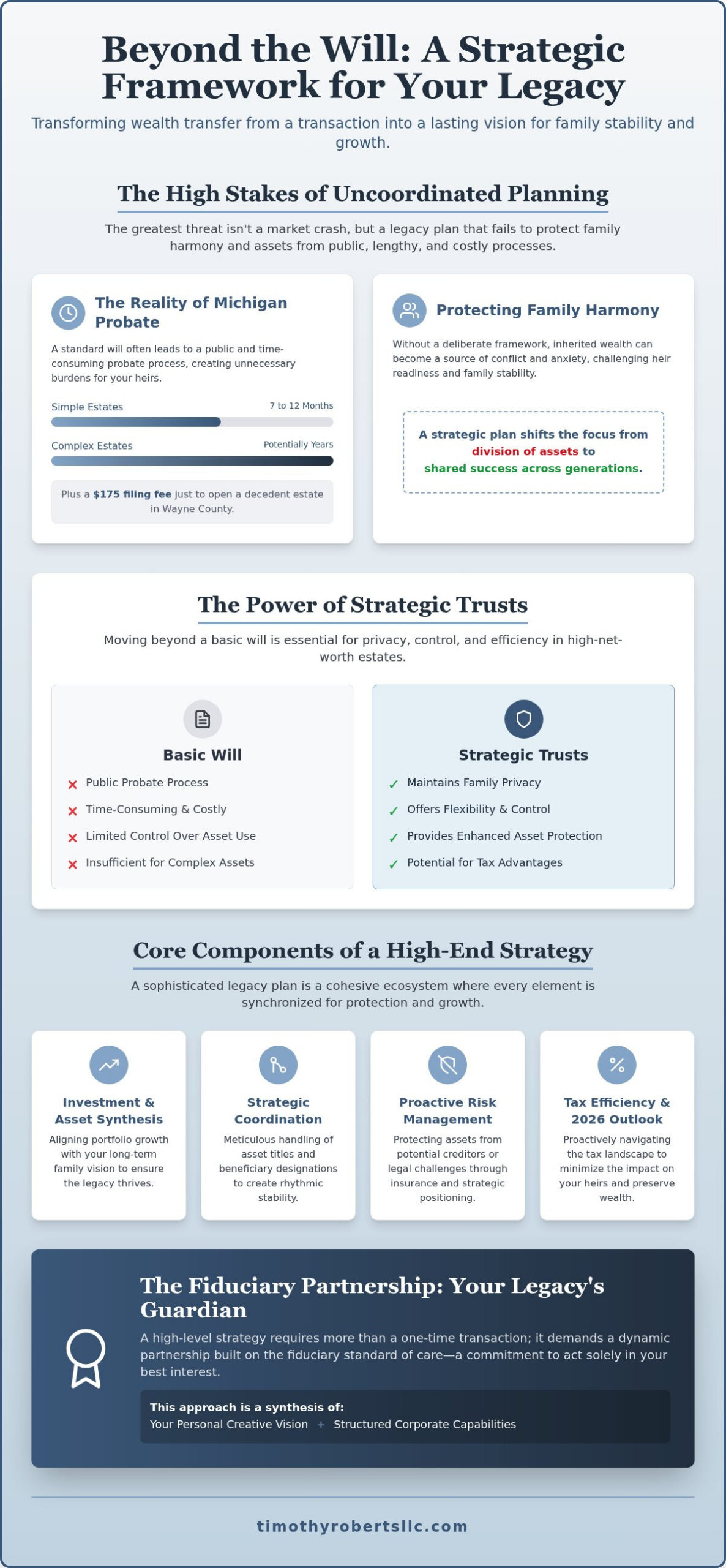
Protecting family harmony is often the highest emotional stake. Without a deliberate framework, wealth can inadvertently create friction or anxiety regarding heir readiness. We view this process as a journey of upward progression. It treats the development of your estate as an evolving journey, where financial security is the foundation for your heirs’ aspirational growth and long-term stability.
To better understand how strategic coordination protects family interests, watch this helpful video:
Moving Beyond Basic Wills
A simple will often lacks the sophistication required for high-net-worth estates. While a will provides a basic directive, it’s frequently insufficient for complex assets and fails to shield your family from the public, time-consuming nature of probate. In Michigan, simple estates can linger in probate for 7 to 12 months, while complex ones might stretch for years. For families seeking inheritance planning detroit, moving beyond basic documents is essential to avoid the loss of privacy and the $175 filing fee required to open a decedent estate in Wayne County. Utilizing a professional estate planning framework allows for the use of strategic trusts. These interventions offer flexibility and control that a standard will cannot match.
The Fiduciary Advantage in Legacy Management
High-level legacy management relies on the fiduciary standard of care. This is not an off-the-shelf solution; it’s a commitment to act solely in your best interest. A visionary strategist doesn’t just manage accounts. They serve as a reliable business advisor who understands the intersection of your personal creative vision and structured corporate capabilities. This synthesis ensures that your legacy is both aesthetically aligned with your values and functionally robust for the challenges of tomorrow. It represents a shift from a one-time transaction to a dynamic plan for organizational evolution, providing the calm confidence needed to face a changing financial landscape.
Core Components of a High-End Estate Strategy
A high-end estate strategy functions as a cohesive ecosystem where every element supports the whole. While basic plans focus on simple distribution, a strategic framework for inheritance planning detroit prioritizes the protection and growth of assets before they ever reach an heir. This requires meticulous coordination of asset titles, beneficiary designations, and the integration of asset-based investment management. By aligning your portfolio’s growth with your long-term vision, you ensure the legacy isn’t just preserved; it actively thrives.
Risk management serves as a critical defensive layer within this architecture. It’s not enough to simply bequeath assets. You must protect them from potential creditors or legal challenges that heirs might face. This involves a synthesis of insurance analysis and strategic asset positioning. Coordinating varied accounts like 401ks, IRAs, and brokerage portfolios ensures that no piece of your financial structure remains siloed, creating a rhythmic stability across your entire holdings.
The Role of Trusts in Wealth Preservation
Trusts act as carefully crafted interventions to maintain control over how your wealth is utilized. Revocable trusts offer flexibility during your lifetime, while irrevocable trusts can provide enhanced asset protection and specific tax advantages. These structures ensure your creative vision for the family’s future remains intact even after the assets have transitioned. Additionally, they allow heirs to benefit from a “step-up in basis.” This adjustment can significantly reduce capital gains taxes when inherited investments are eventually sold, preserving more capital for the next generation.
Coordinating Retirement Accounts and Beneficiaries
Retirement assets present unique tax hurdles that require sophisticated oversight. Navigating Tax Efficiency is paramount when dealing with inherited IRAs and 401ks, as these are often subject to complex distribution rules. The shift away from the traditional “Stretch IRA” means most non-spouse beneficiaries must now deplete these accounts within ten years. This compressed timeline can push heirs into higher tax brackets if the process isn’t managed with foresight.
Effective coordination involves more than just filling out a form. It requires an integrated approach to retirement income planning that accounts for the tax reality of the next generation. By viewing these accounts as part of a broader journey of upward progression, you can mitigate the tax bite and provide a more stable financial foundation. If you’re ready to align your accounts with a comprehensive vision, exploring professional wealth management can provide the clarity needed for long-term success.
Navigating Tax Efficiency and Wealth Transfer
As 2026 approaches, the intersection of tax policy and legacy preservation has never been more critical. The federal estate tax exemption has reached a significant $15 million for individuals and $30 million for married couples. However, the 40% tax rate on assets exceeding these limits remains a formidable hurdle for high-net-worth families. Effective inheritance planning detroit isn’t a reactive year-end task; it’s a synthesis of tax advising and long-term vision. This year-round approach allows for the orchestration of wealth in a way that minimizes liabilities and maximizes the tangible impact for your heirs.
High-level strategy views development as a journey. It treats tax compliance not as a burden, but as a framework for organizational evolution. By integrating tax-efficient investment strategies with estate coordination, you position your family for upward progression. This ensures that every financial decision serves the broader narrative of partnership and shared success.
Minimizing the ‘Inheritance Tax’ Burden
It’s vital to distinguish between the various layers of taxation that can erode a legacy. While Michigan does not impose a state-level inheritance or estate tax, federal obligations and future income tax liabilities for heirs must be managed with precision. Lifetime gifting serves as a powerful tool in this regard. Utilizing the 2026 annual gift tax exclusion of $19,000 per recipient allows you to reduce the taxable estate incrementally without triggering immediate tax consequences. These interventions ensure that wealth transfer remains a controlled process rather than a chaotic transaction.
Strategic Charitable Giving
Philanthropy offers a sophisticated avenue for both tax reduction and the expression of family values. Tools such as Donor-Advised Funds and Charitable Remainder Trusts act as carefully crafted interventions. They allow you to support meaningful causes while securing immediate tax benefits and potentially providing income streams for heirs. This approach bridges individual creative vision with structured corporate capabilities, ensuring your legacy reflects your personal philosophy. It moves beyond simple donation toward a business-minded rigor that benefits both the community and your family’s financial architecture.
The Fiduciary Partnership is essential when implementing these complex strategies. A visionary strategist provides the intellectual curiosity and professional stability required to solve multi-generational problems. This partnership ensures that your inheritance planning detroit remains flexible, adapting to legislative shifts while maintaining a steady and logical flow toward your ultimate goals. It’s about moving away from off-the-shelf solutions toward a narrative of shared success and aspirational growth.
5 Steps to Implementing a Strategic Legacy Plan
Transitioning from a high-level vision to the practicalities of execution requires a steady, logical flow. For those seeking inheritance planning detroit, the journey toward multi-generational success is built on five strategic pillars. This isn’t a simple checklist; it’s an orchestration of your life’s work into a functional, enduring architecture.
Step 1 involves a rigorous audit of all assets and liabilities to ensure no detail is overlooked. Step 2 requires you to define your core values, establishing the “why” that anchors your entire financial roadmap. Step 3 focuses on assembling a professional team of fiduciary advisors and tax experts who act as visionary strategists for your family. Step 4 is the structural phase, where you align your investment portfolio with long-term growth objectives. Finally, Step 5 centers on proactive communication to ensure heirs are prepared for their future roles.
Auditing Your Financial Landscape
A comprehensive audit serves as the essential inventory of your legacy. It extends beyond brokerage accounts to include insurance policies, real estate holdings, and increasingly complex digital assets. A fixed-fee financial plan often provides the initial roadmap for this process, offering a clear view of your current standing without the clutter of hidden costs. Asset auditing is the fundamental foundation of fiduciary oversight, providing the clarity needed for every subsequent strategic decision.
Heir Preparation and Communication
The human element of wealth transfer is perhaps the most complex variable in inheritance planning detroit. Successfully managing sensitive family dynamics requires a blend of creative passion and business-minded rigor. By educating heirs on financial responsibility and the nuances of investment management, you move away from a simple transaction toward a narrative of shared success. This process allows you to address potential anxieties with calm confidence, ensuring the next generation is ready for the upward progression of the family legacy.
If you’re ready to begin this organizational evolution, establishing a customized financial roadmap is the first step toward true peace of mind and long-term stability.
The Fiduciary Partnership: Elevating Your Legacy
True legacy management is never a one-time transaction. It’s a continuous orchestration of assets, tax strategies, and family values that evolves as the world changes. For more than 25 years, Timothy Roberts & Associates has served as a visionary strategist for high-net-worth families, treating wealth development as a journey of upward progression. By operating under a fiduciary standard of care, we ensure that every decision is filtered through the lens of your best interests, positioning our firm as a high-end partner for your family’s organizational evolution.
Our model favors asset-based investment management, which provides a steady and logical flow of oversight. This structure allows for continuous monitoring and rebalancing of your portfolio, ensuring your strategy remains resilient against market shifts and legislative changes. It moves away from the aggressive sales tactics of the past toward a narrative of partnership and shared success. This rhythmic approach to wealth ensures that your financial architecture remains both functional and aesthetically aligned with your core values.
Customized Intervention vs. Off-the-Shelf Solutions
Generic online forms and off-the-shelf legal templates often fail to capture the complexity of a significant estate. These tools lack the intellectual curiosity and business-minded rigor required to solve multi-generational problems. High-level expertise is essential for inheritance planning detroit, where the synthesis of personal vision and structured corporate capabilities creates a unique financial architecture. We provide carefully crafted interventions that address the specific nuances of your family’s wealth, ensuring your plan is as individual as your legacy. This personal attention ensures that no detail of your estate coordination is left to chance.
Securing Your Long-Term Financial Stability
Protecting what you’ve built requires more than just growth; it requires a robust defense. Risk management and insurance analysis serve as critical safeguards, protecting your assets from unforeseen liabilities and ensuring long-term stability. This comprehensive approach transforms your financial plan from a static document into a dynamic roadmap for success. It allows you to face the future with calm confidence, knowing that your family’s upward progression is secured by a professional consultancy that values depth over superficiality. We invite you to move toward a future defined by partnership and aspirational growth.
If you’re ready to align your creative vision with professional expertise, contact Timothy Roberts & Associates to begin your strategic legacy journey.
Architecting Your Family’s Permanent Legacy
The successful transition of wealth is the ultimate expression of a life’s work. By moving beyond basic documents toward a comprehensive framework, you ensure that your assets serve as a foundation for your heirs’ aspirational growth. The 2026 landscape demands a synthesis of creative vision and business-minded rigor, where every account and tax strategy is meticulously aligned. Effective inheritance planning detroit isn’t just about preserving capital; it’s about fostering family harmony through proactive coordination and fiduciary oversight.
Timothy Roberts & Associates brings over 25 years of experience to this delicate process. As fiduciary advisors, we provide personalized financial roadmaps and comprehensive wealth solutions that treat your legacy as a journey of upward progression. It’s time to transform your vision into a structured plan for organizational evolution. We invite you to Schedule a Strategic Consultation with Timothy Roberts & Associates to begin crafting your path toward shared success. Your family’s future deserves the clarity and confidence that only a visionary partner can provide.
Frequently Asked Questions
What is the difference between an estate plan and inheritance planning?
An estate plan provides the broad legal and financial architecture for your assets, while inheritance planning is the strategic orchestration of how that wealth is received. It focuses on the human element, heir readiness, and the tax-efficient transfer of specific assets. While an estate plan sets the foundation, inheritance planning detroit ensures the legacy remains a journey of upward progression for the next generation, prioritizing family stability and the preservation of core values.
How do the 2026 tax law changes affect my inheritance strategy?
The 2026 landscape introduces a significant federal estate tax exemption of $15 million for individuals and $30 million for married couples. This high threshold allows many families to transfer larger sums without federal liability, yet the 40% tax rate on excess assets remains a critical factor. Strategic planning involves using these limits today through gifting while preparing for potential legislative shifts that could lower these amounts in the future, ensuring your legacy remains resilient and adaptable.
Can inheritance planning help avoid the probate process?
Yes, proactive coordination is designed specifically to bypass the public and costly probate system. By utilizing tools like revocable living trusts and updated beneficiary designations, assets can transfer directly to heirs. This avoids the 7 to 12 month delay common in Michigan probate and protects your family’s privacy. Avoiding probate also saves the estate from estimated costs that can reach 5% of the total asset value, preserving more capital for your heirs’ future.
Is a trust better than a will for passing on wealth?
A trust offers a level of sophistication and control that a simple will cannot provide. While a will only dictates distribution after probate, a trust functions as a carefully crafted intervention that manages assets during your lifetime and beyond. It allows for “step-up in basis” tax advantages and protects inherited assets from creditors. For those seeking high-level inheritance planning detroit, trusts provide the flexibility needed to support a multi-generational journey of growth and professional stability.
How can I minimize taxes for my beneficiaries?
Minimizing taxes requires a synthesis of lifetime gifting, strategic asset location, and charitable giving. Utilizing the $19,000 annual gift exclusion reduces the taxable estate while immediately benefiting your heirs. We also focus on tax-efficient investment strategies that maximize capital gains advantages. By coordinating your estate with year-round tax advising, you can mitigate the income tax burden on inherited retirement accounts, ensuring your family’s upward progression isn’t hindered by avoidable fiscal liabilities.
What role does a fiduciary financial advisor play in inheritance?
A fiduciary advisor acts as a visionary strategist who is legally bound to act in your best interest. This partnership moves beyond simple transactions to provide continuous monitoring and rebalancing of your portfolio. We coordinate the complex intersection of tax planning, risk management, and estate coordination. Our role is to bridge your personal creative vision with structured corporate capabilities, ensuring your legacy is managed with the professional stability and intellectual curiosity it deserves.
How often should I review my strategic inheritance plan?
We recommend a comprehensive review every two to three years or whenever a significant life event occurs. Legislative changes, such as the 2026 tax adjustments, or shifts in family dynamics require your strategy to adapt. Regular audits ensure your financial architecture remains functional and aligned with your evolving goals. This steady and logical flow of oversight prevents your plan from becoming stagnant, allowing your family’s legacy to continue its journey of organizational evolution.
What happens if I inherit a 401k or IRA in 2026?
Inheriting a retirement account in 2026 requires careful tax management due to compressed distribution rules. Most non-spouse beneficiaries must now deplete these accounts within ten years, which can significantly increase their annual taxable income. We help heirs navigate these requirements through integrated retirement income planning. By strategically timing withdrawals and considering the tax bracket of the beneficiary, we ensure the inheritance serves as a tool for growth rather than a sudden tax burden.
