

Sep
Tax Planning for Ann Arbor Retirees: Wealth Preservation
What if the greatest threat to your retirement isn’t a market downturn, but the silent erosion of your wealth through inefficient distribution? Many high-net-worth individuals find that while they excel at accumulation, the transition to income distribution introduces a web of complexity they didn’t anticipate. Effective tax planning for retirees is not merely an annual exercise in compliance; it’s a strategic architecture designed to protect your purchasing power from the “Tax Torpedo” and rising healthcare costs.
You’ve worked hard to build your legacy, and the anxiety of seeing it diminished by avoidable tax liabilities is a heavy burden. At Timothy Roberts & Associates, LLC, we understand this challenge, and this article provides the blueprint to master sophisticated strategies for tax-efficient retirement income distribution. We’ll examine the interplay between RMDs, Roth conversion timing, and fiduciary oversight to ensure your wealth remains a source of security. We’ll also detail how to align your withdrawal sequence with the 2026 federal tax brackets and current 4.25% flat tax rates to create a cohesive, multi-generational strategy that prioritizes long-term preservation over short-term gains.
Key Takeaways
- Transition from wealth accumulation to strategic tax decumulation, focusing on the intentional liquidation of assets to minimize lifetime tax exposure.
- Establish a disciplined withdrawal hierarchy that prioritizes tax-efficient liquidity while protecting your long-term purchasing power through specialized tax planning for retirees ann arbor.
- Neutralize the “Tax Torpedo” by coordinating your taxable income levels to prevent unnecessary taxation on Social Security benefits and Medicare premium increases.
- Leverage the “Step-Up in Basis” and other estate coordination strategies to ensure your legacy is preserved for multiple generations without excessive tax erosion.
- Discover the fiduciary advantage of integrating tax advising with portfolio management to create a cohesive, results-driven retirement distribution plan.
The Paradigm Shift: From Income Accumulation to Strategic Tax Decumulation
For decades, the objective was simple: grow the balance. Success was measured by the size of the portfolio, and the psychological focus remained fixed on accumulation. Entering retirement requires a fundamental reversal of this mindset. Tax decumulation is the intentional, strategic liquidation of assets designed to minimize your total lifetime tax liability. It’s a shift from gathering resources to architecting a sustainable, tax-efficient cash flow. This evolution transforms your portfolio from a static collection of assets into a dynamic engine for growth and distribution. You’re moving from the comfort of a growing number to the discipline of a structured spend-down, where sophisticated tax planning for retirees ann arbor involves more than just selecting accounts; it requires a visionary approach to asset location.
The regulatory environment has evolved significantly with the SECURE Act 2.0. For those navigating retirement in 2026, understanding that Required Minimum Distributions (RMDs) now begin at age 73 for many, with a transition to age 75 for later cohorts, is vital. This extension provides a longer window for strategic maneuvers, yet it also increases the risk of higher tax brackets later in life if not managed with precision. High-level tax planning for retirees ann arbor goes beyond simple compliance; it serves as the structural foundation for wealth preservation across a multi-decade horizon.
Understanding the New Tax Landscape
The transition to retirement replaces predictable payroll taxes with complex withdrawal-based liabilities. Your income is no longer a single line item on a W-2. Instead, it’s a mosaic of Social Security, pension distributions, and withdrawals from various U.S. Retirement Plans. Each source carries distinct tax implications that can fluctuate based on legislative shifts. Relying on traditional tax preparation is often insufficient because it looks backward. Effective wealth management requires proactive, year-round tax advising ann arbor to navigate the 4.25% flat tax and shifting federal brackets.
The Fiduciary Standard in Tax Planning
A fiduciary advisor operates under a legal obligation to prioritize your best interests, a standard that’s particularly critical when managing tax efficiency. While a transactional broker might focus on selling specific financial products, a strategic tax partner views your portfolio through the lens of long-term preservation. Personalized strategies outperform off-the-shelf solutions because they account for your unique legacy goals and risk tolerance. This professional oversight ensures that every withdrawal is a deliberate step toward your broader vision of financial independence. This alignment of interests fosters a relationship built on trust and shared success.
The Withdrawal Hierarchy: A Strategic Framework for Tax-Efficient Liquidity
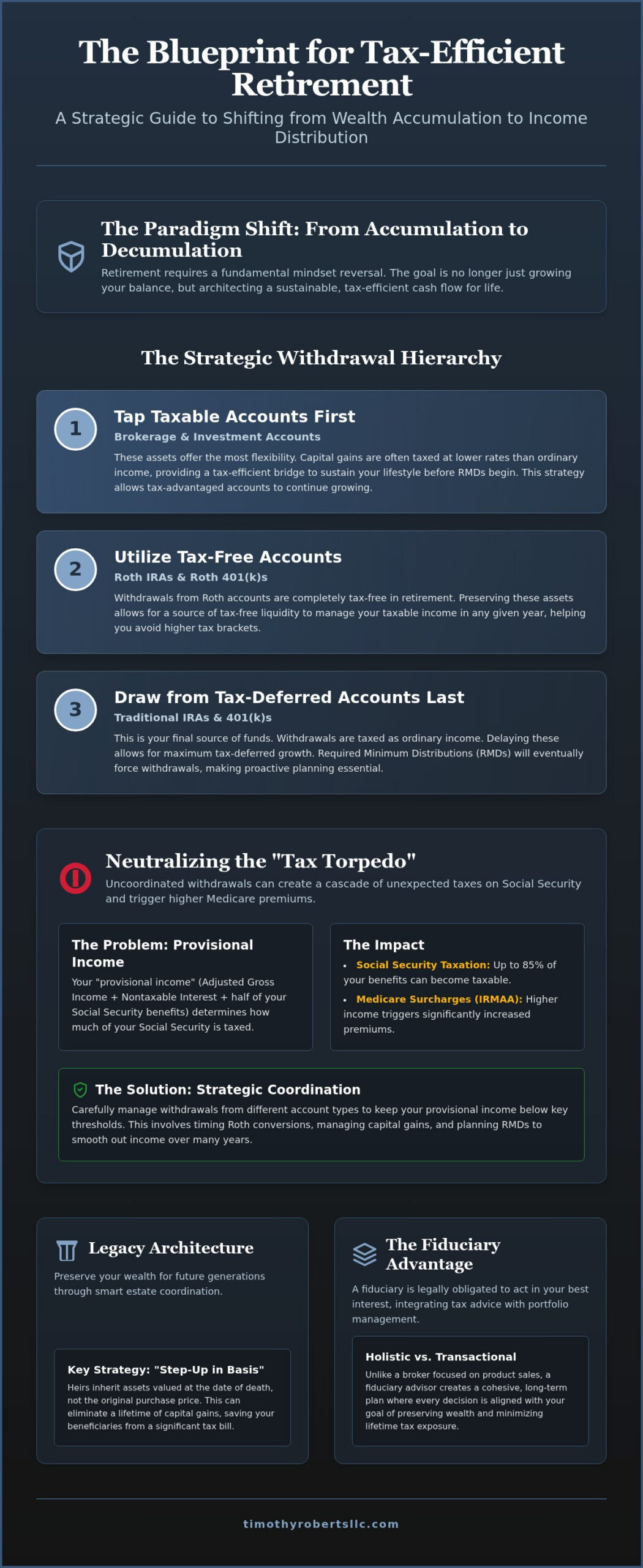
Precision in retirement is not just about the assets you own; it’s about the sequence in which you access them. A disciplined withdrawal hierarchy serves as a blueprint for liquidity, ensuring that each dollar spent carries the lowest possible tax friction. By architecting a logical order of operations, you preserve the compounding power of tax-deferred accounts while managing your current tax bracket. High-level tax planning for retirees ann arbor requires this level of orchestration to prevent unnecessary wealth erosion during the decumulation phase.
Step 1: Utilizing Taxable Brokerage Assets
Brokerage accounts often represent the first line of defense in a tax-efficient strategy. These assets provide unparalleled flexibility because capital gains are frequently taxed at lower rates than ordinary income. During high-consumption years, such as early retirement travel or home renovations, selling appreciated assets allows you to manage your cost basis with surgical precision. This creates a tax-efficient bridge that sustains your lifestyle before you reach the age for Required Minimum Distributions. To further refine this approach, you can use tax-loss harvesting to offset realized gains, effectively neutralizing the impact on your annual return.
Step 2: Managing Tax-Deferred Distributions
Traditional IRAs and 401(k)s require a different tactical approach. As you approach age 73 or 75 under the SECURE Act 2.0, RMDs can inadvertently push you into higher federal tax brackets, potentially reaching 22% or 24% for many affluent households. Strategic bracket topping involves taking distributions up to the ceiling of your current tax tier, preventing a massive tax spike in later years. Integrating retirement income planning ann arbor ensures these withdrawals are synchronized with other income sources. This coordination is essential because these distributions directly influence the taxation of Social Security benefits, where up to 85% of your benefits could become taxable if your combined income exceeds specific thresholds.
Step 3: Preserving Tax-Free Roth Assets
Roth IRAs are the crown jewels of a retirement portfolio. Because these accounts offer tax-free growth and distributions, they should generally be the last assets you touch. They serve as a vital hedge against future tax rate hikes and provide significant advantages for surviving spouses and heirs. By allowing these accounts to compound for as long as possible, you maximize the tax-free legacy you leave behind. If you’re looking for a partner to help refine this sequence, consider how wealth management services can provide the fiduciary oversight necessary for such complex decisions.
Mitigating the Tax Torpedo: Optimizing Social Security and Medicare Intersections
High-net-worth retirees often encounter a hidden structural trap known as the “Tax Torpedo.” This isn’t a simple tax increase; it’s a compounding effect where every additional dollar of investment income or RMD forces a larger percentage of your Social Security benefits into the taxable column. For those engaged in tax planning for retirees ann arbor, understanding this intersection is vital for long-term wealth preservation. It’s a strategic challenge that requires looking beyond the current tax year to anticipate how today’s distributions influence tomorrow’s liabilities.
Social Security Taxation Thresholds
The calculation for Provisional Income is a critical metric in your retirement architecture. When a married couple’s combined income exceeds $44,000, the federal government may tax up to 85% of their Social Security benefits. This creates a high effective marginal tax rate that can disrupt even the most meticulously crafted income distribution plan. Detailed insights into these specific regulations are available in the IRS Tax Guide for Seniors. Strategic interventions, such as delaying the start of benefits to age 70 or performing targeted Roth conversions in lower-income years, can significantly reduce the footprint of taxable income you’re forced to recognize later in life.
Understanding IRMAA Surcharges
Medicare premiums introduce another layer of complexity through the Income-Related Monthly Adjustment Amount (IRMAA). Unlike the progressive nature of standard income tax brackets, IRMAA operates on “cliff” thresholds. Exceeding a limit by even a single dollar can trigger a significant spike in Medicare Part B and Part D premiums. Because these surcharges are based on your tax returns from two years prior, a large, uncoordinated withdrawal today can haunt your cash flow two years later. To mitigate this risk, you can utilize Qualified Charitable Distributions (QCDs). By directing RMDs directly to a qualified charity, you satisfy your distribution requirements without increasing your Adjusted Gross Income, effectively bypassing the IRMAA calculation and preserving your liquidity.
Legacy Architecture: Coordination of Estate Planning and Tax Liability
Effective legacy planning requires a seamless synthesis of estate management and tax preparation. A critical component of this architecture is the “Step-Up in Basis,” which allows highly appreciated assets to be valued at their fair market price at the time of death. This effectively erases years of capital gains liability for your heirs, ensuring the full value of your life’s work is preserved. For those engaged in tax planning for retirees ann arbor, this strategy is foundational. Conversely, the 10-year rule for inherited IRAs introduced by recent legislation requires new strategic thinking. Heirs must now deplete these accounts within a decade, often during their own peak earning years, which can trigger substantial tax burdens. Coordinating these moving parts ensures that your wealth serves your family rather than the treasury.
Multi-Generational Wealth Transfer
Transferring wealth requires more than a simple will; it demands a sophisticated structure of trusts and insurance. Life insurance serves as a potent tool for tax-free wealth transfer, providing the liquidity needed to cover potential federal estate taxes. In 2026, these federal taxes apply to estates exceeding $15 million for individuals and $30 million for married couples. Trusts offer both control and tax efficiency, allowing you to dictate the terms of distribution while shielding assets from unnecessary exposure. By coordinating with comprehensive estate planning advisors, you can ensure your legacy remains intact across multiple generations.
Charitable Giving as a Tax Tool
Philanthropy can be a highly efficient component of your tax strategy. Donor-Advised Funds (DAFs) allow for “bunching” deductions, where you contribute multiple years of charitable gifts into a single tax year to exceed the $32,200 standard deduction for joint filers. This is especially useful when paired with gifting appreciated securities, which eliminates the capital gains tax you’d otherwise owe. For those already taking distributions, Qualified Charitable Distributions (QCDs) satisfy RMD requirements without increasing your adjusted gross income. This approach aligns your personal values with rigorous financial logic. If you’re ready to refine your legacy, explore our Wealth Management solutions for fiduciary oversight.
The Fiduciary Advantage: Elevating Retirement Outcomes Through Professional Oversight
Asset-based investment management creates a symbiotic relationship where the advisor’s success is directly tethered to your own. Unlike commission-based brokers who profit from transactions, a fiduciary is legally and ethically bound to act in your best interest. This alignment transforms the advisor from a salesperson into a visionary strategist. It’s about more than choosing stocks; it’s about carefully crafted financial interventions that respond to the nuances of your life. This professional oversight provides a layer of stability that’s essential for a multi-decade retirement.
Effective tax planning for retirees ann arbor requires a “Roundtable” approach. This methodology synthesizes tax advising, investment management, and estate planning into a singular, cohesive strategy. When these disciplines are siloed, opportunities for tax efficiency are often missed. By integrating tax preparation with wealth management, you ensure that every portfolio rebalance or distribution is evaluated for its immediate and long-term tax impact. This continuous monitoring prevents the “Tax Torpedo” and IRMAA spikes discussed earlier, turning a reactive process into a proactive journey of wealth preservation.
The Intersection of Aesthetics and Functionality
A sophisticated financial plan should be as visually clear as it is technically rigorous. It isn’t enough for a strategy to work; it must also provide the calm confidence necessary to stick with the plan during market volatility. This rhythmic approach to wealth management focuses on intentional progression rather than frantic reaction. Professional guidance ensures that the technical practicalities of execution align with your high-level vision, creating a stable foundation for your future.
Partnering for Organizational Evolution
We treat your personal wealth development as a journey of upward progression rather than a series of disconnected transactions. This perspective bridges your individual creative vision with structured corporate capabilities, providing the rigor of a large consultancy with the personal attention of a specialized firm. Retirement isn’t an end point; it’s an evolution of your legacy. Discover how a fiduciary financial advisor can elevate your retirement architecture and help you master the complexities of tax planning for retirees ann arbor.
Architecting Your Sustainable Financial Legacy
Retirement is not merely the end of a career; it’s the beginning of a sophisticated distribution phase where precision replaces accumulation. Mastering tax planning for retirees ann arbor requires a visionary approach that synthesizes withdrawal hierarchies with the mitigation of Social Security and Medicare surcharges. By coordinating your estate architecture with proactive tax strategies, you ensure that your wealth remains a source of multi-generational security rather than a target for unnecessary erosion. This level of orchestration demands a partner who understands that every financial decision carries a tax implication.
Success in this transition depends on the integration of fiduciary expertise and rigorous business logic. Timothy Roberts & Associates, LLC offers the stability of fiduciary advisors with 25+ years of experience, providing comprehensive wealth and tax integration that moves beyond generic solutions. We invite you to elevate your retirement strategy with a professional consultation and discover a personalized financial roadmap designed for your unique journey. Your legacy deserves the clarity and protection of a meticulously crafted plan. We look forward to helping you move forward with calm confidence and strategic purpose.
Frequently Asked Questions
What is the most tax-efficient way to withdraw money in retirement?
The most tax-efficient approach involves a sequential withdrawal strategy that prioritizes taxable brokerage assets before accessing tax-deferred or tax-free accounts. This hierarchy allows your Roth IRA to compound tax-free for the longest duration while managing capital gains at lower rates. Implementing such a framework is a cornerstone of tax planning for retirees ann arbor, ensuring that your liquidity needs don’t inadvertently trigger a spike into higher federal tax brackets.
How does the SECURE Act 2.0 change my tax planning for 2026?
The SECURE Act 2.0 significantly alters the timeline for Required Minimum Distributions, pushing the start age to 73 or 75 depending on your birth year. For 2026, retirees born between 1951 and 1959 must begin distributions at age 73. This extension provides a wider window for strategic Roth conversions and other tax-efficient maneuvers, allowing for a more deliberate transition from wealth accumulation to distribution while managing future liabilities.
Can I avoid paying taxes on my Social Security benefits?
You can minimize or eliminate taxes on Social Security by managing your Provisional Income below federal thresholds. For married couples, taxation begins when combined income exceeds $32,000, with up to 85% becoming taxable above $44,000. Utilizing tax-free Roth distributions or Qualified Charitable Distributions helps keep your adjusted gross income low. This strategic oversight ensures your benefits remain a reliable, inflation-adjusted source of income rather than a significant tax liability.
What are IRMAA surcharges and how can I avoid them?
IRMAA surcharges are additional premiums for Medicare Part B and Part D applied to retirees whose income exceeds specific limits. These surcharges are determined by your tax return from two years prior, meaning a large withdrawal today can impact your healthcare costs later. To avoid these “cliff” thresholds, you can employ tactical interventions like Qualified Charitable Distributions or managing the timing of capital gains to stay within lower, more favorable income tiers.
Are Roth conversions worth the tax hit in the year of the conversion?
Roth conversions are frequently beneficial when they are part of a long-term strategy to reduce future tax-deferred balances and RMD requirements. While you pay taxes today, you lock in current rates and secure tax-free growth for yourself and your heirs. This is particularly relevant given the 2026 federal tax brackets. A sophisticated analysis compares your current marginal rate against your projected future rates to determine the optimal conversion amount for your portfolio.
How do Required Minimum Distributions (RMDs) affect my tax bracket?
Required Minimum Distributions increase your ordinary taxable income, which can inadvertently push you into higher tax brackets and trigger the “Tax Torpedo” affecting your Social Security. Because RMDs are mandatory, they often force you to recognize income you don’t actually need for daily expenses. Proactive tax planning for retirees ann arbor focuses on reducing the size of these future distributions through early Roth conversions or strategic gifting before the mandatory RMD age begins.
What is a Qualified Charitable Distribution (QCD) and how does it help?
A Qualified Charitable Distribution allows you to transfer up to $100,000 annually directly from your IRA to a qualified charity. This maneuver satisfies your RMD requirement for the year without adding a single dollar to your Adjusted Gross Income. It’s a powerful tool for philanthropic retirees who want to support their favorite causes while simultaneously lowering their tax exposure and potentially avoiding Medicare premium surcharges that are tied to higher income levels.
Why do I need a fiduciary advisor for tax planning instead of just a CPA?
A fiduciary advisor provides a visionary, forward-looking strategy that integrates investment management with tax efficiency, whereas a CPA often focuses on retrospective compliance. Fiduciaries are legally obligated to prioritize your best interests, looking at how every portfolio move affects your long-term wealth preservation. This “Roundtable” approach ensures that your tax preparation is synchronized with your broader financial roadmap, providing the professional oversight necessary for complex retirement decumulation and multi-generational legacy planning.
