

Sep
Michigan Estate Planning Financial Strategies for 2026
Your legacy is not a static legal document; it’s a strategic financial evolution that demands precision and foresight. As the 2026 federal tax law changes approach, the gap between having a simple will and possessing a truly optimized wealth transfer plan is widening. You’ve likely felt the growing uncertainty regarding how these sunsetting exemptions will impact your family’s future security. It’s frustrating to realize that without a cohesive approach, your most valued assets could be vulnerable to excessive taxation or the public complexities of probate.
Implementing proactive michigan estate planning financial strategies ensures that your legal intent and your investment portfolio move in perfect harmony. We believe that true wealth management isn’t about off-the-shelf solutions but about crafting a curated path for upward progression. This article provides a clear roadmap for integrating tax-efficient management with sophisticated legacy goals. You’ll learn how to minimize the tax burden for your beneficiaries while gaining the calm confidence that comes from a synchronized financial plan. We’ll examine the vital intersection of fiduciary oversight and strategic wealth transfer to protect what you’ve built and empower the next generation.
Key Takeaways
- Learn why a static will is insufficient for complex investment portfolios and how to view your estate as a dynamic financial ecosystem.
- Discover proactive michigan estate planning financial strategies designed to mitigate the impact of the 2026 federal tax law changes on your family’s future.
- Understand the tactical selection of trusts and insurance analysis to provide essential liquidity while protecting your assets from excessive taxation.
- Identify how to bridge the retirement income gap to ensure your personal lifestyle needs never compromise your multi-generational legacy goals.
- Explore the value of partnering with a fiduciary led team to synthesize tax preparation and investment management into a single, cohesive vision.
Beyond the Will: Why Estate Planning Requires a Holistic Financial Strategy
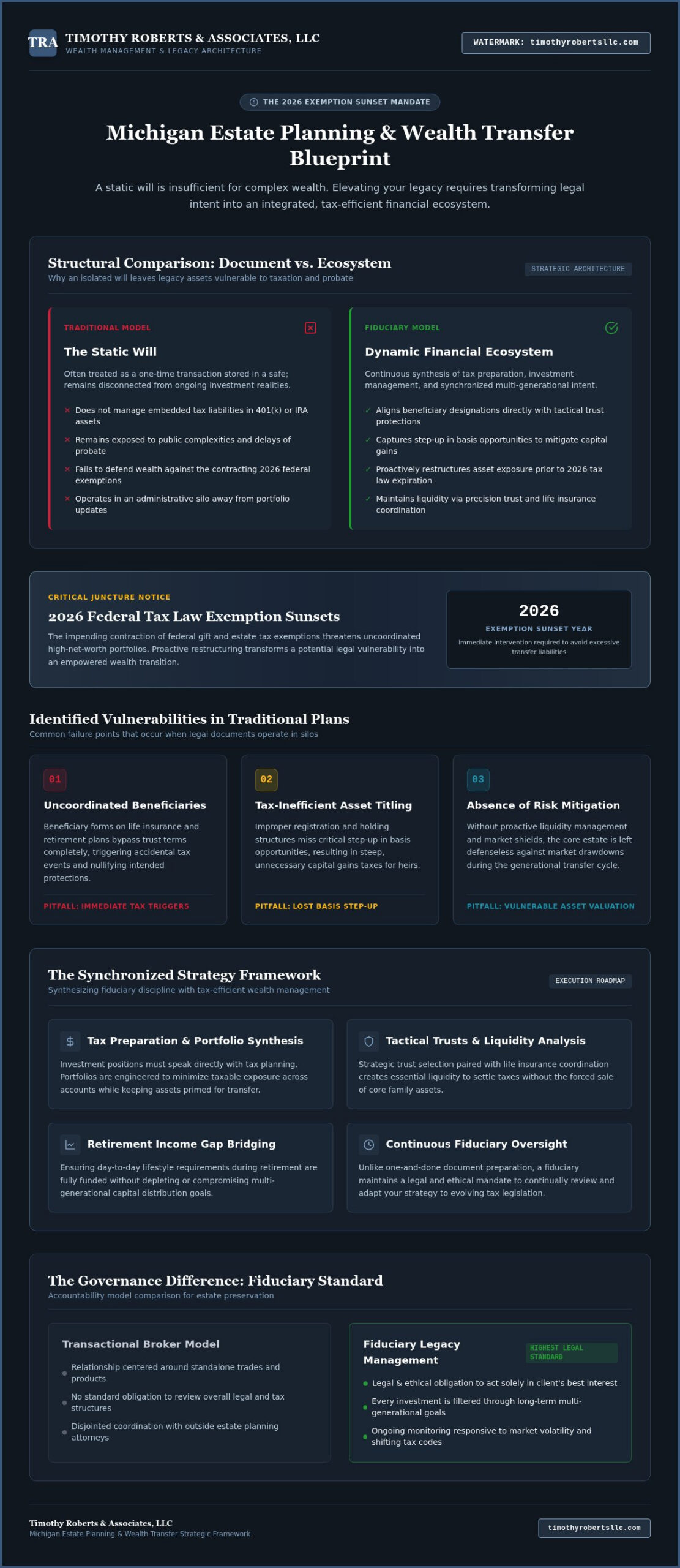
Estate planning is often misunderstood as a one-time transaction, a mere collection of legal documents stored in a safe. In reality, a truly effective comprehensive estate planning framework functions as a dynamic financial ecosystem. For those seeking sophisticated michigan estate planning financial strategies, this requires the continuous synthesis of tax preparation, investment management, and legacy vision. It’s about ensuring your wealth continues its upward progression across generations rather than stagnating in a folder. This holistic approach transforms estate planning from a static legal requirement into a proactive engine for growth.
While a will is a foundational element, it’s often a silent partner to your broader financial portfolio. It doesn’t manage the tax liabilities inherent in your 401k or IRA, nor does it shield your beneficiaries from the complexities of the 2026 tax sunset. Relying on a will alone frequently leaves a significant gap between your legal intent and your financial reality. A strategic plan must account for how your assets are positioned today to ensure they remain viable and impactful tomorrow.
To better understand how these financial shifts impact your family’s future, watch this helpful overview of upcoming trends:
The Fiduciary Difference in Legacy Management
Working with a fiduciary advisor introduces a level of accountability that transactional brokers simply don’t provide. A fiduciary has a legal and ethical obligation to act solely in your best interest, transforming the relationship from a series of trades into a strategic partnership. This oversight is vital when executing michigan estate planning financial strategies, as it ensures that every investment decision is filtered through the lens of your long-term legacy goals. Unlike a firm that may only draft documents, a fiduciary-led firm provides the continuous monitoring necessary to adapt to changing market conditions and evolving tax codes.
Identifying the Gaps in Traditional Estate Plans
Traditional plans often fail because they operate in silos. Your legal documents might say one thing, while your beneficiary designations on a life insurance policy or retirement account say another. These uncoordinated details can lead to assets being lost to probate or excessive taxation. Common pitfalls include:
- Uncoordinated beneficiary designations that bypass trust protections and create immediate tax triggers.
- Tax-inefficient asset titling that fails to utilize step-up in basis opportunities, leading to unnecessary capital gains.
- A lack of risk management, which leaves the core estate vulnerable to market volatility during the transfer process.
Your investment portfolio must speak the same language as your trust. By aligning these elements, you create a cohesive structure that protects the core of your estate while empowering your heirs with a clear, financially viable roadmap.
Tax-Efficient Wealth Transfer: Minimizing Liabilities for Future Generations
The impending sunset of current federal tax provisions in 2026 represents a critical juncture for high-net-worth families. Without proactive intervention, the significant contraction of gift and estate tax exemptions could expose substantial portions of your portfolio to unnecessary taxation. Refining your michigan estate planning financial strategies today is a prerequisite for protecting tomorrow’s wealth. This transition isn’t merely a legal hurdle; it’s a strategic opportunity to restructure your assets for maximum tax efficiency and multi-generational empowerment.
Effective wealth transfer requires a sophisticated synthesis of investment portfolio management and tax advising. It’s about more than just avoiding inheritance taxes; it’s about minimizing capital gains through curated asset titling and strategic rebalancing. Even the structure of your investment management fees plays a role, as asset-based fees can often be integrated into a broader tax-efficient framework. By aligning every financial lever, you ensure that your legacy remains a source of strength rather than a tax burden for your heirs.
Proactive Tax Planning vs. Seasonal Compliance
High-level wealth management demands constant vigilance rather than an annual check-in. Relying on seasonal tax filing often results in missed opportunities for rebalancing and loss mitigation. A strategic partner monitors your portfolio year-round, integrating tax preparation with investment decisions to capture growth while shielding it from liabilities. Tax-loss harvesting is the strategic practice of selling depreciated assets to offset taxable gains, serving as a vital legacy preservation tool. This continuous oversight ensures your financial ecosystem remains resilient against market shifts and regulatory changes.
Strategies for Gift and Estate Tax Mitigation
Utilizing annual gifting limits is one of the most effective ways to reduce the size of a taxable estate over time without triggering immediate tax consequences. These transfers allow you to witness the impact of your legacy during your lifetime while moving future appreciation out of your taxable bucket. For those with philanthropic goals, charitable giving strategies can serve a dual purpose, providing meaningful support to chosen causes while offering significant deductions. It’s essential that these moves align with the current federal estate tax guidelines to ensure no surplus value is lost to the government.
For those seeking a more localized perspective on these shifts, you can explore tax advising in Ann Arbor for localized insights that bridge the gap between state-level nuances and federal mandates. Ultimately, partnering with a fiduciary wealth management firm ensures these tactical moves support your overarching vision, turning complex tax codes into a clear path for upward progression.
Strategic Vehicles for Asset Protection and Distribution
Selecting the right financial vehicle is a critical step in transforming your legacy vision into a functional reality. While many view trusts or retirement accounts as isolated buckets, they actually function as a coordinated fleet designed to move wealth safely across time. Effective michigan estate planning financial strategies require a deep understanding of how these vehicles interact with one another to provide both protection and liquidity. It’s not just about where the money sits; it’s about how it’s structured to withstand the tax and legal pressures of the coming years.
Coordinating your 401k and Roth IRA distributions with your overall estate flow is essential to avoid creating a tax burden for your heirs. While retirement accounts are excellent for wealth accumulation, they often require specific distribution timing to remain tax-efficient after they’re inherited. Similarly, education funding strategies like 529 plans serve a dual purpose. They provide for the next generation’s intellectual growth while simultaneously removing assets from your taxable estate. For those seeking clarity on these mechanisms, Michigan estate and financial planning resources offer a foundational understanding of how state-level rules influence these choices.
Trusts as Financial Interventions
Trusts provide structured, corporate-style capabilities to personal family wealth, moving beyond the limitations of a simple will. A revocable trust offers flexibility and probate avoidance, while an irrevocable trust can provide more robust protection from creditors and potential estate tax liabilities. These aren’t just legal papers; they’re strategic interventions that ensure your assets are managed according to your precise standards. Our approach to estate planning in Farmington Hills emphasizes this level of sophistication, ensuring your legacy is elevated for the complexities of 2026 and beyond.
Alternative Distribution Strategies
Not every asset needs to pass through a trust to be effective. Direct beneficiary designations on insurance policies and retirement accounts can offer a streamlined alternative to probate, provided they’re meticulously coordinated with your broader plan. Life insurance analysis plays a pivotal role here, often serving as a strategic tool for wealth equalization among heirs or providing the necessary liquidity to cover estate taxes without forcing the sale of illiquid assets. This intersection of risk management and long-term stability is what keeps an estate intact during volatile transitions. By aligning these alternative paths with your primary michigan estate planning financial strategies, you create a resilient framework that honors your personal creative vision through structured corporate capabilities.
Coordinating Retirement Income with Multi-Generational Wealth Goals
The transition from accumulating wealth to distributing it is a profound shift that requires both emotional and financial agility. Many families encounter a challenge known as the ‘Retirement Income Gap,’ where the costs of a desired lifestyle begin to compete with the intended value of a future legacy. Balancing these competing needs isn’t a simple calculation; it’s a strategic alignment of michigan estate planning financial strategies to ensure your standard of living doesn’t compromise the empowerment of the next generation. It’s about creating a sustainable cash flow that supports you today while preserving the core assets for tomorrow.
Preserving your principal for heirs hinges on the precision of your withdrawal sequence. By carefully choosing which accounts to draw from first, you can mitigate current tax liabilities and allow your remaining investments to continue their upward progression. This isn’t just about spending; it’s about curated preservation. It allows you to move through this phase of life with the quiet confidence that your daily choices are reinforcing, rather than eroding, your long-term legacy vision.
The Sequence of Returns Risk in Estate Planning
Market volatility during the initial years of retirement can have a lasting impact on the eventual size of your estate. If you’re forced to liquidate investments during a market downturn to fund your lifestyle, you permanently reduce the capital available for future growth and transfer. Building a strategic buffer through diversified investment portfolio management is essential to protect against this sequence of returns risk. For a deeper analysis of how to structure these cash flows for maximum stability, explore our insights on retirement income planning strategies. This oversight ensures your income remains resilient throughout various market cycles.
Legacy as a Journey of Upward Progression
We view retirement as a phase of sophisticated wealth evolution, not an end point. It’s an opportunity to treat your development as a journey, focusing on the synthesis of personal vision and structured corporate capabilities. Utilizing fixed-fee financial planning provides a transparent roadmap that involves the entire family in the wealth transfer narrative. This fosters a sense of partnership between the advisor and the family unit, ensuring every decision is intentional and results-driven. By framing wealth this way, you transform a transactional hand-off into a meaningful legacy of stability and growth.
If you’re ready to align your current income needs with your multi-generational goals, our team is here to guide the way. Reach out to Timothy Roberts & Associates, LLC to begin crafting your strategic roadmap for 2026 and beyond.
Elevating Your Legacy with Timothy Roberts & Associates, LLC
A legacy is far more than a final transaction; it’s the culmination of a lifetime of strategic decisions and intentional growth. Timothy Roberts & Associates, LLC has spent over 25 years serving as a high-end partner for families seeking to navigate the complexities of wealth transfer with grace and precision. We understand that your financial needs aren’t off-the-shelf problems, which is why we don’t provide off-the-shelf solutions. By integrating sophisticated michigan estate planning financial strategies with a human-led, results-driven identity, we ensure that your family’s upward progression remains steady even in shifting regulatory environments. This commitment to fiduciary excellence positions us as a specialized firm where personal attention and high-level expertise go hand in hand.
The personality of our firm is that of a visionary strategist who functions as both an expert craftsman and a reliable business advisor. We move away from aggressive sales tactics, opting instead for a narrative of partnership and shared success. This deliberate pacing reinforces the idea that we take the time to understand and solve complex problems rather than rushing to generic conclusions. By focusing on the intersection of aesthetics and functionality, we ensure your legacy plan isn’t just legally sound but also financially vibrant and ready for the challenges of a new tax era. We treat your development as a journey, bridging individual creative vision with structured corporate capabilities to create a human-led identity that distinguishes us from larger, more anonymous entities.
A Partnership for Organizational and Personal Evolution
We act as visionary strategists for your family’s financial future, bridging the gap between your individual creative vision and structured corporate capabilities. At Timothy Roberts & Associates, LLC, we offer a synthesis of tax advising, investment management, and estate coordination under a single fiduciary roof. This integrated model removes the friction of uncoordinated advice, allowing for a polished and intentional roadmap that respects your long-term goals. Our firm prioritizes depth over superficiality, ensuring that every layer of your plan is meticulously analyzed for both its aesthetic intent and its functional success. We believe that true wealth management requires a consistent focus on the concept of upward progression, treating your financial development as a lifelong journey rather than a simple transaction.
Securing Your 2026 Financial Roadmap
As the 2026 tax sunset approaches, the window for meaningful intervention is narrowing. Moving from a high-level vision to tactical execution requires a deliberate pacing that respects the complexity of your assets and the nuances of your family’s needs. We guide you through a comprehensive portfolio and estate coordination review to identify vulnerabilities before they become liabilities. This process allows us to translate big ideas into supported, detailed explanations that provide clarity and professional stability. Now is the time to transition from uncertainty to a narrative of shared success. Schedule your strategic legacy consultation with Timothy Roberts & Associates, LLC today to secure your family’s roadmap for the years ahead.
The Path Toward Intentional Wealth Evolution
The 2026 tax landscape represents more than a legislative deadline; it’s a call to move beyond static documents toward a living financial architecture. We’ve examined how the synthesis of tax advising and investment management creates a resilient framework for your family’s future. By addressing the retirement income gap and utilizing sophisticated trusts, you ensure your wealth continues its upward progression. Implementing refined michigan estate planning financial strategies is the definitive step in transforming your creative legacy vision into a functional, protected reality.
As fiduciary advisors with over 25 years of experience, Timothy Roberts & Associates, LLC provides the specialized oversight needed to navigate these upcoming shifts. We bring a national standard of care to our Michigan-based expertise, ensuring your tax and investment goals are perfectly synchronized. This partnership is built on depth, intellectual curiosity, and a shared commitment to your family’s success. The journey toward a secure legacy is a steady, logical evolution that starts with a single, intentional decision to act.
Request a Strategic Consultation for Your Legacy Plan
Frequently Asked Questions
What is the difference between a will and a trust in Michigan?
A will is a legal document that outlines asset distribution after death and must go through probate. A trust is a financial vehicle that can hold assets during your lifetime and transfer them directly to beneficiaries without probate court. While we don’t draft these legal documents, we help you structure your financial portfolio to fund these vehicles effectively. This distinction is vital for maintaining privacy and reducing administrative delays during wealth transfer.
How do I minimize inheritance taxes for my heirs in 2026?
Minimizing liabilities requires proactive michigan estate planning financial strategies like annual gifting and strategic asset titling before the 2026 tax sunset. You can move future appreciation out of your taxable estate by utilizing current higher exemption limits. We focus on integrating tax planning with investment management to capture these opportunities. This ensures your heirs receive a larger portion of the wealth you’ve built rather than losing it to excessive federal taxation.
Can a fiduciary financial advisor help with estate planning?
Yes, a fiduciary advisor acts as a strategic partner to ensure your financial assets align with your legacy goals. While we don’t provide legal drafting, we offer the essential financial coordination, tax advising, and investment oversight required to make an estate plan functional. Our team manages the practicalities of wealth transfer, ensuring that beneficiary designations and account titles support your broader vision. This fiduciary standard guarantees every recommendation is made solely in your interest.
What happens to my investment portfolio if I don’t have a clear estate strategy?
Without a clear strategy, your investment portfolio may be subject to probate, leading to public exposure and significant administrative costs. Assets might be distributed according to state law rather than your personal wishes, often resulting in unintended tax triggers for your beneficiaries. Lack of coordination can also lead to a gap where lifestyle spending unintentionally depletes the legacy you intended to leave. Proper financial planning prevents these outcomes by creating a structured roadmap for distribution.
How does retirement income planning affect my eventual legacy?
Retirement income planning directly impacts the surplus capital available for your heirs. If you don’t have a tax-efficient withdrawal strategy, you may overpay on income taxes, which reduces the principal of your estate. We balance your current lifestyle needs with your long-term legacy goals by selecting the most efficient accounts for distributions. This careful orchestration ensures you enjoy your retirement without compromising the upward progression of your family’s multi-generational wealth and future security.
Are asset-based management fees better for estate planning than commission-based models?
Asset-based management fees align the advisor’s interests with yours, as the fee is tied to the value of the portfolio being preserved. This model supports the continuous monitoring and rebalancing necessary for sophisticated michigan estate planning financial strategies. Unlike commission-based models that prioritize transactions, asset-based fees encourage long-term growth and stability. This structure is particularly beneficial for legacy planning, where the focus is on sustainable wealth evolution rather than short-term trades or sales.
How often should I review my Michigan estate planning financial strategies?
You should review your strategies at least every two to three years or whenever a significant life event occurs. The upcoming 2026 tax law changes make a current review especially critical for high-net-worth families. Regular assessments ensure your investment portfolio management and tax planning stay synchronized with evolving federal regulations. This proactive approach allows you to adjust your tactical execution before external shifts negatively impact your family’s financial security or legacy goals.
What is the role of tax advising in a comprehensive wealth management plan?
Tax advising is the engine that drives financial efficiency within a legacy plan. It involves year-round monitoring to harvest losses, manage capital gains, and optimize the timing of distributions. By integrating tax preparation with investment advisory, we ensure every financial move is filtered through a lens of liability mitigation. This synthesis is what distinguishes a high-end financial strategy from a generic plan, providing the depth needed to protect your assets across multiple generations.
