

Sep
How Do I Find a Trusted Financial Consultant with Fiduciary Standards? A Strategic Guide
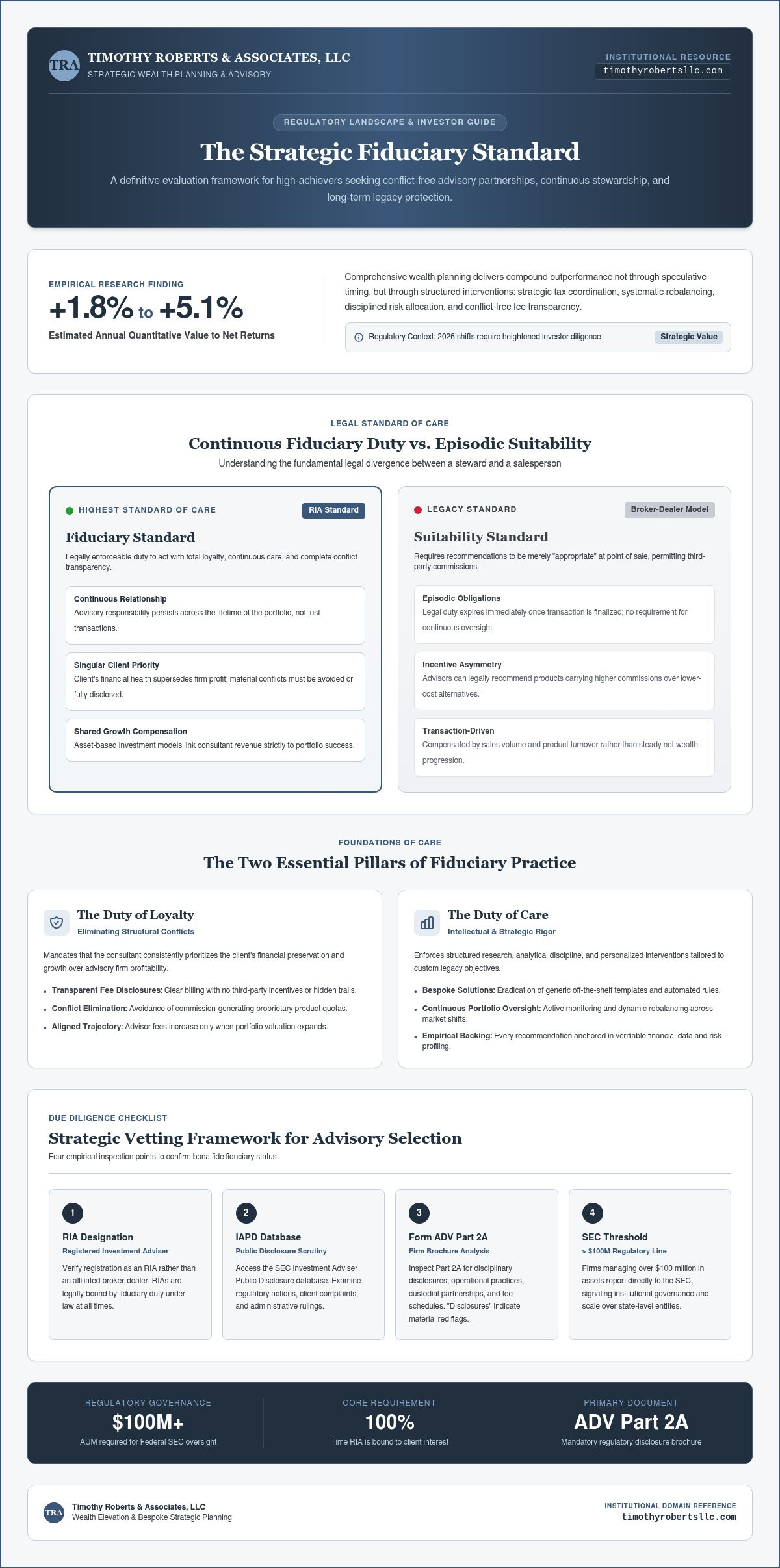
Research indicates that professional wealth planning can contribute an estimated 1.8% to 5.1% in annual quantitative value to your net returns through strategic interventions. Yet, recent regulatory shifts in 2026 have made the distinction between a product salesperson and a true steward more opaque than ever. You are right to ask: how do i find a trusted financial consultant with fiduciary standards? It’s the most critical question for any high-achiever looking to move beyond simple transactions toward a narrative of shared success and upward progression.
You likely seek a partnership built on calm confidence and business-minded rigor. We acknowledge the anxiety that stems from opaque fee structures or the risk of outliving your retirement assets. This guide provides a clear roadmap for vetting consultants, ensuring you can identify a partner who offers bespoke strategic oversight rather than off-the-shelf solutions. We will detail the specific interview checkpoints and regulatory disclosures needed to establish a conflict-free advisory relationship that secures your financial legacy for the long term.
Key Takeaways
- Master the distinction between the continuous fiduciary duty and the episodic suitability standard to ensure your interests remain the singular priority.
- Navigate the sophisticated vetting process by scrutinizing Form ADV disclosures to answer the essential question: how do i find a trusted financial consultant with fiduciary standards?
- Evaluate the transparency of various fee structures to eliminate hidden conflicts and align your consultant’s incentives with your personal growth.
- Identify the specific professional designations and tax-integrated capabilities that characterize a visionary strategist capable of managing complex wealth evolutions.
Understanding the Fiduciary Standard in Modern Wealth Management
The fiduciary standard isn’t a mere marketing slogan. It’s a legal cornerstone that ensures your financial interests remain the singular priority in every recommendation. When you ask, how do i find a trusted financial consultant with fiduciary standards? you’re seeking a partner who operates under a framework of absolute transparency. This relationship is defined by a legally enforceable fiduciary duty, which mandates that the advisor must act with total loyalty and professional skill. The fiduciary duty represents the highest legal standard of care in the financial industry.
To better understand how this standard impacts your search for a partner, watch this helpful video:
Unlike the legacy suitability standard, which only requires a recommendation to be appropriate at the moment of sale, the fiduciary standard is holistic. It covers the entirety of the relationship, moving away from episodic transactions toward a journey of upward progression. It’s the difference between a salesperson and a visionary strategist. This standard rests on two primary pillars that define the quality of the partnership: loyalty and care.
The Duty of Loyalty: Eliminating Conflicts of Interest
The Duty of Loyalty requires a consultant to prioritize your financial health above their firm’s profit. This means they must disclose or avoid all material conflicts of interest. Asking how do i find a trusted financial consultant with fiduciary standards? is the first step in moving away from aggressive sales tactics toward a sophisticated partnership. For the investor, the psychological benefit is profound. You don’t have to wonder if a product was suggested because of a hidden commission or a third-party incentive. Transparency in Asset-Based Investment Management fees is a hallmark of this loyalty. It ensures the consultant’s compensation grows only when your portfolio grows, creating a genuine narrative of shared success.
The Duty of Care: Intellectual Rigor in Strategy
The Duty of Care focuses on the intellectual rigor of wealth management. It demands that advisors base every decision on meticulous research and structured data. Decisions aren’t made on a whim or a generic template. Instead, they’re carefully crafted interventions tailored to your specific risk tolerance and long-term legacy goals. This duty also mandates continuous oversight. A fiduciary doesn’t just set a plan and walk away; they provide the strategic oversight necessary to monitor and rebalance portfolios as market conditions evolve. This ensures your financial evolution remains steady, intentional, and grounded in professional stability.
A Strategic Framework for Identifying Trusted Consultants
Identifying a partner for your wealth evolution requires more than a casual conversation. It demands a structured vetting process designed to surface transparency and intellectual alignment. When you ask, how do i find a trusted financial consultant with fiduciary standards? you are initiating a search for a professional who operates within a rigorous regulatory framework. This starts with verifying their status as a Registered Investment Adviser (RIA). Unlike broker-dealers, RIAs are legally bound to the fiduciary standard at all times, ensuring their advice remains untainted by product sales or hidden quotas.
Verification via Regulatory Databases
A visionary strategist maintains a transparent record. You can verify this by accessing the official Investment Adviser Public Disclosure (IAPD) database. This resource allows you to scrutinize a firm’s Form ADV Part 2A, which acts as a detailed brochure of their business practices. Look specifically for “disclosures” or disciplinary actions. These entries serve as significant red flags that require immediate explanation. It’s also vital to distinguish between individual professional licenses and firm-level registrations. A firm registered with the SEC generally manages over $100 million in assets, signaling a level of institutional stability and regulatory oversight that smaller, state-registered entities may not yet possess.
The most effective fiduciary relationships go beyond simple portfolio management. They integrate tax and estate planning directly into the advisory model. This synthesis ensures that every investment decision considers its long-term tax impact, preserving your legacy from unnecessary erosion. During your search, conduct a “Strategic Intervention” interview. Move away from generic questions. Instead, ask how they handle complex, illiquid assets or multi-generational wealth transfers. This assesses their intellectual fit and their ability to act as a reliable business advisor rather than a mere technician.
The Role of Independent Custodians
Asset security is the foundation of any high-end partnership. A trusted consultant should never have direct physical custody of your funds. Instead, they should utilize independent third-party custodians such as Charles Schwab or Fidelity. This structure ensures you receive independent statements directly from the custodian, providing a critical layer of fraud prevention. It separates the advice you receive from the actual holding of the assets, mirroring the checks and balances found in professional consultancy. For those seeking this level of Wealth Management, ensuring these layers of protection is non-negotiable.
Confirming these operational practicalities allows you to transition from a place of anxiety to one of calm confidence. It ensures that your chosen partner has the infrastructure necessary to support your long-term financial stability through strategic oversight and absolute transparency.
Deciphering Fee Models: Fee-Only vs. Fee-Based Excellence
Choosing a financial partner requires a clear understanding of the compensation structures that drive their advice. When you consider how do i find a trusted financial consultant with fiduciary standards? the answer often lies in the distinction between fee-only and fee-based models. Fee-only consultants are compensated exclusively by their clients. This eliminates the potential opacity found in fee-based models, where advisors may collect both client fees and third-party commissions. This transparency is a core requirement of the CFP Board’s Code of Ethics and Standards of Conduct, which mandates that professionals disclose all potential conflicts arising from their compensation.
Fee alignment creates a shared incentive for portfolio appreciation. When a consultant’s success is tied directly to your own, the relationship moves from a series of transactions to a narrative of shared success. This structural harmony ensures that every strategic choice is made with the goal of long-term wealth elevation rather than short-term product sales. It creates a rhythmic experience where your growth is the primary metric of the firm’s performance.
The Transparency of Asset-Based Management
Asset-Based Investment Management is a primary model for those seeking continuous strategic oversight. By charging a percentage of the assets under management, the consultant’s interests are perfectly mirrored in your portfolio’s growth. This model includes more than just stock selection. It encompasses continuous monitoring, risk management, and fiduciary oversight. It’s a comprehensive intervention that supports long-term stability. You don’t have to worry about per-transaction costs that might discourage necessary adjustments. Instead, you gain a partner who is incentivized to protect and grow your assets with professional stability.
Project-Based Precision with Fixed Fees
For specific, high-level strategic interventions, Fixed-Fee Financial Planning offers a different kind of precision. This model is ideal for comprehensive financial roadmaps that address complex estate coordination or education funding plans. Fixed fees provide predictable pricing for defined projects, allowing you to engage in deep intellectual rigor without the variability of asset-based costs for that specific task. It’s a business-minded approach to solving complex problems. Whether you’re structuring a tax planning strategy or performing a risk management analysis, a flat-rate charge ensures the focus remains entirely on the quality of the advice. This clarity allows you to move forward with calm confidence, knowing the cost of your strategic evolution is established from the outset.
Critical Credentials and the Strategic Interview Process
Professional designations serve as the objective evidence of a consultant’s commitment to intellectual rigor. While the industry is crowded with individuals claiming the title of “advisor,” the gold standards remain the Certified Financial Planner (CFP®) and Certified Public Accountant (CPA) designations. These aren’t just letters after a name. They represent a rigorous dedication to ethical standards and technical mastery. A CFP® professional is bound by the CFP Board’s mandate to act as a fiduciary at all times. Meanwhile, a CPA provides the structured corporate capabilities necessary to navigate complex tax compliance. you’re essentially seeking this specific blend of ethical obligation and technical precision.
The Synergy of Tax and Investment Expertise
Wealth management cannot exist in a vacuum. It requires an integrated approach where portfolio growth is balanced against tax liabilities. For high-net-worth clients, the primary goal is often wealth preservation, which is why tax advising is an inseparable component of fiduciary retirement planning. Year-round tax planning strategies minimize the erosion of your assets, ensuring your financial evolution remains on a steady upward trajectory. This synthesis of personal vision and professional stability is what distinguishes a specialized firm from a generic entity.
The final stage of your discovery process is the strategic interview. This is your opportunity to assess a firm’s “Communication Rhythm.” You aren’t just looking for someone to manage money; you’re looking for a visionary strategist. How does the firm address market volatility? Is their communication steady and logical, or does it feel frantic and cluttered? You deserve a partner who takes the time to understand complex problems rather than rushing to generic conclusions. Identifying this cultural and intellectual fit is how you answer the question: how do i find a trusted financial consultant with fiduciary standards?
The Five Essential Interview Questions
To reveal a consultant’s true philosophy, use these essential questions during your consultation:
- “Are you a fiduciary in all aspects of our relationship?” This ensures the standard applies to both planning and investment implementation.
- “How do you manage the intersection of my tax liabilities and investment growth?” This probes their ability to deliver carefully crafted interventions rather than off-the-shelf solutions.
- “Can you describe a time you recommended a strategy that resulted in lower fees for you but better outcomes for the client?” This tests their adherence to the Duty of Loyalty.
- “What is your philosophy on risk and market volatility?” Look for a narrative of partnership and calm confidence.
- “What professional designations do you hold that ethically bind you to a fiduciary duty?” This confirms their qualifications against the standards of the CFP Board or similar bodies.
Securing your financial legacy requires more than a simple transaction. It requires a partnership of shared success. If you value personal attention and high-level expertise, reach out to Timothy Roberts & Associates, LLC to explore a fiduciary relationship.
Partnering with Timothy Roberts & Associates, LLC for Wealth Elevation
Timothy Roberts & Associates, LLC serves as a specialized sanctuary for those who value depth and craft over generic solutions. You are seeking a high-end partner for your personal and organizational evolution. With over 25 years of experience in fiduciary-first wealth management, our firm emphasizes a synthesis of comprehensive retirement income planning with deep tax rigor. This integrated approach ensures that your financial evolution remains steady, intentional, and grounded in professional stability.
A Visionary Approach to Retirement and Legacy
We view wealth management as a journey of upward progression rather than a simple transaction. Our strategies are not off-the-shelf solutions but carefully crafted interventions tailored to your unique goals and risk tolerance. Through proactive investment portfolio management, we provide the strategic oversight necessary to bridge individual creative vision with structured corporate capabilities. This creates a human-led, results-driven identity that distinguishes us from larger, more anonymous entities. It’s a narrative of partnership where your success is the primary metric of our performance, supported by a lexicon of high-level thinking and expert craftsmanship.
Securing Your Future: The Next Strategic Step
Advancing your financial legacy requires a partner who understands the intersection of aesthetics and functionality in wealth architecture. We manage complex estate and legacy planning with fiduciary precision, protecting your assets from unnecessary tax drag and market volatility. This isn’t a frantic or cluttered experience. It’s a deliberate flow that mirrors a professional consultancy, guiding you from a high-level vision down to the practicalities of execution. We invite you to experience a sophisticated consultation where your objectives are met with business-minded rigor and calm confidence.
Finding the right partner finally answers the central question: how do i find a trusted financial consultant with fiduciary standards? It’s about more than assets; it’s about the upward progression of your life’s work. Reach out to Timothy Roberts & Associates, LLC today to begin a partnership defined by aspirational growth and professional stability. Let’s craft a future that reflects your values and secures your legacy for generations to come.
Cultivating Your Legacy through Strategic Partnership
Securing a prosperous future requires moving beyond transactional advice and into a partnership defined by shared success. You’ve discovered that the answer to how do i find a trusted financial consultant with fiduciary standards? lies in a combination of regulatory verification and intellectual alignment. By scrutinizing fee structures and prioritizing integrated tax expertise, you ensure your wealth strategy isn’t an off-the-shelf solution but a carefully crafted intervention. This strategic oversight provides the foundation for long-term stability and aspirational growth.
With over 25 years of fiduciary excellence, Timothy Roberts & Associates, LLC provides the business-minded rigor your wealth deserves. We specialize in sophisticated, personalized retirement strategies and integrated tax and wealth management services that prioritize your unique vision. It’s time to transition from anxiety to calm confidence with a visionary strategist at your side. Request a Strategic Consultation with Timothy Roberts & Associates, LLC to begin your journey of upward progression. Your financial legacy is worth the precision of a dedicated fiduciary partner.
Frequently Asked Questions
What is the difference between a fiduciary and a financial advisor?
The term financial advisor is a broad marketing title that can apply to various professionals, including brokers and insurance agents. A fiduciary, however, is a specific legal status that requires the professional to put your interests ahead of their own at all times. This distinction is vital for those seeking a high-end partner for organizational evolution. Fiduciaries operate under a mandate of absolute transparency and intellectual rigor.
Are all fee-only advisors fiduciaries?
While most fee-only advisors operate as Registered Investment Advisers, the title itself doesn’t guarantee fiduciary status. You must verify that the professional is legally and ethically bound to a continuous standard of care. When asking, how do i find a trusted financial consultant with fiduciary standards? the answer involves confirming their registration and requesting a written fiduciary oath. This ensures your partnership is built on absolute transparency and a shared vision for growth.
How can I check if a financial consultant has a fiduciary standard?
You can verify a consultant’s standing by accessing the SEC’s Investment Adviser Public Disclosure database. This is a critical step when asking, how do i find a trusted financial consultant with fiduciary standards? as it allows you to scrutinize Form ADV. This document provides the intellectual rigor needed to distinguish a visionary strategist from a salesperson. Additionally, checking for a CFP® designation ensures the individual is ethically bound to the highest standard of care.
What are the red flags when interviewing a new financial consultant?
Red flags include vague explanations of fee structures, a heavy focus on proprietary products, or a refusal to provide a written fiduciary commitment. If a consultant uses aggressive sales tactics instead of a narrative of shared success, they likely lack the sophisticated approach required for complex wealth management. A reliable business advisor should prioritize deep strategic thinking over off-the-shelf solutions, ensuring your journey of upward progression remains steady.
Does a fiduciary cost more than a traditional broker?
Fiduciary services often appear more expensive because their fees are transparent and upfront. Traditional brokers frequently hide costs within transaction commissions, 12b-1 fees, or revenue-sharing agreements. By utilizing Asset-Based Investment Management or Fixed-Fee Financial Planning, a fiduciary ensures that their compensation is clearly defined. This alignment of interests supports long-term stability and prevents the hidden conflicts of interest that can erode your retirement assets over time.
What happens if a fiduciary advisor breaches their duty?
A breach of fiduciary duty occurs when an advisor fails to uphold the Duty of Loyalty or the Duty of Care. This might involve prioritizing their own compensation or failing to conduct meticulous research before making a recommendation. If a breach is identified, the advisor may face regulatory fines, license suspension, or legal action. Choosing a firm with over 25 years of experience helps ensure you are partnering with a reliable business advisor.
Can a fiduciary advisor receive commissions on insurance products?
A fee-only fiduciary is prohibited from receiving commissions on any products, including insurance. However, some fee-based advisors may act as fiduciaries for your investments while earning commissions on insurance sales. This creates a potential conflict of interest that must be disclosed on their Form CRS. To maintain a conflict-free advisory relationship, it’s essential to understand exactly how your consultant is compensated for every carefully crafted intervention they recommend.
How often should I review my fiduciary advisor’s performance?
You should review your advisor’s performance at least annually, though a steady communication rhythm is preferable. These reviews shouldn’t focus solely on market benchmarks. Instead, they should evaluate your upward progression toward specific legacy goals and the effectiveness of your tax planning strategies. This process ensures that your financial evolution remains intentional and that every strategic intervention continues to align with your personal vision and long-term stability.
