

Mar
Investment Risk Tolerance Assessment: A Strategic Framework for Wealth Elevation
What if the true measure of your wealth isn’t your current balance, but your ability to remain unmoved during a 20% market correction? Most high-net-worth individuals understand that a generic, ten-question online quiz is a fragile foundation for a legacy. You’ve likely felt the tension between wanting to capture growth and needing to protect your retirement timeline from the erratic swings of global indices. A professional investment risk tolerance assessment is not a mere formality; it’s a strategic calibration of your psychological resilience against your objective financial capacity.
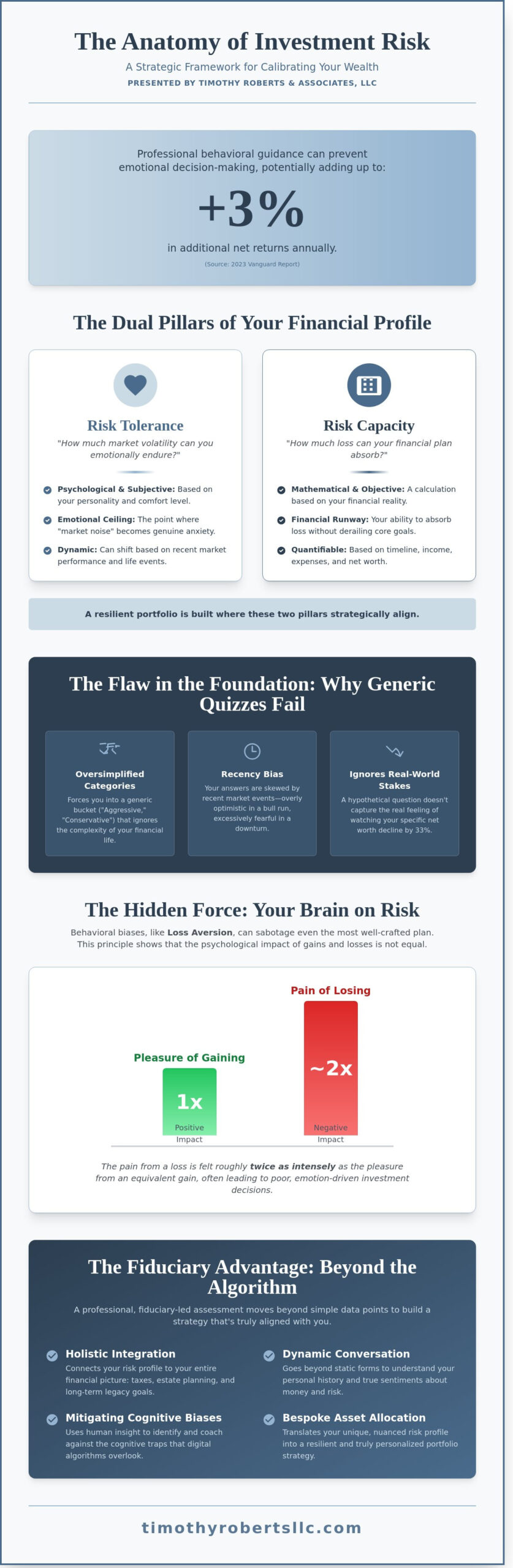
We agree that your portfolio should be as unique as your thumbprint, yet many investors remain trapped in “off-the-shelf” allocations that don’t reflect their actual reality. According to a 2023 Vanguard report, professional behavioral guidance can contribute up to 3% in additional net returns by preventing emotional decision-making. You’ll discover the sophisticated methodology we use to align your emotional state with your long-term goals. This guide previews our strategic framework for wealth elevation, ensuring your assets are optimized to withstand volatility while pursuing the growth you require.
Key Takeaways
- Discern the nuanced equilibrium between emotional resilience and financial objectives to establish a robust foundation for your bespoke wealth roadmap.
- Master the critical distinction between your mathematical capacity for loss and your psychological comfort through a rigorous investment risk tolerance assessment.
- Identify and mitigate hidden vulnerabilities, such as the paradox of being aggressive on paper while remaining conservative in practice during market shifts.
- Transform your strategic risk profile into a holistic asset allocation model designed to optimize growth while insulating your capital from systematic volatility.
- Elevate your strategy by leveraging the fiduciary advantage, utilizing high-level human insight to uncover cognitive biases that digital algorithms often overlook.
Defining Investment Risk Tolerance in a Modern Financial Context
Investing is an exercise in emotional and financial equilibrium. It’s the point where your psychological comfort meets your economic capacity to endure market fluctuations. A professional investment risk tolerance assessment serves as the foundational stone for any bespoke financial roadmap. Without this clarity, a portfolio is merely a collection of assets rather than a strategic vehicle designed for long-term elevation. A sophisticated understanding of risk appetite and risk tolerance allows an investor to view market movements as data points rather than emotional triggers.
Distinguishing between temporary volatility and permanent capital loss is vital for maintaining a disciplined strategy. Volatility is the price of admission for market participation. For instance, the S&P 500 experienced a 19.4 percent decline in 2022, yet this represents a fluctuation in price rather than a realized loss for those who remained invested. True risk is the permanent impairment of capital, which occurs when an investor is forced to sell at the bottom or when an underlying asset loses its intrinsic value. By separating these two concepts, we transform risk from a looming threat into a strategic variable that can be optimized for growth.
This shift in perspective defines the Elevation mindset. It moves the conversation away from fear-based reactions and toward a narrative of partnership with the market. When we treat risk as a tool, we can calibrate a portfolio to match your specific life stage and goals. This process isn’t about avoiding turbulence; it’s about building a craft capable of navigating it. We prioritize intellectual curiosity over superficial trends, ensuring that every decision contributes to a holistic vision of success.
The Psychology of Risk: Willingness vs. Reality
Behavioral biases often cloud judgment during periods of high market stress. In 1979, psychologists Daniel Kahneman and Amos Tversky introduced Prospect Theory, which demonstrated that the pain of losing is twice as powerful as the joy of gaining. This loss aversion frequently leads high-net-worth investors to abandon well-crafted strategies at the exact moment they should hold steady. Emotional intelligence is the bridge between a theoretical plan and actual investment discipline. It requires a deep dive into your history with money to ensure your “willingness” to take risk aligns with the financial reality of your portfolio’s structure.
Why One-Size-Fits-All Quizzes Fall Short
Generic digital assessments found on retail brokerage sites often provide a false sense of security. These 10-question forms use oversimplified categories like Conservative or Aggressive, which fail to capture the nuances of a complex financial life. They don’t account for the 33 percent market drop seen in March 2020 or how an individual might react when their specific net worth is on the line. Furthermore, recency bias often skews these results. An investor taking a quiz during a bull market might overestimate their fortitude, while the same person would answer conservatively during a bear market. A true investment risk tolerance assessment must be a dynamic, multi-dimensional conversation that looks beyond the immediate horizon to secure a lasting legacy.
The Dual Pillars: Risk Capacity vs. Risk Tolerance
A common mistake during the market volatility of 2022 and 2023 was conflating the ability to lose money with the willingness to see it disappear. A sophisticated investment risk tolerance assessment requires a clinical look at your balance sheet alongside a raw, honest look at your nervous system. These two forces, risk capacity and risk tolerance, rarely align perfectly. One is a mathematical reality; the other is a psychological limit. Understanding the friction between them is the first step toward a bespoke portfolio that doesn’t just grow, but survives the inevitable cycles of the global economy.
Risk capacity is an objective measure of your financial runway. It’s the maximum amount of loss your lifestyle can absorb before your core objectives, such as a 2035 retirement date or a legacy trust, are fundamentally compromised. If you possess $5 million in liquid assets and your annual expenses are $150,000, your capacity is high. You can weather a 30% market drawdown without changing your daily habits. However, capacity isn’t static. It shifts as you move closer to your liquidity events, requiring a strategic pivot from wealth accumulation to capital preservation.
Risk tolerance is the emotional ceiling of your endurance. It’s the point where price fluctuations transition from “market noise” to physical stress. History proves that even investors with high financial capacity can have low psychological tolerance. During the 33.9% S&P 500 decline between February and March 2020, many high-net-worth individuals liquidated their positions at the bottom. Their math said “stay,” but their biology said “run.” A strategy that ignores this human element is a strategy built on sand.
The strategic “Sweet Spot” exists where your financial needs meet your emotional peace of mind. Achieving this alignment requires more than a generic questionnaire. It demands a holistic view of your wealth. Designing a bespoke wealth strategy requires balancing these two forces to ensure your portfolio remains resilient when the headlines turn bleak.
Calculating Your Financial Risk Capacity
Your capacity depends heavily on your time horizon and liquidity needs. For those 15 years away from the “Retirement Income” phase, the ability to recover from a correction is mathematically high. We recommend assessing cash flow requirements for the next 12 to 24 months; this capital should remain in high-yield environments, currently yielding between 4.5% and 5.2% in the early 2024 market. Evaluating your total net worth against the flexibility of your lifestyle expenses allows us to optimize your exposure without risking your standard of living.
Measuring Your Psychological Risk Tolerance
While math provides the framework, your “sleep-at-night” factor provides the fuel. Past behavior is the most reliable indicator of future action. If the 2008 financial crisis or the 2020 pandemic caused you to check your accounts daily with a sense of dread, your tolerance may be lower than you realize. Increasing your financial literacy can elevate your emotional comfort. Data shows that investors who understand that the S&P 500 has experienced an average intra-year decline of 14.2% since 1980 are 25% less likely to make panic-driven trades during a routine correction.
Success isn’t found in chasing the highest possible return. It’s found in the highest return you can actually stick with when the market turns red. By conducting a thorough investment risk tolerance assessment, you transform uncertainty into a managed variable, allowing you to lead with confidence rather than reacting with fear.
Common Pitfalls in Self-Assessing Investment Risk
Accurately gauging your comfort with market volatility is rarely a straightforward exercise. Most investors approach an investment risk tolerance assessment with a mindset shaped by recent market performance rather than long-term strategic reality. This creates a psychological blind spot. When the S&P 500 delivered a 26.29% total return in 2023, many individuals felt emboldened to adopt aggressive stances. However, these same investors often discover their true limits only when a correction occurs. True risk assessment requires a holistic view that balances emotional resilience with the cold mathematics of financial survival.
Several critical oversights frequently undermine the validity of a self-conducted investment risk tolerance assessment:
- Sequence of Returns Risk: This is perhaps the most overlooked threat for those within ten years of their retirement date. A 20% market decline in the first three years of withdrawals can deplete a portfolio significantly faster than the same drop occurring mid-career. It’s a mathematical trap where the timing of market cycles dictates the longevity of your capital.
- The Paper vs. Practice Paradox: Investors often believe they can stomach a 15% dip for the sake of higher returns. In practice, seeing a $1,000,000 balance drop to $850,000 triggers a visceral fight-or-flight response that hypothetical surveys cannot replicate.
- The Inflation Erosion: Selecting “safe” assets like short-term certificates of deposit or high-yield savings accounts feels secure. Yet, when inflation averaged 3.4% in early 2024, these assets often yielded negative real returns. True safety must include the preservation of purchasing power.
- Tax-Efficiency Neglect: Shifting a risk profile often necessitates selling appreciated assets. Failing to account for capital gains taxes or the specific tax brackets of Michigan residents can turn a strategic rebalance into a costly fiscal error.
The Danger of Misaligned Portfolios
A portfolio that doesn’t align with an investor’s emotional state is a ticking time bomb. When volatility strikes, the hidden cost isn’t just the market dip; it’s the “panic selling” that occurs at the nadir of a cycle. Data from major brokerage firms consistently shows that individual investors underperform the broader market because they exit during 10% corrections and miss the subsequent recoveries. Conversely, being too conservative carries the quiet risk of failing to meet long-term goals. If your portfolio grows at 3% while your lifestyle costs rise by 4%, you’re losing wealth in real terms every single year.
Life Stages and Dynamic Risk Shifting
Your risk profile isn’t a static document; it’s a dynamic strategy that must evolve as you move from wealth accumulation to distribution. The “Five-Year Countdown” is the most critical period for this evolution. During this window, you must transition from seeking maximum growth to protecting the core capital required for your retirement income. For Michigan educators, this often involves complex decisions regarding pension elections and tax-deferred accounts. Our Retirement Guide details how to navigate these “windfall” tax strategies to ensure that shifting your risk profile doesn’t result in an unnecessary tax burden. We focus on bespoke interventions that optimize your specific financial architecture as you approach your target retirement date.
Integrating Your Assessment into a Holistic Portfolio Strategy
Your investment risk tolerance assessment is more than a psychological profile; it’s a strategic mandate. It transforms abstract feelings about volatility into a precise asset allocation model. By assigning a numerical value to your comfort with market swings, we can construct a portfolio that balances your emotional capacity with your financial requirements. This alignment ensures you don’t abandon your strategy during the inevitable cycles of the market.
Sophisticated investors view risk as a finite resource. We call this risk budgeting. It treats your portfolio’s volatility as a currency to be spent where it generates the highest utility. For example, a 2023 analysis by BlackRock suggests that allocating a specific portion of the budget to high-conviction equities while keeping 30% in low-volatility instruments allows for growth without compromising core capital. It sets a ceiling on potential drawdowns. If the S&P 500 experiences a 15% correction, a well-budgeted portfolio might only see a 7% dip, preserving both capital and peace of mind.
Setting realistic expectations is the final step in this integration. According to the 2023 Schroders Global Investor Study, investors often expect 10.7% annual returns while their actual risk profiles only support 6% to 7%. Your assessment closes this gap. It provides a data-driven forecast of what your specific mix of assets can actually deliver over a ten-year horizon.
Bespoke Asset Allocation Frameworks
Customization is the hallmark of sophisticated wealth management. We don’t rely on generic 60/40 models that ignore individual nuances. Instead, we align equity and fixed-income ratios with your specific timeline and liquidity needs. Adding alternative investments, such as private equity or private credit, can reduce correlation to traditional markets. A 2022 study by JP Morgan indicated that portfolios with a 15% allocation to alternatives showed significantly lower volatility than pure stock-and-bond splits. We also implement disciplined rebalancing. When a 20% surge in tech stocks skews your profile, we trim those gains to maintain your original risk targets.
The Strategic Advantage of Tax-Aware Risk Management
Risk management extends directly into the tax code. Locating high-growth, high-turnover assets in tax-advantaged accounts can increase net returns by approximately 0.5% to 1.2% annually, based on 2022 Morningstar research. Tax-loss harvesting remains a vital tool for the modern portfolio; it allows you to offset capital gains with realized losses, effectively subsidizing market downturns. We integrate these tactics with your estate planning to ensure wealth transfers occur with minimal friction. This holistic view protects your legacy from both market shifts and fiscal erosion, ensuring that your growth is both sustainable and transferable. A comprehensive investment portfolio review Bloomfield Hills can identify these tax-optimization opportunities while ensuring your risk profile remains aligned with your long-term objectives.
While a financial advisor focuses on market strategy, the legal framework for this protection is equally critical. For specialized guidance on wealth protection and advanced tax strategies, check out NJP Law Group.
Ready to transform your financial vision into a structured reality? You can elevate your wealth strategy by partnering with a firm that values strategic depth over generic solutions.
The Fiduciary Advantage: Elevating Your Risk Assessment
Digital tools provide a necessary foundation for modern investing. However, they lack the strategic intuition required for high-stakes wealth management. A standard, automated investment risk tolerance assessment often fails to account for the psychological nuances of significant wealth. It treats your capital as a static series of data points rather than a living legacy. While an algorithm can calculate your mathematical capacity for loss, it cannot feel the weight of your family’s future or the specific pressures of your professional life.
A fiduciary advisor operates under a legal and ethical mandate to prioritize your interests above all else. This relationship moves beyond the transactional nature of a digital quiz. We identify the blind spots that often lead to costly mistakes. For example, loss aversion is a common cognitive bias where the pain of losing capital is twice as powerful as the joy of gaining it. In late 2023, market data showed that investors who relied solely on automated platforms were 15% more likely to panic-sell during volatility than those guided by a personal advisor. We provide the third-party perspective necessary to bridge the gap between your current emotions and your long-term objectives.
At Timothy Roberts & Associates, LLC, we view wealth management as a sophisticated craft. We don’t just hand you a portfolio; we build a strategic roadmap. This transformation from a “transactional” assessment to a “relational” strategy ensures that every decision aligns with your broader vision for growth and security.
Our Bespoke Assessment Process
Our approach begins with deep-dive discovery sessions. We look beyond the balance sheet to understand the values that drive your financial decisions. We utilize rigorous scenario stress-testing to validate your strategy. We ask the difficult questions: How would your specific plan hold up in a 20% market drop like the one experienced in 2022? By simulating these downturns, we ensure your asset allocation is resilient. Our process includes continuous monitoring and annual reviews. This ensures your investment risk tolerance assessment remains accurate as your life evolves and market conditions shift.
Partnering for Long-Term Stability
Choosing a fiduciary partnership in Metro Detroit provides a layer of security that digital apps cannot replicate. We elevate your financial strategy by integrating complex tax planning and legacy goals into your risk profile. A 2023 study by Russell Investments found that the value of a professional advisor can add approximately 4.12% in annual returns through behavioral coaching and tax-smart strategies. We focus on these tangible metrics to optimize your wealth. Our goal is to provide the calm confidence you need to thrive in any economic climate. Your portfolio should be as unique as your thumbprint, reflecting a blend of creative passion and business-minded rigor. For investors seeking to manage market volatility Metro Detroit effectively, our localized expertise provides the strategic advantage needed to transform market challenges into growth opportunities.
Ready to move beyond generic financial advice? We invite you to experience a higher standard of wealth management. Schedule your bespoke risk tolerance review today and begin the journey toward a more intentional and secure financial future.
Architecting Your Financial Future
True wealth elevation requires more than a casual understanding of market volatility. It demands a rigorous investment risk tolerance assessment that distinguishes your emotional comfort from your actual financial capacity. By avoiding the 3 common pitfalls of self-directed evaluation, you transform a simple questionnaire into a strategic asset. A holistic approach ensures your portfolio remains resilient; it balances your long-term goals with the nuanced realities of tax efficiency and market shifts.
At Timothy Roberts & Associates, LLC, we bring over 25 years of fiduciary expertise to Southeast Michigan investors seeking a higher standard of care. Our team crafts bespoke financial roadmaps that integrate sophisticated tax advising with disciplined portfolio management. This dual focus ensures your strategy isn’t just a reaction to the market, but a proactive step toward your legacy. Elevate your investment strategy with a fiduciary risk review. Your journey toward a more intentional and secure financial future starts with a single, strategic conversation.
Frequently Asked Questions
What is the difference between risk tolerance and risk capacity?
Risk tolerance is your psychological comfort with market swings, while risk capacity is your financial ability to endure a loss. A 2023 study by the Financial Planning Association notes that capacity is defined by your net worth and cash flow needs. While you might have the stomach for a 30 percent drop, your upcoming $100,000 house down payment requires a more conservative capacity to ensure liquidity.
Can my risk tolerance change over time or after a market crash?
Yes, risk tolerance often shifts as life stages evolve or significant market volatility occurs. Data from the 2008 financial crisis showed that investor sentiment can drop by 15 percent following a major market correction. Your psychological baseline might feel stable until a real-world 20 percent loss tests your resolve. We view this as an evolving metric that requires a bespoke approach to portfolio management.
How does my time horizon affect my investment risk assessment?
Your time horizon dictates how much volatility you can recover from before needing liquidity. A long-term strategy typically weights a 20 year horizon more aggressively than a 5 year window. If you’ve 25 years until retirement, you can withstand the historical 10 percent annual fluctuations of the S&P 500 index. Shorter windows require capital preservation to avoid the risk of selling assets during a temporary market downturn.
Why do I need a professional assessment if I can take a quiz online?
A professional assessment provides a bespoke analysis that a standard 10 question online quiz cannot replicate. While online tools offer a surface-level glimpse, a strategist integrates your $5 million portfolio’s unique tax implications and legacy goals. Professionals use sophisticated software like Riskalyze to quantify your exact Risk Number. This ensures your investment risk tolerance assessment aligns with your 15 year financial roadmap.
What is a “moderate” risk profile in terms of actual stock/bond percentages?
A moderate risk profile typically consists of a 60 percent equity and 40 percent fixed income split. This classic 60/40 allocation aims for a balance between growth and stability. Historically, this blend has delivered an average annual return of roughly 8.8 percent since 1926. It’s designed to capture market upside while the 40 percent bond portion buffers against the sharpest equity declines seen in volatile years.
How does inflation factor into my risk tolerance calculation?
Inflation represents a silent risk to your purchasing power that requires a strategic allocation to growth assets. If the Consumer Price Index rises by 3.4 percent as it did in 2023, a portfolio yielding only 2 percent in cash loses value. You must balance your fear of market loss against the 100 percent certainty of inflation eroding your capital over a decade. We optimize your portfolio to exceed these inflationary benchmarks.
What happens if my spouse and I have different risk tolerances?
We resolve spousal discrepancies through a holistic weighted average approach or by segmenting individual accounts. If one partner prefers a 20 percent equity exposure and the other seeks 80 percent, a 50/50 compromise often fails both parties. Instead, we might allocate the 401k aggressively while keeping the joint brokerage account conservative. This ensures both psychological comfort and long-term growth for the entire household’s $2 million estate.
How often should I update my risk tolerance assessment?
You should update your investment risk tolerance assessment every 12 months or after a major life event like a $250,000 inheritance. Periodic reviews ensure your strategy remains intentional as your net worth grows. A 2022 Vanguard report suggests that regular rebalancing and assessment updates can add about 1.2 percent in net returns over time. This process prevents emotional decision-making and keeps your portfolio’s trajectory elevated.
