

Apr
College Football Coaching Buyouts Approaching $100M This Season: A Strategic Financial Analysis
In the 2023 cycle, the NCAA landscape witnessed a staggering $78 million in severance payments, yet that figure is already becoming a historical footnote. With college football coaching buyouts approaching $100m this season, the cost of athletic transition has evolved into a sophisticated exercise in capital reallocation. You likely understand that these astronomical sums aren’t just about locker room culture; they represent the high-stakes reality of modern contract negotiation and the immense pressure of institutional performance.
This article promises to help you discover the economic drivers behind this $100M surge and the wealth preservation lessons high-earners can extract from these massive contract terminations. We’ll move beyond the headlines to provide a bespoke look at the current 2026 buyout landscape and the strategic architecture of “golden parachutes.” By examining these holistic financial shifts, you’ll learn how to optimize your own exit strategies and elevate your approach to wealth preservation during your most productive years. This analysis provides the clarity needed to transform complex contract risks into a structured path for long-term stability.
Key Takeaways
- Analyze the unprecedented economic drivers behind college football coaching buyouts approaching $100m this season and what this threshold reveals about the evolving landscape of professional service contracts.
- Decode the anatomy of the “Golden Parachute” to understand how elite talent utilizes liquidated damages as a strategic tool for risk mitigation and wealth security.
- Bridge the gap between the gridiron and the boardroom by comparing why coaching exit strategies often dwarf traditional corporate severance on a percentage basis.
- Extract actionable wealth preservation lessons to help you structure a bespoke “exit fund” that protects your assets during high-stakes professional transitions.
- Discover how a fiduciary-led approach to financial planning can elevate your personal exit strategy, ensuring long-term tax optimization and strategic growth.
The $100M Threshold: Why Coaching Buyouts Are Surging in 2026
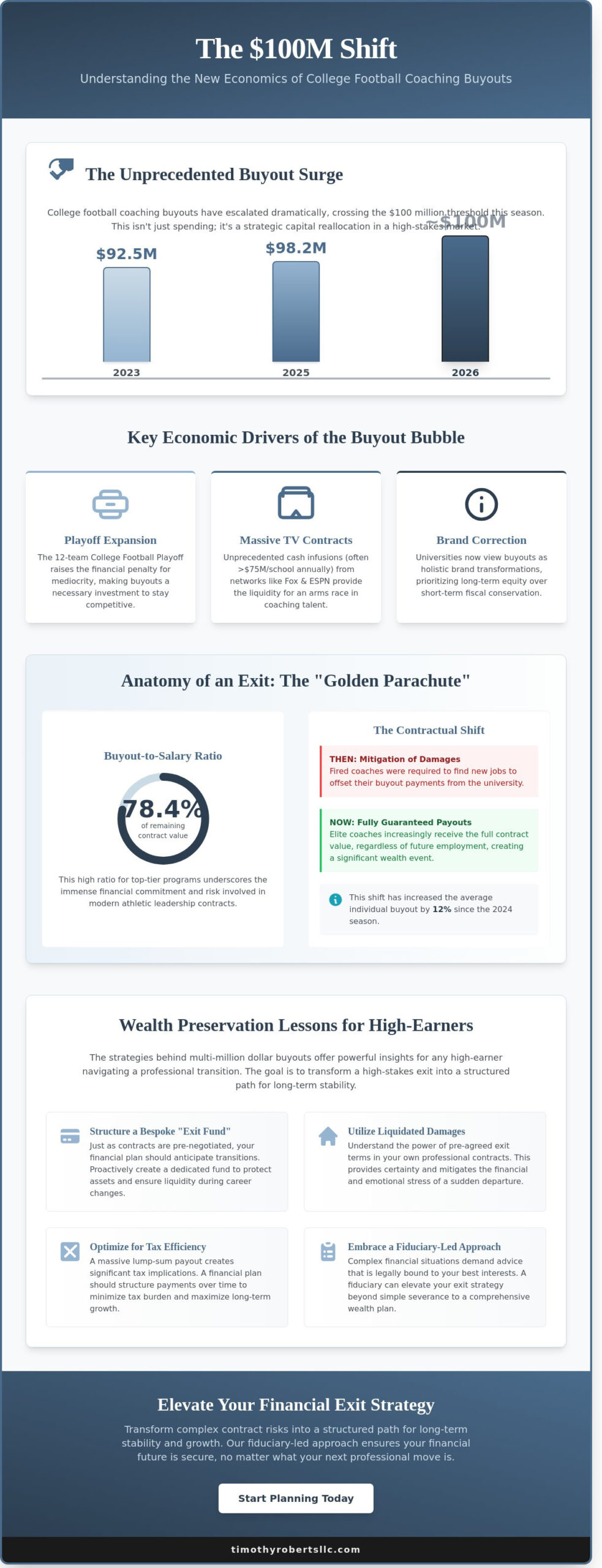
The 2026 college football season marks a watershed moment in athletic department fiscal management. We’re witnessing college football coaching buyouts approaching $100m this season, a figure that represents more than just a series of terminations. It signifies a fundamental shift in how universities view the cost of competitive failure. At its core, a buyout clause functions as a liquidated damages provision in a professional service contract. It’s the price of a clean slate. While 2023 saw record spending of $92.5 million and 2025 reached $98.2 million, the current $100 million threshold reflects a new era of strategic risk. The hot seat isn’t just a coaching narrative anymore. It’s a multi-million dollar liability on a university balance sheet that requires sophisticated mitigation and a visionary approach to leadership.
The Economic Drivers of the 2026 Buyout Bubble
The 12-team College Football Playoff expansion has fundamentally altered the ROI of coaching stability. Missing the playoff now carries a heavier financial penalty than the buyout itself. Massive television contracts from partners like Fox and ESPN have infused universities with unprecedented cash reserves, often exceeding $75 million in annual distributions per school in power conferences. This liquidity fuels an arms race where firing a coach is viewed as a necessary capital reinvestment. Athletic departments are treating these payouts as holistic brand corrections rather than simple personnel changes. It’s a bespoke approach to organizational transformation that prioritizes long-term brand equity over short-term fiscal conservation. The cost of mediocrity has simply become too expensive to ignore in a market that demands excellence.
Major Buyouts Defining the Current Season
High-profile terminations in the SEC and Big Ten have accelerated the climb toward the $100 million mark. Mid-season firings often incur higher costs due to immediate settlement requirements. In contrast, end-of-season strategies allow for more structured negotiations and potential mitigation through future employment offsets. In 2026, the average buyout-to-salary ratio for top-tier FBS programs has stabilized at 78.4% of the remaining contract value. This level of financial commitment underscores the high stakes of modern athletic leadership. Strategic elevation requires moving past sunk costs to focus on future growth. When a university pays $15 million to move on from a coach, they’re buying back their relevance in a saturated market. The following factors have defined the current fiscal landscape:
- Aggressive Acceleration: Schools are moving faster to terminate underperforming leaders to secure top-tier replacements before the December recruiting window.
- Guaranteed Contracts: The prevalence of fully guaranteed deals has increased the average individual buyout by 12% since the 2024 season.
- Donor Intervention: Private booster collectives are increasingly subsidizing these payouts to facilitate rapid brand transformations.
The Anatomy of an Exit: Contractual Risk and the ‘Golden Parachute’
The modern coaching contract is no longer a simple employment agreement; it’s a sophisticated instrument of risk management. As college football coaching buyouts approaching $100m this season become a reality, the “Golden Parachute” has evolved into a strategic tool for talent acquisition. Universities use these massive guarantees to signal stability to recruits and donors alike. By front-loading the risk, an institution demonstrates its total commitment to a specific vision, even if that vision eventually requires a costly course correction.
Traditional “mitigation of damages” clauses, which once required fired coaches to actively seek new employment to offset their buyout payments, are increasingly being waived for elite tier candidates. In 2024 and 2025, we’ve seen a trend where universities agree to pay the full remaining value of a contract regardless of the coach’s next career move. This shift from simple severance to complex, multi-year payout structures creates a unique financial challenge. For the individual, receiving an eight-figure sum over a compressed period requires bespoke financial planning to mitigate tax liabilities and ensure the capital is deployed effectively for the future.
Liquidated Damages vs. Performance Incentives
Liquidated damages serve as a predetermined “price tag” for terminating a contract without cause. While performance-based bonuses in 2026 contracts might reward a 10-win season or a playoff appearance, the liquidated damages clause provides the floor for the coach’s security. Universities now routinely accept the risk of $50M or even $75M in liabilities to secure a coach they believe can transform their brand. This calculation is purely strategic; the potential revenue from a winning program often outweighs the catastrophic cost of a failed tenure. It’s a high-stakes gamble where the downside is a massive liquidity event for the coach and a significant budgetary hurdle for the school.
The Strategic Importance of Exit Clauses
Exit clauses function as a protective barrier for both parties during a transition. For the coach, it’s about guaranteed wealth and career longevity. For the university, it’s about the ability to pivot quickly when the brand’s trajectory falters. This evolution mirrors the corporate world, where top-tier coaches are essentially CEOs in Headphones, commanding exit packages that rival Fortune 500 leaders. Legal counsel and financial advisors now play a primary role in drafting these bespoke agreements, ensuring that the language accounts for every variable from “for cause” definitions to payment schedules.
The psychological impact of this guaranteed wealth shouldn’t be underestimated. It allows coaches to take higher risks on the field and in recruiting, knowing their family’s financial future is secure regardless of the win-loss column. If you find your own career path leading toward a significant professional transition, you might benefit from a strategic consultation to align your assets with your long-term vision.
Comparing Sports Buyouts to Executive Exit Strategies
The financial architecture of elite collegiate athletics has moved beyond simple sport; it now mirrors the complex maneuvers found in the highest tiers of global commerce. For high-net-worth individuals, the current trend of college football coaching buyouts approaching $100m this season represents a fascinating case study in risk mitigation. While a Fortune 500 CEO might receive a severance package totaling 24 months of base salary, elite coaches often secure guaranteed contracts worth 80% to 100% of their remaining term. This disparity transforms a termination into a massive, immediate liquidity event that requires expert handling.
Managing such a sudden influx of capital requires more than a standard brokerage account. It demands sophisticated investment portfolio management to elevate the strategy beyond simple asset allocation and ensure these non-recurring payouts are optimized for long-term growth. Both the sports and corporate sectors rely heavily on restrictive covenants to protect their interests. A professional analysis explains the mechanics of coaching contracts, specifically how “duty to mitigate” and non-disparagement clauses serve as the primary tools for protecting a brand’s reputation during a high-profile divorce.
Public University Disclosure vs. Private Corporate Secrecy
Transparency remains the primary differentiator. Because most elite programs reside within public institutions, state sunshine laws mandate the disclosure of every penny spent on a buyout. Corporate exits often happen behind a veil of private settlements and confidential filings. This public exposure creates a unique “market value” for coaching talent in the 2026 landscape. A coach’s reputation is quantified by their buyout figure, serving as a public signal of their perceived worth, whereas a CEO’s exit is often viewed through the lens of stock price stability and shareholder optics.
The Role of Fiduciary Duty in Large Payouts
The legal obligations of a Board of Trustees differ sharply from a corporate Board of Directors. Trustees must answer to state taxpayers and influential donors, leading to increased scrutiny when college football coaching buyouts approaching $100m this season trigger public outcry. While corporate directors face derivative lawsuits from shareholders for “waste of corporate assets,” university boards often navigate political pressure and donor revolts. Strategic advisors work to frame these payouts as necessary costs for program transformation, ensuring that the institution’s long-term financial stability remains intact despite the immediate fiscal shock.
- Coaching buyouts often lack the performance-based “clawback” provisions common in C-suite contracts.
- Corporate exits are typically tied to equity vesting, while sports buyouts are primary cash-driven.
- Non-compete clauses in coaching are increasingly difficult to enforce compared to tech-sector executive agreements.
Wealth Preservation Lessons from High-Stakes Contract Terminations
While the spectacle of college football coaching buyouts approaching $100m this season feels like a distant reality for most, the underlying financial mechanics offer a masterclass in risk mitigation. You don’t need a multi-million dollar contract to benefit from an exit fund mentality. High-earning individuals often dismiss these trends as celebrity outliers, yet the same principles of contract protection and liquidity apply to any executive or business owner facing a transition.
Success requires foresight. A well-structured exit fund isn’t just a savings account; it’s a strategic layer of protection that ensures your lifestyle remains unaffected by market shifts or corporate restructuring. By analyzing how elite coaches protect their earnings, you can replicate these bespoke strategies to insulate your own household from professional volatility.
Managing Sudden Wealth and Tax Liabilities
Receiving a massive windfall creates an immediate tax cliff. In 2024, the top federal income tax bracket of 37% applies to income over $609,350 for single filers. Without a proactive plan, nearly forty cents of every dollar from a lump-sum payment can vanish into federal obligations before state taxes are even considered. This erosion of capital is the primary threat to long-term wealth elevation.
Structured payment plans offer a sophisticated alternative to the traditional lump sum. By spreading a buyout or bonus over several fiscal years, you can keep more of your income in lower tax brackets. Additionally, utilizing charitable lead trusts or donor-advised funds can provide immediate deductions to offset significant gains. This level of complexity requires strategic tax advising to ensure your assets are optimized for growth rather than depleted by avoidable liabilities.
Diversification as a Defense Against Career Volatility
Coaching careers serve as a perfect metaphor for high-risk, high-reward professional lives. One losing season can end a decade of work. Most high-earners have their greatest asset, their human capital, concentrated in a single industry. If that industry falters, their entire financial ecosystem is at risk. Diversification acts as your personal buyout clause, providing stability when your primary income source is interrupted.
To maintain professional stability, consider this rebalancing checklist after any significant career transition or windfall:
- Audit Liquidity: Ensure you have 24 months of cash reserves held in non-correlated assets.
- Tax-Loss Harvesting: Use market downturns to offset the capital gains from your buyout or bonus.
- Risk Parity: Adjust your portfolio to ensure no single sector represents more than 20% of your total net worth.
- Estate Integration: Update trusts to reflect the sudden influx of capital and minimize future transfer taxes.
True wealth isn’t just about the size of the check; it’s about how much of that check you retain and grow. As college football coaching buyouts approaching $100m this season continue to dominate headlines, use the trend as a prompt to evaluate your own financial defenses. Strategic planning transforms a moment of transition into a foundation for permanent growth.
Elevating Your Financial Exit Strategy with Timothy Roberts & Associates
The fiscal gravity of modern sports contracts is undeniable. With college football coaching buyouts approaching $100m this season, the need for sophisticated exit strategies has never been more apparent for high-earning professionals. Timothy Roberts & Associates serves as the visionary strategist for high-net-worth clients facing these complex transitions. We don’t just manage assets; we orchestrate a comprehensive financial evolution that transforms sudden liquidity into a lasting legacy.
Our fiduciary approach ensures that every decision aligns with your long-term stability and rigorous tax compliance requirements. We move away from aggressive, short-term tactics toward a narrative of partnership and shared success. This polished, intentional methodology inspires trust through a blend of creative passion and business-minded rigor. As college football coaching buyouts approaching $100m this season redefine the market, our firm remains the steady hand for leaders navigating these high-stakes shifts.
Bespoke Solutions for Complex Financial Lives
Managing wealth requires more than a standard portfolio. For over 25 years, our firm has navigated high-stakes financial scenarios with precision and foresight. We integrate multiple disciplines into a single, cohesive framework designed to optimize your financial trajectory. This isn’t a series of transactions; it’s a partnership that values depth over superficiality. Our holistic model includes:
- Integrated Estate Planning: Crafting structures that protect assets across generations.
- Strategic Tax Compliance: Implementing proactive measures to mitigate liabilities during major liquidity events.
- Investment Management: Building resilient portfolios that reflect your individual risk appetite and growth goals.
We treat your wealth as a living ecosystem. It requires constant, intentional cultivation to thrive during periods of career transition or institutional change.
Your Next Step Toward Wealth Elevation
Transformation begins with a meticulous review of your current financial roadmap. Our lead advisors provide a level of professional stability that larger, anonymous firms often lack. We prioritize fiduciary oversight, ensuring our interests always mirror your own. You’ll work directly with experts who understand the nuances of high-level contracts and the unique pressures of public-facing careers.
The path to financial elevation is logical and steady. We guide you from a high-level vision down to the practicalities of execution, avoiding the frantic pace of generic consultancies. To secure your future, you need a plan that accounts for the volatility of high-earning roles while anchoring your family’s security. Contact our office today to begin a personalized consultation. Let’s build a foundation that protects your legacy and elevates your financial vision.
Mastering the Art of the Strategic Exit
The landscape of high-stakes contracts is shifting rapidly. As we observe college football coaching buyouts approaching $100m this season, the need for sophisticated risk mitigation has never been more apparent. These massive payouts highlight the critical importance of structural integrity in contract negotiations and the necessity of protecting long-term capital from sudden transitions. Whether in the stadium or the boardroom, a well-crafted exit strategy serves as the ultimate safeguard for your financial future.
Success isn’t just about the initial win; it’s about how you preserve that victory over decades. Timothy Roberts & Associates provides the high-level expertise required to navigate these complexities. With over 25 years of fiduciary wealth management experience, our team delivers comprehensive tax and estate planning integration. We focus on personalized strategies tailored to high-net-worth goals, ensuring every move you make is both intentional and optimized for growth. We don’t just manage assets; we curate a holistic path toward your aspirational future.
Elevate your wealth strategy with a bespoke financial consultation
The right partnership transforms uncertainty into a legacy of lasting prosperity.
Frequently Asked Questions
How are college coaching buyouts typically funded by universities?
Universities fund buyouts primarily through private donations from athletic booster clubs and liquidated athletic department reserves. In 2024, private donors at major Power Five schools often cover 60 percent or more of these separation costs. These funds are rarely drawn from general academic tuition; athletic departments operate as separate financial entities to protect the university’s core educational mission and credit rating.
What are the tax implications for a coach receiving a $20 million buyout?
A coach receiving a $20 million buyout faces the top federal income tax bracket of 37 percent. This payment is treated as supplemental wages, which requires immediate withholding by the university. Additionally, under the Tax Cuts and Jobs Act of 2017, Section 4960 imposes a 21 percent excise tax on tax-exempt organizations for compensation exceeding $1 million paid to covered employees, adding a fiscal burden to the institution.
Can a coaching buyout be paid into a retirement account or trust?
Coaches can direct buyout funds into non-qualified deferred compensation plans, specifically 457(f) plans, to manage tax exposure. These bespoke structures allow for tax-deferred growth until the funds are distributed at a predetermined date. By utilizing these strategic vehicles, a coach transforms a lump-sum payment into a long-term wealth preservation tool, though they must adhere to strict IRS vesting rules to avoid immediate taxation.
How do coaching buyouts compare to corporate CEO severance in 2026?
Coaching buyouts in 2026 often exceed corporate CEO severance packages because they guarantee a high percentage of the remaining contract value. While a Fortune 500 CEO might receive two years of base salary, a coach’s buyout often covers 75 percent to 100 percent of their total remaining compensation. With college football coaching buyouts approaching $100m this season across the industry, these figures represent a higher percentage of organizational revenue than typical corporate exits.
Why do universities agree to such high buyout figures in their contracts?
Universities agree to high buyout figures to secure elite talent in a hyper-competitive market where only 134 FBS programs exist. These clauses serve as a deterrent against poaching by rival schools or professional franchises. High buyouts reflect a calculated risk where the institution prioritizes long-term stability and recruiting momentum over the potential cost of a future separation, viewing the expense as a necessary premium for brand elevation.
Is a coaching buyout considered ordinary income or capital gains for tax purposes?
A coaching buyout is classified as ordinary income rather than capital gains because the payment represents compensation for the termination of an employment contract. The IRS views these funds as substitute payments for the wages the coach would’ve earned if they remained employed. Consequently, the recipient doesn’t benefit from the lower 15 percent or 20 percent capital gains rates that apply to investment assets.
What happens to a buyout if the coach is hired by another school immediately?
Most modern contracts include a duty to mitigate clause that reduces the university’s payment obligation if the coach finds new employment. If a coach is hired by another school, their new salary is typically offset against the existing buyout balance. If a school owes $10 million and the coach signs a new deal for $2 million annually, the original school’s yearly obligation drops to $8 million.
How can high-earning individuals structure their own exit strategies effectively?
High-earning individuals can optimize their exit strategies by negotiating specific window clauses and structured payout schedules that spread income over multiple tax years. By integrating holistic financial planning with legal counsel, executives can innovate their contracts to include non-compete offsets or charitable lead trusts. This strategic approach ensures that college football coaching buyouts approaching $100m this season serve as a blueprint for sophisticated personal brand protection and wealth transition.
