While 80% of investors expect their taxes to rise under the “One Big Beautiful Bill Act,” only 31% are taking concrete steps to adjust their financial plans. You likely feel the weight of the 37% top marginal rate even if you already have a CPA handling your annual filings. It’s frustrating to see a lack of coordination between your investment strategy and its tax impact, particularly as the 2026 legislative sunsets approach. Our bespoke tax planning services transform this reactive cycle into a proactive engine for wealth elevation. By moving away from the seasonal rush toward a year-round advisory model, we help you reclaim control over your financial narrative.
You’ll discover how a holistic roadmap reduces your lifetime tax liability while seamlessly integrating your investment management. This guide provides a sophisticated overview of the 2026 landscape, from the $32,200 standard deduction for married couples to the strategic use of the $19,000 annual gift tax exclusion. We’ll explore the precise interventions necessary to navigate the $15 million estate tax exemption and the updated tax brackets with total confidence. This is your path to a financial structure that is as intentional as it is effective.
Key Takeaways
- Distinguish between the limitations of traditional tax preparation and the transformative power of bespoke tax planning services designed for sustained wealth elevation.
- Master the architecture of tax-efficient distributions by strategically sequencing withdrawals to preserve the longevity and purchasing power of your retirement portfolio.
- Secure a strategic roadmap to mitigate the impact of the 2026 legislative sunset, ensuring your assets remain protected against shifting federal tax mandates.
- Identify advanced preservation vehicles, such as Grantor Retained Annuity Trusts (GRATs), to seamlessly integrate your tax strategy with a sophisticated legacy plan.
- Discover the benefits of a fiduciary partnership that prioritizes your growth through a transparent, asset-based fee model and deeply personalized advisory.
Beyond Compliance: Why Traditional Tax Preparation Is Not Tax Planning
Most investors view the tax season as a rear-view mirror exercise. They gather documents, tally historical earnings, and hope for a modest refund. This reactive approach is compliance, not strategy. While a standard CPA ensures your filings are accurate and timely, true wealth preservation requires a forward-looking architecture that anticipates legislative shifts before they impact your balance sheet. Tax planning services represent a year-round fiduciary commitment to liability reduction through the intentional orchestration of your financial life.
The goal of this strategic intervention is to generate “Tax Alpha.” This concept refers to the measurable value added to your net worth by reducing the tax drag on your investments. By optimizing the legal use of the tax regime, we move beyond mere record-keeping to create a structural advantage. For high-net-worth individuals, this distinction is the difference between simply following rules and actively mastering them to protect your legacy.
To better understand how this cycle functions throughout the year, watch this helpful video:
The Reactive Trap: The Cost of Waiting Until April
Waiting until the spring to discuss your tax burden is an expensive mistake. By the time you sit down with a tax preparer in April, the opportunities to influence your previous year’s liability have largely vanished. You’re left with a summary of what you owe rather than a plan for what you could have saved. This reactive cycle often leads to “blind” investment moves where selling a position triggers an unexpected 20% capital gains hit because no one was monitoring the total tax impact in real time.
Many clients believe their CPA is already handling this. However, most tax professionals are historians focused on high-volume compliance during a compressed four-month window. They don’t have the bandwidth to analyze how your 401(k) contributions or brokerage rebalancing affects your long-term wealth trajectory. Strategic tax planning services fill this gap by providing a visionary advisor who monitors your portfolio every day, not just once a year.
The Fiduciary Advantage in Tax Strategy
A fiduciary approach changes the fundamental nature of tax advice. Instead of off-the-shelf software solutions that treat every filer the same, we provide bespoke interventions tailored to your specific goals. This holistic view allows us to identify tax-loss harvesting opportunities as market volatility occurs. We don’t wait for a year-end report to offset gains; we act when the data suggests the highest benefit for your portfolio.
Our asset-based oversight ensures that your investment strategy and tax liability are in constant alignment. We analyze the intersection of your income, business interests, and estate goals to ensure every dollar is working efficiently. This level of professional stability provides the confidence you need to navigate the complexities of the 2026 tax law sunsets with precision and calm.
The Architecture of Tax-Efficient Retirement Income
Designing a retirement income stream is an exercise in precision. Wealth preservation isn’t just about the size of your nest egg; it’s about the efficiency of your distributions. When you transition from accumulation to spending, the tax drag on your portfolio can accelerate depletion if not managed with professional rigor. Utilizing tax-efficient retirement strategies prioritizes the longevity of your assets by minimizing the government’s share of every dollar you withdraw. Our retirement income planning pillar provides the strategic guidance necessary to navigate this shift.
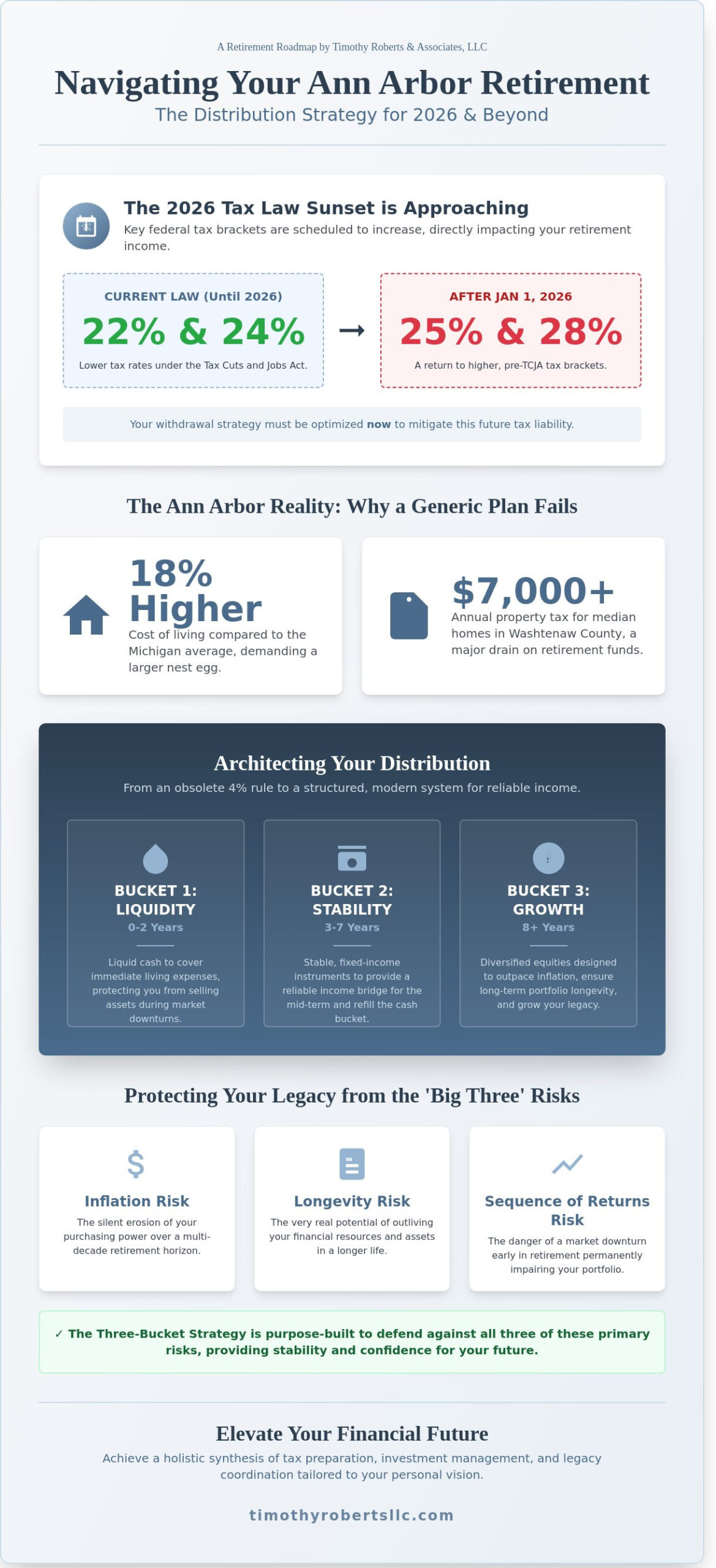
Strategic tax planning services transform how you view your accounts. Instead of seeing a single pool of wealth, we see a collection of distinct tax treatments that must be orchestrated. Roth conversions, for instance, act as a tool for long-term bracket management. By accelerating taxes at today’s rates, you can shield your future distributions from the higher brackets expected in 2026. This proactive approach ensures your income remains stable even as the legislative landscape shifts.
Optimizing the Retirement Withdrawal Sequence
The order in which you access your accounts determines the ultimate efficiency of your plan. Many retirees default to exhausting taxable accounts first, but this can be a missed opportunity for long-term growth. We analyze the “Pro-Rata Rule,” which dictates how the IRS treats distributions from IRAs containing both pre-tax and after-tax contributions. Misunderstanding this rule can lead to double taxation or unexpected liabilities. Our tax planning services help you stay within lower tax brackets, such as the 12% or 22% tiers, by blending income sources to meet your cash flow needs without triggering higher marginal rates. This careful sequencing prevents the “tax torpedo” that often strikes when Social Security benefits and Required Minimum Distributions (RMDs) collide.
Asset Location vs. Asset Allocation
While asset allocation determines your risk profile, asset location determines your tax bill. High-growth assets, like equities, often belong in tax-free Roth accounts to maximize their compound growth. Conversely, income-generating bonds might be better suited for tax-deferred accounts where their interest isn’t taxed annually at ordinary income rates. Where you hold an asset is as important as what you hold. This level of customization ensures that your portfolio isn’t just diversified across sectors, but optimized across tax treatments. If you’re looking for a partner to refine these details, our bespoke advisory can help align your portfolio with your long-term vision.
Navigating the 2026 Tax Landscape: Legislative Shifts and Strategic Responses
The tax landscape of 2026 isn’t a distant concern; it’s a structural shift that demands immediate attention. We’re currently facing the sunsetting of the Tax Cuts and Jobs Act (TCJA), a transition that creates a fiscal “cliff” for many high-earning households. While the “One Big Beautiful Bill Act of 2025” (OBBBA) provided some stability by making the 20% pass-through deduction permanent for business owners, it didn’t eliminate the upward pressure on individual rates. Professional tax planning services are essential to navigate these changes without sacrificing your hard-earned growth.
For 2026, the top marginal tax rate remains at 37% for single filers with taxable income exceeding $640,600 and married couples filing jointly over $768,700. However, the brackets below these thresholds have tightened. A married couple earning $512,450 now finds themselves in the 35% bracket, necessitating a more sophisticated approach to income timing. By following authoritative IRS tax planning guidelines, we ensure your strategy remains grounded in compliance while reaching for maximum efficiency. Locking in current rates through proactive planning is no longer optional; it’s a requirement for wealth preservation.
The Sunsetting of TCJA: What Changes for You?
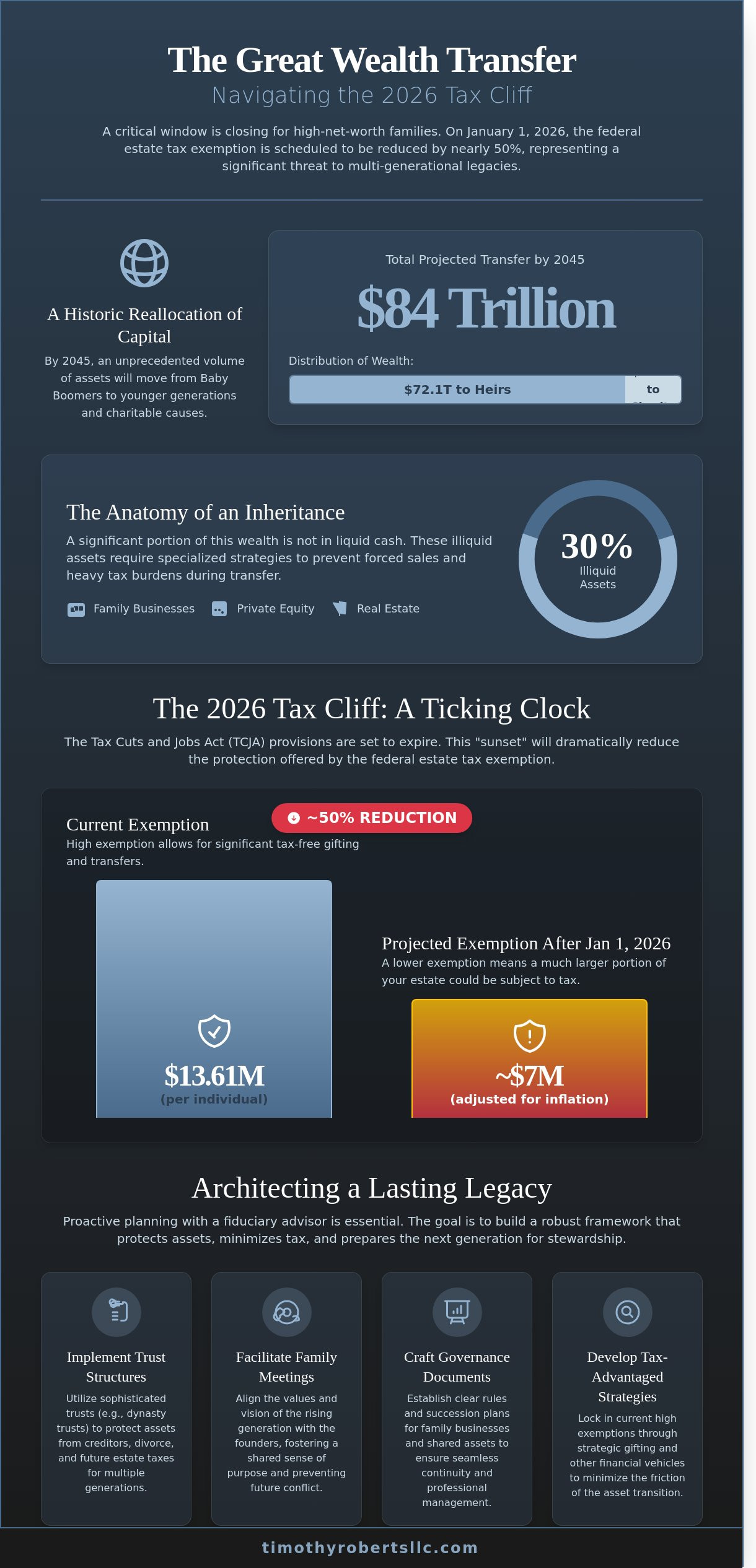
The standard deduction for 2026 is $16,100 for individuals and $32,200 for married couples filing jointly. While these figures are adjusted for inflation, the loss of various TCJA-era deductions means more taxpayers will benefit from a return to strategic itemization. We’re also paying close attention to the federal estate tax exemption, which stands at $15 million per individual. This high threshold offers a unique window for “use it or lose it” gifting strategies. If you don’t move assets out of your taxable estate now, you may face a much heavier burden if future legislation reduces these protections. Our approach focuses on these bespoke interventions to shield your legacy from unnecessary erosion.
Legislative Updates: Secure 2.0 and Beyond
The Secure 2.0 Act continues to offer new avenues for tax-efficient savings. In 2026, the employee contribution limit for 401(k) and 403(b) plans has risen to $24,500. For those aged 60 to 63, a “super” catch-up contribution of $11,250 is now available, allowing for a total employee deferral of $35,750. These vehicles are vital for reducing your current year’s taxable income while fueling long-term growth. We also utilize Qualified Charitable Distributions (QCDs) as a strategic tool. These allow you to donate up to $105,000 directly from an IRA to a charity, satisfying your RMD requirements without increasing your adjusted gross income. For more on how these shifts impact your specific portfolio, review our tax advising insights for wealth elevation.
Advanced Strategies for High-Net-Worth Wealth Preservation
High-net-worth preservation requires more than simple deferrals; it demands a structural synergy between your tax liability and your estate & legacy strategy. We utilize sophisticated vehicles like Grantor Retained Annuity Trusts (GRATs) to effectively freeze the value of rapidly appreciating assets. By transferring the future growth of these assets to your beneficiaries while retaining an annuity interest, you move wealth out of your taxable estate with minimal gift tax impact. This isn’t a template solution. It’s a bespoke intervention designed to protect your family’s financial future from the projected 2026 legislative shifts.
Our approach to tax planning services includes a “Bespoke Portfolio” model where tax-loss harvesting isn’t a seasonal event. It’s a continuous, automated process. We monitor your individual tax lots daily to capture losses that offset gains, lowering your net tax bill in real time. This strategy is paired with step-up in basis optimization. By ensuring that highly appreciated assets are held until they can be passed to heirs with a reset tax basis, we can potentially eliminate decades of capital gains liability. This level of precision is what distinguishes a visionary strategist from a traditional preparer.
Charitable Giving as a Tax Strategy
Strategic philanthropy offers powerful levers for deduction management. By utilizing a Donor-Advised Fund (DAF), you can “bunch” several years of charitable contributions into a single tax year to exceed the $32,200 standard deduction for married couples. Gifting appreciated securities instead of cash is even more efficient. You avoid the capital gains tax on the appreciation while receiving a full fair-market value deduction. This logic extends to multi-generational planning, where education funding strategies like 529 plans can be integrated to reduce your taxable estate while empowering the next generation.
Mitigating the Net Investment Income Tax (NIIT)
High earners must also contend with the 3.8% Net Investment Income Tax (NIIT). This levy applies to individuals with a Modified Adjusted Gross Income (MAGI) over $200,000 and married couples over $250,000. To mitigate this, we focus on reducing your MAGI through strategic deferrals and the use of municipal bonds. Because municipal bond interest is generally exempt from federal income tax, it doesn’t count toward the NIIT thresholds. This provides a clear path to tax-free income that doesn’t trigger additional surcharges. If you’re ready to move beyond basic filing, schedule a strategic consultation to audit your current preservation plan.
Bespoke Tax Advising: The Timothy Roberts & Associates Fiduciary Approach
For 25 years, Timothy Roberts & Associates has operated at the intersection of intellectual rigor and creative strategy. We don’t view wealth as a collection of accounts, but as a dynamic narrative that requires constant refinement. Our tax planning services are built on this foundation of fiduciary excellence, ensuring that every recommendation is made with your best interest as the sole priority. This isn’t a seasonal transaction. It’s a rhythmic, human-led process that aligns your financial architecture with your long-term vision for 2026 and beyond.
We utilize an asset-based fee model to ensure our success is inextricably linked to yours. Unlike commission-based brokers who may be incentivized by product sales, our interests are perfectly aligned with the growth and preservation of your capital. This transparency fosters a level of trust that is essential for navigating complex legislative shifts. It allows us to act as a visionary strategist on your behalf, providing the calm confidence needed to execute sophisticated wealth maneuvers with professional stability.
The Fiduciary Standard: Your Interests, Elevated
A fiduciary advisor offers a level of objectivity that traditional transactional services simply cannot match. When we analyze your tax liability, we aren’t looking for a quick fix for the current filing year. We’re building a strategic partnership that treats tax planning as a continuous investment in your future stability. This holistic oversight allows us to identify nuances in the tax code that others might overlook, transforming your tax burden from a passive expense into a controlled variable. By moving away from aggressive sales tactics toward a narrative of shared success, we help you reclaim the time and energy spent worrying about the 2026 sunsets.
Next Steps: Elevating Your 2026 Strategy
The 2026 legislative sunsets represent a significant turning point for high-net-worth families. Preparing for this shift requires a dedicated partner who understands the nuances of both your portfolio and the evolving law. We invite you to experience the boutique attention of a firm that values depth over superficiality. By conducting comprehensive investment management reviews, we can ensure your assets are positioned for maximum tax efficiency before the window of opportunity closes. Your journey toward elevated wealth preservation starts with a single, intentional conversation to audit your current trajectory and define a new standard of excellence.
Elevating Your Financial Future for the 2026 Shift
The transition into the 2026 tax landscape requires more than just awareness. It demands a structural transformation of your wealth strategy. We’ve explored how moving beyond simple compliance allows you to capture “Tax Alpha” while shielding your retirement distributions from unnecessary erosion. By integrating sophisticated vehicles like GRATs and optimizing your asset location, you turn a complex legislative sunset into a strategic advantage. Our tax planning services provide the intellectual rigor necessary to navigate these shifts with absolute clarity.
With over 25 years of fiduciary expertise, Timothy Roberts & Associates offers a visionary approach to wealth preservation. Our asset-based management model ensures that our goals are perfectly aligned with your long-term success. It’s time to move away from the anxiety of reactive filing toward a narrative of partnership and growth. You’re invited to Request a Strategic Tax Planning Consultation with Timothy Roberts & Associates to audit your current roadmap. We’re here to help you build a legacy that remains resilient and optimized for the years ahead.
Frequently Asked Questions
What is the difference between tax planning and tax preparation?
Tax preparation is a historical compliance exercise focused on accurately reporting past income to meet the April 15 filing deadline. It’s reactive by nature. In contrast, tax planning is a forward-looking strategy that analyzes your financial decisions in real time to minimize future liability. It’s the difference between recording what you’ve already spent and intentionally deciding how much you’ll keep.
How can tax planning services help me in 2026?
Our tax planning services help you navigate the return of higher marginal rates, such as the 37% top bracket for single filers with taxable income over $640,600. We identify opportunities to lock in current rates before the legislative sunsets take effect. This proactive oversight prevents the “tax cliff” many households face when the standard deduction and estate exemptions shift significantly on January 1, 2026.
Is tax planning only for high-net-worth individuals?
Complexity, not just net worth, drives the need for sophisticated tax planning. While high-net-worth individuals face unique challenges, anyone with multiple income streams or retirement accounts benefits from a strategic roadmap. If your Modified Adjusted Gross Income exceeds $250,000 as a married couple, you’re already subject to the 3.8% Net Investment Income Tax, making year-round strategy essential for wealth preservation.
Can tax planning help with my retirement income strategy?
Tax planning is the cornerstone of a sustainable retirement income strategy. We protect the longevity of your assets by optimizing the sequence of your withdrawals across taxable, tax-deferred, and tax-free Roth accounts. This careful orchestration prevents your Required Minimum Distributions from triggering a “tax torpedo,” which can cause up to 85% of your Social Security benefits to become taxable income.
How does the 2026 sunset of the Tax Cuts and Jobs Act affect me?
The sunset reduces the standard deduction to $16,100 for individuals and $32,200 for married couples, while income tax rates revert to higher historical levels. It also impacts the federal estate tax exemption, which currently stands at $15 million per individual. Planning now allows you to utilize “use it or lose it” gifting strategies or Roth conversions before these favorable windows close at the end of 2025.
What are the most common tax planning strategies for investors?
Investors frequently utilize tax-loss harvesting, asset location, and charitable bunching to reduce their annual tax drag. Tax-loss harvesting involves selling securities at a loss to offset capital gains and up to $3,000 of ordinary income. Asset location places high-growth equities in tax-free accounts while keeping income-heavy bonds in tax-deferred vehicles, ensuring your portfolio is as efficient as it is diversified.
How do fiduciary advisors charge for tax planning services?
Fiduciary advisors typically use an asset-based fee model that aligns their success with the growth of your portfolio. This transparent structure covers comprehensive wealth management, including year-round tax advising. Industry data for 2026 shows that high-net-worth clients often pay between $10,000 and $50,000 annually for these integrated services, ensuring they receive bespoke interventions rather than off-the-shelf software solutions.
Can I start tax planning in the middle of the year?
You can and should start tax planning at any point, as the most effective strategies require several months to implement correctly. Waiting until December limits your ability to execute Roth conversions or bunch charitable gifts into a Donor-Advised Fund. Starting mid-year allows for a measured analysis of your income trajectory, ensuring you aren’t rushing into generic decisions as the year-end deadline approaches.