The Roth IRA may look like the obvious choice when tax-free withdrawals are the goal, but Michigan’s 2026 tax rules can make the comparison less straightforward. A roth ira vs traditional ira michigan decision isn’t simply about paying taxes now or later. It also depends on contribution eligibility, whether a traditional IRA contribution is deductible, and how your retirement income may be treated under state rules.
It’s reasonable to want a clear answer before choosing a strategy. The core trade-off is straightforward: Roth contributions are generally made with after-tax dollars, while traditional IRA contributions may be deductible and withdrawals are generally taxable. But eligibility and tax treatment vary, and Michigan’s fully phased-in retirement income deduction for 2026 adds a state-specific consideration to review.
This guide explains key federal differences, outlines 2026 contribution and eligibility rules, and identifies Michigan tax questions to verify before you decide. You’ll also see how expected income, tax rates, and your broader retirement income plan can shape a decision based on your circumstances, rather than a one-size-fits-all answer.
Key Takeaways
- Use a transaction-by-transaction checklist to distinguish contributions, deductions, conversions, withdrawals, and inherited-account questions before assessing Michigan tax treatment.
- The roth ira vs traditional ira michigan decision depends on how eligibility, tax timing, and expected retirement income fit together, not on a universal winner.
- Check current IRS rules for contribution limits, income restrictions, deductibility, and withdrawals before acting. Details can vary by filing status and circumstances.
- Compare more than one retirement income scenario, including how IRA withdrawals may interact with other assets and your withdrawal sequence.
- Coordinate IRA decisions with broader tax and retirement income planning, and verify Michigan treatment using current state guidance.
Roth IRA vs. Traditional IRA in Michigan: What Is the Core Difference?
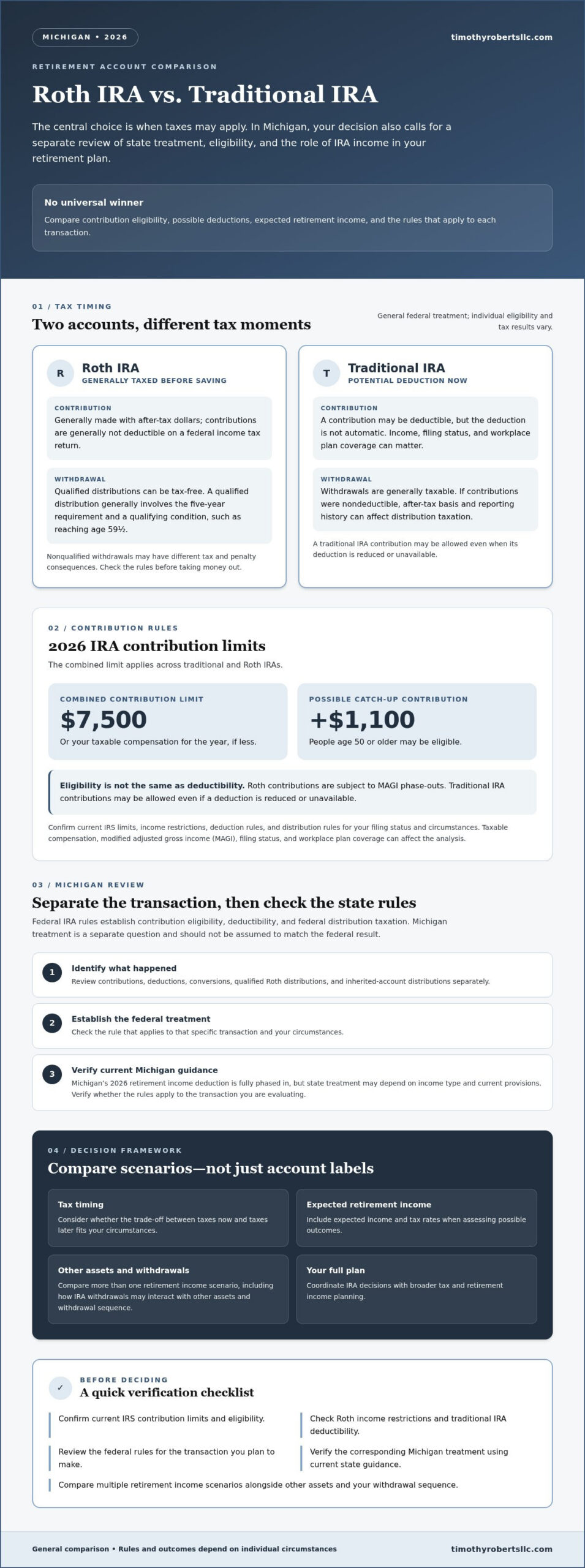
Both Roth and traditional IRAs can support retirement saving, but they generally place the tax bill at different points. A Roth IRA is typically funded with after-tax dollars, while traditional IRA contributions may be deductible depending on your circumstances and applicable rules.
In general, Roth contributions are taxed before they enter the account, and qualified withdrawals can be tax-free. Traditional IRA contributions may be deductible, and withdrawals are generally taxable. Eligibility, deductibility, and distribution taxation depend on current federal rules and your individual situation.
For a neutral overview of Roth IRA core features and how they compare with a traditional IRA, see this reference.
For a concise comparison, watch this video:
How does the tax timing differ?
With a Roth IRA, contributions are generally not deductible on your federal income tax return. A distribution is generally tax-free if it’s qualified, which usually means the account meets the five-year requirement and the distribution follows a qualifying condition, such as reaching age 59½. Nonqualified withdrawals can have different tax and penalty consequences, so check the rules before taking money out.
Traditional IRA contributions may be deductible, but a deduction isn’t automatic. Whether you can claim one may depend on your income, filing status, and whether you or your spouse is covered by a workplace retirement plan. If contributions aren’t deductible, distribution taxation can depend on the account’s after-tax basis and reporting history.
What does the Michigan part change?
Federal rules establish IRA contribution eligibility, deductibility, and federal distribution taxation. Michigan state income tax treatment is a separate question, and shouldn’t be assumed to mirror the federal result. For the roth ira vs traditional ira michigan decision, identify the transaction first, then verify its federal treatment and check current Michigan guidance for that same transaction.
Review contributions, deductions, conversions, qualified Roth distributions, and inherited-account distributions separately. Michigan’s retirement income rules may affect how some distributions are treated, but the outcome can depend on the type of income and current state provisions. Confirm the applicable 2026 guidance before estimating the state tax effect or choosing an account strategy.
How Roth and Traditional IRA Rules Affect Contributions and Withdrawals
Before comparing tax outcomes, separate two questions: can you contribute, and can you deduct a traditional IRA contribution? The rules depend on taxable compensation, modified adjusted gross income (MAGI), filing status, and whether you or your spouse is covered by a workplace retirement plan. Roth contribution eligibility and traditional IRA deductibility have different tests.
Who may contribute, and when might a traditional contribution be deductible?
For 2026, the combined contribution limit across traditional and Roth IRAs is $7,500, or your taxable compensation for the year if less. People age 50 or older may be eligible for an additional $1,100 catch-up contribution. Roth contributions are subject to MAGI phase-outs; traditional IRA contributions may be allowed even when a deduction is reduced or unavailable.
For example, workplace plan coverage can affect whether a traditional IRA contribution is deductible, while income and filing status also shape the result. For 2026, the IRS’s Traditional and Roth IRAs guidance, along with Publications 590-A and 590-B, is the authoritative reference for confirming contribution limits, eligibility, deduction rules, and distribution treatment for the tax year.
Check the current IRS thresholds for your filing status before contributing or claiming a deduction. Permission to contribute does not necessarily mean the contribution is deductible.
What should readers know about distributions and conversions?
A Roth IRA distribution is generally tax-free when it meets the IRS requirements for a qualified distribution, including applicable holding-period and qualifying-condition rules. A withdrawal that doesn’t qualify may have different tax consequences, so review the rules before taking funds out. Traditional IRA distributions are generally taxable to the extent they represent pre-tax money; after-tax basis and individual circumstances can affect the calculation.
A conversion moves eligible traditional IRA assets into a Roth IRA and can create taxable income, particularly when the converted amount consists of pre-tax funds. The tax impact depends on the account’s basis and your broader situation. Model the potential consequences before converting rather than assuming the move will lower your future tax bill.
For the roth ira vs traditional ira michigan decision, keep records of contributions, deductions, and any after-tax basis. Those details can matter when you later withdraw or convert assets. Review Michigan treatment separately from federal rules. Coordinated tax and retirement income planning can help you evaluate how an account choice fits into a wider strategy.
Roth IRA vs. Traditional IRA: Compare the Trade-Offs Before Choosing
Neither account is automatically better. For the roth ira vs traditional ira michigan decision, compare when taxes may apply, whether a deduction is available, and how each account could fit your future income needs. Your current tax rate matters, but it can’t determine future account value on its own. The value of a deduction, how it’s used, future tax rules, and withdrawal timing all influence the comparison.
| Factor | Roth IRA | Traditional IRA |
|---|---|---|
| Tax timing | Contributions are generally made with after-tax dollars. | Contributions may be deductible, depending on eligibility and circumstances. |
| Potential deduction | Contributions generally aren’t deductible. | A deduction may be available under applicable income, filing-status, and workplace-plan rules. |
| Withdrawals | Qualified distributions are generally tax-free; other withdrawals may have different tax consequences. | Distributions are generally taxable to the extent they represent pre-tax funds; basis and circumstances matter. |
| Planning flexibility | Generally not subject to lifetime required minimum distributions for the original account owner, subject to current rules. | Required minimum distributions generally apply under applicable rules. |
The IRS guide to Traditional and Roth IRAs explains the federal framework. Confirm current requirements before acting, and assess Michigan tax treatment separately rather than assuming it matches federal treatment.
When might Roth contributions fit a saver’s circumstances?
A Roth may suit someone who values paying tax before retirement in exchange for the potential of tax-free qualified withdrawals. Consider whether your income may change, how long the money could remain invested, and whether paying tax on contributions now fits your cash flow. A lower tax bracket today doesn’t automatically make Roth contributions the better choice. Future income, deductions, and state tax treatment can change the comparison.
When might a traditional IRA merit consideration?
A traditional IRA may warrant consideration if a contribution is deductible and that deduction supports your current plan. Weigh the potential upfront tax benefit against expected taxable income and withdrawal needs in retirement, without relying on a single forecast. Workplace-plan coverage, any after-tax account basis, and other retirement assets also affect the analysis.
Keep the investment decision distinct from the account’s tax structure. An IRA’s tax treatment doesn’t determine which investments it holds or how those investments perform. Compare account rules and investment choices separately, then review how both fit into your broader retirement income strategy.
Michigan IRA Tax Questions to Verify Before Making a Decision
A useful way to assess the roth ira vs traditional ira michigan question is to review each potential transaction in sequence: identify what you plan to do, confirm the federal rules, then check Michigan’s treatment for the relevant tax year. A contribution, deduction, conversion, withdrawal, and inherited-account distribution can each raise different questions. Don’t assume one answer covers them all.
Which Michigan tax details should readers check?
Start with the transaction. For a traditional IRA distribution, check whether the amount may be taxable under federal rules, then review how Michigan treats that income and whether current retirement-income provisions apply. For a Roth distribution, confirm whether it qualifies for tax-free federal treatment, then verify the Michigan result separately. Conversions and inherited-account distributions also call for their own review.
For tax year 2026, verify the Michigan treatment for your specific IRA transaction using current Michigan Department of Treasury guidance or qualified tax advice. State rules can change, and this section doesn’t establish a particular exemption or tax outcome.
Keep the questions distinct: Was a contribution made? Was a deduction claimed? Did a conversion occur? Is a withdrawal qualified under federal rules? Is the account inherited? Clear answers help you identify which guidance applies and what records to bring to a tax professional.
What information should readers gather first?
Prepare the details that can shape the analysis:
- Your filing status, income context, and whether you or your spouse had workplace-plan coverage.
- IRA contribution and deduction records, including any documented after-tax basis.
- The transaction you’re considering, its expected timing, and relevant account history.
- Other expected retirement income sources and the order in which you may draw from them.
This context matters because a tax result may depend on more than the IRA balance alone. Knowing your other income sources and planned withdrawal timing can help frame Michigan tax questions more precisely. Reviewing retirement income planning guidance can also help you consider how IRA withdrawals may fit alongside other sources of income.
Once you’ve gathered the relevant records, consider coordinating tax questions with your wider retirement income plan. Explore retirement income planning as one way to connect account decisions with your longer-term strategy.
Build an IRA Choice Into a Long-Term Retirement Income Plan
An IRA doesn’t operate in isolation. Its tax structure can interact with workplace accounts, taxable investments, expected retirement income, and the order in which you draw from different assets. A sound plan compares scenarios rather than relying on one prediction about your future tax rate. Income, goals, tax rules, and withdrawal needs can change over time.
For the roth ira vs traditional ira michigan decision, consider how each account could fit alongside your other resources. For example, a potential traditional IRA deduction may matter to your household today, while future withdrawals could affect taxable income later. A Roth account has a different pattern of tax treatment, but its role also depends on eligibility, Michigan rules, and the rest of your plan.
What questions can help clarify the decision?
Use these questions to move from a general comparison to a more personal review:
- Would a traditional IRA deduction, if available under current rules, meaningfully support your household’s current tax and savings plan?
- How do workplace retirement accounts and taxable assets fit with the income you expect to draw in retirement?
- What assumptions about income, tax rules, withdrawal timing, or personal goals should be revisited as circumstances change?
Compare more than one withdrawal sequence. A plan that draws from an IRA first may create a different tax picture than one that coordinates IRA withdrawals with workplace accounts or taxable assets. Treat projections as planning scenarios, not promises about future taxes or investment performance.
When can professional planning add perspective?
Coordinated tax and retirement income planning can be useful when an account decision affects several goals at once, such as current cash flow, future withdrawals, and investment management. Tax planning strategies can help frame the questions and compare possible outcomes, but they can’t guarantee a specific tax result. Strategic tax planning guidance may help you assess these connected decisions.
Consider discussing your circumstances with a fiduciary advisor. Ask how the advisor’s role applies to your situation, what assumptions inform the analysis, and how tax considerations connect with your broader retirement income plan. A coordinated review can help you weigh trade-offs without treating either IRA as the default answer.
Explore personalized retirement income planning to consider how an IRA choice may fit into your long-term strategy.
Make Your IRA Choice Part of a Broader Plan
The roth ira vs traditional ira michigan decision involves more than choosing whether to pay taxes now or later. Contribution eligibility, the availability of a deduction, federal distribution rules, Michigan tax treatment, and your other retirement resources all deserve consideration. Verify current rules for your tax year, then compare how each account could work within your expected income and withdrawal plan.
A single estimate of your future tax rate can’t settle the question. Compare multiple scenarios and revisit your assumptions as your income, goals, or tax rules change. Coordinated tax and retirement income planning can help bring those factors into a more coherent strategy, without promising a particular tax outcome.
Timothy Roberts & Associates, LLC describes its advisors as fiduciaries and offers personalized retirement income and tax planning services. Its more than 25 years of experience may help you evaluate how an IRA fits into your broader financial picture. Explore personalized retirement income planning to discuss an IRA strategy in the context of your circumstances.
Frequently Asked Questions
Is a Roth IRA better than a traditional IRA in Michigan?
Neither account is universally better. The right fit depends on your eligibility, tax situation, and retirement income plan. In the roth ira vs traditional ira michigan comparison, consider whether a traditional IRA deduction is available, when you prefer to pay taxes, and how withdrawals may be treated under current Michigan rules. Compare more than one future-income scenario rather than relying on a single tax-rate estimate.
Are Roth IRA withdrawals tax-free in Michigan?
Qualified Roth IRA distributions are generally tax-free under federal rules, but that doesn’t by itself settle Michigan state tax treatment. Confirm whether your distribution meets current federal qualification requirements, then check Michigan Department of Treasury guidance for the applicable tax year and transaction. Nonqualified withdrawals may have different federal consequences. Inherited Roth accounts also follow separate distribution rules, so don’t assume the original account owner’s treatment applies.
Can I contribute to both a Roth IRA and a traditional IRA?
Generally, you may contribute to both types in the same year if you meet the applicable requirements, but the annual limit applies across your traditional and Roth IRAs combined. Your taxable compensation, Roth income eligibility, and the rules for any traditional IRA deduction still matter. Before contributing to both accounts, check current IRS limits and eligibility rules, and track the total deposited for the tax year.
How much can I contribute to an IRA in 2026?
For 2026, the combined contribution limit for traditional and Roth IRAs is $7,500, or your taxable compensation for the year if that amount is lower. If you’re age 50 or older, you may contribute an additional $1,100, for a possible total of $8,600. These limits apply across both IRA types, not separately to each one. Confirm eligibility and current IRS guidance before contributing.
What happens if my income is too high for a Roth IRA contribution?
If your modified adjusted gross income exceeds the applicable Roth IRA limit, your permitted direct contribution may be reduced or eliminated. The exact result depends on filing status and the tax year. You may still be eligible to contribute to a traditional IRA, though deductibility is a separate question. Some people consider a Roth conversion strategy, but conversions can create taxable income and should be reviewed against current rules.
Do traditional IRA contributions reduce Michigan state income taxes?
They may, but a Michigan tax reduction isn’t automatic. A deductible traditional IRA contribution can affect federal adjusted gross income, which is relevant to Michigan tax calculations, but state adjustments and your specific facts may change the result. A nondeductible contribution generally doesn’t provide the same upfront deduction. Check current Michigan Department of Treasury instructions for your tax year or consult a qualified tax professional.
When are required minimum distributions due from an IRA?
Traditional IRA owners generally must begin required minimum distributions by the applicable age under current law. For people born from 1951 through 1959, that age is generally 73; for those born in 1960 or later, it is generally 75. The first RMD is usually due by April 1 of the following year, with later annual RMDs due by December 31. Roth IRA owners don’t have lifetime RMDs, but inherited accounts have separate rules.