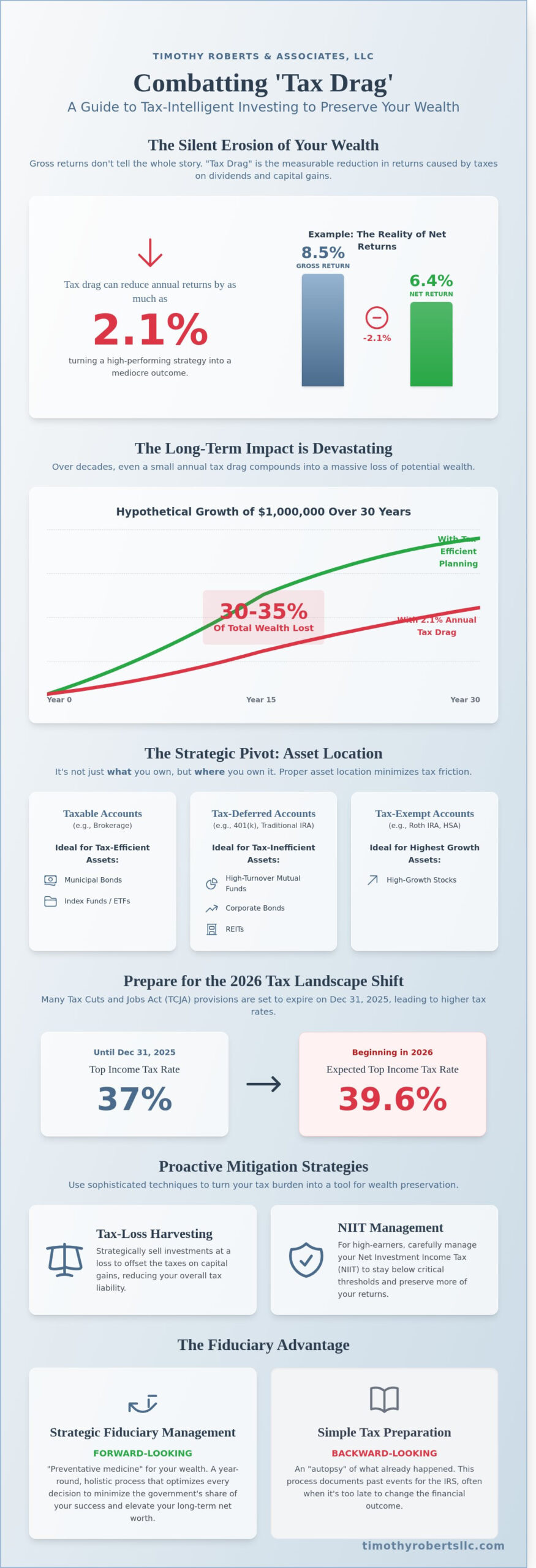
The true measure of your wealth isn’t found on your brokerage statement; it’s found on the bottom line of your tax return. As the sunset of the Tax Cuts and Jobs Act at the end of 2025 reshapes the fiscal landscape, the need for sophisticated tax-efficient investing strategies michigan investors can leverage has never been more urgent. You likely recognize the frustration of watching high tax drag diminish your portfolio’s growth, particularly when your tax preparer and financial advisor don’t seem to be reading from the same playbook.
We believe that true wealth elevation requires a synthesis of proactive asset location and expert tax preparation. In this guide, you’ll discover how to minimize your liability and maximize after-tax returns through a cohesive strategy that treats tax planning as a core component of investment management. We’ll examine the impact of Michigan’s 4.25% flat tax rate, explore the expanded flexibility of 529 plans beginning in 2026, and show you how a fiduciary-led approach provides the confidence that someone is finally looking at your entire financial picture with precision and care.
Key Takeaways
- Transition from reactive year-end filings to a proactive discipline that identifies and mitigates hidden tax drag on your investment compounding.
- Master the distinction between asset allocation and location to ensure high-tax-drag assets are strategically placed within tax-advantaged accounts.
- Capitalize on the 2026 tax landscape by optimizing Roth conversions and maximizing contribution limits for “super-funded” vehicles like 401(k)s and SEP IRAs.
- Transform market volatility into a strategic advantage by employing tactical tax-loss harvesting while strictly navigating complex IRS wash sale regulations.
- Secure your financial evolution through tax-efficient investing strategies michigan residents use to unify fiduciary portfolio management with expert tax preparation.
The Strategic Importance of Tax-Efficient Investing Strategies in Michigan
Wealth evolution isn’t defined by the numbers on a quarterly statement but by the capital that remains in your accounts after the government takes its share. High-net-worth individuals often realize too late that their growth is being stifled by “tax drag,” the silent friction created when taxes on dividends, interest, and capital gains erode the power of compounding. To combat this, we view tax-efficient investing strategies michigan residents can utilize as a proactive, year-round discipline rather than a reactive scramble during the first week of April. This approach transforms tax liability from an unpredictable expense into a manageable variable within your broader financial architecture.
It’s vital to distinguish between illegal tax evasion and strategic tax avoidance. While the former involves willful non-payment, the latter is a sophisticated exercise in efficiency. By aligning your portfolio with the current tax code, you aren’t just following the law; you’re optimizing your right to keep more of what you’ve built. Utilizing tools like Tax-Loss Harvesting allows investors to turn market volatility into a strategic asset, using realized losses to offset gains and lower their overall tax bill.
To better understand the mechanics of this high-level approach, watch this overview of tax-efficient portfolio construction:
Understanding After-Tax Yield
After-tax yield is the only performance metric that truly dictates your future purchasing power and lifestyle flexibility. Gross returns offer a superficial view of success, but they fail to account for the “silent” costs of tax inefficiency that disproportionately affect high-earners. When standard investment allocations are applied without regard for tax brackets, the resulting “leakage” can significantly delay your arrival at key financial milestones.
The 2026 Tax Landscape for Michigan Investors
The year 2026 represents a critical juncture for investors due to the scheduled sunset of the Tax Cuts and Jobs Act (TCJA) at the end of 2025. This shift means federal tax provisions are changing, potentially pushing many into higher brackets just as retirement savings limits have increased. In Michigan, the 4.25% flat income tax rate also applies to capital gains, making it essential to understand how state-specific policies interact with federal regulations. For residents in cities like Detroit, where an additional 2.4% local income tax applies, a localized wealth management framework isn’t just a benefit; it’s a necessity for preserving wealth in a shifting fiscal environment.
Optimizing Asset Location: Beyond Traditional Allocation
Asset allocation defines what you own, yet asset location determines what you keep. This distinction is a cornerstone of the sophisticated tax-efficient investing strategies michigan investors employ to shield their growth from unnecessary erosion. While traditional allocation balances risk and reward across various asset classes, strategic location focuses on placing those assets in the specific account types, taxable, tax-deferred, or tax-exempt, that offer the most favorable treatment. It’s a rhythmic exercise in precision that ensures your portfolio’s structure is as intentional as its selection.
For high-net-worth families, this isn’t merely a matter of organization; it’s a critical component of multi-generational wealth transfer. By placing assets with high growth potential in taxable accounts, investors can maximize the benefit of a “step-up in basis” for their heirs, effectively erasing decades of capital gains taxes upon transfer. Conversely, income-heavy assets are better suited for the shelter of a retirement vehicle. This high-level thinking transforms a simple list of holdings into a robust engine for long-term preservation.
Tax-Inefficient vs. Tax-Efficient Assets
Identifying which investments trigger the highest tax drag is the first step in a custom intervention. Assets like Real Estate Investment Trusts (REITs), taxable bonds, and high-turnover actively managed funds often generate significant ordinary income or frequent capital gains distributions. These tax-inefficient holdings are best housed in protected accounts like a Roth IRA or 401(k). These accounts act as a strategic buffer against the recurring tax events that would otherwise hinder compounding.
In contrast, tax-efficient assets such as broad-market index funds or ETFs, which trade infrequently, are ideal for taxable brokerage accounts. According to the guidelines in IRS Publication 550, the way investment income is categorized, whether as interest, dividends, or capital gains, radically alters its fiscal impact. Actively managed funds often create “tax surprises” by distributing gains even when the fund’s overall value has decreased, a scenario that sophisticated planning aims to avoid through the use of more stable, index-based vehicles.
The Fiduciary Approach to Portfolio Rebalancing
Maintaining a target allocation is vital for risk management, but the act of rebalancing itself can be a catalyst for unintended tax events. A fiduciary manages this process with a tax-first mindset, using dividends or new contributions to adjust weights rather than selling appreciated positions. This tax-aware rebalancing ensures that your risk profile remains stable without triggering a significant bill from the Treasury. It’s a method that values depth over superficial movement, prioritizing your net-of-tax results.
Our approach to investment portfolio management detroit integrates these nuances into every trade. By viewing the portfolio as a single, cohesive ecosystem rather than a collection of isolated accounts, we help clients maintain their upward progression with minimal friction. If you’re unsure if your current holdings are in the optimal location, a comprehensive review of your tax planning strategies can reveal significant opportunities for optimization.
Navigating Tax-Deferred and Tax-Advantaged Vehicles for 2026
The selection of investment vehicles is no longer a static decision. With the sunset of the Tax Cuts and Jobs Act, the 2026 fiscal environment demands a more agile approach to where capital is deployed. Maximizing “super-funded” vehicles like 401(k)s and 403(b)s, which see contribution limits rise to $24,500 in 2026, serves as the first line of defense against rising federal brackets. For Michigan residents, these contributions provide a dual benefit by lowering federal taxable income while simultaneously reducing the state’s 4.25% flat tax burden. It’s a foundational element of the Tax-Efficient Investing framework that prioritizes long-term compounding over immediate liquidity.
Beyond traditional retirement accounts, the Health Savings Account (HSA) has emerged as a premier investment tool for those seeking a triple-tax advantage. Contributions are tax-deductible, growth is tax-free, and withdrawals for qualified medical expenses remain untaxed. With 2026 limits reaching $4,400 for individuals and $8,750 for families, the HSA functions as a specialized intervention for long-term wealth preservation. Additionally, Michigan municipal bonds remain a cornerstone of local strategy. They offer interest income that is typically exempt from both federal and state taxes, providing a high level of after-tax stability for conservative portfolio tranches.
Roth Conversion Strategies for High-Net-Worth Individuals
The shift toward higher tax brackets in 2026 makes the “pay now or pay later” dilemma particularly acute. Executing a Roth conversion allows you to pay taxes at today’s known rates to secure tax-free distributions in the future. This strategy requires identifying the “sweet spot” within your current bracket to avoid an accidental jump into the highest marginal tier. Our approach to retirement income planning ann arbor integrates these conversions into a multi-year roadmap, ensuring that your tax-efficient investing strategies michigan plan accounts for both current cash flow and future legacy goals.
Advanced Small Business Retirement Planning
Michigan entrepreneurs have access to powerful tax-shielding tools that go beyond standard individual limits. SEP IRAs and Solo 401(k)s allow business owners to contribute significantly larger sums, effectively turning business revenue into personal wealth with minimal tax friction. This synergy between corporate expense management and personal growth is vital for those planning an eventual exit. By structuring these plans correctly years in advance, you ensure that your business succession is as tax-efficient as the growth phase that preceded it. This level of business-focused fiscal oversight is similar to the expertise provided by The Sphere Group, which helps business owners align their corporate structure with long-term wealth goals. It’s a journey of upward progression that requires a visionary strategist to execute with precision.
Tactical Wealth Preservation: Tax-Loss Harvesting and Rebalancing
Volatility is not a threat to be feared; it’s a resource to be harvested. Tactical tax-loss harvesting is one of the most potent tax-efficient investing strategies michigan families can use to offset capital gains and reduce overall liability. By selling securities that have declined in value, you lock in a tax asset that neutralizes gains elsewhere in your portfolio. If your losses exceed your gains, you’re permitted to use up to $3,000 of the excess to offset ordinary income annually, with any remaining amount carried forward to future years. This strategy ensures that even market downturns contribute to your long-term upward progression.
While many firms treat this as a seasonal December rush, a true fiduciary maintains a state of constant vigilance. Market fluctuations happen year-round, and capturing losses when they occur ensures you aren’t leaving money on the table. This proactive stance ensures your portfolio remains lean and fiscally optimized regardless of the calendar date. If you’re ready to move beyond reactive planning, contact our team to discuss a year-round harvesting strategy tailored to your specific goals.
The Wash Sale Rule and Strategic Replacements
Precision is paramount when booking losses. The IRS mandates a 30-day window before and after a sale where you cannot purchase substantially identical securities. Violating this Wash Sale Rule results in the loss being disallowed for tax purposes. We solve this by selecting replacement assets that maintain your target risk profile while respecting these regulatory boundaries. This level of oversight is particularly crucial for those with multiple accounts, as automated platforms often trigger wash sales across separate IRAs and brokerage accounts without warning.
Capital Gains Management and Gifting
For those with highly appreciated assets, gifting can be more effective than selling. Donating long-term appreciated securities to a qualified charity allows you to eliminate the capital gains tax entirely while claiming a deduction for the full fair market value. This is a sophisticated intervention that aligns your philanthropic goals with your fiscal efficiency. Our work in estate planning farmington hills often uses these moves to bridge the gap between current wealth management and long-term legacy objectives. By timing the realization of gains and losses with surgical precision, we help you maintain a portfolio that is as functional as it is tax-aware.
The Fiduciary Advantage: Integrating Tax Advising with Portfolio Management
A disconnected financial life is often the primary source of wealth erosion. When your investment strategy and your tax compliance exist in separate silos, the result is “tax leakage,” a series of missed opportunities that only become visible when it’s too late to intervene. True wealth management requires a single, cohesive vision where every trade is evaluated for its impact on your next filing. This “One Team” approach is the cornerstone of the fiduciary advantage. By integrating tax preparation directly with portfolio management, we ensure that the tax-efficient investing strategies michigan residents rely on are executed with surgical precision.
Timothy Roberts & Associates, LLC bridges the gap between your brokerage statements and your tax return. We move beyond transactional advice to build a long-term partnership focused on your organizational and personal evolution. This isn’t about off-the-shelf solutions; it’s about a carefully crafted intervention that respects the complexity of your financial life. With over 25 years of strategic advisory experience, we’ve seen how a unified front can transform a portfolio from a collection of assets into a high-performance engine for growth. Our fiduciary standard of care means your best interest is the only metric that matters.
The Synthesis of Tax Preparation and Wealth Management
Seeing the actual tax return allows for a level of precision that a disconnected advisor simply cannot match. It’s one thing to estimate a tax bracket; it’s quite another to analyze the specific line items of your 1040 to identify exact rebalancing opportunities. This synthesis allows us to transition from once-a-year filing to a state of constant, year-round optimization. Our tax advising ann arbor services are designed to elevate your wealth by ensuring that your investments are always aligned with the latest regulatory shifts and personal milestones. This proactive stance eliminates the “tax surprises” that often plague high-net-worth investors.
Your Path to Upward Progression
The journey from reactive investing to strategic wealth elevation is a transformation from uncertainty to confidence. It’s the peace of mind that comes from knowing a fiduciary partner is looking at the “big picture,” balancing the aesthetics of a well-constructed portfolio with the hard-edged functionality of tax-efficient investing strategies michigan. As you look toward the fiscal changes of 2026, don’t settle for a fragmented strategy. Your upward progression deserves a visionary strategist who understands that every dollar saved from tax drag is a dollar that continues to work for your legacy. We invite you to a customized consultation to evaluate your current tax efficiency and discover how a unified approach can redefine your after-tax results.
Securing Your Financial Evolution for 2026 and Beyond
Managing wealth in a shifting fiscal landscape requires more than just selecting the right holdings; it demands a meticulous alignment of your assets with the ever-evolving tax code. By mastering the nuances of asset location and employing tactical tax-loss harvesting, you transform potential liabilities into strategic advantages. The upcoming sunset of the Tax Cuts and Jobs Act makes this the ideal moment to refine your approach. Implementing sophisticated tax-efficient investing strategies michigan families use to preserve capital ensures that your upward progression remains uninterrupted by unnecessary tax drag.
At Timothy Roberts & Associates, we offer the rare synthesis of integrated tax and wealth management solutions designed for high-net-worth individuals. With over 25 years of fiduciary expertise, our team provides the personalized strategies necessary to navigate Michigan’s unique tax environment with confidence. It’s time to bridge the gap between your portfolio and your tax return to ensure every dollar works toward your legacy. We invite you to Schedule a Strategic Consultation with Timothy Roberts & Associates today. Your future self will appreciate the precision you apply to your wealth today.
Frequently Asked Questions
What is the most tax-efficient investment strategy for Michigan residents in 2026?
The most effective tax-efficient investing strategies michigan residents can employ in 2026 involve a synthesis of precise asset location and maximizing the expanded flexibility of 529 plans. By placing high-growth assets in taxable accounts to benefit from the step-up in basis and utilizing Michigan’s 4.25% flat tax rate for strategic income realization, you can significantly enhance your after-tax yield. This approach ensures your portfolio’s architecture remains resilient against the sunsetting provisions of the Tax Cuts and Jobs Act.
How does the fiduciary standard protect my interests in tax planning?
The fiduciary standard mandates that an advisor acts with a legal obligation to prioritize your best interests above their own at all times. In the context of tax planning, this means your advisor is incentivized to focus on your net-of-tax returns rather than simply chasing gross performance numbers that might trigger unnecessary liabilities. This level of accountability ensures that every recommendation is a carefully crafted intervention designed to support your long-term upward progression.
Can tax-loss harvesting really improve my long-term portfolio performance?
Tax-loss harvesting improves long-term performance by systematically reducing the “tax drag” that otherwise erodes compounding. By realizing losses to offset capital gains and up to $3,000 of ordinary income, you essentially create a tax asset that keeps more of your capital working in the market. Over decades, the reinvestment of these tax savings can lead to a substantially larger portfolio compared to a reactive, non-harvested strategy.
What is the difference between asset allocation and asset location?
Asset allocation focuses on the diversification of your holdings to manage risk, while asset location dictates the specific account types where those holdings reside. Allocation answers the question of what you should own, such as a mix of stocks and bonds. Location determines whether those assets should be held in taxable brokerage accounts, tax-deferred IRAs, or tax-exempt Roth accounts to minimize the recurring friction of annual taxes.
How do Roth conversions impact my Michigan state taxes?
Executing a Roth conversion triggers Michigan’s 4.25% flat income tax on the total converted value during the year of the transaction. While this creates an immediate state and federal tax bill, it effectively locks in today’s rates and shields all future growth and distributions from further taxation. For many high-net-worth families, paying this state tax now is a strategic move to avoid potentially higher local or federal burdens in the future.
Is it better to pay taxes now or later on my retirement investments?
The decision to pay taxes now or later rests on your projected marginal tax rate at the time of distribution versus your current rate. With many federal tax provisions set to expire at the end of 2025, paying taxes now through Roth contributions or conversions may be more efficient if you expect your future bracket to be higher. It’s a journey of balancing current cash flow needs with the visionary goal of long-term tax-free growth.
What are the tax implications of rebalancing my portfolio?
Rebalancing often necessitates the sale of appreciated assets, which can trigger capital gains taxes in taxable brokerage accounts. To mitigate this, a tax-aware rebalancing strategy uses new contributions or incoming dividends to buy underweighted assets rather than selling winners. When sales are necessary, fiduciaries look for offsetting losses to ensure that maintaining your risk profile doesn’t result in an unintended and costly surprise on your next tax return.
How does Timothy Roberts & Associates integrate tax preparation with financial planning?
Timothy Roberts & Associates eliminates the disconnect between your wealth strategy and your tax return by operating as a single, integrated team. We use the specific data from your prepared tax return to inform our tax-efficient investing strategies michigan, ensuring that rebalancing and harvesting decisions are based on reality rather than estimates. This “One Team” approach provides a level of precision and personal attention that siloed firms simply cannot replicate.