

Mar
Tax Implications of Your Investment Portfolio: A Strategic Guide to Wealth Preservation
The most significant threat to your financial legacy isn’t a volatile market; it’s the silent erosion of your wealth through inefficient planning. It’s common to feel as though you’re being punished for your success, especially as the December 31, 2025, sunsetting of critical tax provisions approaches. Managing the tax implications investment portfolio structures create across multiple accounts is a sophisticated challenge that requires more than just a passive approach.
You’ve worked diligently to grow your assets, yet without a bespoke strategy, you may be losing significant ground to avoidable liabilities. You’ll discover how to identify and mitigate “tax drag,” a phenomenon that can reduce annual returns by as much as 2.1% according to recent industry benchmarks, to secure your retirement and elevate your net-worth. This guide provides a strategic framework for asset location and actionable techniques like tax-loss harvesting to transform your tax burden into a powerful tool for wealth preservation.
Key Takeaways
- Identify the hidden impact of “tax drag” to ensure your retirement projections reflect the reality of net returns rather than mere gross performance.
- Navigate the complexities of the 2026 tax landscape to proactively shield your diverse assets from upcoming legislative shifts and sunsetting provisions.
- Learn to distinguish between asset allocation and asset location, an essential pivot for mitigating the tax implications investment portfolio structures face today.
- Implement sophisticated mitigation strategies, such as tax-loss harvesting and NIIT management, to preserve your wealth against high-earner tax thresholds.
- Discover how a holistic, fiduciary-led approach can elevate your financial trajectory through bespoke, tax-intelligent planning tailored to your unique goals.
Understanding ‘Tax Drag’: Why Gross Returns Aren’t the Full Story
True wealth isn’t captured by the top-line numbers on a brokerage statement. It’s found in the net residue after the fiscal authorities have taken their portion. Many investors spend years chasing high-performance funds, only to realize their actual progress is stunted. This disconnect occurs because the tax implications investment portfolio owners face are often treated as an afterthought rather than a primary strategy. To build a legacy, you must shift your focus from what you make to what you keep. This is the foundation of tax-aware investing.
To visualize how different investment vehicles affect your bottom line, watch this analysis:
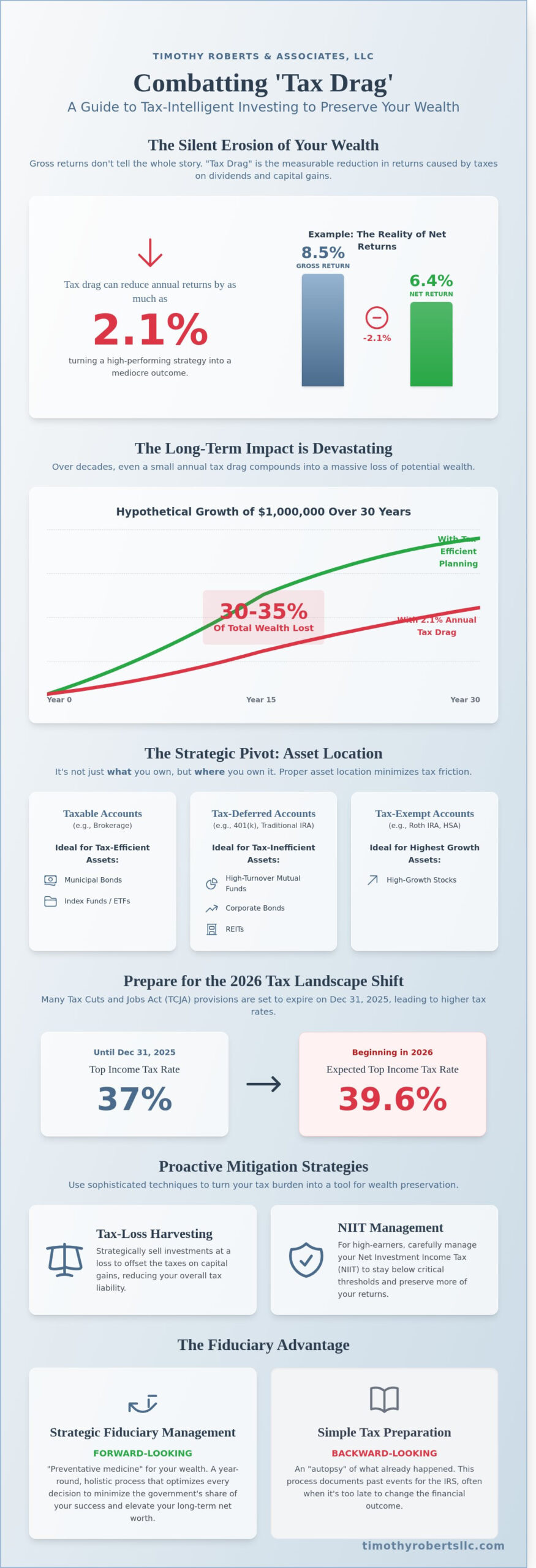
Tax drag represents the measurable reduction in your potential return caused by taxes on capital gains and dividends. It’s the friction that slows your wealth engine. Tax drag is the silent erosion of wealth that occurs when investment decisions ignore fiscal consequences. When you ignore this friction, your retirement projections become dangerously inaccurate. A portfolio showing an 8.5% gross return might only deliver 6.8% after accounting for the Capital Gains Tax in the U.S. and various dividend levies. Over several decades, this gap doesn’t just grow; it explodes, leaving you with a fraction of the lifestyle you anticipated.
The psychological shift required for high-net-worth individuals is profound. You’ve likely spent your career optimizing for income and growth. However, the tax implications investment portfolio structures create can turn a successful year into a liability. Strategic management requires a bespoke approach where every asset is placed intentionally. This holistic perspective ensures that your growth is not just theoretical on a spreadsheet but tangible in your bank account. It’s about moving away from the vanity of gross returns toward the reality of spendable wealth.
The Impact of Compounding on Tax-Eroded Returns
A 1.5% annual tax drag might seem negligible in a single year. However, over a 30-year horizon, that small leak can siphon off 30% to 35% of your total wealth. Frequent trading in non-sheltered accounts creates constant tax friction, forcing you to pay the IRS today instead of letting that capital compound for tomorrow. This structural inefficiency turns a high-performing strategy into a mediocre outcome. Every dollar paid in unnecessary taxes is a dollar that loses its ability to grow exponentially for your future.
Fiduciary Oversight vs. Simple Tax Preparation
Standard tax preparation is a backward-looking exercise. Your CPA documents what already happened, often when it’s too late to change the outcome. In contrast, strategic fiduciary management involves forward-looking tax planning. It’s the difference between an autopsy and preventative medicine. Holistic oversight ensures that every trade and rebalancing decision is optimized to elevate your long-term net worth. True advisors don’t just file forms once a year; they innovate and optimize your holdings year-round to minimize the government’s share of your success.
Decoding the 2026 Tax Landscape: How Different Assets Are Taxed
Building a resilient financial legacy requires more than selecting high-performing assets. It demands a holistic understanding of how the IRS views those gains. The current tax environment is temporary. On December 31, 2025, many provisions of the Tax Cuts and Jobs Act (TCJA) will expire. This shift will fundamentally alter the tax implications investment portfolio owners must manage. Investors should prepare for a return to higher individual brackets, with the top rate climbing from 37% back to 39.6%. This transition transforms tax planning from a seasonal task into a strategic necessity.
Capital Gains in a Post-TCJA World
The distinction between short-term and long-term gains remains a cornerstone of strategic tax planning. Short-term gains are taxed at ordinary income rates, which could reach 39.6% after 2025. Long-term gains benefit from preferential rates of 0%, 15%, or 20%. According to IRS Publication 550, an asset must be held for more than one year to qualify for these lower tiers. High-income earners often face an additional 3.8% Net Investment Income Tax, making the effective top rate 23.8% for long-term gains. This makes the timing of asset liquidation a high-stakes decision.
Checklist for Long-Term Readiness:
- Assets held for 366 days or more to ensure preferential rate eligibility.
- Mutual fund distributions categorized specifically as capital gain distributions.
- Stocks purchased during market dips that have reached a mature growth phase.
- Bespoke portfolios aligned with a multi-year growth horizon rather than rapid turnover.
Interest Income and Ordinary Dividends
Fixed-income instruments like corporate bonds generate interest that the IRS treats as ordinary income. This makes bond interest the most expensive income in a taxable account because it’s taxed at your highest marginal rate. While municipal bonds offer tax-exempt interest, corporate yields are fully exposed to the upcoming 2026 bracket increases. Real Estate Investment Trusts (REITs) also present a unique challenge. Most REIT distributions are non-qualified, meaning they don’t receive the 15% or 20% dividend rate. Currently, the Section 199A deduction allows individuals to deduct 20% of qualified business income from REITs, but this incentive is scheduled to disappear in 2026, significantly reducing the net yield for many investors.
Strategic investors prioritize qualified dividends to optimize their after-tax returns. To qualify, you must hold the stock for more than 60 days during the 121-day period surrounding the ex-dividend date. This distinction allows high-income earners to pay 20% instead of nearly 40% on their distributions. It’s a powerful lever for those looking to elevate their portfolio’s efficiency. A strategic portfolio review can identify opportunities to shift assets into more tax-efficient vehicles before the 2026 deadline. Proper asset location, such as placing high-interest bonds in tax-deferred accounts and growth stocks in taxable accounts, remains a vital tactic to mitigate the tax implications investment portfolio structures face in a shifting regulatory environment.
The intersection of aesthetics and functionality in a portfolio isn’t just about the assets you choose; it’s about the structure you build around them. By anticipating the 2026 sunset, you can innovate your approach to wealth preservation. This proactive stance ensures that your growth isn’t eroded by avoidable tax liabilities.
The Strategic Pivot: Asset Location vs. Asset Allocation
Investment success is often viewed through the lens of what you own. This is asset allocation, the foundational decision of how to divide capital between stocks, bonds, and alternatives. Yet, a more sophisticated layer exists that frequently determines the difference between a high-performing portfolio and a truly optimized one. Asset location is the strategic art of deciding where you hold those assets. While allocation manages risk and reward, location manages the tax implications investment portfolio owners face every year. It’s the most overlooked tool for elevating net returns without increasing market exposure.
Sophisticated investors utilize the Tax Triangle to organize their wealth. This framework consists of three distinct buckets: taxable brokerage accounts, tax-deferred vehicles like Traditional IRAs, and tax-free environments such as Roth accounts. A 2023 study by Vanguard suggests that proper asset location can add up to 75 basis points (0.75%) to a portfolio’s annual net return. This isn’t a product of market timing; it’s a product of structural discipline. By aligning the tax characteristics of an asset with the tax treatment of the account, you transform a standard strategy into a bespoke financial architecture.
- Taxable Bucket: Best for assets that generate little annual income or benefit from lower capital gains rates.
- Tax-Deferred Bucket: Ideal for high-yield bonds and REITs that would otherwise be taxed at ordinary income rates up to 37%.
- Tax-Free Bucket: Reserved for high-growth equities with the greatest potential for long-term appreciation.
Optimizing the Taxable Brokerage Account
In a taxable environment, efficiency is the primary objective. Index funds and municipal bonds represent the bespoke choice for these accounts because they minimize involuntary tax events. Conversely, many actively managed mutual funds are notoriously inefficient. In 2021, for instance, several prominent funds triggered capital gains distributions exceeding 20% of their net asset value, forcing investors to pay taxes even if they didn’t sell a single share. To maintain control, focus on Tax-Efficient Investing Strategies that prioritize low-turnover assets. This approach ensures your capital remains invested rather than being diverted to the IRS.
Leveraging Roth and Traditional IRAs
The strategic placement of assets within retirement accounts requires a forward-looking vision. Roth IRAs are the ultimate sanctuary for high-growth assets. Since withdrawals are tax-free, placing your most aggressive equity holdings here maximizes the benefit of compounding. Traditional IRAs serve a different, more utilitarian purpose. These accounts are the logical home for tax-inefficient, high-income producing assets like corporate bonds or Real Estate Investment Trusts (REITs). By shielding these distributions from immediate taxation, you optimize the tax implications investment portfolio performance experiences over a multi-decade horizon. This careful calibration turns a generic retirement plan into a powerful engine for wealth preservation.
Proactive Mitigation: Harvesting Losses and Managing the NIIT
Sophisticated wealth management isn’t just about selecting high-performing assets; it’s about the precision with which you manage the friction of taxation. To optimize the tax implications investment portfolio owners face, one must move beyond passive holding. Proactive mitigation transforms market volatility into a strategic advantage through structured loss harvesting and disciplined bracket management. This process requires a visionary strategist who views a portfolio as a living ecosystem rather than a static collection of tickers.
The Wash Sale rule remains a critical hurdle for the unwary investor. Under Internal Revenue Code Section 1091, the IRS disallows a loss deduction if you purchase a substantially identical security within 30 days before or after the sale. This 61-day window requires a bespoke approach to rebalancing. You must replace the sold asset with a correlated, yet legally distinct, alternative to maintain market exposure without triggering a costly tax penalty. It’s a delicate balance of aesthetics and functionality in portfolio design.
A 4-Step Framework for Tax-Loss Harvesting
Strategic harvesting requires a logical sequence to ensure compliance and maximize the economic benefit of a market downturn. This framework allows you to elevate your returns by lowering your tax bill.
- Step 1: Identify underperforming assets where the current market value has fallen below the original cost basis meticulously.
- Step 2: Sell these positions to lock in the capital loss, creating a tax asset that offsets realized capital gains.
- Step 3: Reinvest the proceeds into a different security that offers similar sector exposure to avoid the 30-day Wash Sale trap while staying invested.
- Step 4: Use the loss to offset up to $3,000 of ordinary income on your federal return, carrying any excess forward into future tax years indefinitely.
Navigating the 3.8% Net Investment Income Tax
The Net Investment Income Tax (NIIT) represents a significant 3.8% levy on top of existing capital gains rates for high earners. For the 2026 tax year, the Modified Adjusted Gross Income (MAGI) thresholds are projected to remain at $250,000 for married couples filing jointly and $200,000 for individuals. Strategic distributions are essential here. By shifting the timing of income or utilizing tax-exempt municipal bonds, you can keep your MAGI below these critical levels and protect your net returns from this additional layer of taxation.
Transitioning into retirement demands a holistic view of tax-bracket management. This process isn’t a static event but a multi-year journey that requires intellectual curiosity and business-minded rigor. You can optimize your lifetime tax liability by intentionally realizing income in lower-bracket years, perhaps through partial Roth conversions or targeted brokerage withdrawals. This level of foresight ensures that the tax implications investment portfolio shifts don’t erode your purchasing power during your most vital years. It’s about crafting a narrative of partnership between your current self and your future legacy. As the calendar year draws to a close, implementing a comprehensive year-end tax planning strategy becomes essential for maximizing these opportunities before the 2026 legislative changes take effect.
The Fiduciary Advantage: Integrating Tax Strategy into Your Holistic Wealth Plan
True wealth management transcends simple asset allocation. It requires a rigorous, forward-looking assessment of how taxes erode capital over decades. When we analyze the tax implications investment portfolio structures create, we aren’t just looking for deductions. We’re engineering a defense against the friction that slows your financial momentum. Most investors view their accounts as a fragmented collection of statements. We transform that view into a unified, strategic engine where tax efficiency is built into the architecture of every trade. This shift from a reactive stance to a proactive strategy is what separates a standard portfolio from a high-performance wealth plan.
A fiduciary standard demands more than just “good enough” returns. It requires a commitment to maximizing what you keep. By synchronizing your investment decisions with a proactive tax strategy, we ensure that every dollar remains purposeful. This integration provides a rare level of clarity. You stop reacting to tax season and start dictating your financial outcomes. It’s about the peace of mind that comes from knowing your wealth plan is optimized for the 37% top federal bracket or the nuances of state-level obligations. We focus on the intersection of aesthetics and functionality, ensuring your financial structure is as elegant as it is effective.
Bespoke Wealth Engineering for Michigan Families
For over 25 years, Timothy Roberts & Associates, LLC has served as a strategic anchor for high-net-worth families across the Metro Detroit and Ann Arbor regions. We understand that Michigan’s 4.25% flat income tax rate is only one piece of a complex puzzle. Our firm bridges the traditional gap between tax preparation and investment advisory by housing both disciplines under one roof. This synergy eliminates the communication silos that often lead to missed opportunities for tax-loss harvesting or inefficient capital gains distributions. We don’t offer off-the-shelf products. Instead, we craft bespoke interventions that reflect your specific legacy goals, whether you’re navigating the sale of a business or optimizing multi-generational transfers.
Your Next Strategic Move
The transition from a collection of accounts to a high-performance portfolio begins with a diagnostic review. We frequently identify “tax leaks” where investors inadvertently pay 15% to 20% more in capital gains taxes than necessary due to poor asset location. Our team provides a comprehensive analysis to plug these gaps and realign your holdings with your long-term vision. It’s time to move beyond passive management and embrace a more intentional approach to growth. We look at the granular details, from the timing of your distributions to the specific tax-character of your assets, to ensure nothing is left to chance.
Take the first step toward a more efficient financial future. Explore our Tax Advising services to see how Timothy Roberts & Associates, LLC can elevate your strategy. We invite you to schedule a portfolio review where we’ll examine the tax implications investment portfolio management has on your net worth. Let’s ensure your wealth works as hard for you as you did to build it. Our goal is to move you from a state of uncertainty to a position of strategic command, where every financial move is a deliberate step toward your ultimate objective.
Mastering the Future of Your Wealth
The landscape of wealth preservation is shifting as we approach the 2026 sunset of the Tax Cuts and Jobs Act. True growth isn’t measured by gross returns; it’s defined by what remains after accounting for the 3.8% Net Investment Income Tax and the inevitable friction of tax drag. Moving beyond simple asset allocation toward a strategy of meticulous asset location transforms a static portfolio into a dynamic engine for preservation. By integrating proactive loss harvesting and holistic planning, you ensure that your capital works with precision rather than reacting to legislative shifts.
Managing the tax implications investment portfolio owners face requires more than a casual glance at annual returns. It demands a visionary approach rooted in 25 years of fiduciary experience. Based in Ann Arbor and serving the Metro Detroit area, Timothy Roberts LLC provides the integrated tax and investment management necessary to navigate complex financial terrains. We don’t just manage assets; we craft bespoke trajectories for enduring success. Elevate your portfolio with a bespoke tax-efficiency review. Your path to optimized wealth is a shared journey toward lasting clarity and confidence.
Frequently Asked Questions
Do I pay taxes on my investments if I don’t sell them?
You don’t pay capital gains taxes on assets that remain unsold in your portfolio. This concept, known as unrealized gains, allows your capital to compound without immediate tax friction. However, you’ll still owe taxes on any interest or dividends paid out during the year. IRS Publication 550 confirms that tax liability only triggers upon a realization event like a sale, ensuring your long-term growth remains uninterrupted by annual levies.
What are the expected capital gains tax rates for 2026?
Long-term capital gains rates for 2026 are projected to remain at 0%, 15%, and 20% based on income thresholds, though the sunset of the Tax Cuts and Jobs Act on December 31, 2025, may shift the underlying income brackets. For a single filer, the 15% rate currently begins at $47,025 in 2024. Strategic planning ensures you optimize the tax implications investment portfolio owners face when these structural shifts occur in the federal code.
What is the difference between a qualified and a non-qualified dividend?
Qualified dividends are taxed at lower long-term capital gains rates, while non-qualified dividends are taxed as ordinary income. To qualify, you must hold the stock for more than 60 days during the 121-day period starting 60 days before the ex-dividend date. This distinction can mean the difference between paying a 15% tax rate versus a 37% rate for high-earning investors seeking a bespoke wealth strategy that prioritizes efficiency and precision.
How does tax-loss harvesting actually save me money?
Tax-loss harvesting saves you money by using investment losses to offset realized capital gains, reducing your total taxable liability. If your losses exceed your gains, you can use up to $3,000 to offset your ordinary income each year. This holistic approach transforms market volatility into a strategic advantage, allowing you to reinvest the tax savings back into your growth-oriented assets to elevate your overall market position.
Is it better to hold municipal bonds in a taxable or tax-deferred account?
You should typically hold municipal bonds in a taxable account because their primary benefit is their federal tax-exempt status. Placing them in a tax-deferred account like a 401(k) wastes this advantage, as all withdrawals from those accounts are eventually taxed as ordinary income. By optimizing asset location, you ensure that every component of your investment strategy serves a specific, elevated purpose in your broader and more sophisticated financial architecture.
What is the Net Investment Income Tax (NIIT) threshold for 2026?
The Net Investment Income Tax threshold is currently set at $200,000 for single filers and $250,000 for married couples filing jointly. This 3.8% surtax applies to the lesser of your net investment income or the amount by which your modified adjusted gross income exceeds these limits. Understanding these thresholds is essential for managing the tax implications investment portfolio growth creates for high-net-worth individuals navigating the complex 2026 fiscal environment.
Can I use investment losses to lower my regular income tax?
You can use up to $3,000 of net investment losses to reduce your ordinary taxable income annually. If your total losses exceed this $3,000 limit, the IRS allows you to carry the remaining balance forward to future tax years indefinitely. This mechanism provides a reliable safety net, ensuring that even underperforming assets contribute to a more efficient and resilient financial structure. It transforms a simple loss into a strategic tool for wealth preservation.
How does a Roth conversion impact my portfolio’s tax implications?
A Roth conversion creates an immediate tax event by treating the converted amount as ordinary income in the year of the transfer. While this requires a bespoke upfront payment, it eliminates future tax liabilities on both the principal and all subsequent growth. This strategic maneuver elevates your long-term flexibility, as qualified distributions after age 59.5 are entirely tax-free, protecting your legacy from future rate hikes and providing a predictable income stream.
