

Mar
Tax-Efficient Retirement Withdrawals in Farmington Hills: Your Strategic Checklist
A single misstep in your distribution sequence can cost a Michigan retiree upwards of $100,000 in unnecessary taxes over a twenty year period. You’ve spent decades building your legacy, yet the complexity of the 2024 Michigan pension tax updates and the search for tax-efficient retirement withdrawals in Farmington Hills often create a sense of persistent unease. It’s frustrating to watch your hard earned wealth diminish because of a lack of coordination between your 401(k), IRA, and taxable accounts. We believe your transition into this next chapter should be defined by clarity rather than confusion.
This guide introduces a sophisticated framework designed to transform your distribution strategy into a source of strategic stability. We’ll move beyond generic advice to provide a bespoke order of operations that minimizes your lifetime tax bill and protects your heirs. By the end of this checklist, you’ll have a holistic roadmap to optimize your sequencing, navigate RMDs with precision, and elevate your financial peace of mind for the years ahead.
Key Takeaways
- Identify why the “Retirement Red Zone” represents a critical window for transitioning from simple asset accumulation to sophisticated income engineering.
- Implement a strategic sequence for tax-efficient retirement withdrawals farmington hills residents can use to protect their wealth against unnecessary fiscal erosion.
- Navigate the upcoming 2026 Michigan pension tax phase-out and local property tax nuances to optimize your long-term financial position.
- Utilize the Three-Bucket Framework to optimize tax-efficient retirement withdrawals farmington hills by harmonizing tax-deferred, tax-free, and taxable assets for a more resilient and flexible retirement income stream.
- Discover the bespoke Timothy Roberts & Associates, LLC approach to elevating your retirement by integrating tax strategy with holistic investment advisory.
Mastering the Transition: Why Withdrawal Strategy Trumps Accumulation
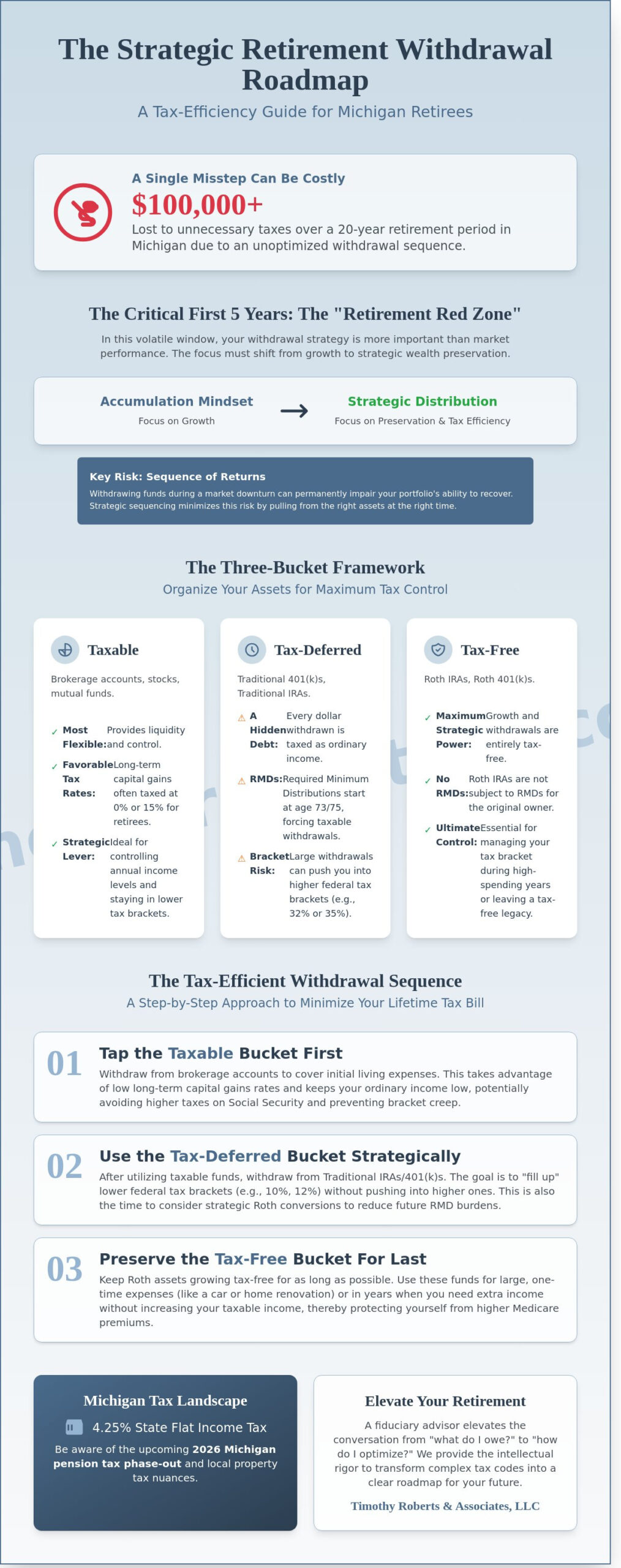
The first 1,825 days of your retirement, frequently termed the Retirement Red Zone, represent the most volatile period for your financial longevity. During this window, the sequence of your withdrawals carries more weight than the performance of the underlying market. A 15% market correction in your second year of retirement is exponentially more damaging than the same dip occurring in year twenty. Achieving tax-efficient retirement withdrawals farmington hills requires a fundamental shift from the accumulation mindset that defined your career to a strategy centered on strategic income engineering.
Tax drag is a silent predator of wealth. For a Farmington Hills household generating $160,000 in annual retirement income, an unoptimized withdrawal sequence can result in a 12% to 18% loss in total portfolio value over 30 years. This isn’t merely about tax preparation; it’s about the deliberate orchestration of asset classes. We view tax efficiency as the delta between gross income and spendable wealth.
The Shift from Growth to Preservation
Average returns are a mathematical abstraction that can’t sustain a lifestyle. You don’t live on averages; you live on the specific dollar amounts available after the government takes its share. When you stop receiving a paycheck, sequence of returns risk becomes your primary adversary. A poorly timed withdrawal from a depreciating asset can permanently impair your portfolio’s ability to recover. Navigating U.S. retirement plan tax rules requires more than a casual understanding of 401(k) or IRA structures. It demands a bespoke approach that treats every dollar as a strategic tool for preservation.
- Sequence Risk: Withdrawing capital during a 10% market downturn compounds losses.
- Tax Brackets: Strategic distributions prevent “bracket creep” that triggers higher Medicare premiums.
- Asset Location: Placing high-growth assets in tax-exempt accounts to maximize long-term spendable wealth.
The Role of a Fiduciary Advisor in Farmington Hills
Traditional brokerage models often focus on asset allocation, yet they frequently overlook the holistic impact of local and federal taxes. A fiduciary advisor operates under a legal mandate to put your interests first, which is critical when managing tax-efficient retirement withdrawals farmington hills. In Metro Detroit, this expertise must extend to Michigan’s 4.25% flat income tax and the specific property tax nuances of Oakland County.
We elevate the conversation from “what do I owe?” to “how do I optimize?” This involves a rigorous analysis of your taxable, tax-deferred, and tax-free buckets to create a rhythmic, predictable cash flow. Our partnership transforms complex tax codes into a clear, authoritative roadmap for your future. We provide the intellectual rigor necessary to ensure your portfolio serves your life, rather than the other way around.
The Three-Bucket Framework: Categorizing Your Michigan Assets
Precision in retirement planning requires a departure from the “one big pile” mentality. To achieve truly tax-efficient retirement withdrawals in Farmington Hills, you must view your wealth through a lens of tax diversification. This framework organizes your capital into three distinct buckets, each governed by unique IRS rules and state level mandates. Understanding how these buckets interact allows you to control your taxable footprint rather than letting the tax code dictate your lifestyle.
- Tax-Deferred: This bucket includes traditional 401(k)s and IRAs. Every dollar you withdraw is taxed as ordinary income. These accounts often represent a significant hidden debt to the government, especially as Required Minimum Distributions (RMDs) begin at age 73 or 75.
- Tax-Free: Roth IRAs and Roth 401(k)s offer the most strategic power. Because you’ve already paid taxes on the contributions, the growth and withdrawals are entirely yours. These are essential for managing your tax bracket during high-spending years.
- Taxable: Standard brokerage accounts hold assets like stocks and mutual funds. These are taxed at favorable long-term capital gains rates, which are often 0% or 15% for retirees, providing a sophisticated lever for controlling annual income levels.
A leaking bucket occurs when you withdraw from the wrong source at the wrong time. For instance, taking large sums from a traditional IRA to buy a vacation home can push you into a 32% or 35% federal bracket. Strategic planning involves analyzing Michigan’s 2026 retirement tax changes to ensure your state-level liability doesn’t spike as the current pension tax phase-out reaches full implementation. You can find more clarity through a bespoke withdrawal strategy tailored to your specific asset mix.
Managing the ‘Tax Torpedo’
The “tax torpedo” is a common trap where a single extra dollar of withdrawal triggers taxes on a larger portion of your Social Security. The IRS uses a metric called provisional income to determine this. If a couple’s provisional income exceeds $44,000, up to 85% of their Social Security benefits become taxable. It’s a steep threshold that can effectively double your marginal tax rate on those specific dollars. We aim to keep your income within a safe zone by balancing withdrawals across your three buckets, ensuring you don’t inadvertently trigger this fiscal penalty.
The Hidden Value of HSAs
The Health Savings Account (HSA) is arguably the most tax-efficient vehicle in a Farmington Hills portfolio. It offers a triple tax advantage: tax-deductible contributions, tax-deferred growth, and tax-free withdrawals for medical expenses. High-net-worth retirees often use a “shoeboxing” strategy. This involves paying for current medical costs out of pocket and saving the receipts. Years later, you can reimburse yourself from the HSA tax-free for those old expenses, effectively using the account as a tax-free supplemental pension. It’s a holistic way to integrate healthcare costs into your broader withdrawal sequence.
Navigating the Michigan Tax Landscape: Local Nuances for 2026
Michigan’s fiscal environment is undergoing a structural transformation that will reach its peak in 2026. This shift redefines how high-net-worth individuals approach tax-efficient retirement withdrawals farmington hills, as the state completes its multi-year phase-out of the 2011 “retirement tax.” By aligning your withdrawal sequence with these local adjustments, you can effectively lower your lifetime tax liability while elevating your portfolio’s longevity.
The Michigan Pension Tax Update
In March 2023, the passage of Public Act 4 initiated a four-year phase-in to restore exemptions for retirement income. For the 2026 tax year, joint filers can expect to deduct up to $100,000 of private pension or IRA income from their state returns, while many public pensions will regain 100% exempt status. Michigan’s tax code requires a bespoke approach for every retiree. This state-level relief must be balanced against federal obligations, particularly the IRS Required Minimum Distribution rules. For those reaching age 73 or 75 under current SECURE 2.0 timelines, the interaction between Michigan’s 4.25% flat tax and federal progressive brackets requires meticulous timing to avoid “tax “torpedoes” that can erode 15% to 20% of your annual purchasing power.
Strategic Local Nuances in Farmington Hills
Retiring in Farmington Hills offers specific advantages through the Primary Residence Exemption (PRE). This local provision can reduce your property tax burden by 18 mills, a significant factor when calculating your annual cash flow needs. For Michigan public school employees and state workers, managing the windfall from the MPSERS system is critical. We focus on optimizing the transition from active service to pension status, ensuring that deferred compensation plans like 403(b) or 457(b) accounts don’t trigger unnecessary state-level tax spikes during the 2026 transition period.
Estate Planning in Southeast Michigan
Michigan has not collected an inheritance or estate tax since the state-level death tax was effectively repealed in 1993. This absence of a state-level “death tax” simplifies the legacy process, allowing us to focus withdrawals on federal gift tax thresholds and the optimization of the step-up in basis. Your withdrawal strategy should serve as the foundation for your eventual transfer of wealth. By coordinating your current income needs with Estate & Legacy Planning in Farmington Hills, you ensure that your assets are preserved for the next generation rather than lost to avoidable administrative friction. This holistic approach transforms simple distribution planning into a sophisticated vehicle for family growth.
The Tax-Efficient Withdrawal Checklist: A Strategic Sequence
Precision in the distribution phase is what separates a standard retirement from a bespoke financial legacy. Mastering tax-efficient retirement withdrawals in Farmington Hills requires a chronological approach that prioritizes tax-bracket management over simple convenience. We treat your portfolio as a dynamic ecosystem where every dollar moved has a specific tax consequence. Following a structured sequence ensures you don’t inadvertently trigger higher brackets or unnecessary surcharges.
- Step 1: Satisfy Required Minimum Distributions (RMDs). Current law mandates these withdrawals first. Failing to meet the requirement results in a 25% excise tax on the amount not distributed. We prioritize these to clear your legal obligations before looking at other sources.
- Step 2: Exhaust Taxable Brokerage Assets. By tapping into individual or joint brokerage accounts early, you utilize favorable long term capital gains rates, which often sit at 15% for most high net worth households. This allows your tax advantaged accounts more time to compound.
- Step 3: Target Tax-Deferred Accounts to the Bracket Ceiling. We withdraw from Traditional IRAs and 401ks up to the top of your current marginal tax bracket. This prevents a “tax spike” in later years when RMDs might otherwise push you into a 32% or 35% bracket.
- Step 4: Preserve Roth Assets. These are your most valuable tools. Because they grow tax free and have no RMD requirements for the original owner, we reserve them for late retirement healthcare shocks or as a tax free inheritance for your heirs.
- Step 5: Execute Annual Bracket Topping. We analyze your remaining “headroom” in your current tax bracket each December. If there’s space, we may accelerate income or perform conversions to maximize the value of lower rates before they expire.
The RMD Trap and How to Avoid It
The SECURE Act 2.0 shifted RMD ages to 73, and eventually 75 for those born in 1960 or later. This delay creates a “tax valley” between retirement and age 75. Savvy investors use this window to draw down tax deferred balances early, reducing the total size of future RMDs. For those with philanthropic goals, the Qualified Charitable Distribution (QCD) remains the ultimate tool. You can transfer up to $105,000 directly from your IRA to a 501(c)(3) starting at age 70.5, satisfying your RMD without adding a penny to your adjusted gross income.
Roth Conversion Strategies
A Roth conversion is essentially a “tax sale” on your future liability. We look for opportunities to convert traditional assets into Roth accounts when the market is down or when your income hits a temporary low. This locks in current tax rates, which is vital considering the 2025 sunset of the Tax Cuts and Jobs Act. Paying a 22% tax today to avoid a potential 28% tax in the future offers a clear mathematical ROI. For a deeper look at regional nuances, explore our insights on Strategic Tax Advising for Ann Arbor Investors to see how we coordinate multi city wealth strategies.
Your withdrawal strategy should be as unique as the life you’ve built. If you’re ready to move beyond generic advice, it’s time to elevate your distribution strategy with a plan designed for long term optimization.
Elevating Your Retirement: The Timothy Roberts Bespoke Approach
Effective wealth management requires more than a passive glance at market trends. It demands a holistic integration of tax strategy and investment philosophy. We view your portfolio as a dynamic entity that needs constant refinement. By housing tax preparation and investment advisory within a single firm, we ensure your financial experts aren’t working in silos. This unified approach allows us to optimize tax-efficient retirement withdrawals in Farmington Hills with a level of precision that fragmented teams simply cannot match.
Our current focus remains fixed on the impending 2026 tax landscape. With the Tax Cuts and Jobs Act provisions scheduled to sunset on December 31, 2025, individual tax brackets are poised to revert to higher levels. We’re actively pivoting client strategies now to lock in current rates through accelerated distributions or strategic Roth conversions. This real-time agility transforms a potential tax burden into a calculated advantage for your estate, ensuring your “Elevation” journey continues upward regardless of shifting legislation.
A Partnership for Brand Transformation… of Your Wealth
We approach financial planning as a creative and strategic craft rather than a transactional service. Our ‘Visionary Strategist’ model ensures you receive the professional rigor of a global firm with the bespoke attention of a boutique agency. We believe your wealth is a reflection of your life’s work; it deserves a plan that’s as unique as your personal history. We invite you to transform your retirement anxiety into strategic confidence by partnering with a firm that values depth over superficiality.
Next Steps for Farmington Hills Residents
Preparation is the foundation of a successful strategy. For your initial retirement income planning session, please gather your last two years of Form 1040 filings and your most recent statements from all qualified and non-qualified accounts. Our process begins with a rigorous audit of your current withdrawal plan to identify “tax leaks” that could cost you thousands over a 30-year retirement. We examine your cost basis, analyze your Social Security timing, and evaluate the impact of Medicare Part B premiums to ensure your sequence is optimal. We provide a clear roadmap to tax-efficient retirement withdrawals in Farmington Hills, ensuring every dollar supports your vision for the future. For those seeking additional income security beyond traditional withdrawal strategies, consider exploring strategic annuities Michigan residents can use to guarantee baseline income and reduce sequence of returns risk. For neighboring communities seeking similar expertise, our retirement income planning services Ann Arbor residents trust provide the same level of sophisticated tax coordination and fiduciary guidance.
Ready to refine your strategy? Request a Bespoke Consultation with Timothy Roberts at our Farmington Hills or Detroit offices to begin your elevation journey.
Secure Your Legacy Through Strategic Precision
Your wealth represents over 30 years of professional discipline. Transitioning from the accumulation phase to a distribution model requires a fundamental shift in your financial architecture. By mastering the three-bucket framework and preparing for the 2026 Michigan tax adjustments, you protect your portfolio against unnecessary erosion. Success isn’t found in a single transaction; it’s found in a sequence-driven checklist that optimizes every dollar you’ve earned. Executing tax-efficient retirement withdrawals farmington hills requires a bespoke plan that bridges the gap between investment returns and complex tax liabilities. At Timothy Roberts LLC, we leverage 25+ years of fiduciary expertise to provide integrated tax and investment management through a boutique, personalized model. We don’t believe in off-the-shelf solutions for individuals who value precision. Our holistic approach transforms your financial complexity into a clear, actionable path forward. You’ve built a remarkable life. Now it’s time to ensure your strategy is as refined as your vision. For those concerned about market volatility impacting their retirement timeline, integrating annuities Michigan retirees trust can provide the guaranteed income foundation that allows your other assets to grow without the pressure of immediate liquidity needs.
Elevate Your Retirement Strategy: Schedule a Consultation
Frequently Asked Questions
What is the most tax-efficient way to withdraw retirement funds in Michigan?
The most efficient strategy involves balancing withdrawals across taxable, tax-deferred, and tax-exempt accounts to maintain a consistent tax bracket. In Michigan, retirees benefit from the $56,960 single or $113,920 joint deduction on private pension income for those born before 1946. By coordinating these distributions, you can minimize the impact of the 4.25% state income tax. This holistic approach ensures your tax-efficient retirement withdrawals in Farmington Hills align with both federal and state regulations.
How does the Michigan pension tax repeal affect my 2026 withdrawals?
Public Act 4 of 2023 allows Michigan retirees to fully exempt qualified retirement income from state taxes by the 2026 tax year. This legislative shift restores the pre-2011 deduction levels, effectively eliminating the state tax burden on public pensions and significantly raising limits for private plans. For a couple filing jointly in 2026, this means protecting over $100,000 in distributions from the state’s 4.25% levy. It transforms how we calculate your net spendable income.
Can I avoid taxes on my Social Security benefits if I live in Farmington Hills?
Michigan is one of 41 states that doesn’t tax Social Security benefits, ensuring every dollar of your benefit remains state-tax-free. However, federal taxes apply if your combined income exceeds $25,000 for individuals or $32,000 for couples. Up to 85% of your benefits become taxable at the federal level if you cross these thresholds. We optimize your withdrawal sequence to keep your provisional income below these critical triggers whenever possible; it’s a bespoke way to protect your cash flow.
What happens if I don’t take my RMD on time?
Failing to take your Required Minimum Distribution (RMD) by the December 31 deadline results in a 25% excise tax on the amount not withdrawn. Under the SECURE 2.0 Act of 2022, this penalty is reduced to 10% if you correct the error within a two-year window. For a $20,000 missed RMD, the initial penalty would be $5,000. Timely execution is vital to preserve your capital and avoid unnecessary losses to the IRS.
Is a Roth conversion right for someone already in retirement?
A Roth conversion is often a strategic move for retirees who expect their future tax rates to rise or who wish to eliminate RMDs for a surviving spouse. By paying taxes now at a known rate, perhaps 12% or 22%, you shield all future growth and withdrawals from taxation. This creates a bespoke tax hedge. It’s particularly effective during the gap years between retirement and age 73 when your taxable income is lower.
How do Farmington Hills property taxes impact my retirement income needs?
Farmington Hills residents face a total millage rate of approximately 54.00 mills, which requires a robust cash flow strategy to cover annual assessments. On a home valued at $400,000 with a taxable value of $200,000, you should budget roughly $10,800 for property taxes annually. We incorporate these fixed costs into your tax-efficient retirement withdrawals in Farmington Hills to ensure your liquid assets remain sufficient. This precision prevents property tax obligations from eroding your lifestyle.
Why should I use a fiduciary for my tax planning instead of just a CPA?
A fiduciary advisor is legally bound to act in your best interest, whereas a CPA often focuses on historical compliance and annual filing. While a CPA tracks what you’ve already spent, a fiduciary strategist builds a forward-looking plan to optimize your entire balance sheet. This distinction is crucial for long-term wealth preservation. We integrate investment management with tax strategy to elevate your financial trajectory beyond simple tax preparation.
What is ‘bracket topping’ and how does it save money?
Bracket topping is the strategic practice of withdrawing additional funds up to the ceiling of your current federal tax bracket, such as the 12% or 22% mark. If you’re $15,000 below the 24% threshold, you top off the 22% bracket by converting that amount to a Roth IRA. This prevents future distributions from being pushed into a higher 32% or 35% bracket later. It’s a calculated method to accelerate tax payments at a discount.
