

Apr
Tax-Efficient Retirement Income: Strategic Strategies for Wealth Preservation in 2026
What if the wealth you’ve spent three decades accumulating is quietly eroded by a 2026 tax landscape you didn’t see coming? It’s a legitimate concern for those who value precision in their financial planning. You’ve likely felt the weight of impending Required Minimum Distributions or the frustration of seeing Social Security benefits taxed at rates that feel punitive. Achieving tax-efficient retirement income isn’t a matter of chance. It’s a deliberate orchestration of your assets that must begin before the Tax Cuts and Jobs Act provisions expire on December 31, 2025.
You deserve a plan that reflects the sophistication of your career. We’ll show you how to design a bespoke withdrawal strategy that minimizes tax liabilities and elevates your long-term retirement security. This guide provides a clear sequence for asset liquidations, methods to maximize your after-tax spendable income, and legacy strategies that won’t burden your heirs. We’ll move beyond generic advice to help you optimize every dollar for the decade ahead.
Key Takeaways
- Shift your perspective from vanity gross metrics to net spendable reality to ensure your retirement lifestyle is supported by actual, available wealth.
- Orchestrate a tax-efficient retirement income using the three-bucket framework to mitigate the inherent risks of over-concentration in tax-deferred accounts.
- Implement advanced bracket management strategies to navigate the “tax torpedo” and shield your Social Security benefits from unnecessary tax erosion.
- Evaluate sophisticated withdrawal sequences that prioritize long-term preservation over short-term gains through a balanced and intentional proportional approach.
- Elevate your financial trajectory by unifying bespoke tax strategy and fiduciary investment advisory into a single, holistic roadmap for wealth preservation.
The Strategic Importance of Tax-Efficient Retirement Income
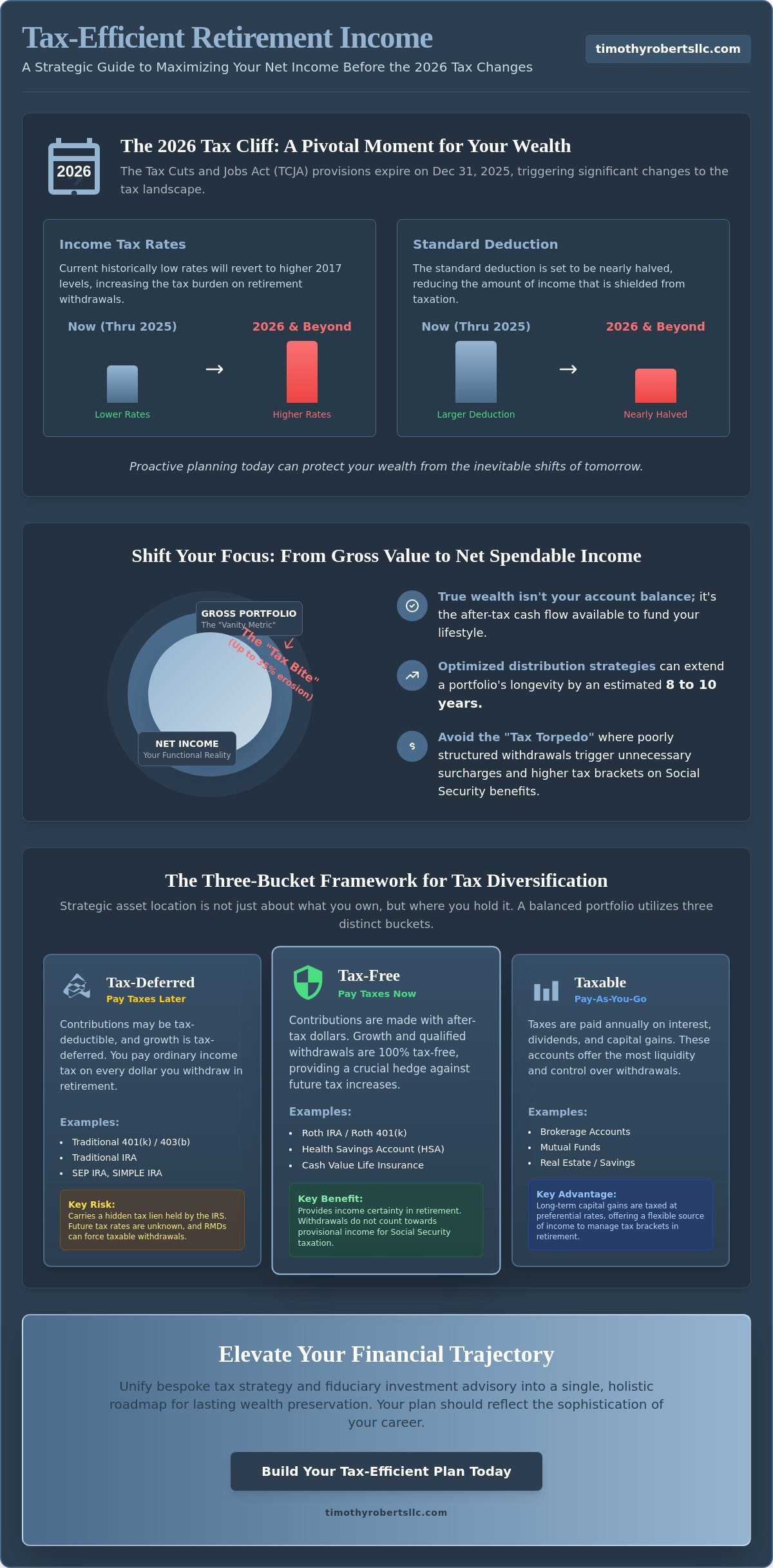
True wealth isn’t measured by the balance on a monthly statement. It’s defined by the liquidity available after the government takes its share. We define tax-efficient retirement income as the sophisticated art of maximizing after-tax cash flow through intentional asset location and withdrawal sequencing. While gross income serves as a vanity metric for the uninitiated, net spendable income represents the functional reality of your retirement. A portfolio that ignores the friction of taxation is a leaky vessel, losing value every year to avoidable liabilities.
The impact of the “tax bite” is often the difference between a legacy that lasts generations and a portfolio that runs dry too soon. Poorly structured withdrawals can trigger unnecessary surcharges and higher brackets, effectively eroding up to 35% of a portfolio’s purchasing power. Research indicates that optimizing these distributions can extend a portfolio’s longevity by 8 to 10 years. Our fiduciary perspective moves beyond simple savings, shifting the focus toward a strategic distribution model that treats every dollar as a tool for wealth preservation.
To better understand this concept, watch this helpful video:
The Shift from Accumulation to Distribution
The transition from saving to spending requires a complete reversal of financial logic. The tax-deferred growth that fueled your accumulation phase can become a significant liability once required minimum distributions begin. Managing a Retirement spend-down involves a complex sequence of withdrawals across taxable, tax-deferred, and tax-exempt accounts. Many high-net-worth individuals find the psychological shift from “growing” to “depleting” assets difficult to navigate without a clear roadmap. Tax-efficient distribution is the intentional orchestration of asset withdrawals to minimize lifetime tax liability and maximize legacy value.
Why 2026 is a Pivotal Year for Tax Strategy
The year 2026 marks a critical juncture for American investors. Most provisions of the Tax Cuts and Jobs Act (TCJA) of 2017 are scheduled to sunset on December 31, 2025. Unless Congress intervenes, individual income tax rates will revert to higher 2017 levels, and the standard deduction will be nearly halved. This legislative shift necessitates a proactive approach rather than a reactive one. Utilizing comprehensive retirement income planning allows you to capitalize on the current window of historically low rates. Strategizing for tax-efficient retirement income today ensures that your wealth remains protected against the inevitable shifts in the political and economic landscape.
The Three-Bucket Framework: Diversifying Your Tax Exposure
True wealth preservation requires more than just high-yield accumulation; it demands a sophisticated approach to asset location to ensure a tax-efficient retirement income. Many high-net-worth individuals fall into the trap of tax infatuation, where the immediate gratification of a 401(k) deduction creates a massive future liability. By 2026, as the 2017 Tax Cuts and Jobs Act provisions are slated to sunset, the tax landscape will likely become more aggressive. Relying on a single account type leaves you vulnerable to legislative whims. A balanced portfolio distributes assets across three distinct buckets: taxable, tax-deferred, and tax-free.
Strategic asset location isn’t just about what you own, but where you hold it. Placing tax-inefficient assets like high-turnover funds or bonds in deferred accounts while keeping growth-oriented equities in taxable or Roth accounts creates the levers needed to manage annual tax bills. This holistic structure allows you to pivot your withdrawal strategy based on the prevailing tax climate of the year, providing the control necessary to protect your purchasing power.
Tax-Deferred: The Traditional IRA and 401(k)
These accounts carry a hidden tax lien held by the IRS. Every distribution is taxed at ordinary income rates, which for top earners in 2026 could easily exceed 37%. You don’t truly own the entire balance; a significant portion is reserved for the government. Managing the impact of Required Minimum Distributions (RMDs), which now begin at age 73 or 75, is critical. Failing to plan for these mandatory withdrawals can trigger unnecessary tax spikes that erode your tax-efficient retirement income and increase Medicare premiums.
Tax-Free: The Power of the Roth IRA
Roth assets represent the ultimate strategic tool for retirement flexibility. They provide a sanctuary of tax-free growth and distributions, entirely decoupled from future tax rate hikes. Since Roth IRAs don’t require RMDs during the owner’s lifetime, they serve as a powerful vehicle for legacy planning. High-earners often employ bespoke strategies, such as the “Backdoor Roth” conversion, to build these positions when direct contributions are restricted by income limits. This creates a pool of capital that can be accessed without increasing your taxable footprint.
Taxable Accounts: Brokerage and Capital Gains
Taxable brokerage accounts offer a level of agility that retirement-specific accounts can’t match. By utilizing long-term capital gains rates, currently capped at 0%, 15%, or 20%, you can access liquidity at a lower cost than ordinary income. Tax-loss harvesting should be used as a rhythmic tool to offset gains, ensuring the portfolio remains lean and optimized. For those focused on estate planning, the step-up in basis remains a vital provision, allowing heirs to inherit assets at their fair market value on the date of death. To explore how these buckets fit into your broader financial narrative, consider a strategic consultation to refine your approach.
Advanced Tactics for Managing Retirement Tax Brackets
Precision is the hallmark of sophisticated wealth preservation. Architecting a tax-efficient retirement income strategy isn’t just about paying less today; it’s about maintaining architectural control over your future liabilities. By filling lower tax brackets through intentional withdrawals, investors avoid the “tax cliff” where a single dollar of additional income pushes them into a significantly higher tier. This is especially critical as 2026 approaches and the sunset of the Tax Cuts and Jobs Act threatens to reset rates to higher levels. We must also address the “Tax Torpedo.” This occurs when IRA withdrawals trigger taxation on up to 85% of Social Security benefits, effectively pushing a retiree’s marginal tax rate far beyond their nominal bracket.
Managing these brackets requires a delicate balance of income sources. If you don’t fill your lower brackets early in retirement, you risk being forced into much higher brackets later when RMDs begin. This proactive approach ensures that your wealth remains protected from the volatility of shifting federal tax policies.
Strategic Roth Conversions
The period between your final paycheck and the commencement of Required Minimum Distributions (RMDs) represents a unique window for tax-efficient retirement income planning. This gap allows for bespoke Roth conversions that elevate the long-term health of an estate. Finding the sweet spot involves converting just enough to stay within a favorable bracket while accounting for the two-year look-back on Medicare Part B and D premiums. If your income exceeds specific IRMAA thresholds, your monthly healthcare costs can spike significantly. Paying the conversion tax with cash from taxable brokerage accounts ensures that every dollar moved into the Roth remains there to compound. A Roth conversion is essentially “buying out” the IRS at today’s rates.
Social Security and the Tax Intersection
Tax efficiency requires a holistic understanding of how different income streams collide. The IRS uses a provisional income formula, which includes half of your Social Security benefits plus other adjusted gross income, to determine your tax liability. Delaying Social Security until age 70 often serves as a strategic play to minimize this intersection during the early years of retirement. This delay creates space for larger Roth conversions or more aggressive capital gains harvesting. Coordinating these benefits with investment portfolio management ensures that your withdrawal sequence doesn’t inadvertently trigger a tax surge. It’s a method of optimizing net spendable cash while preserving the core of your wealth through disciplined, business-minded rigor.
- Provisional Income Thresholds: For 2024, if your provisional income exceeds $44,000 as a couple, up to 85% of your benefits may be taxable.
- IRMAA Surcharges: Income reported in 2024 determines your 2026 Medicare premiums, making current income management vital.
- Sequence of Returns: Strategic withdrawals can prevent the liquidation of assets during market downturns, protecting the portfolio’s longevity.
Optimizing Your Withdrawal Sequence to Preserve Wealth
The order in which you access your assets defines the longevity of your portfolio. While the traditional sequence suggests exhausting taxable accounts first, followed by tax-deferred and finally tax-free buckets, this linear path often fails high-net-worth individuals. Optimizing your strategy for tax-efficient retirement income ensures that you control your financial narrative. A standard sequence creates a tax cliff later in life when Required Minimum Distributions (RMDs) collide with Social Security benefits, often pushing retirees into higher brackets they spent years trying to avoid.
Strategic sequencing requires a holistic view of your entire balance sheet. By pulling a percentage from each bucket simultaneously, you can maintain a steady tax bracket throughout your retirement years. This proportional approach prevents the tax bump often seen in the mid-retirement phase, where RMDs can inadvertently push your effective tax rate to 37% or higher. It’s about precision rather than just following a standard rule of thumb; it’s about making your capital work with maximum efficiency.
Step-by-Step Withdrawal Planning
Achieving tax-efficient retirement income requires a disciplined annual process. You can’t rely on a set-it-and-forget-it model when tax codes and market conditions shift constantly. A bespoke plan allows for agility and growth.
- Calculate your total spending needs for the year after accounting for fixed sources like Social Security or private pensions.
- Examine your current tax bracket to identify how much room remains before you hit the next tier, such as the jump from 24% to 32%.
- Select assets for liquidation based on their specific tax cost basis to minimize realized gains and preserve principal.
- Review these selections every 90 days to adjust for market volatility or unexpected capital needs.
The Role of RMDs in Your Sequence
The SECURE Act 2.0 updated the timeline for RMDs, moving the starting age to 73 for those born between 1951 and 1959, and eventually to 75 for those born in 1960 or later. These mandatory distributions can disrupt even the best-laid plans if they aren’t integrated into a broader strategy. Qualified Charitable Distributions (QCDs) remain a premier tool for those who don’t need the full RMD for living expenses. You can direct up to $105,000, a limit that is now indexed for inflation, directly to a 501(c)(3) organization. This satisfies your RMD requirement without adding a cent to your adjusted gross income.
True wealth preservation involves more than just picking the right stocks. It requires strategic tax advising to ensure your withdrawal sequence aligns with your long-term legacy goals. By treating your tax strategy as a dynamic component of your portfolio, you elevate your financial standing and protect your hard-earned capital from unnecessary erosion. Precision in execution is what separates a standard retirement from an elevated one.
Elevating Your Strategy with Fiduciary Tax and Wealth Management
True financial mastery requires more than just asset allocation. It demands a seamless integration of tax preparation and investment advisory, a philosophy we call the Timothy Roberts difference. Most investors suffer from siloed advice where the left hand doesn’t know what the right hand is doing. A CPA might focus solely on the previous year’s filing, while a wealth manager ignores the tax implications of a trade. This lack of coordination creates significant friction. By merging these disciplines, we transform a collection of disparate accounts into a unified engine for wealth preservation.
This holistic approach outperforms fragmented models by identifying efficiencies that others miss. For instance, data from the Tax Foundation indicates that the upcoming 2026 sunset of the Tax Cuts and Jobs Act will likely return the top individual tax rate to 39.6 percent. Without a synchronized strategy, your distributions could face higher-than-necessary tax hits. We prioritize a bespoke roadmap tailored to your unique legacy, ensuring your lifestyle goals remain the focal point of every tactical move. It’s time to stop managing accounts and start executing a strategy that secures your tax-efficient retirement income.
Bespoke Planning vs. Off-the-Shelf Solutions
Standardized financial models often fail to capture the nuance of a high-net-worth individual’s legacy. While digital dashboards offer convenience, they lack the human-led, results-driven identity necessary for complex wealth management. Our approach prioritizes fiduciary oversight. This means we’re legally and ethically bound to act in your best interest, a standard that protects your long-term wealth from hidden conflicts. Personal attention allows us to navigate the 2026 tax landscape with a level of precision that generic software simply cannot replicate. We believe your financial future is too important for an off-the-shelf solution.
Partnering for a Strategic Retirement
A successful retirement strategy balances the aesthetics of your desired lifestyle with the rigid functionality of tax law. We don’t just manage money; we curate a polished, intentional plan that provides the peace of mind you’ve earned. Our team optimizes your portfolio to ensure your tax-efficient retirement income supports your vision for the future. This evolution from a collection of accounts to a unified strategy is the hallmark of a sophisticated retirement. It’s about creating a plan that is as functional as it is inspiring. We invite you to elevate your strategy and secure your legacy by scheduling a professional consultation today.
Master Your Financial Future Beyond 2026
The landscape of wealth preservation is shifting as we approach the 2026 sunset of the Tax Cuts and Jobs Act provisions. This regulatory evolution demands a proactive stance on tax-efficient retirement income to prevent the unnecessary erosion of your hard-earned capital. Success in this new era hinges on the rigorous application of a three-bucket framework and the precise optimization of your withdrawal sequence. These strategic interventions transform a standard portfolio into a resilient engine for long-term growth.
At Timothy Roberts LLC, we provide over 25 years of fiduciary expertise to guide you through these intricate complexities. Our approach isn’t a generic, off-the-shelf solution. We develop bespoke strategies that bridge the gap between sophisticated tax preparation and disciplined investment advisory. This holistic method ensures every financial decision aligns with your specific risk tolerance and legacy goals. You deserve a partner who values deep strategy over superficial gains. By synthesizing your personal vision with our professional rigor, we can optimize your financial architecture for the decades ahead.
Elevate your retirement strategy with a bespoke consultation
Your journey toward a secure and prosperous retirement starts with a single, intentional step forward.
Frequently Asked Questions
Is Social Security income taxable at the federal level?
Yes, up to 85% of your Social Security benefits are taxable if your provisional income exceeds $34,000 for individuals or $44,000 for joint filers. This calculation includes your adjusted gross income, tax-exempt interest, and 50% of your annual benefits. Strategic management of these distributions is vital for securing tax-efficient retirement income. It prevents you from falling into higher brackets that unnecessarily diminish your purchasing power and long-term wealth preservation.
What is the most tax-efficient order for retirement withdrawals?
The most effective strategy typically involves withdrawing from taxable brokerage accounts first, then tax-deferred accounts, and finally tax-free Roth accounts. This sequence allows your most tax-advantaged assets to compound for the longest possible duration. We often recommend a blended approach to fill lower tax brackets each year. This prevents a massive tax bill later in life when mandatory distributions begin. It’s a bespoke way to optimize your total portfolio value.
How do Roth conversions help reduce taxes in retirement?
Roth conversions reduce long-term taxes by moving funds from traditional IRAs to Roth IRAs during years when your income is lower. You pay taxes on the converted amount now at a known rate to enjoy tax-free growth and withdrawals later. This is a powerful hedge against future tax hikes, especially with the scheduled expiration of current tax rates in 2026. It effectively eliminates the burden of future mandatory distributions on those specific converted assets.
What are Required Minimum Distributions (RMDs) and when do they start?
Required Minimum Distributions are mandatory withdrawals from traditional retirement accounts that currently begin at age 73 under the SECURE 2.0 Act. This timeline will eventually shift to age 75 in 2033 to account for increased longevity. If you fail to take the full distribution, the IRS imposes a 25% penalty on the shortfall amount. Proactive planning for these withdrawals is a cornerstone of maintaining tax-efficient retirement income throughout your golden years.
Can I use my retirement accounts to give to charity tax-free?
You can give to charity tax-free using a Qualified Charitable Distribution (QCD) once you reach age 70.5. This allows you to transfer up to $105,000 directly from your IRA to a 501(c)(3) organization without counting the distribution as taxable income. It’s an elegant solution that satisfies your mandatory distribution requirements while lowering your adjusted gross income. This strategy is more effective than taking a standard deduction if you don’t itemize your taxes.
How does capital gains tax work for retirement investments?
Capital gains on investments held for more than one year are taxed at 0%, 15%, or 20% depending on your taxable income levels. For 2024, you’ll pay 0% in capital gains tax if your total taxable income is below $47,025 as a single filer. This is significantly lower than ordinary income tax rates applied to traditional 401(k) withdrawals. We focus on asset location to ensure your most tax-sensitive investments reside in these favorable brokerage accounts.
What is the “tax torpedo” and how can I avoid it?
The tax torpedo is a phenomenon where a modest increase in income triggers a disproportionate jump in taxes on your Social Security benefits. This can lead to an effective marginal tax rate of 40.7% or higher for some retirees. You can avoid this by keeping your provisional income below the $32,000 threshold for married couples. Using tax-free Roth distributions or municipal bond interest helps you stay within these safer, more predictable tax boundaries.
Should I pay off my mortgage using retirement funds?
You shouldn’t use retirement funds to pay off a mortgage if the resulting tax liability exceeds the interest you’d save. Taking a $150,000 distribution from a traditional IRA could push you into the 32% tax bracket, costing you far more than a 4% mortgage interest rate. It’s often wiser to keep your capital invested where it can outpace the cost of debt. We prioritize liquidity and long-term growth over premature debt elimination.
