

Apr
Retirement Withdrawal Strategies 2026: Elevating Your Strategic Income Plan
What if the very tax strategies that built your wealth become the primary obstacles to preserving it as we approach the December 31, 2025, sunset of current tax provisions? For many high-net-worth individuals, the shift from accumulation to distribution is a profound psychological hurdle. You’ve spent decades disciplined in your saving, yet the prospect of drawing down assets during a period of legislative transition creates a unique kind of friction. It’s understandable to feel uneasy about how the retirement withdrawal strategies 2026 landscape will impact your long-term security. We believe that clarity is the ultimate antidote to anxiety.
This article serves as a strategic manual to master the frameworks required to protect your legacy. You’ll learn how to elevate your income plan through bespoke sequencing and holistic tax management. We’ll examine the specific mechanics of Roth conversions, the timing of Required Minimum Distributions, and the sophisticated frameworks necessary to mitigate sequence-of-returns risk in a volatile market. By the end, you’ll have a clear, actionable roadmap to transform your portfolio into a predictable, tax-efficient engine for your lifestyle. We’re here to help you move from a place of uncertainty to a state of calm, strategic confidence.
Key Takeaways
- Redefine the traditional 4% rule by implementing the 3.9% benchmark, a strategic adjustment designed for the unique market cycles and economic shifts of 2026.
- Transition from rigid spending to dynamic “Guardrails,” allowing you to optimize your lifestyle while protecting your portfolio from sequence-of-returns risk.
- Secure your financial future using advanced retirement withdrawal strategies 2026 to navigate the sunset of TCJA provisions and the complexities of new tax caps.
- Elevate your long-term vision by aligning tax-efficient sequencing with estate goals, ensuring a seamless transition of wealth and optimal basis adjustments for heirs.
- Synthesize time-segmentation models like the “Bucket Method” with holistic cash-flow planning to create a stable, multi-decade roadmap for financial independence.
Navigating the Decumulation Shift: Retirement Planning in 2026
Transitioning from decades of disciplined asset accumulation to the phase of Retirement spend-down represents a profound psychological shift. For most high-net-worth individuals, the challenge isn’t just the math of the withdrawal; it’s the mental hurdle of watching a portfolio balance fluctuate while drawing an income. This transition requires a move from a growth-oriented mindset to one focused on sustainable, tax-efficient distribution. It’s a strategic pivot that prioritizes cash flow reliability over raw market performance.
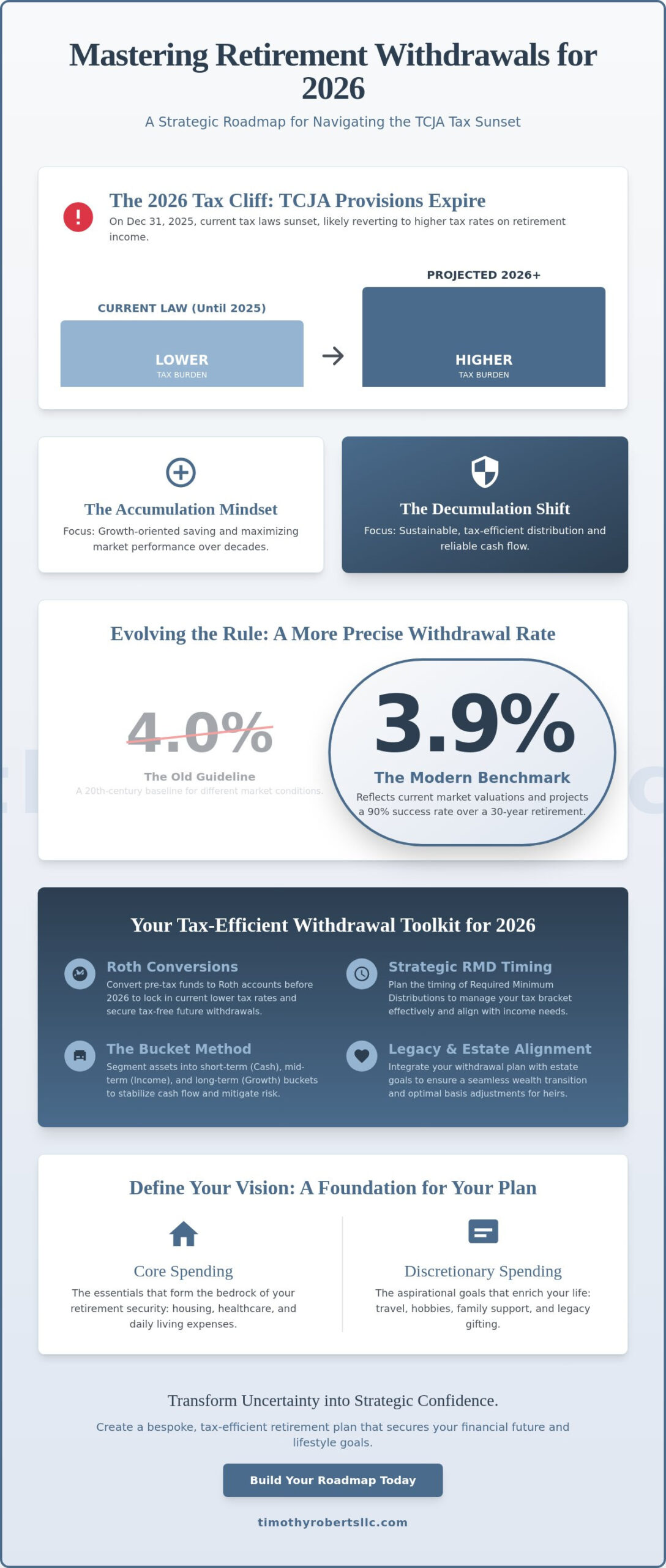
The year 2026 marks a significant inflection point for American retirees. On December 31, 2025, the individual income tax provisions of the Tax Cuts and Jobs Act (TCJA) are scheduled to sunset. This means tax brackets will likely revert to higher 2017 levels, potentially increasing the tax burden on traditional IRA distributions. Investors must refine their retirement withdrawal strategies 2026 to account for this fiscal shift. Successfully navigating this period involves more than just picking stocks; it requires a fiduciary partner to manage the “Retirement Risk Zone,” the critical five-year window before and after the retirement date where sequence of returns risk is at its peak.
To better understand this concept, watch this helpful video:
The Evolution of Retirement Income
Modern income planning has moved past the “set-it-and-forget-it” models of the late 20th century. While the 4% rule provided a baseline for decades, it often fails to account for the volatile inflation data seen in the early 2020s. We’ve seen Consumer Price Index (CPI) fluctuations that render static withdrawal rates obsolete. Bespoke planning replaces generic retail advice by integrating active income management. This approach ensures your retirement withdrawal strategies 2026 stay resilient against both market corrections and purchasing power erosion.
Defining Your 2026 Financial Vision
A sophisticated income plan starts with a clear vision of lifestyle goals. We distinguish between “core” spending, which covers essential housing and healthcare, and “discretionary” spending, which fuels aspirational travel and legacy gifting. Timothy Roberts & Associates elevates this process by creating tailored roadmaps. We don’t just look at the numbers; we optimize the intersection of your personal values and your financial capacity. This holistic view transforms a simple withdrawal schedule into a strategic engine for personal freedom.
The 3.9% Benchmark and the Science of Safe Withdrawal Rates
Precision defines the modern retirement landscape. While the 4% rule served as a reliable North Star for decades, the economic shifts anticipated for 2026 demand a more nuanced, bespoke calculation. Morningstar recently adjusted the suggested safe withdrawal rate to 3.9% for a 30-year retirement horizon with a 90% probability of success. This shift reflects a strategic response to higher equity valuations and the reality of lower projected bond yields compared to the late 20th century. Effective retirement withdrawal strategies 2026 must account for these compressed margins to ensure capital longevity.
Asset allocation remains the primary lever for these calculations. A portfolio weighted 60% in equities and 40% in fixed income provides the traditional foundation, yet 2026 projections suggest that even a 10% shift toward bonds can lower the sustainable starting withdrawal rate by 20 to 30 basis points. Inflation also looms as a persistent variable. With 2026 inflation targets hovering near 2.4%, the purchasing power of a fixed dollar amount erodes faster than many retirees anticipate. Elevating your plan requires a holistic view of how these market forces intersect with your specific lifestyle needs.
Is the 4% Rule Outdated?
Bill Bengen established the 4% rule in 1994 based on historical data that didn’t account for the current low-yield environment. Modern retirees face a 30-year horizon where initial over-withdrawing creates irreversible damage. If you withdraw 5% or 6% during the first five years of retirement, the mathematical drag on your remaining principal often becomes insurmountable. Refining these variables requires a strategic approach to asset architecture that goes beyond simple percentages. Conservative assumptions are now the hallmark of a sophisticated income plan.
Sequence of Returns Risk: The Hidden Threat
Market timing during the early years of your retirement can dictate the success of your entire 30-year journey. Sequence risk is the volatility of returns early in decumulation. When a market downturn occurs just as you begin taking distributions, you’re forced to sell assets at depressed prices, which permanently reduces your portfolio’s recovery potential. To mitigate this, consider these tactical buffers:
- Cash Bucketing: Maintaining 18 to 24 months of living expenses in liquid accounts to avoid selling equities during a correction.
- Dynamic Spending: Reducing discretionary withdrawals by 10% during years following a negative market return.
- Floor Income: Using fixed annuities or Social Security to cover 100% of non-discretionary costs.
Applying these retirement withdrawal strategies 2026 allows for a composed response to market fluctuations. It transforms a rigid withdrawal schedule into a flexible, resilient framework. By prioritizing the 3.9% benchmark and addressing sequence risk head-on, you protect your legacy from the unpredictability of the early decumulation phase.
Dynamic Guardrails vs. Fixed Rules: Selecting Your Strategic Framework
Rigid frameworks often fail to account for the inherent volatility of modern markets. While the traditional “Constant Dollar” approach provides a predictable baseline by adjusting for inflation annually, it lacks the agility required for high-level wealth preservation. Modern retirement withdrawal strategies 2026 prioritize dynamic frameworks that respond to real-time data. This shift from static to fluid planning allows for a more holistic management of your legacy. It moves the conversation away from simple math and toward a bespoke strategy that optimizes for both longevity and lifestyle.
Technology now allows fiduciaries to provide oversight that was previously impossible. We use advanced simulations to monitor “Probability of Success” scores monthly rather than annually. This real-time visibility enables strategic pivots that protect capital during downturns and capture gains during upswings. Flexible withdrawals maximize lifetime spending power by ensuring you aren’t forced to sell assets when prices are depressed. It’s a sophisticated dance between market performance and personal goals.
The Guyton-Klinger Guardrail Method
The Guyton-Klinger approach establishes a 20% buffer around your initial withdrawal rate to maintain portfolio equilibrium. If market gains push your withdrawal rate down by 20% or more, the strategy dictates “taking a raise” to enjoy your wealth. Conversely, if a market downturn pushes the rate 20% higher than the target, you reduce spending by a small, predetermined percentage. High-net-worth individuals favor this method because it provides a clear, data-driven roadmap for making adjustments without the emotional stress of market timing.
The Portfolio Bucket Strategy
This framework segments your assets into three distinct time horizons to provide calm confidence during market swings. You allocate 1 to 2 years of living expenses into a Cash bucket for immediate needs. The Income bucket holds 3 to 10 years of capital in bonds or fixed-income instruments. Finally, the Growth bucket contains equities for use 10 or more years in the future. Effective Investment Portfolio Management ensures these buckets are refilled strategically, preventing the need to liquidate growth assets during a temporary market correction. This structured approach transforms a complex financial puzzle into a clear, visual roadmap for long-term success.
By moving beyond fixed rules, you embrace a philosophy of elevation and precision. These dynamic frameworks ensure that your retirement withdrawal strategies 2026 remain resilient against economic shifts. You gain the freedom to spend confidently, knowing that your plan is built to adapt rather than break under pressure. It’s a transition from basic survival to a curated, high-performance financial life.
Tax-Efficient Sequencing: Optimizing Withdrawals for the 2026 Landscape
The sunset of the Tax Cuts and Jobs Act on December 31, 2025, represents a significant fiscal pivot for affluent retirees. As individual income tax rates revert to their higher 2017 levels, the top bracket will climb from 37% to 39.6%. This shift demands a sophisticated approach to retirement withdrawal strategies 2026. Standard linear sequencing, which typically exhausts taxable accounts before touching tax-deferred assets, often fails in a high-tax environment. A more strategic methodology involves a bespoke blend of withdrawals across account types to stay within lower tax brackets while tax rates remain relatively predictable.
Effective sequencing requires a deep understanding of the interplay between your brokerage accounts, traditional IRAs, and Roth vehicles. By drawing proportionately from these buckets, you can manage your adjusted gross income (AGI) with precision. This holistic coordination prevents the “bracket creep” that occurs when Required Minimum Distributions (RMDs) force high-income earners into the 35% or 39.6% tiers later in life. Proactive planning today ensures your wealth remains a tool for growth rather than a target for excessive taxation.
The 2026 SALT Deduction and Itemization
High-earning retirees must prepare for the evolution of the State and Local Tax (SALT) deduction. While the current $10,000 cap is scheduled to expire, many legislative forecasts suggest a new $40,000 SALT cap for high-earners to balance federal revenue needs. This change necessitates a shift toward strategic itemization. High-net-worth individuals can optimize their returns by bunching charitable contributions into a single tax year or accelerating significant medical expenses to surpass the 7.5% AGI threshold. You can explore these nuances further through our Strategic Tax Advising services, which align your deduction strategy with the 2026 fiscal reality.
Bracket Management and Roth Conversions
The window between retirement and the commencement of RMDs offers a unique opportunity for Roth conversions. By filling lower tax brackets with converted funds now, you effectively “pre-pay” taxes at today’s rates before they rise in 2026. This maneuver reduces the future size of tax-deferred accounts, which minimizes the “Tax Torpedo” effect. This phenomenon occurs when RMDs increase your AGI to a level where up to 85% of your Social Security benefits become taxable. Implementing tax-efficient sequencing can extend portfolio longevity by up to 10 years. This disciplined management of your tax brackets ensures that your retirement withdrawal strategies 2026 are built on a foundation of mathematical rigor and long-term sustainability.
Ready to elevate your financial trajectory? Partner with Timothy Roberts LLC to design a bespoke income plan that masters the 2026 tax transition.
Beyond the Math: Integrating Legacy and Lifestyle into Your Strategy
A sophisticated financial architecture transcends simple cash flow mechanics. While the math of your retirement withdrawal strategies 2026 remains vital, the true measure of success lies in the synergy between your lifestyle and the legacy you intend to leave behind. Your withdrawal sequence dictates more than just your current tax bracket; it determines the preservation of capital for your heirs and the longevity of your influence.
Strategic distribution involves balancing immediate liquidity needs with the long-term benefits of the Step-up in Basis. Under Internal Revenue Code Section 1014, assets held within a taxable brokerage account receive a reset to fair market value upon the owner’s death. if you liquidate highly appreciated stocks today to fund travel, you essentially pay capital gains taxes that your heirs could have avoided. Conversely, prioritizing distributions from tax-deferred accounts can reduce the future tax liability of your estate while protecting those assets destined for a basis adjustment.
A holistic wealth strategy often incorporates guaranteed income streams to provide a structural floor. Whether through private pensions or structured annuities, these vehicles mitigate longevity risk. This allows the remainder of your portfolio to be positioned for growth or charitable intent. This balance ensures that your plan remains resilient against market volatility while maintaining your desired standard of living, providing a sense of calm confidence that only a well-crafted plan can deliver.
Elevating Your Legacy Planning
Effective wealth transfer requires a meticulous coordination between your annual income and your long-term estate goals. As the Tax Cuts and Jobs Act provisions approach their sunset on December 31, 2025, the individual estate tax exemption is projected to drop from approximately $13.99 million to roughly $7 million. This shift makes your retirement withdrawal strategies 2026 a critical component of your tax mitigation plan. We focus on Estate & Legacy Planning that integrates charitable lead trusts or remainder trusts to optimize these shifting thresholds. This ensures your withdrawal strategy supports your philanthropic vision without eroding your family’s future security.
The Fiduciary Advantage
Bespoke financial planning is an ongoing dialogue, not a static document. It requires a deep understanding of your unique risk tolerance and a commitment to year-round monitoring. At Timothy Roberts & Associates, we provide the professional rebalancing and strategic foresight necessary to adapt to changing fiscal climates. Our role is to act as your visionary strategist, ensuring every tactical move aligns with your broader ambitions. We invite you to schedule a consultation to elevate your 2026 retirement strategy and secure a partnership built on transparency, excellence, and a shared vision for your success.
Mastering Your Financial Ascent in 2026
Navigating the transition from wealth accumulation to strategic decumulation requires a sophisticated approach that transcends traditional advice. The 3.9% safe withdrawal rate serves as a vital benchmark for modern portfolios, but it’s only the beginning of a resilient plan. By implementing dynamic guardrails and tax-efficient sequencing, you can protect your capital against the specific market shifts anticipated in the coming years. These retirement withdrawal strategies 2026 are designed to transform complex financial data into a clear, actionable path forward for your estate.
Precision in planning is the hallmark of a secure future. With over 25 years of fiduciary expertise, Timothy Roberts & Associates provides comprehensive wealth management and tax integration that addresses the nuances of high-net-worth portfolios. We focus on crafting bespoke roadmaps tailored to your unique HNW goals, ensuring every decision aligns with your vision for legacy and lifestyle. Elevate your retirement income with a bespoke 2026 strategy from Timothy Roberts & Associates. You’ve spent a lifetime building your success; now it’s time to ensure your strategy is as intentional and robust as the wealth you’ve created.
Frequently Asked Questions
Is the 4% withdrawal rule still safe for retirement in 2026?
The 4% rule remains a useful baseline but requires adjustments for the 2.5% long-term inflation targets projected for 2026. Modern research from Morningstar suggests a 3.3% to 4.0% range is more sustainable given current market valuations. You should view this as a starting point rather than a rigid mandate. Elevating your approach involves a bespoke analysis of your specific portfolio yield and life expectancy.
How do the 2026 SALT deduction changes affect my retirement income?
The expiration of the $10,000 SALT cap on December 31, 2025, allows retirees in high-tax states to once again deduct their full state and local taxes. This shift potentially lowers your taxable income, which increases the net value of each dollar withdrawn from your traditional IRA. It’s a pivotal moment to recalibrate your retirement withdrawal strategies 2026 to maximize these restored deductions. This optimization ensures your plan remains both tax-efficient and compliant.
What is the most tax-efficient order for withdrawing retirement funds?
The standard sequence involves withdrawing from taxable accounts first, followed by tax-deferred accounts, and finally tax-free Roth assets. This method preserves the tax-free growth of your Roth IRA for as long as possible. However, a strategic blend of all three account types can help you stay within lower tax brackets. This holistic approach prevents you from being pushed into a 22% or 24% bracket prematurely. It’s about precision and long-term preservation.
Can I increase my retirement withdrawal rate if I use a flexible strategy?
You can often increase your initial withdrawal rate to 5% or higher if you implement dynamic spending rules that adjust for market performance. Guardrail strategies, such as those developed by Guyton and Klinger, allow for larger distributions during bull markets while requiring 10% reductions during downturns. This agility ensures your plan remains robust. It transforms a static income stream into a responsive financial engine that adapts to your changing lifestyle needs.
What is sequence-of-returns risk and how can I avoid it in 2026?
Sequence-of-returns risk is the danger that a market decline during the first 3 to 5 years of retirement will permanently deplete your portfolio. You can mitigate this by maintaining a cash reserve equivalent to 24 months of living expenses. This buffer allows you to avoid selling equities at a loss during a 2026 market correction. It’s a disciplined way to protect your long-term capital while maintaining the lifestyle consistency you’ve worked hard to achieve.
How do Roth conversions fit into a 2026 withdrawal strategy?
Roth conversions act as a strategic hedge against the higher tax rates scheduled to return when the Tax Cuts and Jobs Act provisions expire in 2026. By converting traditional IRA funds to a Roth IRA now, you lock in current rates and eliminate future tax liabilities on those assets. This move is particularly effective if you expect your tax bracket to rise. It represents a proactive shift toward a more tax-optimized and secure financial future.
What happens to my withdrawal plan if I have a significant RMD?
Required Minimum Distributions (RMDs) can force you into a higher tax bracket if they exceed your actual spending needs. For those reaching age 73 or 75 under SECURE Act 2.0 guidelines, these mandatory withdrawals can trigger higher Medicare Part B premiums through IRMAA surcharges. Integrating these distributions into your retirement withdrawal strategies 2026 ensures you don’t face unexpected tax penalties. You might consider charitable gifting or Qualified Charitable Distributions to offset the income.
Should I use the bucket method or a total return approach for income?
The bucket method offers psychological comfort by segmenting assets into short-term cash and long-term equities, while the total return approach focuses on portfolio growth. A sophisticated strategy often combines both, using the total return method to manage the core portfolio and the bucket method to secure immediate liquidity. This hybrid model provides the clarity of a cash-flow timeline with the efficiency of a diversified investment strategy. It balances your emotional security with technical excellence.
