

Apr
What Is the 4% Rule in Retirement? A Strategic Guide to Sustainable Income
What if the mathematical formula you’ve relied on for decades to fund your future is no longer enough to protect your legacy? The prospect of a 30-year retirement often feels less like a reward and more like a high-stakes endurance test. Understanding what is the 4% rule in retirement remains the foundational step for individuals seeking a strategic and sustainable exit strategy. This benchmark, famously established by William Bengen in 1994, suggests you can safely withdraw 4% of your initial portfolio value in your first year, adjusted for inflation thereafter, without exhausting your funds.
You’ve likely worked hard to reach this milestone; however, 2024 market volatility and rising costs can make even the most robust plan feel fragile. We’ll explore the mechanics, modern limitations, and bespoke adjustments necessary to ensure your portfolio supports your lifelong aspirations. This guide provides a holistic framework to help you optimize your withdrawal strategy, protect against early market downturns, and elevate your confidence in a long-term income plan.
Key Takeaways
- Establish a foundational understanding of the traditional withdrawal framework to ensure your baseline strategy is rooted in historical rigor.
- Discover exactly what is the 4% rule in retirement and evaluate whether this classic benchmark remains a viable cornerstone for your modern financial landscape.
- Recognize the hidden vulnerabilities of rigid spending models, particularly the “sequence of returns risk” that can impact your portfolio’s longevity during early retirement years.
- Master sophisticated adjustments such as dynamic spending and guardrails to optimize your income flow in response to shifting market performance.
- Learn to synthesize Social Security and diverse assets into a bespoke distribution roadmap that transforms your wealth into a legacy of sustainable growth.
Defining the 4% Rule: A Foundational Benchmark for Retirement
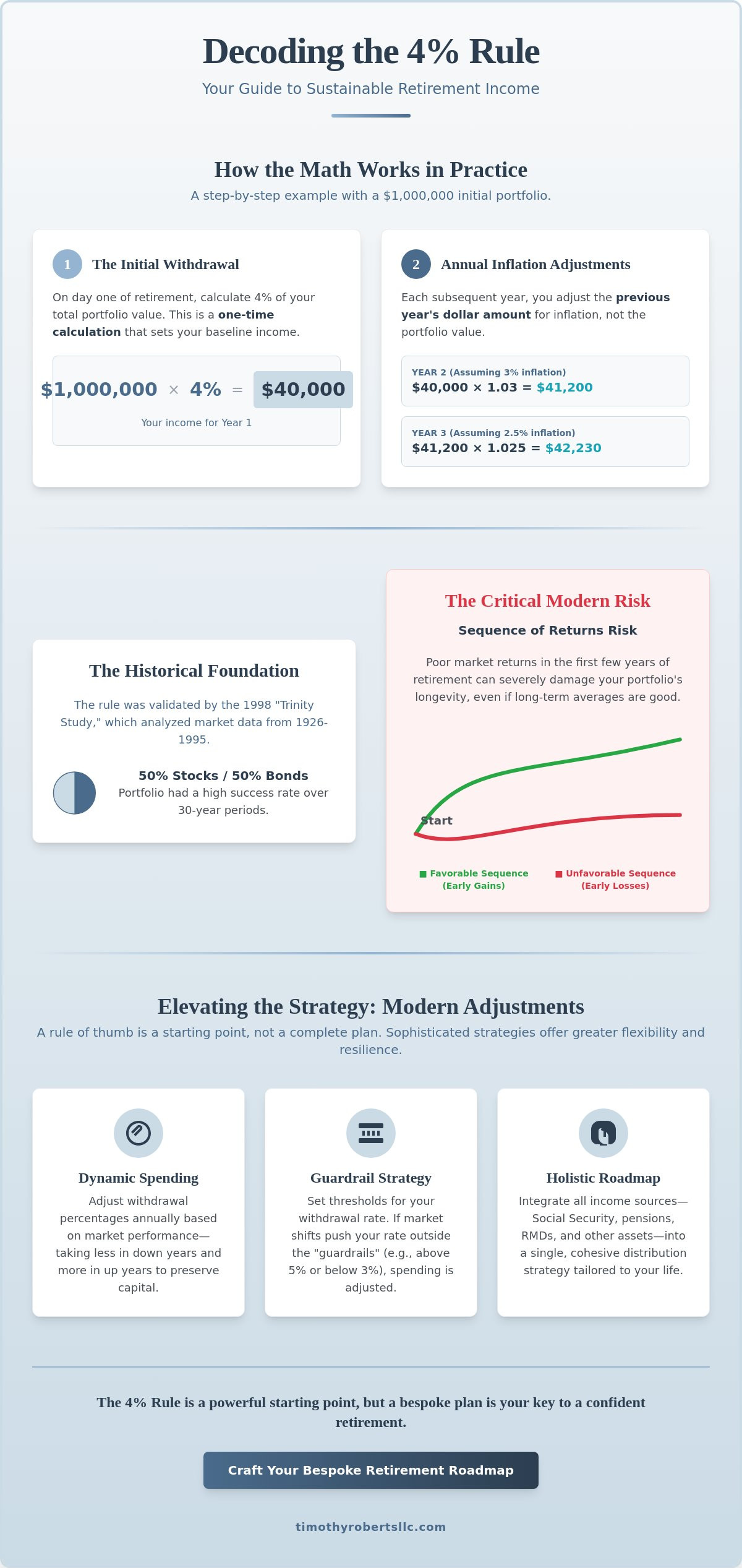
Within the sphere of high-level financial planning, few concepts carry as much weight as this specific withdrawal strategy. Originally formulated by financial advisor William Bengen in 1994, the framework addresses a fundamental question for every retiree: how much can you spend without outliving your assets? Understanding what is the 4% rule in retirement begins with its core premise. It suggests that if you withdraw 4% of your total portfolio during your first year of retirement and adjust that amount for inflation every year thereafter, your wealth should last at least 30 years. This methodology was born from a desire to provide a safety net against the sequence of returns risk, ensuring that a market downturn early in retirement doesn’t deplete the principal prematurely.
To better understand how this strategy functions in real-world scenarios, watch this detailed breakdown:
The Historical Context of the Trinity Study
The framework gained significant academic rigor through the 1998 research commonly known as the Trinity Study. Three professors from Trinity University analyzed market performance data spanning a 70-year period from 1926 to 1995 to determine sustainable spending rates. Their research confirmed that a portfolio composed of a 50/50 stock-to-bond ratio could withstand various economic cycles, including the Great Depression and the high inflation of the 1970s. By examining rolling 30-year periods, the authors found that a 4% initial withdrawal rate resulted in a high probability of portfolio survival. This historical backtesting provides a sense of security, yet it relies on a specific set of market conditions that may not mirror the unique complexities of today’s global economy.
Why ‘Rule of Thumb’ Does Not Equal a Bespoke Plan
While this benchmark remains the most cited guideline in wealth management, it’s a starting point rather than a final destination. High-end financial strategy requires a more holistic approach that accounts for individual tax liabilities, legacy goals, and shifting lifestyle needs. The rule helps elevate the conversation from simple savings to strategic decumulation. It serves as an essential baseline for initial retirement conversations, allowing advisors to stress-test a client’s readiness for the transition into a new phase of life. This collaborative process ensures that the focus remains on aspirational growth and long-term stability. The 4% rule is a stress-tested historical benchmark for portfolio longevity. Ultimately, determining what is the 4% rule in retirement for your specific situation requires moving beyond generic averages toward a customized wealth strategy that reflects your personal values and long-term vision.
The Mechanics of the Rule: How the Math Works in Practice
Understanding what is the 4% rule in retirement requires a shift from asset accumulation to strategic distribution. This framework serves as a mathematical baseline for longevity. It transforms a volatile portfolio into a predictable stream of income. The rule isn’t a static withdrawal percentage; it’s a dynamic adjustment designed to preserve your lifestyle over a 30-year horizon. By establishing a clear protocol, you remove the emotional burden of market fluctuations and replace it with a disciplined, holistic strategy.
Step 1: Determining Your Initial Withdrawal Amount
The math begins on the first day of your retirement. You calculate 4% of your total investable assets to set your baseline income. For a $1,000,000 portfolio, this results in an initial annual withdrawal of $40,000. This calculation happens only once. It’s the only time the 4% figure is actually used in the process. Precision matters here. If your portfolio is valued at $1,250,000 on your retirement date, your first-year income is $50,000. This figure becomes your permanent benchmark. Accurate asset valuation is vital; a discrepancy of even 5% can alter your annual baseline by thousands of dollars.
Step 2: Adjusting for Inflation Annually
Inflation is the silent predator of purchasing power. To counter this, you adjust your dollar amount by the Consumer Price Index (CPI) each year. You don’t take 4% of the remaining balance every year. Instead, you take the previous year’s total and add a cost-of-living adjustment. If inflation is 3%, your second-year withdrawal from a $1,000,000 portfolio becomes $41,200. This ensures your “paycheck” maintains its value even as the cost of goods rises. Learning how the 4% rule works in high-inflation environments is essential for long-term stability. This mechanism provides the psychological benefit of a predictable, inflation-protected raise every year, regardless of how the stock market performs.
Step 3: Monitoring Portfolio Depletion
The 30-year trajectory of the 4% rule assumes you might spend down your principal. You’re tracking a “burn rate” that fluctuates with market cycles. In a bull market, your portfolio may actually grow despite the withdrawals. In a bear market, you’ll see your principal balance decline. The goal isn’t necessarily to leave a massive inheritance. The goal is ending year 30 with at least $1 in the account. Success is defined by the sustainability of the income stream, not the final balance. As you refine your long-term vision, consider how a strategic partnership can help elevate your financial architecture and optimize your asset burn rate.
This systematic approach provides a bespoke roadmap for retirees. It balances the need for immediate cash flow with the long-term necessity of asset preservation. By following these three steps, you create a structured environment where your wealth serves your life, rather than your life serving the management of your wealth.
Why the 4% Rule May Fall Short in a Modern Economy
The 4% rule originated from a 1994 study by William Bengen, yet the financial environment has shifted dramatically since that era. While the framework provides a convenient starting point, its inherent rigidity often ignores the nuances of modern economic cycles. Relying on a fixed percentage fails to account for market volatility, fails to respect individual goals, and fails to address the impact of inflation. When asking what is the 4% rule in retirement, one must recognize it as a baseline rather than a bespoke solution.
Modern longevity also challenges the rule’s 30-year safety window. To properly optimize a retirement strategy, you must look beyond standard horizons. Consider these variables that impact long-term sustainability:
- A 65-year-old woman today has a 31% chance of living to age 94, according to Social Security Administration data.
- Inflation, which averaged 3.8% annually between 1960 and 2023, erodes the purchasing power of a fixed withdrawal over longer periods.
- Rigid rules don’t adjust for the retirement smile spending pattern, where costs are higher in early and late retirement but lower in the middle years.
The Hidden Impact of Taxes and Fees
Your portfolio’s gross withdrawal rate rarely matches your actual spendable income. If you pull 4% from a traditional IRA, the IRS views that entire amount as taxable income at ordinary rates, which can range from 10% to 37% depending on your bracket. Without strategic tax advising, you might find your net purchasing power reduced by nearly a third. Additionally, investment management fees, which often hover around 1% of assets under management, are not accounted for in the original 4% calculation. These costs must be integrated into your holistic plan to ensure your lifestyle remains elevated and your wealth stays protected.
Sequence of Returns Risk Explained
Timing is everything in a decumulation strategy. A market downturn during the first five years of retirement is far more damaging than a crash twenty years later. If your portfolio drops by 15% in year one while you’re simultaneously withdrawing funds, you’re effectively selling shares at a discount and depleting the principal needed for future growth. This compounding loss creates a mathematical hurdle that’s difficult to overcome even during subsequent bull markets. Sequence risk is the primary reason rigid withdrawal rules fail in volatile markets. Understanding what is the 4% rule in retirement requires acknowledging that the order of annual returns dictates the ultimate longevity of your wealth.
Elevating the Strategy: Modern Alternatives and Adjustments
Rigid adherence to a static withdrawal rate often overlooks the nuances of a shifting global economy. While knowing what is the 4% rule in retirement provides a vital baseline; modern wealth management requires a more agile approach. We view the 4% figure as a starting point rather than a permanent ceiling. By integrating dynamic spending models, you can optimize your lifestyle during bull markets while protecting your principal during downturns.
Strategic retirees often utilize the Variable Percentage Withdrawal (VPW) method to maximize utility. This approach adjusts your annual income based on your current portfolio balance and remaining life expectancy. It ensures you consume more when your assets are thriving and scale back when the market resets. To further insulate your plan, we recommend cash bucketing. Segregating 24 to 36 months of liquid expenses allows you to avoid selling equities at a loss during a correction, preserving your long-term growth engine.
Implementing Guyton-Klinger Guardrails
The Guardrails approach, pioneered by Jonathan Guyton and William Klinger in 2006, introduces two critical safety valves: the prosperity rule and the capital preservation rule. If your portfolio performs well and your current withdrawal rate drops 20% below your initial target; the prosperity rule suggests taking a 10% raise. This rewards your discipline and captures market gains for immediate enjoyment.
Conversely; if a market dip pushes your withdrawal rate 20% above your initial target; the capital preservation rule triggers a 10% spending cut. This proactive adjustment prevents the portfolio from entering a “death spiral” during poor sequence of returns. These rules create a resilient income stream that reacts to real-world data rather than hypothetical projections.
The Role of Asset Allocation in Sustainable Income
Traditional 60/40 portfolios may no longer provide the necessary cushion against modern inflationary pressures. Elevating your strategy requires moving toward a bespoke investment portfolio that balances growth with stability. High-yield fixed-income alternatives and private credit now play a larger role in the 4% math than they did in the 1990s.
- Inflation Hedging: Incorporating assets like TIPS or infrastructure can protect purchasing power.
- Yield Optimization: Dividend-growth stocks provide a rising income floor that bonds often lack.
- Risk Mitigation: Strategic diversification across uncorrelated asset classes reduces the volatility that threatens a 4% withdrawal strategy.
Refining what is the 4% rule in retirement means acknowledging that your portfolio must evolve alongside your life stages. A customized framework ensures that your wealth remains a tool for freedom rather than a source of anxiety. If you are ready to move beyond generic financial advice and build a plan tailored to your specific legacy, partner with Timothy Roberts LLC today.
Crafting a Bespoke Retirement Income Roadmap
Transitioning from wealth accumulation to decumulation requires a fundamental shift in mindset. For decades, the focus was on the climb. Now, the priority is a controlled, strategic descent. Understanding what is the 4% rule in retirement provides a useful starting point, but it’s merely a baseline. A truly resilient plan requires a synthesis of all your assets, moving beyond a static percentage to create a dynamic flow of capital that honors your unique lifestyle goals.
The shift from saving to spending is often the most challenging psychological hurdle for high-net-worth individuals. It requires a partner who understands that your portfolio is a tool for life, not just a number on a screen. We focus on transforming your accumulated wealth into a structured, reliable stream of income that accounts for taxes, inflation, and the unexpected shifts of the global economy. This level of precision ensures that your wealth serves your vision, rather than the other way around.
Integrating Diverse Income Streams
Your portfolio doesn’t exist in a vacuum. Effective retirement income planning coordinates your liquid assets with Social Security, private pensions, and real estate holdings. For instance, the timing of Social Security claims is a critical lever. Delaying benefits until age 70 can increase your monthly payment by 8% annually, providing a significant hedge against longevity risk. This strategic delay might allow you to draw more heavily from your portfolio in your early 60s, optimizing your total lifetime wealth.
- Tax Efficiency: Coordinating withdrawals to stay within lower tax brackets and manage capital gains.
- RMD Management: Planning for Required Minimum Distributions, which begin at age 73 or 75 under the SECURE Act 2.0.
- Legacy Protection: Structuring your drawdowns so they don’t compromise the inheritance you intend to leave behind.
The Fiduciary Advantage in Income Planning
A generic rule of thumb cannot account for the nuances of your specific estate objectives or tax situation. This is where the value of a fiduciary becomes clear. A personalized roadmap outperforms a calculator because it adapts. When you understand what is the 4% rule in retirement, you see it’s a guide, not a law. We provide ongoing monitoring and strategic rebalancing to protect your purchasing power, especially when inflation fluctuates as it did in 2023, when the Consumer Price Index saw a 3.4% increase over the year.
Elevation in retirement planning means moving from a defensive posture to one of quiet confidence. It’s about having a strategy that’s as sophisticated as the career that built your wealth. Don’t settle for an off-the-shelf solution for your most important journey. Elevate your retirement strategy with a professional consultation and transform your vision into a sustainable reality.
Beyond the Benchmark: Securing Your Financial Legacy
Understanding what is the 4% rule in retirement provides a helpful starting point, yet relying on a 1994 formula in a modern landscape is a risk few can afford. While the original Trinity Study suggests a steady withdrawal rate, today’s 3.4% average inflation and shifting market cycles demand a more agile response. A successful retirement isn’t found in a static percentage; it’s built through active optimization and a deep understanding of how tax layers impact your total liquidity.
At Timothy Roberts & Associates, we move past generic models to deliver high-end, personalized guidance. With over 25 years of fiduciary expertise, we specialize in comprehensive wealth and tax integration that protects your lifestyle against unforeseen economic shifts. Our team works to transform your accumulated assets into a resilient, holistic engine for growth. Elevate your retirement strategy with a bespoke income plan from Timothy Roberts & Associates. You’ve spent decades building your wealth; it’s time to ensure your strategy is as sophisticated as the life you’ve envisioned.
Frequently Asked Questions
Is the 4% rule still valid for retirement in 2026?
The 4% rule remains a viable baseline for 2026, though modern research suggests a more bespoke approach. Morningstar’s 2023 State of Retirement Income report indicated that a 4% starting withdrawal rate is sustainable for a 30 year horizon. This shift reflects higher bond yields compared to the low interest environment of 2021. You’ll find that what is the 4% rule in retirement serves as a foundational pillar rather than an immutable law.
Does the 4% rule include taxes on my withdrawals?
The 4% rule calculates gross withdrawals before any tax liabilities are deducted. If you hold assets in a traditional 401k or IRA, your net income will be lower after the IRS takes its share. A $1 million portfolio provides $40,000 annually, but a 22% effective tax rate reduces your spendable cash to $31,200. We recommend a strategic, holistic view of your tax buckets to optimize actual liquidity.
What happens to the 4% rule if the stock market crashes early in my retirement?
A market crash early in retirement triggers sequence of returns risk, which can deplete your capital prematurely. If your portfolio loses 20% in year one, your 4% withdrawal represents a much larger portion of the remaining assets. Historical data from the 1966 bear market shows that rigid withdrawal patterns can lead to portfolio exhaustion. You must remain agile; perhaps reducing spending during these volatile periods to protect your long term growth.
Can I withdraw more than 4% if I have a high-equity portfolio?
You can potentially elevate your withdrawal rate to 4.5% or 5% with a high equity allocation, though this invites significant volatility. Bill Bengen’s later research in 2006 suggested that including small cap stocks could justify a 4.7% initial rate. However, the 1929 and 2000 market cycles prove that heavy equity exposure requires a disciplined stomach. This isn’t a generic solution; it’s a calculated trade between higher income and increased failure risk.
How do I adjust the 4% rule for high inflation years?
You adjust your dollar amount annually based on the Consumer Price Index (CPI) regardless of your current portfolio performance. If your initial withdrawal was $40,000 and inflation hits 3.4% as it did in 2023, your second year withdrawal becomes $41,360. This method ensures your purchasing power remains stable over a 30 year horizon. Understanding what is the 4% rule in retirement requires mastering these nuanced annual adjustments to maintain your lifestyle.
Is the 4% rule based on my initial portfolio value or the current value?
The 4% rule is strictly based on your portfolio value at the exact moment you retire. You calculate 4% of that initial balance and then adjust that specific dollar amount for inflation every year thereafter. It doesn’t fluctuate with the daily market value of your assets. This provides a predictable income stream, though it requires a robust initial strategy to ensure the principal lasts through varying market cycles.
What is the biggest risk when using the 4% rule?
Sequence of returns risk is the most formidable threat to the success of the 4% rule. If the market experiences a downturn during the first 5 to 10 years of your retirement, the mathematical probability of your money lasting 30 years drops. Research into the 2008 financial crisis highlights how early losses compound when combined with steady withdrawals. A strategic buffer, such as a cash reserve, can mitigate this specific danger.
Should I use the 4% rule if I plan to retire early at age 50?
You shouldn’t rely on a 4% withdrawal rate if you retire at 50, as your horizon extends to 40 or 50 years. The original Trinity Study focused on a 30 year period, but longer retirements face higher failure rates. Financial researchers often suggest a more conservative 3.3% rate for those entering retirement early. This lower threshold provides the necessary margin of safety to navigate half a century of economic shifts and inflation.
