

May
How to Feel Financially Secure in Retirement: A Strategic Guide to Wealth Elevation
What if your retirement wasn’t a gamble on the next market cycle, but a meticulously engineered masterpiece of cash flow? Most high-net-worth individuals spend decades accumulating assets, yet they still wake up wondering how to feel financially secure in retirement while inflation sits at 3.3% and market volatility threatens their hard-earned legacy. It’s a valid concern. You’ve worked too hard to let a shifting economic landscape dictate your quality of life or erode the $24,500 you’re diligently contributing to your 401(k) in 2026.
Paying off a mortgage is often a psychological decision that impacts how to feel financially secure in retirement as much as a mathematical one. Eliminating a large monthly liability reduces your required income floor, which can lower your overall portfolio risk. However, if your mortgage interest rate is lower than the expected return on your investments, keeping the loan might preserve more liquidity for your estate. This trade off is a central focus of Retirement Planning, and we analyze these factors based on your specific cash flow needs and tax situation.
You likely recognize that a large account balance doesn’t automatically equate to a sustainable lifestyle. We’re here to bridge that gap. This guide reveals our professional framework for transforming a volatile portfolio into a bespoke, predictable income stream that ensures lifelong peace of mind. We’ll explore the strategic intersection of tax-efficient withdrawal sequencing, risk mitigation, and the long-term impact of the 2025 One Big Beautiful Bill Act on your estate to ensure your wealth remains elevated for the next generation.
Key Takeaways
- Master the fundamental shift from wealth accumulation to strategic income generation, ensuring your lifestyle remains sustainable regardless of market fluctuations.
- Discover the specific frameworks for how to feel financially secure in retirement by transforming a static nest egg into a sophisticated, predictable paycheck.
- Implement a bespoke withdrawal sequencing strategy to neutralize “Sequence of Returns Risk,” a primary threat to early retirement stability.
- Learn to mitigate the three great risks of longevity, healthcare costs, and the eroding effects of inflation on your long-term purchasing power.
- Elevate your financial future by moving beyond “suitable” advice toward a fiduciary partnership that prioritizes holistic wealth management and legacy planning.
Transitioning from Wealth Accumulation to Strategic Income Generation
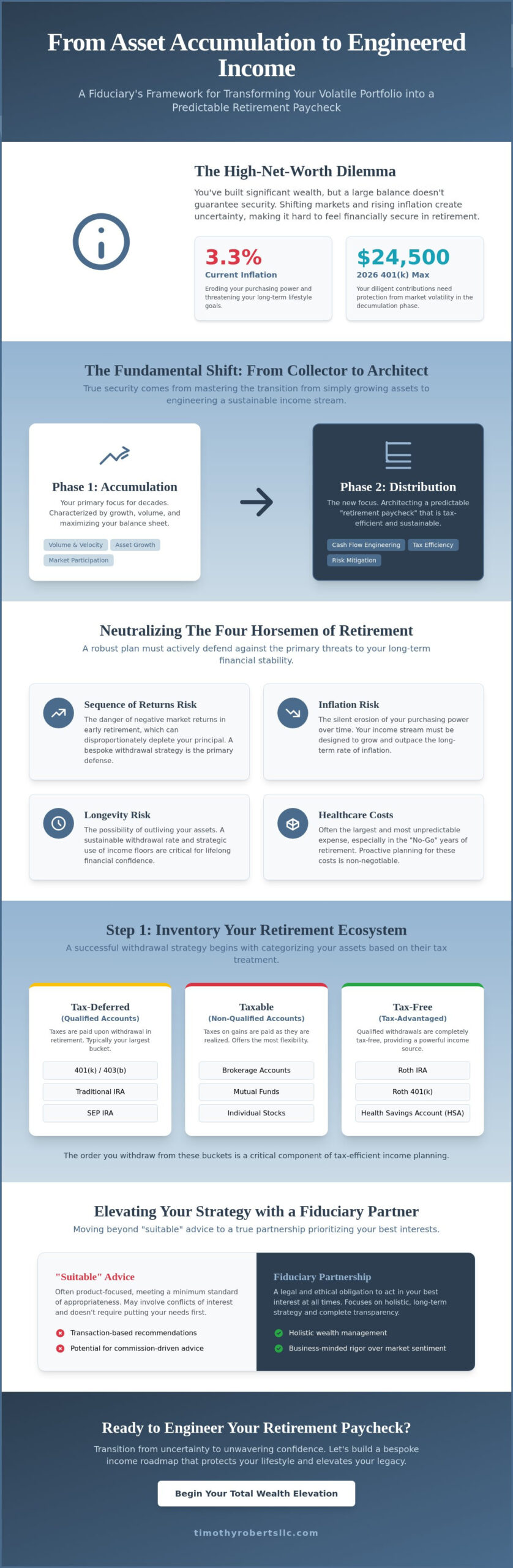
True financial security in retirement is the unwavering confidence that your cash flow will exceed your expenses, regardless of whether the markets are surging or retracting. For decades, you’ve focused on the growth of your balance sheet. This accumulation phase was about volume and velocity. However, as you approach your post-career years, you must master the decumulation phase. This requires a profound mindset shift. You’re no longer just a collector of assets; you’re now the architect of a sustainable income engine. Learning how to feel financially secure in retirement involves viewing your portfolio as a functional ecosystem rather than a static trophy.
We define this transition as Total Wealth Elevation. It’s a strategic approach that looks far beyond the bottom line of a brokerage statement to account for tax efficiency, inflation protection, and legacy goals. It’s a common misconception that a high net worth automatically guarantees a stress-free retirement. Without a rigorous distribution plan, even a substantial nest egg remains vulnerable to the twin pressures of market volatility and tax drag. A bespoke strategy transforms these raw assets into a predictable stream of liquidity that supports your lifestyle without depleting your principal.
The Psychology of the Retirement Paycheck
The emotional relief of moving from volatile growth to a structured “retirement paycheck” cannot be overstated. Many high-achieving individuals experience significant spending guilt in their early retirement years, fearing that every withdrawal might jeopardize their long-term stability. A strategic income plan provides the objective permission to enjoy the fruits of your labor. When market dips occur, the presence of a fiduciary partner provides the calm confidence needed to stay the course. This professional relationship ensures that your decisions are based on business-minded rigor rather than temporary market sentiment.
Inventorying Your Retirement Ecosystem
A successful transition begins with a holistic inventory of your financial landscape. You must categorize your assets based on their tax treatment: Qualified accounts like your 401(k) or IRA, Non-Qualified brokerage accounts, and Tax-Free vehicles such as a Roth IRA. Simultaneously, you should identify your guaranteed income floors, which typically include Social Security, pensions, or certain annuities. To better understand these foundational components, many investors refer to a comprehensive guide to retirement planning to align their assets with their long-term objectives. The Income Gap is the specific dollar amount representing the difference between your guaranteed fixed income sources and the total annual cost of your desired lifestyle.
Creating Your Bespoke Retirement Income Roadmap
A generic financial plan is a disservice to a lifetime of achievement. To truly understand how to feel financially secure in retirement, you must look beyond mere account balances and establish a holistic view of your household’s financial health. This process involves auditing current liabilities, defining specific estate goals, and ensuring your principal is protected from market shocks while still capturing inflation-beating growth. Relying on off-the-shelf products often leads to suboptimal outcomes because they fail to account for your unique tax situation or family dynamics. Instead, we advocate for strategic retirement income planning that serves as the foundation for every decision you make. This roadmap isn’t a static document; it’s a living strategy designed to elevate your wealth and preserve your legacy.
Step 1: The Expense Discovery Phase
Your retirement won’t be a static event. It’s a dynamic journey with shifting costs and priorities that require careful calibration. We begin by differentiating between “needs,” which are your essential living expenses, and “wants,” representing your discretionary lifestyle choices. A sophisticated roadmap accounts for the “Go-Go” years of active travel, the “Slow-Go” years of local leisure, and the “No-Go” years where healthcare needs may naturally increase. As you prepare for retirement, it’s vital to build a liquidity buffer. This protects your lifestyle from unexpected family support needs or sudden changes in the 3.3% inflation rate recorded in March 2026. This buffer provides the psychological freedom to spend your discretionary funds without the fear of depleting your core assets.
Step 2: Asset Allocation vs. Asset Location
Many advisors focus solely on asset allocation, which describes the mix of stocks and bonds you hold. A more strategic approach prioritizes asset location, which focuses on the specific types of accounts where those assets reside. This distinction is critical for tax efficiency and maximizing your net spendable income. For example, placing high-growth assets in tax-free Roth accounts while keeping high-income, tax-inefficient assets in tax-deferred vehicles can significantly reduce your annual tax drag. This level of optimization ensures that your wealth isn’t just growing; it’s also accessible in the most cost-effective manner possible. By aligning your portfolio with the 2026 tax brackets, where the 24% bracket starts at $211,400 for married couples, you can effectively manage your lifetime tax liability. If you’re looking to refine these details, our retirement income planning services can help harmonize your portfolio with your long-term vision.
Optimizing the ‘Retirement Paycheck’ through Withdrawal Sequencing
The greatest threat to a long term retirement plan isn’t necessarily a market crash; it’s the timing of that crash. Selling assets into a declining market during the first few years of your post-career life can permanently impair your portfolio’s longevity. This phenomenon, known as sequence of returns risk, is a primary reason why high net worth individuals often struggle with how to feel financially secure in retirement. To neutralize this threat, we utilize a sophisticated bucket strategy. This framework partitions your wealth into immediate liquidity, intermediate income, and long term growth, providing the psychological and financial stability needed to weather periodic volatility without sacrificing your lifestyle.
A truly elevated strategy goes beyond simple asset management to incorporate strategic tax advising into every withdrawal decision. By coordinating which accounts you draw from and when, you can potentially extend the life of your portfolio by several years. This coordination is especially vital when managing Required Minimum Distributions (RMDs). If left unaddressed, these mandatory withdrawals can become a significant tax burden, pushing you into a 32% or 35% federal bracket and increasing the cost of your retirement. Proactive planning allows us to transform these obligations into opportunities for portfolio rebalancing or charitable giving.
The Tax-Efficient Withdrawal Hierarchy
A standard hierarchy often suggests depleting taxable brokerage accounts first, followed by tax-deferred IRAs, and finally tax-free Roth accounts. However, a bespoke plan requires flexibility. We may deviate from this order to perform strategic Roth conversions, intentionally filling lower tax brackets today to avoid higher rates in the future. This is particularly relevant given the 3.3% inflation rate recorded for the 12 months ending March 2026, which necessitates a more precise approach to preserving purchasing power. Strategic tax sequencing can also potentially lower Medicare Part B premiums by managing your income to stay below specific IRMAA thresholds.
Managing Market Volatility with Cash Cushions
Maintaining a cash cushion of one to two years’ worth of living expenses is a non-negotiable component of a resilient plan. This liquidity allows you to avoid selling equities during a market correction, effectively buying time for your portfolio to recover. We implement rebalancing strategies that harvest gains during bull markets to replenish this cash bucket, ensuring your income stream remains uninterrupted. For additional perspective on organizing your liquidity, the FDIC guide on retirement saving provides foundational insights on maintaining financial order. By using spending guardrails, we can adjust your discretionary outflows based on real-time portfolio performance, creating a dynamic system that prioritizes long term security over short term fluctuations.
Mitigating the Three Great Risks: Inflation, Longevity, and Healthcare
A successful retirement strategy must solve for more than just portfolio growth; it must account for the silent erosions of time and rising costs. While market volatility often captures the headlines, the true challenge in how to feel financially secure in retirement lies in managing longevity risk. With a 30 year retirement horizon now becoming the standard for high net worth couples, your plan must transition from avoiding the “risk of loss” to mitigating the “risk of outliving money.” This requires a shift toward assets that provide real, inflation adjusted growth to maintain your lifestyle through three decades of economic change. We look at your portfolio not as a static collection of stocks, but as a dynamic engine built to withstand the pressures of an evolving global economy.
Inflation remains a formidable opponent to fixed income and long term stability. At the 3.3% annual inflation rate recorded in March 2026, the purchasing power of a dollar is effectively halved in approximately 22 years. If your income strategy doesn’t include a mechanism for cost of living adjustments, the lifestyle you enjoy at age 65 will be unrecognizable by age 87. Protecting your wealth requires a holistic approach to risk management and insurance analysis to ensure these external pressures don’t compromise your long term peace of mind.
Strategic Social Security Optimization
Social Security shouldn’t be viewed as a mere government benefit, but as a powerful, inflation protected longevity hedge. By delaying your claim from age 66 to 70, you secure a guaranteed 8% annual increase in your benefit amount. For a high earning couple, strategic spousal coordination can significantly maximize the survivor benefit, providing a critical safety net for the remaining spouse. This optimization provides a solid foundation of guaranteed income, allowing your other invested assets more room to pursue growth without the immediate pressure of funding daily expenses. It’s a key component in elevating your total wealth strategy.
Planning for the ‘Unpredictable’ Healthcare Cost
Medicare is not an all encompassing solution for the modern retiree. With the 2026 Medicare Part B standard monthly premium at $202.90 and an annual deductible of $283, out of pocket expenses can accumulate quickly. More significantly, a 65 year old today has a 70% chance of needing some form of long term care. With nursing home costs averaging $119,340 per year in 2026 and median home care reaching $34 per hour, self funding isn’t always the most efficient path. We evaluate hybrid insurance models and the strategic use of Health Savings Accounts as “stealth IRAs” to provide tax free liquidity for medical needs. By contributing to an HSA during your peak earning years, you create a dedicated fund for future premiums and long term care expenses that grows entirely tax free. This level of customization ensures that a healthcare crisis doesn’t become a financial crisis for your estate.
The Fiduciary Standard: Elevating Your Retirement Strategy
The distinction between a financial salesperson and a fiduciary strategist is the difference between a transaction and a transformation. While many institutions offer “suitable” advice, this standard only requires that a product fits a general profile, not that it’s the absolute best choice for your specific legacy. To truly master how to feel financially secure in retirement, you require the fiduciary standard. This legal obligation ensures every recommendation is made with your best interests as the singular priority. It moves your financial life away from fragmented product sales toward a continuous, high-level partnership. This professional oversight provides a calm confidence that your strategy is being monitored with business-minded rigor, allowing you to focus on the lifestyle you’ve spent decades building.
Professional management serves as the central nervous system for your wealth. It coordinates the complexities of tax planning strategies, estate management, and investment portfolio management into a single, cohesive vision. For example, the July 2025 passage of the One Big Beautiful Bill Act (OBBBA) made the seven-bracket federal income tax structure permanent, creating a unique window for long-term tax optimization. Without a dedicated advisor to synthesize these legislative shifts with your withdrawal sequence, you risk unnecessary wealth erosion. The return on investment for this level of strategic coordination is measured in peace of mind and the preservation of capital for the next generation.
Bespoke Wealth Management vs. Automated Solutions
Target Date Funds and automated “robo-advisors” are designed for the masses, yet they often fail high-net-worth retirees during the critical decumulation phase. These off-the-shelf solutions are too blunt to handle the nuances of tax-efficient sequencing or the specific risks of a $200,000+ annual lifestyle. A bespoke approach prioritizes personalized risk tolerance assessments that evolve as you move through different stages of retirement. Perhaps most importantly, a dedicated advisor acts as a behavioral coach. During periods of market panic, having a visionary strategist to provide objective reassurance is the most effective way to prevent emotional decisions that could jeopardize decades of growth.
Your Next Steps Toward Elevation
True elevation begins with a comprehensive audit of your current financial landscape. This involves a meticulous review of your estate goals, investment documents, and insurance coverage to ensure they align with the 2026 economic reality. Year-round tax compliance and proactive planning are not optional; they’re the essential tools for preserving your retirement capital against inflation and shifting regulations. We invite you to elevate your retirement strategy with a personalized consultation. Together, we can transform your current assets into a sophisticated, predictable income stream that reflects the depth of your achievements and the ambition of your future.
Elevating Your Vision for a Sustainable Legacy
Retirement is not the end of your financial journey; it’s the beginning of a more sophisticated chapter. You’ve learned that true security requires a deliberate shift toward decumulation and the implementation of a bespoke withdrawal hierarchy. By neutralizing the threats of inflation and healthcare costs through strategic tax integration, you ensure your lifestyle remains sustainable for 30 years or more. Understanding how to feel financially secure in retirement is ultimately about replacing uncertainty with a professional framework designed for elevation.
Our firm brings over 25 years of fiduciary expertise to help you coordinate tax planning and estate management into one holistic strategy. We don’t believe in off-the-shelf solutions. Instead, we craft interventions tailored to your unique risk tolerance and long-term ambitions. It’s time to move beyond simple accumulation and secure the predictable income stream you deserve. Schedule a Strategic Retirement Income Review with Timothy Roberts & Associates, LLC today. Your future is a masterpiece waiting to be realized.
Frequently Asked Questions
How much money do I really need to feel secure in retirement?
The specific amount depends entirely on your personal “Income Gap,” which is the difference between your guaranteed income and your desired lifestyle costs. Rather than focusing on a single net worth figure, you should prioritize the sustainability of your cash flow. For context, the average weekly wage in the U.S. reached $1,280 as of March 2026. A bespoke plan ensures your portfolio can support your specific expenses while maintaining a buffer for the 3.3% inflation rate.
What is the 4% rule, and is it still valid in 2026?
The 4% rule is a traditional guideline suggesting you can safely withdraw 4% of your initial portfolio balance annually, adjusted for inflation, without running out of money. In 2026, this rule is often considered a blunt instrument rather than a precise strategy. With current market conditions and a 3.3% inflation rate, we favor dynamic spending guardrails. These allow for higher distributions during bull markets and strategic reductions during contractions to preserve your principal.
Can I retire early if the market is currently volatile?
Early retirement is possible during volatility if you have a dedicated cash cushion of one to two years to avoid selling assets at a loss. This liquidity allows your growth oriented investments time to recover from temporary dips. By mastering how to feel financially secure in retirement through a structured bucket strategy, you can insulate your daily lifestyle from the noise of the stock market. This approach transforms market cycles from a threat into a manageable variable.
What is the best way to minimize taxes on my retirement withdrawals?
Strategic withdrawal sequencing across taxable, tax deferred, and tax free accounts is the most effective way to minimize your lifetime tax liability. For 2026, married couples filing jointly enter the 24% bracket at incomes over $211,400. We utilize Roth conversions and proactive tax advising to stay within lower brackets whenever possible. This level of coordination prevents “tax spikes” caused by Required Minimum Distributions or the sale of highly appreciated assets.
How do I protect my retirement income from high inflation?
Protecting your purchasing power requires a combination of equity growth, Social Security optimization, and inflation adjusted assets. Since the annual inflation rate was 3.3% for the 12 months ending March 2026, static income sources will naturally lose value over time. Delaying Social Security to age 70 provides a guaranteed 8% annual increase, serving as a powerful longevity hedge. We also incorporate assets that historically outpace inflation to ensure your lifestyle remains elevated for decades.
Should I pay off my mortgage before I retire to feel more secure?
Paying off a mortgage is often a psychological decision that impacts how to feel financially secure in retirement as much as a mathematical one. Eliminating a large monthly liability reduces your required income floor, which can lower your overall portfolio risk. However, if your mortgage interest rate is lower than the expected return on your investments, keeping the loan might preserve more liquidity for your estate. We analyze this trade off based on your specific cash flow needs and tax situation.
What happens to my retirement security if I need long-term care?
Long term care is one of the most significant risks to retirement stability, as a 65 year old has a 70% chance of needing assistance. With nursing home costs averaging $119,340 per year in 2026, an unmanaged health crisis can quickly deplete a portfolio. We integrate risk management strategies, such as hybrid insurance models or dedicated Health Savings Accounts, to cover these costs. This proactive planning ensures that your medical needs don’t compromise the legacy you intend for the next generation.
How often should I review my retirement income plan with a professional?
You should review your plan at least annually or whenever significant legislative changes occur, such as the 2025 One Big Beautiful Bill Act. Regular audits allow us to adjust your withdrawal strategy based on the current 2026 tax brackets and your evolving risk tolerance. These sessions serve as a strategic recalibration, ensuring your assets remain aligned with your long term vision. Constant oversight transforms a one time financial plan into a dynamic, results driven partnership.
