

May
Managing Investment Risk in Retirement: A Strategic Framework for 2026
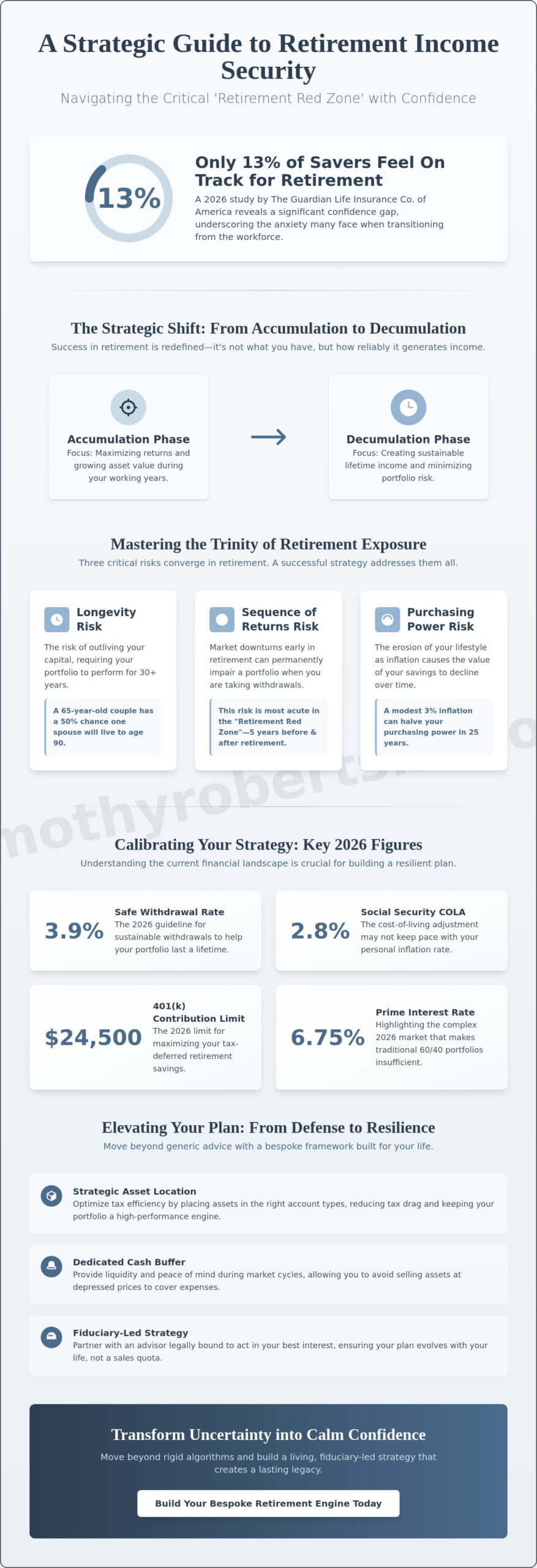
Only 13% of savers feel truly on track to sustain their lifestyle throughout retirement according to a 2026 study by The Guardian Life Insurance Co. of America. It’s a statistic that underscores a deep-seated anxiety many individuals face as they enter the critical five-year window surrounding their transition from the workforce. You likely recognize that managing investment risk in retirement is no longer about simple preservation; it’s about protecting your purchasing power against a 2.8% Social Security COLA that may not keep pace with your actual cost of living.
We believe your portfolio should be more than a defensive shield. It should be a bespoke, strategically elevated income engine designed to thrive in any climate. This guide will show you how to move beyond basic withdrawal rules toward a sophisticated framework that integrates the 2026 safe withdrawal rate of 3.9% with holistic tax efficiency. We’ll explore how rising equity glide paths and optimized 401(k) contributions, which sit at $24,500 for 2026, can transform your financial trajectory from one of uncertainty into a narrative of calm confidence and lasting legacy.
Key Takeaways
- Transition from a mindset of asset accumulation to a strategic decumulation phase where success is defined by sustainable, lifetime income.
- Address the “Trinity of Exposure” to master managing investment risk in retirement, specifically targeting sequence of returns and the erosion of purchasing power.
- Implement strategic asset location to optimize tax efficiency, ensuring your portfolio remains a high-performance engine rather than a victim of unnecessary tax drag.
- Calibrate a bespoke framework that utilizes a dedicated cash buffer to provide liquidity and peace of mind during inevitable market cycles.
- Elevate your financial future by moving beyond rigid algorithms toward a living, fiduciary-led strategy that evolves with your personal lifestyle goals.
The Strategic Shift: Defining Investment Risk in the Decumulation Phase
Success during your working years is measured by the size of the harvest. Once you transition into retirement, the metric shifts from the total value of your assets to the reliability of your income. This pivot marks the beginning of the decumulation phase, a period where traditional growth strategies can become liabilities if they aren’t carefully recalibrated. Managing investment risk in retirement is no longer about maximizing returns; it’s about minimizing the probability that you’ll outlive your capital.
Understanding the nuances of retirement spend-down strategies is essential for this transition. While a market dip during your 40s is an opportunity to buy at a discount, the same dip in your 60s, while you’re actively withdrawing funds, can lead to a permanent loss of capital. Market volatility is temporary, but permanent loss is structural. Liquidating assets at depressed prices to cover basic expenses diminishes the portfolio’s ability to recover. Such a reality requires a bespoke financial roadmap rather than a generic asset allocation, moving your strategy from a defensive crouch into a position of resilient strength.
To better understand how these risks are managed at a high level, watch this helpful video:
Why Traditional Diversification May No Longer Be Sufficient
The classic 60/40 portfolio, once the gold standard of stability, faces significant pressure in 2026. With the prime interest rate sitting at 6.75% as of March 2026, managing investment risk in retirement has become increasingly complex. During periods of extreme market stress, asset classes that usually move in opposite directions often begin to move in tandem. This convergence of correlations means that simple diversification won’t protect you from systemic shocks. You need a multi-layered approach that considers inflation, which can halve your purchasing power over 25 years even at a modest 3% rate. A holistic strategy looks beyond asset classes to include tax-efficient structures and alternative hedges.
The Fiduciary Standard in Risk Assessment
Effective risk management isn’t a product you buy; it’s a standard of care you deserve. A fiduciary advisor is legally bound to act in your best interest, a sharp contrast to the suitability standard that often prioritizes product sales over client outcomes. By choosing sophisticated investment portfolio management, you ensure that your strategy is built on unbiased analysis and strategic foresight. This partnership elevates your plan from a static document into a living, breathing strategy that adapts to both market shifts and your evolving personal vision. It’s about finding a visionary strategist who understands the intersection of your wealth and your life’s purpose.
The Trinity of Exposure: Longevity, Sequence, and Purchasing Power
Successful wealth preservation requires a synthesis of three distinct threats that often converge during the first decade of your transition. While many advisors treat these as isolated variables, we view them as a “perfect storm” that can dismantle even the most diligent accumulation plans. Managing investment risk in retirement is not a static task; it’s a dynamic response to the intersection of how long you live, when the market fluctuates, and how quickly your dollars lose their value. When these three factors align unfavorably, the result is a structural deficit that no amount of late-stage frugality can easily repair.
This “Retirement Red Zone,” the period five years before and after you stop working, is when your portfolio is most vulnerable. A 65-year-old couple today has a 50% chance of at least one spouse living to age 90, meaning your assets must maintain their performance for three decades or more. This longevity requires a portfolio with the stamina to withstand short-term shocks while funding a lifestyle that will likely include an estimated $315,000 in healthcare costs alone. Without a strategic framework, you risk outliving your capital simply by being healthy and resilient.
Sequence of Returns: The Silent Portfolio Killer
Average returns are a mathematical myth during the withdrawal phase. In your accumulation years, the order of returns didn’t matter; in retirement, it’s everything. If you experience a significant market downturn while simultaneously taking distributions, you are forced to sell more shares to meet your income needs. This permanently depletes your principal and leaves fewer assets to participate in the eventual recovery. Sequence risk is the vulnerability of a portfolio to the order of annual returns during withdrawals. Sophisticated investors often utilize specific managing sequence of returns risk strategies to ensure that a poorly timed bear market doesn’t dictate the success of their entire future.
Inflation and the Erosion of Lifestyle
Purchasing power risk is the quietest threat to your standard of living. Even a moderate inflation rate of 3% can cut the purchasing power of your fixed income in half over a 25-year horizon. While cash and short-term CDs might feel “safe” because their principal value doesn’t fluctuate, they often carry the highest risk of failing to keep pace with rising costs. Managing investment risk in retirement requires a balance of inflation-hedging assets, such as equities and real estate, that can grow faster than the 2.8% Social Security COLA announced for 2026. A truly resilient strategy focuses on bespoke retirement income planning to ensure your lifestyle remains sustainable regardless of the economic climate.
Beyond Diversification: Asset Allocation vs. Strategic Asset Location
Most investors understand asset allocation, the strategic mix of stocks, bonds, and cash designed to balance risk and reward. However, truly sophisticated wealth management requires a deeper focus on asset location. This is the art of determining which specific accounts should hold which specific assets. Managing investment risk in retirement is often reduced to a defensive move into conservative bonds, but we view it as a structural optimization that accounts for the IRS’s share of your future growth. By placing tax-inefficient assets into tax-deferred accounts and growth-oriented equities into taxable or tax-free buckets, you can significantly reduce the “tax drag” that quietly erodes your portfolio performance.
This drag often costs investors between 1% and 2% in annual returns, a figure that compounds into a substantial loss of purchasing power over a 30-year retirement. Roth conversions and tax-loss harvesting serve as critical interventions within this framework. Converting traditional IRA funds to a Roth IRA during market pullbacks allows you to pay taxes on a depressed valuation, ensuring the eventual recovery is entirely tax-free. This level of precision is why strategic tax advising is an indispensable component of a resilient financial plan. It transforms your tax liability from a random variable into a manageable risk factor.
The Tax-Risk Connection
High taxes don’t just reduce your net income; they force you to take larger, riskier withdrawals from your portfolio to maintain your standard of living. If your effective tax rate is 25%, you must withdraw significantly more capital to meet your spending needs than if your rate were 15%. This increased withdrawal rate heightens your exposure to sequence of returns risk, especially during the volatile “Retirement Red Zone.” A tax-aware strategy that utilizes taxable, tax-deferred, and tax-exempt accounts effectively increases your safe withdrawal rate without requiring you to move further out on the risk curve. Managing investment risk in retirement therefore becomes a function of tax efficiency as much as market selection.
Dynamic Rebalancing in Volatile Markets
Traditional rebalancing often follows a rigid calendar, such as every January or June. We favor threshold rebalancing, which triggers trades only when an asset class deviates from its target weight by a specific percentage, such as 5%. This method is more responsive to the 2026 economic landscape, ensuring you sell high and buy low when the market actually provides the opportunity. It demands a level of continuous monitoring and intellectual rigor found in a bespoke wealth management strategy. This disciplined approach removes emotion from the equation, replacing anxiety with a logical, strategic process for maintaining portfolio resilience.
The Bespoke Framework: Five Steps to Calibrating Portfolio Resilience
Constructing a resilient retirement strategy requires moving beyond the abstract theories of diversification toward a tactical, five-step implementation plan. Managing investment risk in retirement is achieved through the precise alignment of your liquid resources with your long-term aspirations. This framework replaces the anxiety of market timing with the stability of a structured process, ensuring that your lifestyle remains insulated from the noise of the 24-hour financial news cycle. It is a transition from reactive guessing to proactive orchestration.
- Step 1: Quantify Spending Needs. Separate your essential costs, such as the estimated $315,000 required for lifetime healthcare, from discretionary desires like travel or legacy gifting.
- Step 2: Establish a Liquidity Tier. Secure 1-3 years of anticipated expenses in high-quality, short-term instruments to avoid selling equities during a downturn.
- Step 3: Segment Assets by Time Horizon. Adopt a bucket approach that matches conservative assets to near-term needs and growth assets to goals ten or twenty years in the future.
- Step 4: Stress Test the Portfolio. Run your allocation against historical bear markets, such as the 2008 financial crisis or the 2022 inflationary spike, to identify hidden vulnerabilities.
- Step 5: Implement Systematic Withdrawals. Utilize a dynamic strategy that adapts to the 2026 safe withdrawal rate of 3.9%, adjusting your distributions based on portfolio performance.
This disciplined sequence ensures that your wealth serves your life, rather than your life being dictated by your wealth. To begin your journey toward a more secure future, explore our bespoke wealth management strategy to see how these steps integrate into your unique vision.
The Liquidity Tier: Immunizing Against Market Volatility
A dedicated cash or short-term bond bucket serves as the psychological and financial anchor of your plan. By maintaining a clear separation between your spending money and your “growth” money, you eliminate the pressure to make emotional decisions during periods of high volatility. This safety net allows your equity positions the necessary time to recover from temporary corrections without compromising your monthly income. A cash buffer is a strategic reserve designed to fund immediate needs while allowing long-term assets time to recover.
Stress Testing and Scenario Analysis
Relying on “average” historical returns is a dangerous gamble for a retiree. We utilize Monte Carlo simulations to run thousands of potential market scenarios, calculating the mathematical probability of your portfolio lasting through age 95 or 100. This analysis identifies the “guardrails” for your spending, signaling when it’s safe to increase distributions or when a temporary reduction is prudent. Managing investment risk in retirement through scenario analysis provides the calm confidence that your plan is built to withstand even the most challenging economic environments.
Elevating Your Strategy: The Fiduciary Path to Retirement Security
True financial security isn’t found in a static spreadsheet or a generic algorithm. While automated tools can calculate basic probabilities, they lack the intellectual curiosity to understand your unique aspirations. Managing investment risk in retirement is a strategic journey that requires a human partner; a visionary strategist who treats your portfolio as a bespoke masterpiece rather than a commodity. At Timothy Roberts & Associates, we serve as expert craftsmen, meticulously refining your financial architecture to ensure it stands resilient against the unpredictable currents of the 2026 economic landscape.
A sophisticated retirement plan is never finished; it’s a living document that requires regular elevation. As your life evolves and global markets shift, your strategy must adapt with poise and precision. This holistic approach integrates every facet of your wealth, bridging the gap between current income needs and long-term preservation. By weaving estate and legacy planning into your broader risk framework, we ensure that your wealth isn’t just a source of personal comfort, but a permanent foundation for your family’s future.
The Value of Professional Oversight
The greatest threat to a successful retirement often isn’t the market itself, but the human response to it. Behavioral risks, such as the urge to panic sell during a correction or the temptation to overspend in a bull market, can derail even the most robust plans. A fiduciary-led strategy provides a calm, authoritative voice during times of turbulence. We help you move from a state of quiet anxiety to one of aspirational growth, providing the peace of mind that comes from knowing every variable is being actively managed. It’s about replacing reactive fear with strategic foresight.
Next Steps for Your Retirement Transformation
Your journey toward an elevated financial future begins with a comprehensive portfolio risk review. We don’t offer off-the-shelf solutions; we offer a partnership built on shared success and business-minded rigor. Our process is collaborative and intentional, designed to uncover hidden vulnerabilities and optimize your path to security. If you’re ready to transform your retirement from a defensive posture into a resilient income engine, we invite you to schedule a strategic consultation. Let’s work together to innovate, optimize, and elevate your legacy for 2026 and beyond.
Securing Your Legacy Through Strategic Elevation
The transition from accumulation to decumulation is a defining moment for your financial legacy. It demands a pivot from broad market participation to a precise, multi-layered defense against sequence risk and the silent erosion of purchasing power. Managing investment risk in retirement is not a simple defensive maneuver; it’s a continuous process of elevation that transforms your portfolio into a resilient income engine. By integrating sophisticated asset location with the strategic liquidity tiers we’ve explored, you ensure your wealth remains insulated from the volatility of the 2026 economic landscape.
Timothy Roberts & Associates brings over 25 years of fiduciary expertise to this complex intersection of wealth and tax strategy. We specialize in crafting personalized financial roadmaps that move beyond off-the-shelf solutions to provide a truly bespoke experience. Our holistic approach ensures that your lifestyle remains sustainable and your legacy stays protected regardless of market cycles. Elevate your retirement strategy with a bespoke risk assessment from Timothy Roberts & Associates. You’ve spent a lifetime building your wealth; let’s work together to ensure it serves your vision with calm confidence and absolute precision.
Frequently Asked Questions
What is the most significant investment risk for retirees in 2026?
Sequence of returns risk remains the most formidable challenge for those entering the “Retirement Red Zone,” the critical period five years before and after you stop working. While a 2.8% Social Security COLA was announced for 2026, it may not fully shield your portfolio from the mathematical impact of taking withdrawals during a market downturn. The timing of your distributions during these early years can dictate whether your capital lasts for three decades or is depleted prematurely.
How does sequence of returns risk differ from standard market volatility?
Market volatility represents the temporary rise and fall of asset prices, whereas sequence risk involves the permanent depletion of your principal through forced liquidations. If you’re forced to sell depressed assets to meet income needs, you reduce the underlying capital available to participate in the eventual market recovery. Managing investment risk in retirement requires a strategy that creates a buffer between your spending needs and market fluctuations, preventing temporary volatility from becoming a permanent loss.
Should I move my entire portfolio to bonds once I retire?
Shifting entirely to bonds often introduces significant purchasing power risk, as even moderate inflation can halve your wealth over a 25-year retirement. While 2026 MYGA rates ranging from 5.00% to 6.30% offer attractive fixed returns, they may not provide the growth necessary to sustain your lifestyle through age 90. A more resilient strategy often involves a rising equity glide path, starting conservatively and gradually increasing stock exposure to combat the long-term erosion of your dollar.
What is a safe withdrawal rate for a 30-year retirement?
Morningstar’s base-case safe starting withdrawal rate for 2026 is 3.9%, a slight increase from the 3.7% baseline used in 2025. This figure assumes a balanced portfolio and a 30-year horizon, but it should be viewed as a starting point rather than a rigid rule. A bespoke strategy might adjust this rate dynamically based on your specific tax efficiency and the performance of your underlying assets, allowing for more flexibility in your spending.
How does tax planning actually reduce my investment risk?
Tax planning reduces the “tax drag” on your portfolio, which effectively lowers the gross withdrawal amount required to meet your net income needs. If you’re more tax-efficient, you can withdraw less capital to maintain the same lifestyle, leaving more assets in the market to grow. This lower withdrawal rate directly mitigates sequence risk and provides a larger margin of safety, making managing investment risk in retirement a more attainable goal.
Can I manage my own retirement risk using online tools?
Online tools offer static snapshots, but they lack the strategic foresight and fiduciary rigor required to navigate a 6.75% prime interest rate or complex SECURE 2.0 Act provisions. Statistics show that only 13% of people feel on track for their retirement goals using generic methods. A visionary strategist provides the personalized attention and intellectual curiosity necessary to transform a standard portfolio into a sophisticated, high-performance income engine.
What is the “bucket approach” to retirement income?
The bucket approach is a method of segmenting your assets by time horizon to ensure you never have to sell growth assets during a market dip. Your first bucket typically holds 1 to 3 years of expenses in a liquidity tier, while subsequent buckets hold diversified equities and inflation-hedging assets for your mid-term and long-term needs. This structure provides the “permission to spend” your liquid cash while giving your more volatile investments the 10 to 20 years they need to mature.
How often should a retirement risk strategy be reviewed?
A retirement risk strategy should be reviewed at least once a year or whenever a major life event or market shift occurs. Your plan is a living document that must adapt to changing regulations, such as the 2026 401(k) contribution limit of $24,500. Regular elevations of your strategy ensure that your asset location and risk mitigation techniques remain perfectly aligned with your evolving vision for your legacy and lifestyle.
