

May
The Strategic Benefits of Having a Comprehensive Financial Plan in 2026
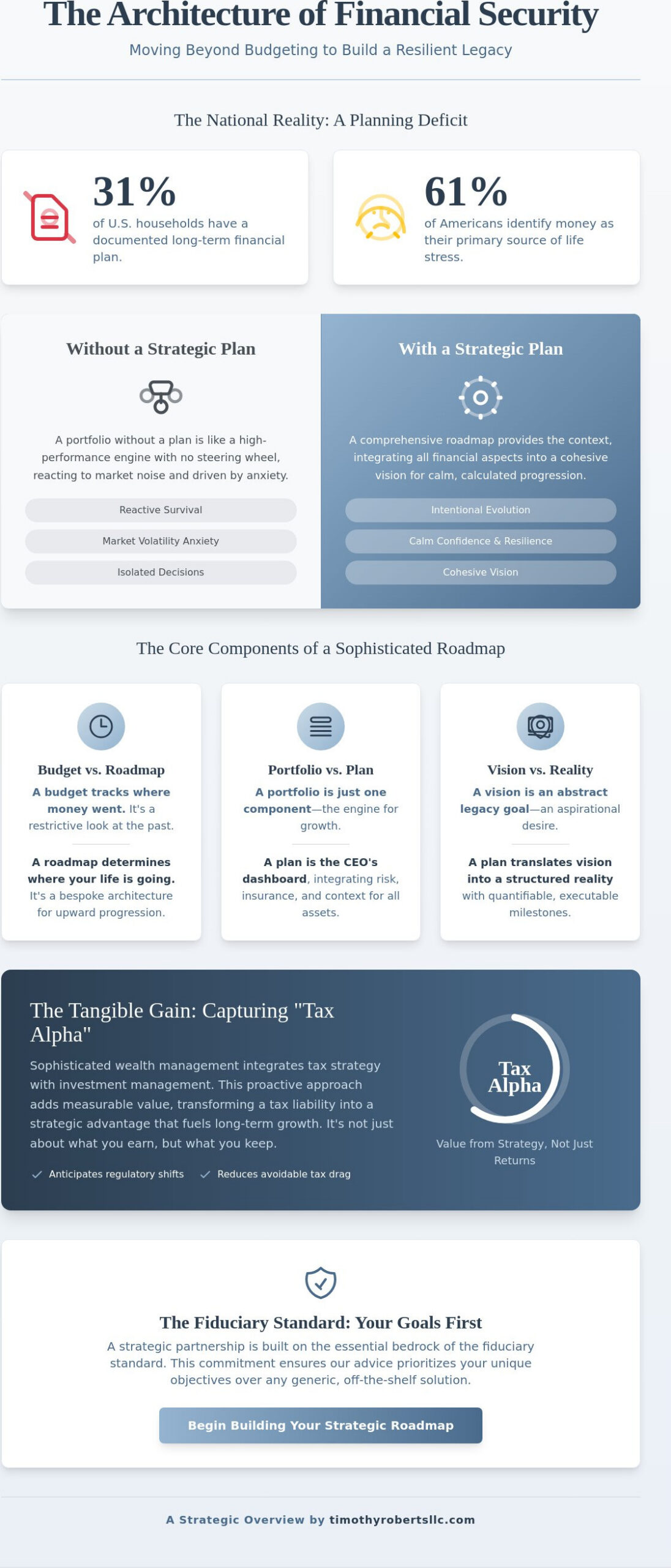
Only 31% of U.S. households maintained a documented, long-term financial strategy as we entered 2026. It’s a striking figure, especially when you consider that 61% of Americans now identify money as their primary life stressor. You likely feel the weight of this complexity yourself. With the 2026 estate tax exemption sitting at $15 million and new mandatory Roth catch-up rules for high earners now in effect, managing wealth has become a high-stakes endeavor. The primary benefits of having a financial plan lie in its ability to replace market volatility anxiety with a sense of calm, calculated progression.
True wealth management is an expert craft, not a series of generic transactions. We believe a sophisticated roadmap transforms abstract goals into a structured reality through strategic wealth elevation and tax optimization. This guide examines how a curated approach to your capital creates long-term stability and tax efficiency. You will discover how to bridge your individual creative vision with the structured fiscal rigor required to secure a lasting legacy. We’ll explore the practicalities of execution that turn a high-level vision into a resilient reality for your future.
Key Takeaways
- Move beyond basic budgeting to understand how a bespoke financial roadmap serves as a dynamic intervention for long-term upward progression.
- Discover the strategic benefits of having a financial plan that integrates tax advising with portfolio management to capture “tax alpha” and elevate your net wealth.
- Learn how a pre-defined strategy provides a sense of calm confidence, allowing you to navigate market fluctuations with resilience rather than anxiety.
- Uncover the architecture of professional planning, where rigorous discovery phases transform abstract legacy goals into a structured, executable reality.
- Understand why the fiduciary standard is the essential bedrock for a partnership that prioritizes your unique objectives over generic, off-the-shelf solutions.
Beyond Budgeting: Defining the Strategic Financial Roadmap
A budget tracks where your money went; a strategic roadmap determines where your life is going. While many view fiscal management as a restrictive exercise in cost-cutting, we see it as a bespoke architecture for upward progression. A true financial plan serves as a comprehensive evaluation of an individual’s current pay and future financial state, acting as a bridge between your current resources and your ultimate legacy. One of the primary benefits of having a financial plan is the transition from reactive survival to intentional evolution. It’s the difference between merely existing within your means and actively designing your future through a series of calculated, high-level choices.
This shift in perspective allows you to align the aesthetics of your desired lifestyle with the rigorous functionality of your fiscal health. It ensures that every decision serves a high-level purpose rather than responding to temporary market noise. To better understand how this structure serves your goals, watch this helpful overview:
The Distinction Between a Plan and a Portfolio
Investment management is a critical engine, but it’s not the entire vehicle. A portfolio without a plan is like a high-performance engine without a steering wheel. While investment portfolio management focuses on asset allocation and growth, comprehensive planning provides the context for those assets. It acts as the CEO’s dashboard for your personal wealth, integrating risk management and insurance analysis into a single, cohesive vision. This oversight ensures that your capital is protected against unforeseen disruptions, allowing you to maintain your trajectory even when external conditions shift. It’s a strategic intervention that prioritizes your total financial ecosystem over isolated market performance, ensuring that your wealth management is as resilient as it is ambitious.
Aligning Personal Vision with Fiscal Reality
Translating aspirational growth into quantifiable milestones requires both a visionary strategist and an expert craftsman. We don’t view wealth as a static number, but as a medium for realizing your personal and professional ambitions. When you consider the long-term benefits of having a financial plan, the most significant gain is the move toward intentionality. Every dollar is assigned a specific purpose, whether it’s funding a legacy, securing a transition, or fueling a new venture. This synthesis of individual creative vision and structured corporate capabilities ensures that your fiscal reality never lags behind your imagination. It creates a steady, logical rhythm for your financial life, guiding you from high-level dreams to the practicalities of successful execution.
The Tangible Gains of Integrated Tax and Investment Management
Integrated fiscal management is the hallmark of a sophisticated wealth strategy. While many firms treat tax preparation and investment growth as separate silos, we view them as a singular, unified mechanism for wealth elevation. One of the core benefits of having a financial plan is the realization of tax alpha. This is the measurable value added to a portfolio through proactive tax strategies rather than investment performance alone. By viewing tax efficiency as a catalyst for reinvestment, we transform a mandatory liability into a strategic advantage that fuels long-term upward progression.
Tax efficiency isn’t a seasonal event; it’s a continuous process of calibration. High-net-worth individuals facing the 2026 lifetime gifting exemption of $15 million or high earners adjusting to mandatory Roth catch-up contributions require more than a standard tax return. They need strategic tax advising that anticipates shifts in the regulatory landscape. This depth of planning ensures that your growth isn’t eroded by avoidable tax drag, allowing more of your capital to remain at work in the market.
Optimizing Tax Efficiency for Long-Term Growth
The impact of tax-intelligent planning on compounding returns is profound. In the current economic climate, where the bank prime loan rate reached 6.75% in May 2026, preserving every dollar of capital is essential. Tax-loss harvesting is a proactive wealth preservation tool that involves selling underperforming assets to offset capital gains and reduce overall taxable income. This approach ensures that your portfolio remains lean and efficient. Utilizing a financial empowerment toolkit can help you understand the basics of goal setting, but professional intervention is required to navigate the complexities of year-round tax compliance.
Asset Management as a Catalyst for Expansion
Professional investment portfolio management ensures that your holdings are carefully crafted interventions rather than generic products. Asset-based fees provide more than just transactions; they offer ongoing fiduciary oversight and constant monitoring of your assets. This model aligns our success with yours, moving away from transactional sales toward a narrative of shared growth. One of the primary benefits of having a financial plan is the ability to rebalance your holdings continuously in a shifting landscape. This discipline ensures that your risk tolerance remains in check even when market sectors fluctuate. If you’re ready to move beyond superficial tracking, exploring a comprehensive wealth management strategy is the logical next step for your legacy.
Navigating Uncertainty with Calm Confidence and Market Resilience
A common objection suggests that planning is futile in an unpredictable market. This perspective mistakes a plan for a prediction. In reality, one of the most profound benefits of having a financial plan is the psychological dividend it pays during periods of systemic shock. With 61% of Americans identifying money as their primary stressor in 2026, the value of a pre-defined strategy cannot be overstated. It transforms you from an anxious observer of market fluctuations into a strategic participant who understands that volatility is a temporary condition, not a permanent destination. You aren’t just hoping for the best; you’re operating from a position of strength.
A comprehensive strategy acts as a framework for intellectual decision-making. It replaces the frantic energy of reactive choices with the steady, logical rhythm of a professional partnership. By integrating Risk Management & Insurance Analysis, we ensure that your assets are shielded from unforeseen events that could otherwise derail your upward progression. This isn’t about guessing the future. It’s about being prepared for it regardless of the outcome. When your fiscal health is anchored by a structured roadmap, you can view market shifts as opportunities for calibration rather than reasons for alarm.
Mitigating the Emotional Impact of Volatility
Emotional discipline is the invisible engine of long-term success. Without a structured vision, it’s easy to fall into the “buy high, sell low” trap that erodes so much personal wealth. A professional advisor provides a steady communication rhythm that helps maintain focus on the high-level vision. This partnership moves away from aggressive sales tactics toward a narrative of shared success. When you know your trajectory is supported by rigorous analysis, the daily noise of the financial news cycle loses its power over your peace of mind. You gain the freedom to ignore the headlines and focus on your broader legacy.
Establishing a Framework for Rational Decisions
Your plan serves as a filter for every new opportunity and potential risk. Whether you’re evaluating a 30-year fixed mortgage at the current 6.32% to 6.51% rates or considering CD rates of 4.20% APY, the plan tells you if the move aligns with your broader goals. Liquidity planning is a vital component here. It ensures you have the stability to withstand downturns without being forced to liquidate long-term investments at inopportune times. This level of intentionality allows you to navigate the complexities of 2026 with an air of quiet ambition and intellectual curiosity. It’s about maintaining a clear-eyed perspective on your progress, even when the external environment feels cluttered. One of the primary benefits of having a financial plan is the ability to make these high-level interventions with total clarity.
Implementing Your Vision: The Stages of Professional Planning
A sophisticated financial strategy is never a finished product. It’s a dynamic, living intervention that must evolve alongside your ambitions. While competitors often treat a plan as a static checklist of goals, we view it as a continuous cycle of upward progression. One of the primary benefits of having a financial plan is the structured methodology it provides for transforming abstract desires into executable reality. This process moves through distinct phases of discovery, architecture, and execution, all held together by a steady rhythm of fiduciary oversight. It’s about moving from a high-level vision down to the practicalities of day-to-day execution.
The transition from vision to reality requires an expert craftsman who can navigate the complexities of modern finance. With the estimated “magic number” for a comfortable retirement reaching $1.46 million in 2026, the stakes for precision have never been higher. This isn’t a journey you should take alone. It requires a partner who understands that your fiscal health is the foundation for your creative and professional vision. To begin the architecture of your own legacy, consider how a personalized financial strategy can provide the clarity you require.
The Discovery Phase: Uncovering Latent Opportunities
The process begins with a deep-dive analysis that goes far beyond a simple balance sheet. We explore your multi-generational goals and current assets to uncover latent opportunities that might otherwise remain hidden. This is where we identify critical gaps in your estate management or education funding strategies. An advisor’s role here is to ask the hard questions that challenge your assumptions about risk and legacy. By understanding your specific risk tolerances and lifestyle requirements, we lay the groundwork for a strategy that’s as unique as your own thumbprint. It’s a phase of intellectual curiosity that ensures every subsequent move is rooted in absolute clarity.
Dynamic Rebalancing: Adapting to Life’s Evolution
Static documents fail because life doesn’t stand still. Your strategy must be a living intervention that adjusts for business transitions, inheritances, or shifts in the economic landscape. Tactical rebalancing is a deliberate method for maintaining the plan’s integrity by adjusting asset weights in response to short-term market opportunities or specific risk shifts. This continuous monitoring ensures that your portfolio remains aligned with the high-level vision even when external headlines are cluttered. As you move through different stages of your journey, your plan evolves to reflect your upward progression. This ensures that your wealth management remains a relevant tool for growth rather than a relic of past decisions.
Strategic Partnership: Why a Fiduciary Approach Elevates Your Outcome
A strategic partnership is the final, essential element of a sophisticated wealth strategy. While larger, more anonymous firms often focus on digital matching tools or generic checklists, a specialized firm prioritizes the fiduciary standard as the bedrock of every interaction. This standard represents more than just a professional courtesy; it’s a legal and ethical obligation to act in your best interest at all times. One of the primary benefits of having a financial plan within this framework is the total elimination of the conflicts of interest inherent in commission-based models. By utilizing an asset-based management approach, your advisor’s success is directly tied to the growth and protection of your capital, creating a narrative of shared success and mutual ambition.
This partnership offers a single point of coordination for the multifaceted components of your fiscal life. Instead of managing fragmented advice from disparate sources, you gain a visionary strategist who synthesizes tax advising, investment oversight, and risk management into a cohesive whole. In an era where 53% of financial advisors increased their fees over the past year, the value of high-level expertise and personalized attention has never been more apparent. You aren’t just purchasing a static report. You’re securing a reliable business advisor who values depth over superficiality and treats your upward progression as a long-term journey.
The Fiduciary Advantage in Wealth Preservation
The fiduciary advantage lies in the transparency and rigor of the relationship. It ensures that every intervention, from portfolio rebalancing to insurance analysis, is performed with the sole objective of elevating your net worth. This model moves away from aggressive sales tactics toward a collaborative dialogue rooted in intellectual curiosity. Because your advisor is an expert craftsman rather than a salesperson, the focus remains on the tangible impact of the work. This creates a rhythmic experience where big ideas are supported by detailed explanations, providing the professional stability required to navigate complex global markets with calm confidence.
Crafting a Legacy that Transcends Numbers
True wealth management extends beyond the balance sheet to encompass the values and visions you wish to pass down. Integrating estate and legacy planning into the core financial roadmap ensures that the multi-generational transfer of assets is both seamless and intentional. It’s about protecting your creative passion and business-minded rigor for the next generation. One of the strategic benefits of having a financial plan is the peace of mind that comes from a meticulously balanced professional strategy. When your legacy is anchored by a fiduciary partner, you can focus on the present, knowing that your future transitions are handled with the highest level of expertise and personal attention.
Securing Your Legacy Through Intentional Architecture
True financial evolution requires a transition from passive tracking to active, visionary stewardship. We’ve explored how a sophisticated roadmap bridges the gap between your current resources and your ultimate ambitions. By integrating tax advising with investment oversight, you capture the measurable value of tax alpha while maintaining resilience against market volatility. The strategic benefits of having a financial plan extend far beyond mere numbers; they provide the intellectual clarity required to lead a life of purpose and impact. You’re not just managing assets. You’re crafting a multi-generational legacy that reflects your unique values and creative vision.
With over 25 years of fiduciary expertise, Timothy Roberts & Associates, LLC specializes in the seamless synthesis of wealth and tax strategies. We provide personalized interventions designed for both individual and organizational evolution. If you’re ready to transform your abstract goals into a structured reality, we invite you to take the next step in your journey. Request a strategic consultation with Timothy Roberts & Associates, LLC to begin the architecture of your future. It’s time to move forward with calm confidence and a partner dedicated to your shared success.
Frequently Asked Questions
Is a financial plan necessary for someone who isn’t wealthy yet?
A strategic roadmap is essential for anyone seeking upward progression, regardless of their current net worth. One of the primary benefits of having a financial plan is its ability to transform modest resources into a structured engine for growth. By assigning a purpose to every dollar early on, you create a foundation for long-term stability. It’s a proactive intervention that ensures your fiscal habits align with your future creative and professional ambitions.
How often should a comprehensive financial plan be updated?
You should update your strategy at least once per year or whenever a significant life event occurs. Major transitions like business sales, inheritances, or changes in tax laws require immediate calibration to maintain the plan’s integrity. Since the economic environment is dynamic, a static document quickly becomes a relic. Regular reviews ensure your asset allocation and tax strategies remain aligned with your evolving high-level vision and the current regulatory landscape.
What is the difference between a financial plan and investment management?
Financial planning is the comprehensive architecture of your entire fiscal life, while investment management is the specific execution of your portfolio strategy. Planning incorporates tax advising, estate management, and risk analysis to provide a high-level vision. Investment management focuses on the technical practicalities of asset allocation and growth. Think of the plan as the steering wheel and the portfolio as the high-performance engine that moves you toward your destination.
Can a financial plan help reduce my current tax liability?
A sophisticated plan integrates strategic tax advising to identify immediate and long-term savings. By utilizing tools like tax-loss harvesting and optimizing contributions to 401(k) or Roth IRA accounts, you can capture tax alpha that elevates your total return. This proactive approach ensures you aren’t merely reacting to tax season but are instead using tax efficiency as a catalyst for reinvestment and accelerated wealth elevation. It’s about preserving more of your capital for future growth.
How does a fiduciary advisor differ from a standard broker?
A fiduciary advisor is legally and ethically bound to act in your best interest at all times, whereas a standard broker may operate under a suitability standard. This distinction eliminates the conflicts of interest inherent in commission-based models. Fiduciaries typically use an asset-based fee structure, which aligns their success directly with your portfolio’s growth. This partnership fosters a narrative of shared success and provides the calm confidence that your advisor is an expert craftsman, not a salesperson.
What are the core components of a professional financial roadmap?
A professional roadmap synthesizes retirement income planning, investment portfolio management, and estate and legacy planning into a single vision. It also includes rigorous risk management and insurance analysis to shield your assets from unforeseen systemic shocks. These components work in a steady, logical rhythm to ensure every aspect of your fiscal health is optimized. This integrated approach is one of the most tangible benefits of having a financial plan in a complex economy.
How does financial planning help with retirement income stability?
Planning provides a structured methodology for converting accumulated assets into a reliable stream of retirement income. It accounts for inflation, market volatility, and shifting interest rates to ensure your lifestyle remains sustainable for decades. By coordinating Social Security timing with withdrawals from various retirement plans, you create a predictable fiscal environment. This strategic intervention replaces the anxiety of outliving your assets with a sense of quiet ambition and long-term security. The benefits of having a financial plan become most apparent during this transition.
What should I expect during the initial financial planning discovery phase?
The discovery phase is an intellectual deep dive into your current assets, liabilities, and multi-generational goals. You should expect your advisor to ask hard questions that uncover your true risk tolerance and creative vision. This isn’t a superficial data collection exercise; it’s the beginning of a specialized partnership. We take the time to understand the complexities of your situation to ensure the resulting architecture is a carefully crafted intervention rather than a generic solution.
