

May
How to Create a Personal Financial Roadmap: A Strategic Guide to Wealth Architecture
What if your current portfolio is merely a collection of assets rather than a coordinated engine for your legacy? It’s a common realization among those who find that disparate investments rarely equate to a cohesive future. You’ve likely felt the weight of shifting tax codes or the quiet concern that your retirement assets won’t sustain your vision for three decades. Learning how to create a personal financial roadmap is about more than just picking stocks. It is about architecting a structure where every dollar serves a specific, intentional purpose.
You’re about to master the sophisticated process of aligning your current liquidity with your long-term aspirations through professional wealth architecture. We’ll explore how to leverage the 2026 tax landscape, including the permanent provisions of the One Big Beautiful Bill Act, to keep your strategy tax-efficient. This article provides a documented framework for the next 20 years that harmonizes your risk tolerance with growth goals and legacy planning. It’s time to move beyond simple budgeting toward a strategy that reflects your true ambition.
Key Takeaways
- Identify the four architectural pillars—Asset Management, Risk Mitigation, Tax Strategy, and Estate Planning—essential for constructing a resilient wealth framework.
- Master the sophisticated process of how to create a personal financial roadmap that bridges the gap between tactical budgeting and a multi-generational legacy.
- Recognize the value of a fiduciary partnership in navigating complex tax codes and ensuring your strategy remains aligned with your specific risk tolerance.
- Learn to translate abstract life aspirations into concrete, inflation-adjusted financial targets through systematic vision quantification.
- Transition from static planning to active execution, ensuring your documented strategy evolves alongside the shifting economic landscape of 2026.
Beyond the Budget: Defining the Strategic Financial Roadmap
A personal financial roadmap is not a mere spreadsheet of monthly expenses or a list of isolated accounts. It is a living, strategic synthesis of your current capital and your multi-generational vision. While many individuals treat their finances as a series of disconnected reactions to market shifts, a professional roadmap serves as the definitive North Star for every investment choice and tax strategy. By establishing a comprehensive financial plan, you transition from reactive management to proactive wealth architecture. This shift replaces the persistent anxiety of the unknown with the strategic confidence of a documented, intentional path.
To better understand the mechanics of shifting your financial trajectory, watch this helpful analysis on rapid wealth transformation:
The Distinction Between Tactical Savings and Strategic Architecture
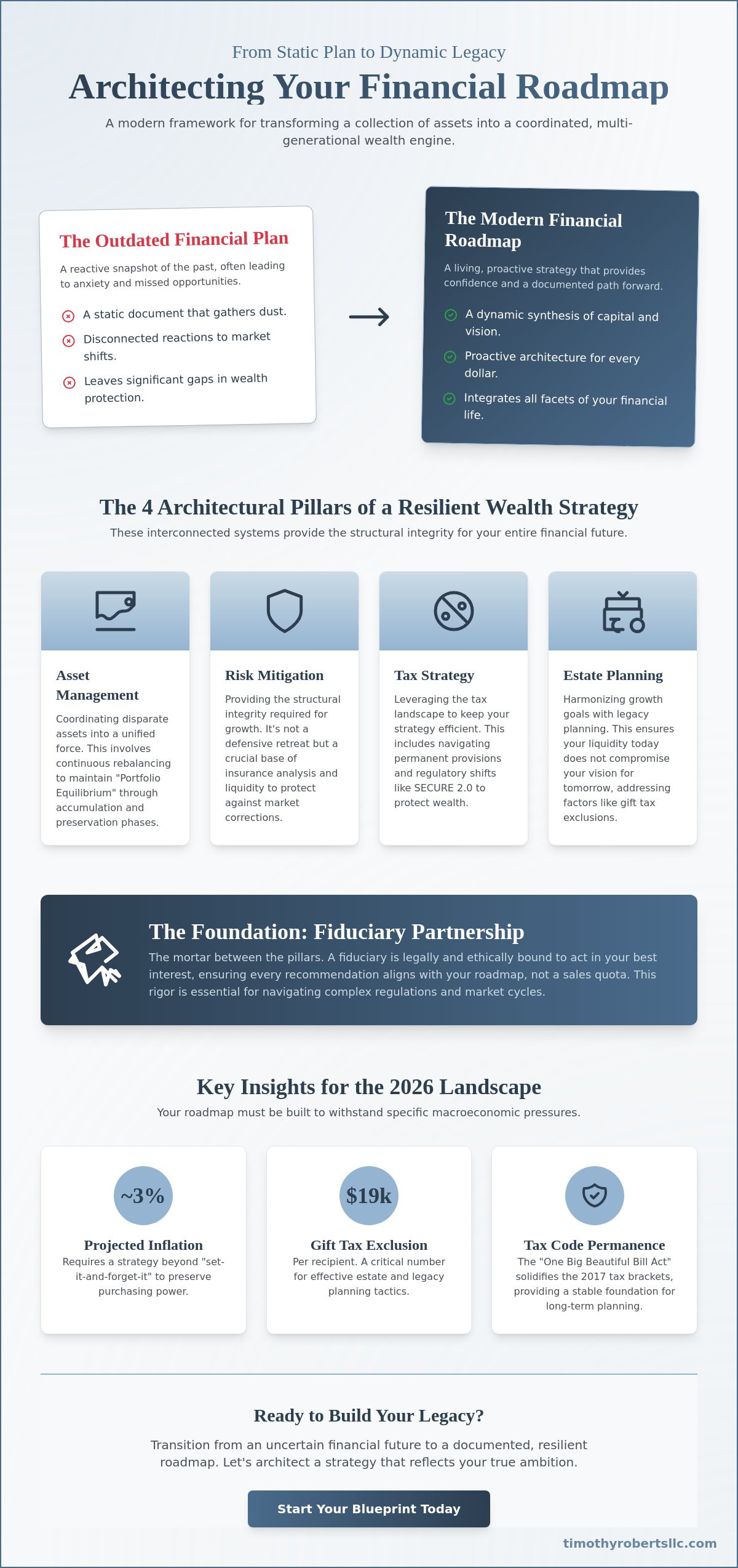
Tactical saving focuses on the “how,” such as the mechanics of contributing to a 401(k) or maximizing an HSA. Strategic architecture addresses the “why.” In a 2026 economic environment where inflation has settled in the 3% range, a “set-it-and-forget-it” mentality is often insufficient for preserving high-net-worth status. Learning how to create a personal financial roadmap involves coordinating disparate assets into a unified force. It ensures that your liquidity today does not compromise your legacy tomorrow. This process requires a sophisticated understanding of how interest rate projections, currently trending lower into 2026, impact your overall debt-to-growth ratio and long-term purchasing power.
Why Most Financial Plans Fail to Become Roadmaps
Most traditional plans fail because they are static documents that gather dust in a drawer. They often lack the deep integration of tax advising and estate planning, leaving significant gaps in wealth protection. A true roadmap must be dynamic, accounting for regulatory shifts like the SECURE 2.0 Act and the permanence of the 2017 tax brackets following the 2025 “One Big Beautiful Bill Act.” Without this holistic view, a plan is just a snapshot of the past rather than a guide for the next 20 years. When you discover how to create a personal financial roadmap, you move beyond simple projections to create a resilient strategy that accounts for rising healthcare costs and shifting gift tax exclusions, which currently sit at $19,000 per recipient for 2026.
The Architectural Pillars of a Resilient Financial Strategy
A resilient financial strategy rests on four non-negotiable pillars: asset management, risk mitigation, tax strategy, and estate planning. These are not independent silos. They are interconnected systems that support the weight of your wealth architecture. Many investors mistakenly view risk management as a defensive retreat, yet it actually provides the structural integrity required for aggressive growth strategies. Without a base of insurance analysis and sufficient liquidity, a single market correction can derail decades of progress. Maintaining this stability requires “Portfolio Equilibrium,” a state where your risk exposure is perfectly calibrated to the 2026 economic climate. With interest rates projected to lower gradually and inflation hovering near 3%, your strategy must adapt to these specific macro-economic pressures to remain viable.
Fiduciary oversight serves as the mortar between these pillars. Unlike transactional advisors, a fiduciary is bound to act in your best interest, ensuring that every recommendation aligns with your roadmap rather than a sales quota. This professional rigor is essential when determining how to create a personal financial roadmap that survives shifting regulations and market cycles. It moves the focus from short-term gains to the preservation of your long-term vision.
Asset-Based Management and Portfolio Equilibrium
Stability isn’t a destination; it’s a process of continuous rebalancing. Your roadmap must evolve as you move from the accumulation phase of your career into the preservation phase of retirement. This requires a professional commitment to investment portfolio management that monitors asset correlation in real-time. By ensuring your holdings don’t become overly concentrated in a single sector, you protect your vision from localized volatility. This equilibrium allows you to capture growth during market upswings while maintaining a buffer against downturns.
Integrating Tax Compliance and Liability Mitigation
Tax strategy is the silent engine of wealth preservation. While many treat taxes as a seasonal obligation, a strategic roadmap views tax planning as a year-round discipline. Understanding Financial Planning Basics reveals that tax-alpha—the value added through tax-efficient strategies—can often be as impactful as market returns. For 2026, single filers face a 24% bracket starting at $105,700, while the standard deduction for married couples has risen to $32,200. Utilizing professional tax advising ensures you aren’t overpaying into a system that offers numerous legal avenues for mitigation. This level of coordination is why learning how to create a personal financial roadmap is a necessity for those seeking to protect a legacy. If you’re ready to solidify these pillars, engaging with a fiduciary wealth manager can provide the oversight needed to maintain your strategy’s integrity.
Evaluating the DIY Approach vs. Fiduciary Partnership
The choice between managing one’s own capital and partnering with a specialized firm is often framed as a simple cost-benefit analysis. While DIY enthusiasts highlight the immediate savings of avoiding management fees, they frequently overlook the significant “opportunity cost” of inefficient asset allocation or overlooked tax-loss harvesting. True wealth architecture requires more than just basic knowledge of how to create a personal financial roadmap; it requires the professional rigor to execute that strategy during periods of high market volatility. A professional advisor serves as a vital behavioral coach, providing the steady hand needed to prevent emotional impulses that lead to selling at market lows or chasing speculative peaks.
This partnership moves beyond transactional advice toward a narrative of shared success. By delegating the technical complexities of portfolio rebalancing and risk analysis, you regain the most valuable asset of all: time. The value-add of professional wealth management is found in the synthesis of disparate financial elements into a singular, high-functioning engine for growth.
When Complexity Outpaces the DIY Checklist
As your net worth scales, you eventually cross a “Complexity Threshold” where a standard checklist is no longer sufficient. This point is often marked by indicators such as multi-state tax liabilities, complex inheritance structures, or the need to navigate the $15 million lifetime estate tax exemption currently in place for 2026. For business owners, the stakes are even higher. Coordinating corporate assets with personal liquidity requires specialized financial planning services that account for both succession and risk mitigation. Blind spots in estate integration or insurance analysis can lead to wealth erosion that far exceeds the cost of professional oversight. A roadmap without professional validation is often just a collection of assumptions waiting to be tested by the market.
The Value of Strategic Fiduciary Oversight
The baseline for any high-end financial strategy is the Fiduciary Standard. Unlike commission-based models that may prioritize product sales, a fiduciary is legally and ethically bound to act solely in your best interest. This eliminates the conflicts of interest found in traditional brokerage models and ensures that every strategic intervention is designed for your upward progression. When you are determining how to create a personal financial roadmap, the long-term ROI of this partnership is realized through optimized tax-efficiency and the precise alignment of your risk tolerance with your growth goals. It’s the difference between a static document and a professional-grade strategy that evolves alongside your vision.
Five Essential Phases to Constructing Your Personal Roadmap
Constructing a professional-grade strategy requires a departure from surface-level planning. It demands a rigorous, phased approach that treats your wealth as a complex architectural project rather than a series of isolated decisions. When you determine how to create a personal financial roadmap, you’re building a framework that must withstand economic shifts, regulatory changes, and personal life transitions. This process moves through five distinct phases to ensure your vision is both ambitious and achievable. Each phase adds a layer of structural integrity to your financial future.
- Phase 1: Deep Inventory Analysis. A comprehensive audit of all assets, liabilities, and liquidity.
- Phase 2: Vision Quantification. Translating qualitative life goals into precise financial targets.
- Phase 3: Stress-Testing and Risk Modeling. Simulating the impact of market volatility and inflation.
- Phase 4: Structural Integration. Coordinating tax strategies with investment and estate goals.
- Phase 5: The Iterative Review. Establishing a disciplined cadence for strategic adjustment.
Phase 1 & 2: Inventory Analysis and Goal Quantification
The foundation of your roadmap is a clear-eyed calculation of your true net worth. This goes beyond checking bank balances; it involves a sophisticated valuation of illiquid assets, private equity interests, and business entities. You must categorize your goals into immediate liquidity needs and long-term legacy aspirations. This ensures that your short-term lifestyle doesn’t inadvertently cannibalize your multi-generational wealth. Goal Quantification is the strategic process of assigning a future value to a present dream. By accounting for the 3% inflation rate projected for 2026, you ensure that your targets remain realistic as the cost of living and healthcare continues to rise.
Phase 3 & 4: Risk Stress-Testing and Tax Optimization
A resilient roadmap must be tested against the unexpected. Professional risk modeling identifies hidden vulnerabilities, such as concentrated stock positions or insufficient insurance coverage, that could jeopardize your trajectory. This phase also prioritizes tax-efficient withdrawal strategies, ensuring that you minimize the impact of the 37% top federal tax rate on your distributions. Integrating estate planning is vital here; it protects the final destination of your assets and ensures your legacy is preserved according to your exact specifications. Without this structural integration, your roadmap remains a collection of hopes rather than a functional strategy.
The journey from vision to reality requires consistent, high-level oversight to remain on course. If you’re ready to move from a static plan to a dynamic strategy, you can schedule a strategic consultation to begin architecting your personalized roadmap today. This iterative review process ensures your strategy remains aligned with your evolving life stages and the shifting regulatory landscape.
Executing Your Vision: From Roadmap to Realized Legacy
The finalization of your strategy is not the conclusion of your effort. It is the commencement of a disciplined journey toward a realized legacy. A document that remains static is merely a collection of historical data; it lacks the vitality required to navigate the shifting economic currents of 2026. To be effective, your strategy must transition from theoretical planning into active, asset-based investment management. This transition ensures that the high-level vision you have architected responds to market nuances while staying anchored to your long-term goals. Understanding how to create a personal financial roadmap is a critical first step, but the true value of the process is found in the relentless, professional execution of its principles.
Execution is where abstract strategy becomes tangible wealth. It requires a move away from reactive decisions toward a narrative of steady, aspirational growth. By treating your roadmap as a living engine rather than a trophy on a shelf, you ensure that every financial intervention serves your upward progression. This proactive stance is what distinguishes a professional-grade strategy from a standard savings plan.
Transitioning from Planning to Active Management
Active management involves translating your high-level roadmap into daily investment decisions and tactical rebalancing. This creates a powerful synergy between your overall strategy and specific retirement income planning. For example, as interest rates gradually lower through 2026, your roadmap may dictate a shift in fixed-income duration or a re-evaluation of dividend-growth equities. A professional strategist ensures these adjustments happen seamlessly, maintaining your Portfolio Equilibrium without triggering unnecessary tax liabilities. This level of coordination ensures that your liquidity today never compromises the multi-generational vision you have established.
The Role of a Visionary Strategist in Your Success
True wealth architecture is a craft that requires intellectual curiosity and business-minded rigor. At Timothy Roberts & Associates, we position ourselves as the expert craftsman for your personal and organizational evolution. With a 25-year history of guiding clients through complex financial landscapes, we understand that a roadmap must be as unique as the individual it serves. We invite you to see your wealth as a project that deserves the care of a master strategist who values depth over superficiality. Our firm takes the time to solve complex problems, ensuring your strategy remains a dynamic engine for your future success.
To move beyond static planning and begin architecting a future of strategic confidence, contact us for a comprehensive roadmap consultation. Let us help you bridge the gap between your current assets and your realized legacy through a professional-grade financial roadmap.
Architecting Your Strategic Legacy
Transitioning from a collection of isolated assets to a unified wealth architecture represents a profound shift in perspective. You’ve explored the core pillars of portfolio equilibrium and the necessity of moving beyond tactical budgeting toward multi-generational roadmapping. Mastering the sophisticated process of how to create a personal financial roadmap ensures that your long-term vision remains resilient against regulatory shifts and market volatility. This strategic framework serves as your definitive North Star, providing the clarity needed to navigate the complexities of wealth with calm confidence and intentionality.
Achieving this level of structural integrity requires a partner who values intellectual curiosity and business-minded rigor. With more than 25 years of fiduciary expertise, Timothy Roberts & Associates specializes in the comprehensive tax and estate integration essential for high-net-worth evolution. We invite you to Request a Strategic Consultation to Build Your Financial Roadmap and begin the process of architecting your personalized legacy. Your journey toward a documented, high-functioning strategy is a testament to your ambition and your commitment to lasting success. It’s time to realize the full potential of your vision.
Frequently Asked Questions
What is the difference between a financial plan and a financial roadmap?
A financial plan is often a static document focusing on specific milestones; a roadmap is a comprehensive, multi-generational synthesis of goals and resources. While a plan might address a single “fork in the road” decision, a roadmap provides the strategic architecture needed for long-term legacy. It acts as a North Star, coordinating investment, tax, and estate decisions into a single, proactive journey rather than a reactive checklist.
How often should I update my personal financial roadmap?
You should conduct a strategic review of your roadmap at least annually or whenever a significant life or regulatory shift occurs. Major events like the “One Big Beautiful Bill Act” of 2025 or shifts in interest rates require immediate recalibration. This iterative process ensures your strategy remains aligned with your evolving vision and the current economic landscape, preventing the “static plan” trap where documents lose relevance over time.
Can I create a financial roadmap if I have significant debt?
Yes, managing liabilities is a fundamental component of architecting your financial future. A roadmap treats debt not as an isolated burden but as a factor in your overall liquidity and risk mitigation strategy. While this firm focuses on wealth management rather than credit counseling, understanding how to create a personal financial roadmap involves balancing debt repayment with asset growth to ensure your upward progression remains unhindered.
Do I need a financial advisor to create a professional-grade roadmap?
While basic budgeting can be handled individually, a professional-grade roadmap usually requires fiduciary oversight to manage high-level complexity. A fiduciary provides the intellectual curiosity and technical rigor needed to integrate disparate elements like tax strategy and estate planning. This partnership eliminates conflicts of interest and ensures every strategic intervention is legally bound to your best interests, protecting your legacy from common DIY blind spots.
How does tax planning fit into a personal financial roadmap?
Tax planning serves as the silent engine of wealth preservation within your roadmap. It moves beyond annual reactive filing to incorporate year-round strategies that minimize liabilities and maximize tax-alpha. By aligning your investment distributions with the 2026 federal tax brackets, a roadmap ensures more of your capital remains working toward your long-term growth goals rather than being eroded by avoidable tax burdens.
What are the most common mistakes people make when creating their own roadmap?
The most frequent error is treating a roadmap as a static document rather than a dynamic strategy. Many individuals fail to integrate their estate plans with their investment portfolios, leading to a lack of coordination that risks the final legacy. Additionally, ignoring the impact of inflation or failing to account for shifting regulatory landscapes like the SECURE 2.0 Act can result in a roadmap that fails to perform in practice.
Is a financial roadmap only for people near retirement?
A financial roadmap is essential at every stage of wealth accumulation, not just during the transition to retirement. It provides a framework for education funding strategies, business succession, and early-stage legacy planning. Learning how to create a personal financial roadmap early allows you to leverage compound growth and structural tax efficiencies for decades, ensuring your upward progression is intentional from the beginning of your career.
How do I account for inflation in my long-term financial strategy?
Inflation is managed through vision quantification, which involves translating present dreams into future, inflation-adjusted dollar amounts. With 2026 inflation projections hovering around 3%, your roadmap must use realistic growth assumptions to preserve your purchasing power over the next 20 to 30 years. This ensures your retirement income planning accounts for the rising costs of healthcare and housing, keeping your long-term vision achievable in real-world terms.
