

Sep
Strategic Michigan Retirement Planning Advice for 2026
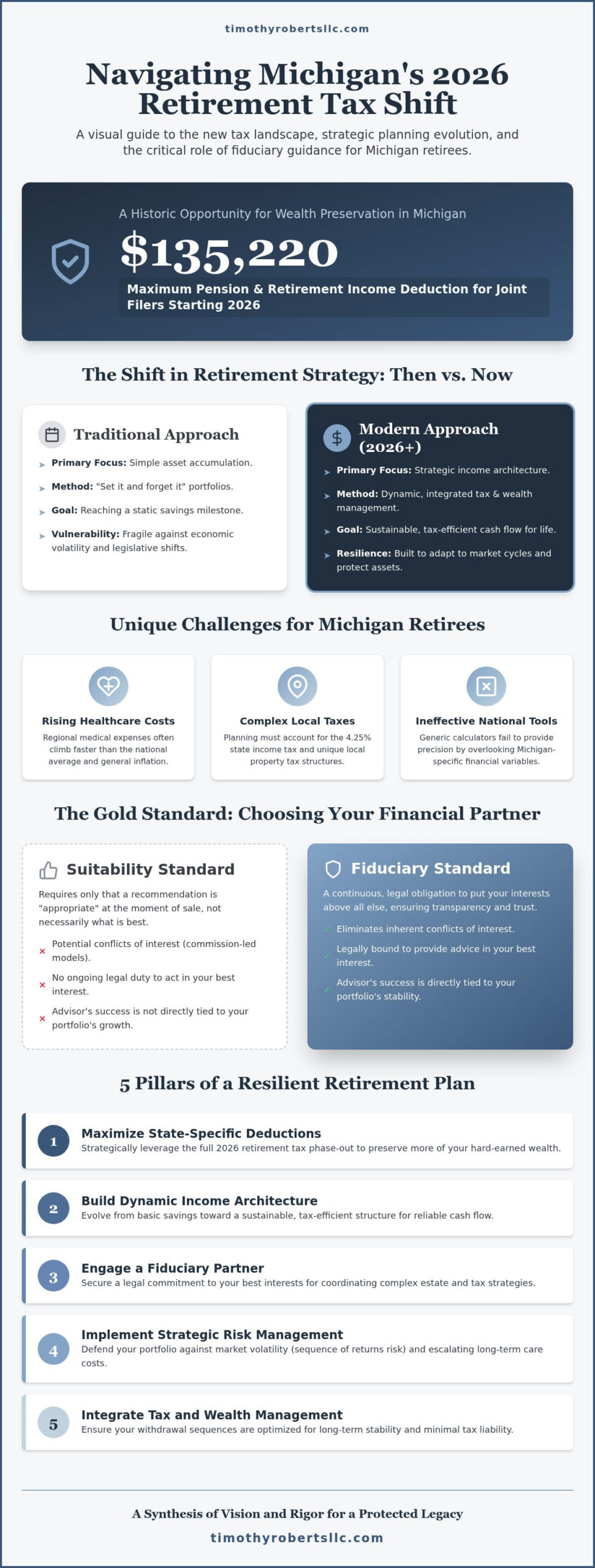
The 2026 tax year marks a historic shift for Michigan retirees, as the full implementation of Public Act 4 now allows joint filers to deduct up to $135,220 in pension and retirement income. While this expansion offers a significant opportunity for wealth preservation, the complexity of these new regulations often leaves even the most diligent savers feeling uncertain about their long-term stability. It’s natural to feel a sense of anxiety when your lifelong savings are subject to the shifting gears of state legislation and economic volatility.
Securing your future requires a sophisticated, fiduciary-led framework that moves beyond generic solutions. Our strategic michigan retirement planning advice is designed to help you navigate these evolving tax landscapes with absolute precision, ensuring your income remains steady and your legacy stays protected. We’ll provide a clear, tax-efficient roadmap that bridges the gap between your personal vision for retirement and the rigorous business-minded structures required to sustain it. This exploration covers the nuances of the 2026 tax code, the importance of integrated wealth management, and the tactical interventions necessary to ensure you never outlive your assets in an unpredictable economy.
Key Takeaways
- Understand the full implications of the 2026 retirement tax phase-out to maximize state-specific deductions and preserve more of your hard-earned wealth.
- Identify why sophisticated michigan retirement planning advice must evolve from basic savings toward a dynamic architecture of sustainable, tax-efficient income.
- Recognize the essential role of a fiduciary partner in coordinating complex estate and tax strategies with a legal commitment to your best interests.
- Implement strategic risk management and insurance analysis to defend your portfolio against sequence of returns risk and escalating care costs.
- Leverage the synergy of integrated tax and wealth management to ensure your withdrawal sequences are optimized for long-term stability.
The Evolution of Michigan Retirement Planning Advice
The traditional concept of retirement has undergone a profound transformation. It’s no longer a static destination reached by hitting a specific savings milestone. Instead, 2026 demands a shift toward complex income architecture. For high-net-worth individuals, the focus has moved from the simple accumulation of assets to the strategic orchestration of distributions. While retirement planning fundamentals remain relevant, the application of these principles must be hyper-local and deeply technical to be effective.
Current economic volatility has exposed the fragility of “set it and forget it” portfolios. Michigan’s unique regulatory environment requires a level of sophistication that national firms often overlook. Expert michigan retirement planning advice now integrates state-specific tax advantages with global market insights to create a shield against inflation and legislative shifts. This is a journey of evolution. Your financial structure must be as dynamic as the world around it.
To better understand the specific tax changes impacting your strategy this year, watch this helpful video:
Understanding the State-Level Economic Landscape
Michigan’s economic climate presents both opportunities and challenges for the affluent retiree. While the state’s flat 4.25% income tax rate is attractive, local cost of living trends are bifurcated. Healthcare costs in the region continue to climb, often outpacing general inflation. Generic national calculators frequently fail Michigan residents because they lack the granularity to account for state-specific property tax structures and the full 2026 implementation of the pension tax deduction. Precision in forecasting is the only way to ensure long-term wealth stability.
The Strategic Pivot to Income Planning
Resilience is built on sustainable cash flow, not just total return. The narrative has shifted. We don’t just ask how much your portfolio grew last quarter; we ask how much of that growth can be safely converted into spendable income. A truly robust plan relies on integrated tax and wealth management to minimize liabilities during the withdrawal phase. Drawing on over 25 years of industry experience, we’ve seen that while market cycles are temporary, a flawed distribution strategy can have permanent consequences. Success in 2026 is defined by the synergy of vision and rigor.
Selecting a Fiduciary Partner: The Gold Standard
Choosing a partner for your financial evolution isn’t merely a matter of convenience; it’s a decision of legal consequence. Most investors remain unaware of the profound gap between the suitability standard and the fiduciary duty. While the former only requires that a recommendation is “appropriate” at the moment of sale, the fiduciary standard mandates a continuous, legal obligation to put your interests above all else. This distinction is critical when seeking michigan retirement planning advice, as complex estate and tax coordination requires an advisor who is legally bound to transparency.
A fiduciary partnership eliminates the inherent conflicts of commission-led models. Instead of product sales, the focus shifts to asset-based management or fixed-fee arrangements. This alignment ensures that your advisor’s success is directly tied to the growth and stability of your portfolio. When you seek michigan retirement planning advice, the goal is to find a visionary strategist who functions as both an expert craftsman and a reliable business advisor. True expertise is found in the ability to synthesize disparate financial threads into a cohesive, forward-looking strategy.
The Fiduciary Checklist for Sophisticated Investors
Rigorous due diligence is the hallmark of a visionary investor. Begin by verifying independent oversight and demanding full conflict-of-interest disclosures. Sophisticated planning often involves professional guidance similar to University of Michigan retirement counseling to ensure every variable is accounted for. Fiduciary advisors excel here by synthesizing your personal legacy goals with a clinical assessment of risk tolerance. They don’t just manage money; they manage the intersection of your life’s work and your future aspirations.
- Independent Oversight: Ensure the firm uses a third-party custodian for asset protection.
- Transparency: Demand a clear breakdown of all asset-based fees and project-specific costs.
- Holistic Integration: Confirm the advisor can coordinate with tax and estate professionals.
Customization vs. Off-the-Shelf Solutions
High-net-worth strategies require carefully crafted interventions rather than generic, off-the-shelf products. Your financial plan should be a synthesis of aesthetics and functionality. The aesthetics represent your lifestyle goals and creative vision for the future, while the functionality is the underlying financial math that makes those goals possible. This balance creates a narrative of calm confidence. By moving away from aggressive sales tactics toward a professional wealth management partnership, you ensure that your retirement strategy is a progressive journey of upward growth, tailored to the specific nuances of the Michigan landscape.
Michigan’s Unique Tax Landscape and Pension Strategies
The 2026 tax year represents a watershed moment for residents seeking sophisticated michigan retirement planning advice. With the full implementation of Public Act 4 of 2023, the state has moved away from the restrictive tiered system based on birth years. This evolution simplifies the tax code but increases the need for strategic orchestration of your income streams. Success in this new environment isn’t about following generic rules; it’s about understanding how these state-level shifts interact with your federal tax liabilities to maximize your net-of-tax wealth.
Strategic withdrawal sequences are the foundation of a resilient plan. By coordinating distributions from various accounts, you can maintain a lower effective tax rate while preserving the longevity of your assets. It’s essential that your tax preparation and wealth management functions operate in total tandem. A visionary strategist doesn’t just look at portfolio performance; they analyze the tax efficiency of every dollar moved. This clinical approach ensures that your lifestyle goals aren’t compromised by avoidable state tax burdens.
Maximizing the Pension Tax Rollback
The rollback of the so-called “retirement tax” offers a significant opportunity for both public and private pension holders. High-net-worth individuals must verify their eligibility for these expanded subtractions to ensure they aren’t overpaying. For the 2026 tax year, Michigan’s retirement and pension income deduction is fully implemented, allowing single filers to deduct up to $67,610 and joint filers up to $135,220. You can find more detailed specifics in Michigan’s official retirement and pension tax guidance. This expanded deduction significantly alters the math for those deciding between lump-sum distributions and monthly annuities.
Tax-Efficient Asset Location
Resilient wealth management requires a disciplined approach to asset location within Michigan’s flat 4.25% income tax framework. Strategic use of Roth IRAs and SEP IRAs can serve as a powerful hedge against future tax hikes at the federal level. By placing high-growth assets in tax-free vehicles and keeping tax-efficient investments in taxable accounts, you create a balanced architecture for long-term growth. This process includes:
- Disciplined Rebalancing: Minimizing capital gains through precise, well-timed portfolio adjustments.
- Integrated Estate Planning: Mitigating future legacy tax burdens by considering the state’s lack of an inheritance tax.
- Social Security Optimization: Leveraging the fact that Michigan does not tax Social Security benefits to lower your overall provisional income.
Your michigan retirement planning advice should reflect these hyper-local nuances. By treating tax planning as a journey of upward progression rather than a simple annual transaction, you position your estate for enduring stability.
Longevity and Risk: Protecting Your Michigan Legacy
Longevity is the ultimate goal of any retirement strategy, yet it introduces the significant challenge of asset endurance. For those seeking michigan retirement planning advice, the “sequence of returns” risk is a primary concern. Experiencing a market downturn during the early years of distribution can disproportionately impact the total lifespan of a portfolio. We treat risk management and insurance analysis not as separate products, but as essential defensive hedges within a broader wealth architecture.
Protecting a legacy also involves balancing personal security with aspirational goals like education funding strategies. High-net-worth families often feel the tension between supporting the next generation and ensuring their own long-term cash flow. In 2026, the cost of long-term care in Michigan has reached critical levels, with nursing home semi-private rooms averaging approximately $11,254 per month. Without a clinical approach to risk, these escalating costs can quickly erode a lifetime of accumulation.
Mitigating Market Volatility
Dynamic rebalancing is the cornerstone of asset-based investment management. Unlike static portfolios, a strategic approach requires continuous monitoring to capitalize on market shifts while maintaining your intended risk profile. You can learn more about these high-level asset strategies by exploring our sophisticated investment portfolio management framework. A fiduciary relationship ensures that these adjustments are made with intellectual curiosity and professional rigor, prioritizing your upward progression over short-term trends.
The Strategic Legacy: Estate Coordination
Estate and legacy planning is a journey of synthesis. It requires meticulous coordination with legal professionals to ensure that your corporate capabilities and personal visions are perfectly aligned. Strategic legacy planning includes charitable giving strategies that provide immediate tax relief while creating a tangible impact on the causes you value most. This process is about more than just documents; it’s about providing calm confidence for surviving spouses and heirs. By integrating comprehensive estate and legacy planning into your roadmap, you transform a simple transaction into a multi-generational success story.
The Timothy Roberts Approach: A Synthesis of Vision and Rigor
Timothy Roberts & Associates, LLC offers a partnership built on over 25 years of industry experience. Most firms treat tax preparation and investment advisory as separate silos, which often leads to missed opportunities for optimization. We don’t. Our approach recognizes that your tax strategy and your income plan are two sides of the same coin. By integrating tax advising directly into our wealth management framework, we provide a level of strategic intervention that off-the-shelf solutions simply can’t match. This is the essence of refined michigan retirement planning advice in 2026.
We believe that a financial plan should be a living architecture. It’s not just about the numbers; it’s about the narrative of your life. Our firm moves away from transaction-based interactions, favoring a steady and logical flow that mirrors a professional consultancy. We take the time to understand the complexities of your situation, from your risk tolerance to your multi-generational legacy goals. This deliberate pacing ensures that we solve problems rather than rushing to generic conclusions. We aim to inspire trust through a blend of creative passion and business-minded rigor, positioning ourselves as a high-end partner for your personal evolution.
A Narrative of Upward Progression
Depth is our standard. We value the intellectual curiosity required to model complex financial outcomes. Our strategic planning process is a rhythmic experience, guiding you from a high-level vision down to the practicalities of execution. To build a solid base, you can review our strategic retirement income planning pillar. This foundational guidance serves as a precursor to the customized interventions we craft for our partners. Development is a journey, not a simple transaction. It requires a firm that values long-term wealth stability over superficial gains.
Requesting Your Strategic Consultation
Designing your roadmap for 2026 begins with a fiduciary-led retirement review. You can expect a sophisticated assessment of your current trajectory, paired with strategic recommendations for optimization. We integrate your unique risk tolerance and lifestyle aspirations into a cohesive plan that prioritizes upward progression. It’s time to move past the anxiety of tax liabilities and the fear of market volatility. You deserve a partner who brings both creative passion and business-minded rigor to the table. Our role is to act as a visionary strategist, an expert craftsman, and a reliable business advisor all at once. This standard of michigan retirement planning advice ensures that your personal attention and high-level expertise go hand in hand. Elevate your retirement strategy with a professional consultation today and begin the next chapter of your financial evolution with confidence.
Architecting Your Future in the New Michigan Landscape
The 2026 tax year represents more than a legislative shift; it’s an invitation to refine your personal financial architecture. By leveraging the full implementation of pension deductions and coordinating complex withdrawal sequences, you can transform potential liabilities into long-term wealth stability. This journey requires a move from static accumulation toward a dynamic, income-focused strategy that accounts for both market volatility and escalating care costs. Success in this evolving environment depends on precision, foresight, and a commitment to professional rigor.
Securing elite michigan retirement planning advice ensures that your lifestyle goals are supported by sound financial math and integrated tax expertise. With over 25 years of strategic wealth management experience, our fiduciary advisors provide the depth and customization necessary for high-net-worth evolution. We don’t offer off-the-shelf solutions. Instead, we provide carefully crafted interventions designed for your unique legacy. Secure your legacy with a fiduciary retirement review and begin your next chapter with calm confidence. Your path to upward progression is waiting.
Frequently Asked Questions
Is Michigan a tax-friendly state for retirees in 2026?
Yes, Michigan is significantly more tax-friendly in 2026 due to the full implementation of the expanded retirement income deduction. Joint filers can now deduct up to $135,220 of pension and retirement income, effectively shielding a substantial portion of their wealth from state taxes. Combined with a flat 4.25% income tax rate and no state-level estate or inheritance taxes, the state offers a favorable environment for preserving wealth and maintaining long-term financial stability.
How does a fiduciary advisor differ from a standard financial planner in Michigan?
The primary difference lies in the legal obligation known as fiduciary duty. A fiduciary advisor is legally mandated to prioritize your best interests at all times, whereas a standard financial planner might only follow the suitability standard, which requires recommendations to be merely appropriate at the time of sale. For those seeking michigan retirement planning advice, a fiduciary partnership ensures transparency regarding fees and potential conflicts, providing a higher level of professional rigor and ethical alignment.
What are the current Michigan state tax exemptions for pension income?
For the 2026 tax year, the exemptions for pension income have reached their full phase-in under recent legislative changes. Single filers are eligible for a deduction of up to $67,610, while joint filers can deduct up to $135,220. These deductions apply to both public and private pensions, as well as distributions from traditional IRAs and 401k plans. This shift simplifies the tax landscape by removing the previous tiered system based on birth years, allowing for more predictable income architecture.
Can I still contribute to a 529 plan while in retirement?
Yes, you can continue to contribute to a 529 plan during retirement as part of your broader education funding strategies. These contributions allow you to support the academic aspirations of children or grandchildren while potentially benefiting from state tax deductions. In Michigan, contributions to state-sponsored 529 plans are deductible up to $5,000 for single filers and $10,000 for joint filers. This approach serves as a powerful tool for legacy planning, allowing for tax-advantaged wealth transfer across generations.
How often should a Michigan retirement plan be reviewed for tax efficiency?
We recommend a comprehensive review of your retirement plan at least once per year to account for shifts in state legislation and market volatility. However, significant life events or major changes in federal tax law may necessitate more frequent strategic interventions. Continuous monitoring is a hallmark of a fiduciary relationship, ensuring that your withdrawal sequences and asset locations remain optimized. Regular reviews allow you to capitalize on Michigan’s evolving tax landscape, maintaining a trajectory of upward progression and wealth stability.
What happens if I retire in Michigan but have out-of-state investment properties?
As a Michigan resident, your worldwide income is generally subject to the state’s 4.25% flat tax, including rental income from out-of-state properties. However, Michigan typically provides a tax credit for income taxes paid to other states to prevent double taxation. This complexity highlights why integrated tax advising and investment portfolio management are essential. Strategic planning ensures that your out-of-state holdings are structured efficiently within your overall retirement income planning, protecting your cash flow from unnecessary tax leakage across different jurisdictions.
Are Social Security benefits taxable in the state of Michigan?
No, Michigan does not tax Social Security benefits. This exemption is a foundational component of michigan retirement planning advice, as it allows retirees to receive their full federal benefit without state-level erosion. When combined with the expanded pension deductions available in 2026, this policy significantly lowers the provisional income used to determine state tax liability. Leveraging this exemption is a key tactic in creating a tax-efficient retirement roadmap that maximizes your spendable income and preserves your portfolio’s longevity.
What is the difference between asset-based fees and fixed-fee financial planning?
Asset-based fees are ongoing charges calculated as a percentage of the total assets under management, covering continuous monitoring, rebalancing, and fiduciary oversight. In contrast, fixed-fee financial planning involves a flat-rate charge for specific, project-based initiatives, such as the creation of a comprehensive retirement roadmap or estate coordination. Both models offer transparency and align the advisor’s interests with your success. Choosing between them depends on whether you require continuous, high-level portfolio management or a one-time strategic intervention for your financial evolution.
