

Sep
Key Person Insurance in Michigan: A Strategic Fiduciary Guide to Business Stability
What if the most valuable asset on your balance sheet isn’t your physical infrastructure, but the specific intellectual capital of a single visionary leader? You’ve dedicated years to refining your organization’s culture and output, yet you likely recognize that the stability of your enterprise often rests on the shoulders of just a few key individuals. Integrating key person insurance into your corporate structure is a strategic move that addresses this reality. It’s a common concern for successful owners who worry that the loss of a partner could trigger immediate insolvency or a sudden decline in business valuation.
This approach serves as a sophisticated fiduciary tool rather than a simple expense. We’ll show you how to leverage these strategies to stabilize your enterprise value and secure your long-term retirement legacy. This guide explores how to align risk management with your broader wealth portfolio and tax strategies, ensuring your business remains a source of strength for your heirs and your community. By treating business protection as a journey of upward progression, you can move away from uncertainty and toward a narrative of shared success and professional stability.
Key Takeaways
- Determine how key person insurance in Michigan acts as a strategic buffer, protecting your firm’s valuation and intellectual capital from the volatility of leadership loss.
- Move beyond basic salary multiples to establish a rigorous economic valuation of your top talent, including the tangible costs of recruitment and lost momentum.
- Identify the structural differences between continuity-focused insurance and ownership-focused buy-sell agreements to build a more resilient organizational foundation.
- Master the 2026 fiduciary landscape by aligning your policies with IRS Section 101(j) requirements and the latest Corporate Transparency Act protocols.
- Synthesize corporate risk management with your personal legacy by exploring how policy cash values can support a seamless transition into retirement income.
The Strategic Role of Key Person Insurance in Organizational Evolution
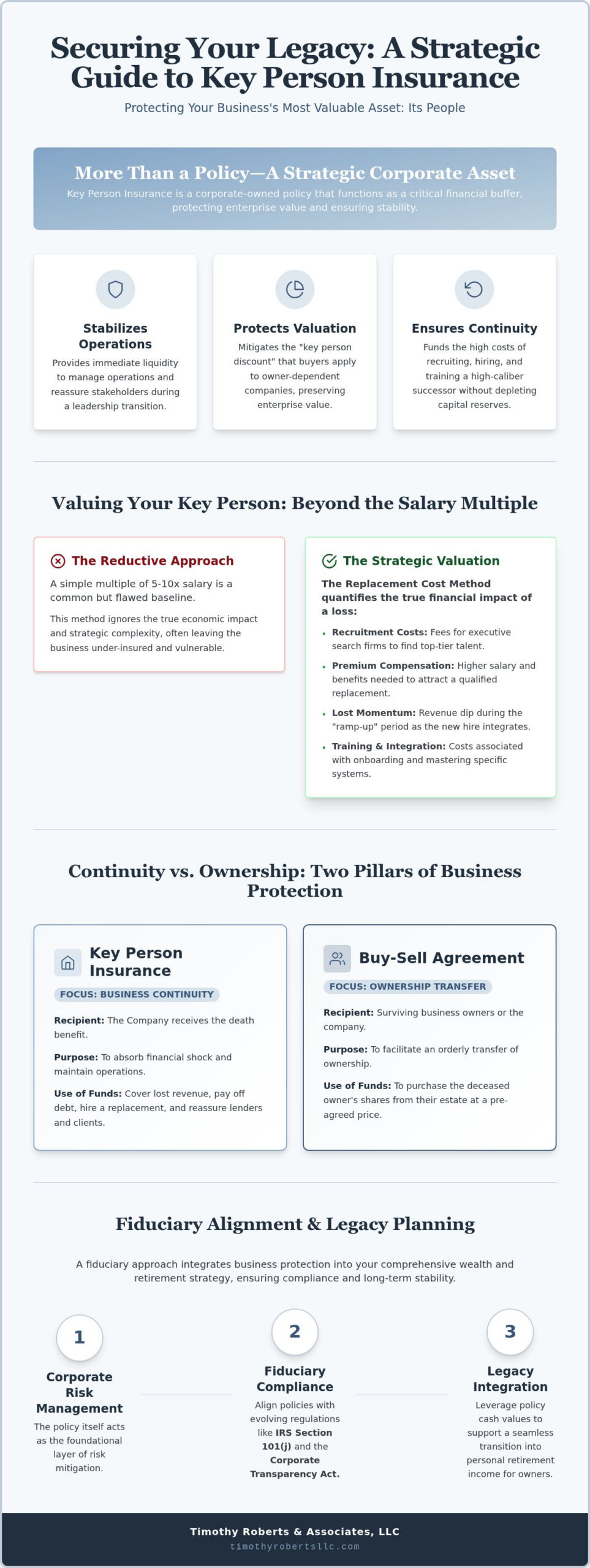
Success in a competitive market is rarely an accident; it’s the result of meticulous engineering and the specific brilliance of key contributors. To understand what is key person insurance, one must look past the policy itself and view it as a strategic corporate asset. It’s a corporate-owned insurance policy designed to act as a financial buffer, providing the liquidity needed to stabilize operations or recruit a successor if a critical leader is lost. This isn’t merely a safety net; it’s a fundamental pillar of a sophisticated business valuation strategy.
For many firms, key person insurance michigan represents the difference between a thriving legacy and an abrupt liquidation. While traditional insurance might focus on replacing a lost salary, a strategic approach prioritizes preserving enterprise value. This distinction is vital because the true cost of losing a leader isn’t their compensation, it’s the momentum, client trust, and intellectual capital they represent. A fiduciary advisor evaluates these risks within a broader financial roadmap, ensuring that the protection of the business aligns with the owner’s personal wealth evolution.
Identifying the ‘Key’ in Your Organization
The first step in organizational evolution is identifying exactly where your company’s value resides. A key person often possesses a unique blend of technical expertise, deep-seated client relationships, and visionary leadership that isn’t easily found on the open market. The loss of such an individual can have immediate ripple effects, particularly with business banking relationships. Many lenders view the presence of a specific leader as a prerequisite for maintaining credit lines; without them, the firm’s perceived risk profile changes instantly. Human capital risk represents the potential for structural instability when the departure of a specific individual threatens the operational continuity and market confidence of a specialized Michigan firm.
Fiduciary Oversight vs. Transactional Insurance Sales
Choosing a protection strategy requires a move away from transactional sales toward a narrative of partnership. A fiduciary perspective ensures that risk management isn’t a siloed purchase but an integrated component of your financial planning framework. This approach favors bespoke risk interventions over off-the-shelf solutions, treating each policy as a carefully crafted intervention. By aligning insurance analysis with long-term wealth goals, you create a system where business stability and personal growth work in tandem, moving your organization toward a future defined by intentionality rather than chance.
Calculating the Economic Value of a Key Contributor
Many advisors suggest a simple multiple of five to ten times an executive’s salary as a baseline for coverage. This is a reductive approach that ignores the strategic complexity of your organization. A truly sophisticated valuation requires a deep dive into the specific economic contribution of your top talent. By implementing key person insurance michigan, you aren’t just purchasing a policy; you’re engineering a defense against the valuation discount that savvy buyers apply to owner-dependent companies. Buyers often apply a significant haircut to the purchase price of firms that rely too heavily on the unique skills or relationships of a single individual, making a funded continuity plan essential for preserving your life’s work.
The Replacement Cost Method
When a visionary leader departs, the financial impact extends far beyond their immediate compensation. You must account for the substantial search fees required to secure top-tier talent and the premium salaries often necessary to lure them from competitors. There’s also the critical ramp-up period to consider. Even a highly skilled replacement won’t reach peak productivity on day one; they require time to integrate into your culture and master your specific systems. Properly calculating key person value involves quantifying these variables to ensure the death benefit provides sufficient liquidity to bridge this gap without depleting your capital reserves.
This level of protection is essential for long-term investment portfolio management. It ensures that a sudden leadership void doesn’t force you to liquidate assets at an inopportune time, preserving the enterprise value for future transitions and maintaining your firm’s progressive trajectory.
Linking Valuation to Your Retirement Income Gap
Your business is likely your largest asset, and its value is inextricably linked to your personal legacy. If the loss of a partner causes a sudden drop in enterprise value, that loss translates directly into a smaller nest egg for your heirs. Integrating retirement income planning into your analysis of key person insurance michigan allows you to set limits that protect your lifestyle, not just the company’s ledger. Meticulous valuation prevents a retirement shortfall after a business exit by ensuring the firm’s transferability remains intact regardless of personnel changes.
A visionary strategist understands that risk management is the foundation of sustainable growth. You can explore how these bespoke interventions fit into your specific organizational evolution by coordinating your corporate protection with your personal wealth goals.
Key Person Insurance vs. Buy-Sell Agreements: A Comparison
Distinguishing between business continuity and ownership transfer is a hallmark of a sophisticated organizational strategy. While key person insurance michigan focuses on the operational survival of the entity, a buy-sell agreement addresses the legal and financial transition of equity. The primary objective of key person coverage is to provide the corporation with immediate liquidity to buffer the shock of losing a leader. In contrast, a buy-sell agreement is designed to facilitate the orderly transfer of shares between individual partners or from an estate back to the firm. These two instruments are most effective when they function in tandem.
A fiduciary advisor doesn’t view these as competing products but as complementary interventions within a comprehensive estate planning framework. By naming the corporation as the beneficiary of the key person policy and using separate life insurance policies to fund the buy-sell, you create a dual layer of protection. This synthesis ensures the company has the capital to stay afloat while the remaining owners have the means to maintain control without depleting operational reserves. It’s a method of engineering stability that protects both the firm’s future and the individual partner’s personal wealth.
Funding the Buy-Sell Agreement
Liquidity is the lifeblood of any successful buyout. Without a funded agreement, surviving partners often face the grim reality of forced liquidations or high-interest debt to satisfy an heir’s demand for equity value. Funding the buy-sell with life insurance proceeds provides a clean, immediate solution. This prevents family disputes and ensures that the firm’s leadership remains in the hands of those capable of driving its upward progression. It transforms a potential crisis into a structured, professional transition that honors the original creative vision of the founders.
Key Person Disability: The Often Overlooked Risk
While many owners focus on the finality of death, the statistical probability of a long-term disability during a working career is a significant concern that requires strategic attention. A key person’s inability to work due to illness or injury can be more financially taxing than their loss; the firm may feel a moral or contractual obligation to continue their compensation while simultaneously paying for a replacement. Integrating disability buy-out provisions into your key person insurance michigan strategy ensures that cash flow remains stable. These bespoke interventions protect the firm’s overhead and provide a dignified exit for the disabled partner, securing the enterprise value for all stakeholders and maintaining the firm’s rhythmic growth.
Tax Mitigation and Fiduciary Compliance in 2026
A visionary strategist recognizes that the structural integrity of a business protection plan is only as strong as its tax compliance. Integrating key person insurance michigan into your corporate structure requires more than just selecting a policy; it demands a rigorous adherence to federal and state regulations. Under IRS Section 101(j), the tax-free nature of death benefits isn’t guaranteed. It’s a privilege earned through meticulous documentation and proactive disclosure. Without proper fiduciary oversight, what should be a source of corporate liquidity can quickly transform into a significant tax liability, undermining the very stability you’ve worked to build.
The 2026 regulatory environment also brings the Corporate Transparency Act (CTA) into sharper focus for Michigan enterprises. As leadership transitions occur or ownership structures shift due to a key person’s departure, the reporting requirements for beneficial ownership become critical. Ensuring your organization remains compliant with FinCEN protocols during a period of transition is a fiduciary duty that cannot be ignored. By aligning your tax advising with your risk management, you create a seamless narrative of professional stability that protects both the firm and its heirs.
Section 101(j) Compliance: Avoiding the Tax Trap
The IRS is uncompromising when it comes to the notice and consent requirements of the Pension Protection Act. To ensure death benefits remain income-tax-free, the business must obtain written consent from the insured employee before the policy is even issued. This document must explicitly state that the employer intends to insure the employee’s life and will be the beneficiary of the proceeds. If these steps aren’t documented with precision, the death benefit may be taxed as ordinary income, effectively stripping away nearly half of the intended liquidity. Audit-readiness isn’t an afterthought; it’s a foundational requirement for any sophisticated business owner.
Strategic Tax Interventions for Business Owners
Beyond simple protection, key person insurance michigan can be structured as a high-end tool for executive retention. Many firms use these policies to support executive bonus plans, creating a synthesis between corporate risk management and individual wealth accumulation. While premiums are generally not tax-deductible when the business is the beneficiary, the long-term cash value growth can offer strategic advantages for future corporate needs. Coordinating these efforts with legal counsel ensures that every intervention is both progressive and legally sound. You can partner with a fiduciary strategist to ensure your corporate insurance portfolio is optimized for the current tax landscape.
Integrating Risk Management with Your Retirement Legacy
The journey of organizational evolution eventually leads to a pivotal threshold: the transition from active leadership to a secured retirement legacy. At this stage, the focus shifts from protecting the entity to engineering personal wealth evolution. Key person insurance michigan acts as the bridge between these two phases, serving as a strategic tool that does more than just mitigate catastrophe. By integrating this coverage into a broader financial roadmap, you ensure that the enterprise value you’ve built remains a liquid, transferable asset that can fund your lifestyle long after you’ve stepped away from daily operations.
Many sophisticated business owners leverage the cash value accumulation within certain key person policies to support future retirement income streams. This approach allows the corporation to fund a deferred compensation plan or a supplemental executive retirement benefit, turning a risk management tool into a high-end retention and retirement vehicle. It’s a method of diversifying your wealth away from the business asset itself. Relying solely on the eventual sale of your firm for retirement is a concentrated risk; a visionary strategist builds layers of liquidity that exist independently of the company’s market valuation at any single point in time.
The Post-Exit Wealth Roadmap
Transitioning out of a business requires a meticulous rebalancing of your balance sheet. The liquidity provided by a well-structured exit, supported by the stability that key person insurance provides, must be funneled into a diversified income-generating portfolio. This ensures that your personal commitments, such as your education funding strategies for the next generation, remain secure regardless of the business’s future trajectory. This phase is often an emotional journey. It marks the shift from being an operator to becoming a steward of a lasting family legacy, requiring a steady, logical approach to wealth management.
Partnering for Aspirational Growth
A long-term partnership with a fiduciary advisor is the ultimate risk mitigation tool. At Timothy Roberts & Associates, we specialize in the synthesis of personal and professional goals, ensuring that every corporate intervention serves your broader wealth narrative. We move away from transactional interactions toward a relationship built on intellectual curiosity and business-minded rigor. This provides you with the calm confidence of knowing your family and your firm are protected by a polished, intentional strategy. Your business is your greatest asset; protect it with a visionary strategy that honors your craft and secures your progressive future.
Securing the Future of Your Organizational Evolution
Building a resilient enterprise requires a sophisticated synthesis of operational protection and personal vision. You’ve seen how a precise economic valuation of your top talent prevents the valuation discount that often plagues owner-dependent firms during a transition. By aligning key person insurance michigan with your broader financial roadmap, you transform a potential risk into a pillar of stability. This integration ensures that compliance with tax standards isn’t a hurdle but a foundation for your retirement legacy.
Timothy Roberts & Associates, LLC brings over 25 years of experience in retirement income planning to this complex intersection. We provide a fiduciary-led approach to strategic wealth management, offering integrated oversight of tax, investment, and insurance analysis. This partnership allows you to focus on growth while we secure the technical details of your succession. Partner with a fiduciary strategist to secure your business legacy and retirement future.
Your business represents your life’s work. It deserves a protection strategy as sophisticated as the organization you’ve built, ensuring your progressive journey continues with calm confidence and professional stability.
Frequently Asked Questions
What is the primary purpose of key person insurance for a Michigan business?
The primary purpose is to provide an immediate influx of capital to stabilize operations if a critical leader is lost. This liquidity allows the organization to fund the recruitment of a successor while reassuring lenders and clients of the firm’s continuity. By implementing key person insurance michigan, businesses protect their enterprise valuation and intellectual capital during high-stress transitions, ensuring that the departure of one individual doesn’t lead to a forced liquidation.
How is key person insurance different from a standard life insurance policy?
The fundamental difference lies in the ownership and the strategic intent of the coverage. In a standard policy, an individual pays premiums to protect their family’s lifestyle. With key person insurance, the corporation owns the policy, pays the premiums, and is the designated beneficiary. The death benefit is intended to preserve the firm’s market value and maintain operational momentum rather than serving as personal income replacement for the deceased’s heirs.
Are the premiums for key person insurance tax-deductible for my business?
Premiums for this type of coverage are generally not tax-deductible when the business is the beneficiary of the policy. This is a common point of confusion for owners seeking to minimize corporate liabilities. However, the trade-off is significant; if the firm complies with all federal notice and consent requirements, the resulting death benefit is typically received income-tax-free. This creates a powerful source of tax-exempt liquidity to stabilize the organization’s financial roadmap.
How much coverage should I carry on a critical executive or founder?
Determining the appropriate coverage amount requires a move away from simple salary multiples toward a comprehensive economic valuation. You must quantify the cost of executive search fees, the premium required for top-tier talent, and the revenue loss expected during a new hire’s ramp-up period. A fiduciary strategist often evaluates these variables alongside your long-term wealth goals to ensure the policy amount effectively bridges the gap between the current valuation and the post-exit reality.
What happens to the key person policy if the employee leaves the company?
If a key employee departs, the corporation typically has several strategic options regarding the policy. The firm may choose to cancel the coverage, surrender a permanent policy for its cash value, or transfer the ownership to the departing individual as part of a retirement package. Alternatively, if the departure is amicable, the business might maintain the policy to protect against the loss of the intellectual capital that the former leader still represents to the firm’s history.
Does the Corporate Transparency Act affect how we report corporate-owned insurance?
The Corporate Transparency Act primarily focuses on identifying beneficial owners of an entity rather than specific assets like insurance. However, if the death of a key person triggers a change in ownership or control, those shifts must be reported to FinCEN to maintain regulatory compliance. Integrating key person insurance michigan into your continuity plan ensures that you have the administrative resources to manage these reporting requirements during the complex transition of leadership and equity.
How does key person insurance fund a buy-sell agreement?
Key person insurance provides the immediate liquidity required to facilitate a smooth buyout of a deceased partner’s shares. Without these funds, surviving owners might be forced to liquidate assets or take on high-interest debt to satisfy the deceased’s estate. This funding mechanism ensures that control of the firm remains with the active leadership while providing the deceased’s family with a fair, immediate cash payment for their inherited equity in the enterprise.
Can key person insurance be used to secure a business loan in Michigan?
Lenders often require key person coverage as a condition for approving substantial business loans or lines of credit. This is particularly common when the firm’s success is heavily dependent on a specific visionary leader. The policy acts as collateral through a collateral assignment, reassuring the bank that the loan will be repaid even if the key individual is no longer there to drive revenue. This protects the firm’s creditworthiness and maintains essential banking relationships.
