

Sep
Creating a Financial Plan for Peace of Mind
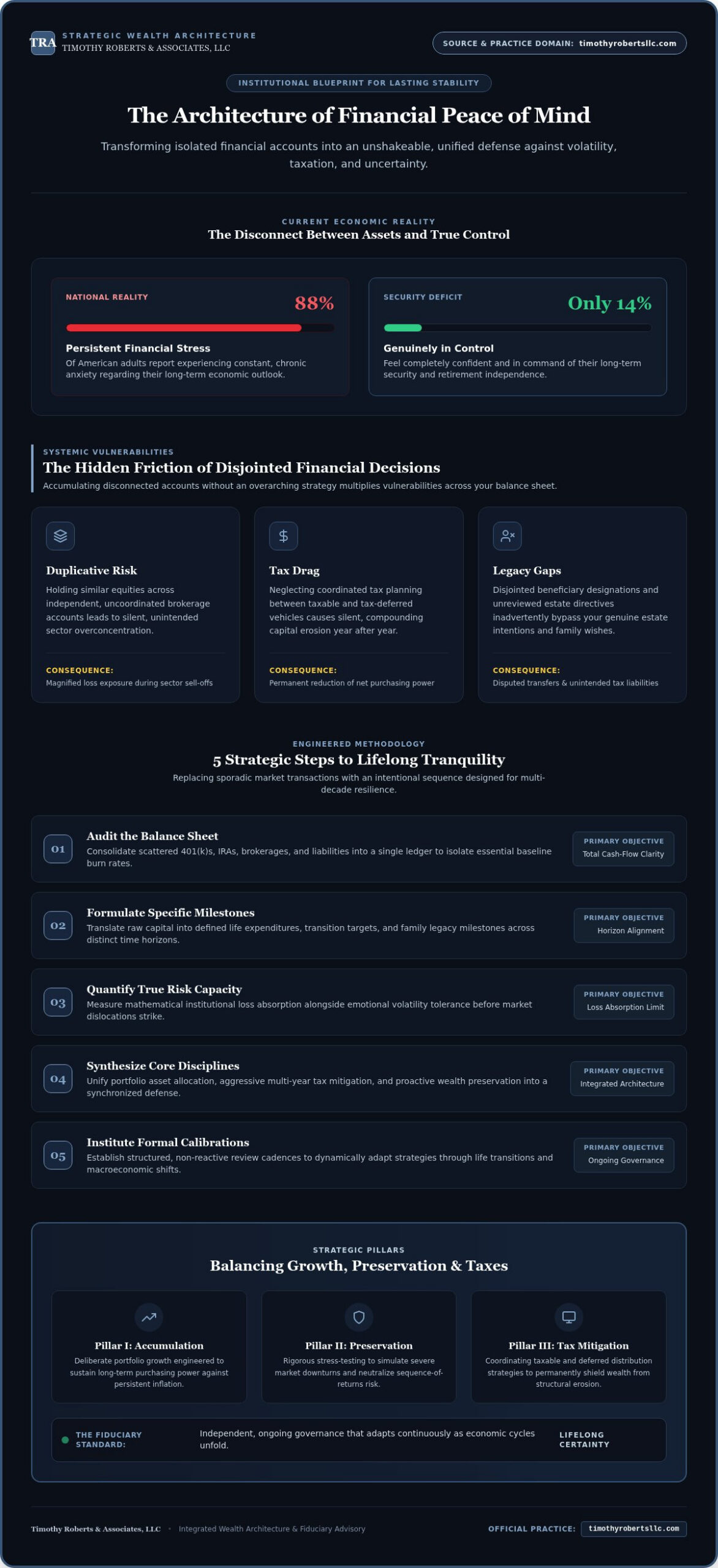
Nearly 88% of American adults report feeling persistent financial stress, yet only 14% feel genuinely in control of their long-term security. If you feel overwhelmed by fragmented accounts, conflicting advice, and quiet anxiety over market downturns or tax erosion, you aren’t alone. Disconnected tactics rarely produce lasting confidence. True stability begins with creating a financial plan for peace of mind, transforming isolated wealth decisions into a deliberate, harmonious strategy.
You don’t have to carry the ongoing worry of outliving your assets or leaving your family unprotected. In this guide, you’ll discover how to design an integrated, resilient financial roadmap that eliminates uncertainty, mitigates tax liabilities, and insulates your future against sudden market volatility. Ahead, we will unpack how unifying portfolio management, retirement income planning, and strategic tax mitigation creates an unshakeable foundation for lifelong independence.
Key Takeaways
- True financial tranquility stems from deliberate preparedness rather than market timing, replacing disconnected accounts with an integrated wealth architecture.
- A strategic process for creating a financial plan for peace of mind begins with an unsparing net-worth inventory and establishes clear milestones across multi-decade horizons.
- Balancing the core pillars of growth, defense, and proactive tax planning strategies preserves your purchasing power against inflation and structural tax erosion.
- Rigorous stress-testing simulates severe market downturns before they occur, insulating your retirement income against sequence of returns risk.
- Aligning with an independent fiduciary provides the disciplined, ongoing oversight required to adapt your strategy as life transitions and economic cycles unfold.
The Anatomy of Peace of Mind: What a Strategic Financial Plan Solves
True financial tranquility isn’t found in a solitary account balance or the temporary surge of a bull market. Rather, a comprehensive financial plan serves as an evolving blueprint that coordinates all your economic resources into a single, cohesive architecture. While the financial industry often fixates on market timing and speculative returns, genuine security stems from deliberate preparedness. Merely accumulating disconnected assets without an overarching strategy fails to resolve anxiety; it simply multiplies the number of moving pieces you must track.
Clarity across your cash flow and capital reserves produces an immediate psychological shift. When you consult a comprehensive overview of personal finance, you quickly recognize that wealth isn’t an abstract scorecard. It’s a functional instrument designed to support your life vision. To explore how intentional planning establishes genuine clarity and confidence, watch this brief overview:
Moving Beyond Spreadsheets to Emotional Certainty
Spreadsheets track historical transactions, but they rarely soothe chronic anxiety. The strategic process of creating a financial plan for peace of mind translates cold figures into defined, human milestones. By establishing pre-decided contingencies for market dislocations, health events, and career shifts, you replace panic with calculated action. Clear cash-flow buffers and structured liquidity parameters insulate your day-to-day lifestyle from cyclical volatility.
The Hidden Friction of Disjointed Financial Decisions
Isolated financial decisions generate hidden friction across your balance sheet. When accounts remain uncoordinated, critical vulnerabilities emerge unnoticed:
- Duplicative Risk: Holding similar equities across independent brokerage accounts often leads to unintended sector overconcentration.
- Tax Drag: Neglecting coordinated tax planning strategies between taxable and tax-deferred vehicles causes silent, compounding capital erosion.
- Legacy Gaps: Disjointed beneficiary designations can inadvertently bypass your estate intentions.
A unified roadmap directly harmonizes investment portfolio management with proactive tax preparation and retirement income planning. In doing so, creating a financial plan for peace of mind transforms sporadic transactions into an aligned defense against future uncertainty.
5 Strategic Steps to Creating a Financial Plan for Peace of Mind
Transforming complex economic realities into a stable, enduring strategy requires a disciplined sequence. Instead of chasing sporadic returns or collecting isolated retail products, establishing true stability demands an engineered methodology. Deliberately creating a financial plan for peace of mind involves five structured phases that bridge your current capital with your lifelong objectives.
- Audit the balance sheet: Aggregate every asset, liability, and baseline cash obligation.
- Formulate specific milestones: Define lifestyle expenditures and family legacy ambitions across distinct time horizons.
- Quantify true risk capacity: Measure institutional loss absorption alongside personal volatility comfort.
- Synthesize core disciplines: Unify asset allocation, proactive tax planning strategies, and risk protection.
- Institute formal calibrations: Establish disciplined review cadences to adjust for shifting economic cycles and life events.
Auditing Current Capital and Establishing True Baselines
Clarity starts with an unsparing inventory. Consolidate scattered employer 401(k)s, legacy IRAs, taxable brokerage accounts, and private assets into a single comprehensive net-worth ledger. Next, evaluate fixed liabilities against your discretionary burn rate. Isolating your essential living expenses defines the baseline cash flow required to secure daily stability, regardless of what broader equity markets do.
Formulating Realistic Milestones and Quantifying Risk Capacity
Emotional risk tolerance measures how you feel during a downturn; mathematical risk capacity measures whether you can afford the loss without altering your lifestyle. Aligning both requires establishing dedicated liquidity buffers. Reserving planned spending needs within conservative, low-volatility pools over rolling three- to five-year horizons prevents forced asset liquidations when market valuations retreat.
Synthesizing Investment, Tax, and Preservation Strategies
Wealth preservation demands coordination across accounts. Structuring holdings across taxable, tax-deferred accounts like Traditional IRAs, and tax-free Roth vehicles optimizes asset location, curbing long-term tax friction. Concurrently, comprehensive risk management and insurance analysis insulates accumulated capital against catastrophic health or liability events. When you examine sophisticated frameworks for retirement income planning, you see how these pieces work together seamlessly. Partnering with a dedicated team at Timothy Roberts & Associates, LLC ensures your multi-tiered architecture remains aligned, tax-efficient, and engineered for durable peace of mind.
Core Pillars: Balancing Wealth Accumulation, Preservation, and Taxes
A sustainable wealth strategy functions like a balanced tripod. If any leg fails, the entire structure topples. Growth engines must expand your purchasing power ahead of persistent inflation, while defensive instruments shield essential lifestyle expenditures from multi-year market downturns. Simultaneously, intelligent tax structures prevent structural capital leakage across both wealth accumulation and distribution horizons. Successfully creating a financial plan for peace of mind means calibrating these three forces so they reinforce, rather than contradict, one another.
Investment Portfolio Architecture: Strategic Diversification
Durable portfolios balance equity exposure to generate long-term capital appreciation with non-correlated fixed income to dampen drawdown severity. True diversification demands looking beyond single sectors or domestic equities. By implementing systematic, global investment portfolio management, you eliminate home-country bias, stabilize risk-adjusted returns, and position your holdings to participate in worldwide economic growth without taking uncompensated gambles.
Proactive Tax Planning Strategies to Preserve Net Capital
Taxes represent the single largest friction on long-term compound growth. Strategic asset location places income-generating bonds or high-turnover strategies inside tax-deferred accounts, reserving long-term capital gains treatments for taxable brokerage balances. Additionally, navigating lower-income transitional windows before mandatory distributions allows for calculated Roth conversions. Integrating disciplined tax advising ensures you systematically capture lower marginal rates today rather than exposing distributions to higher future brackets.
Defensive Risk Management and Capital Protection
Protecting accumulated capital requires equal technical rigor. Without layered defenses, an unexpected liability or sudden health crisis can unravel decades of prudent saving. Essential risk safeguards include:
- Excess Liability Coverage: Comprehensive personal umbrella policies insulate balance sheets from catastrophic legal claims.
- Multi-Year Liquidity Reserves: Tiered cash reserves prevent you from liquidating equities during cyclical market bottoms.
- Longevity Buffers: Structured income layers and tailored healthcare modeling protect your capital against extended life expectancies.
When these defensive measures mesh with proactive growth and tax efficiency, creating a financial plan for peace of mind shifts from a theoretical exercise into an enduring operational reality.
Stress-Testing Your Strategy Against Economic Volatility and Life Transitions
A static blueprint offers false comfort. True resilience requires subjecting your wealth structure to rigorous stress-testing before economic storms hit. By modeling prolonged stagflation, sudden asset depreciations, and unexpected healthcare costs, you prove plan durability under adverse conditions. Real confidence doesn’t mean hoping markets avoid turmoil; it means engineering a framework that thrives regardless of macroeconomic headwinds.
Navigating Market Cycles and Sequence of Returns Risk
Timing matters most at retirement’s threshold. Suffering severe equity declines during your first years of distribution can permanently impair portfolio longevity, a vulnerability known as sequence of returns risk. To insulate capital, create multi-year cash and short-duration fixed-income reserves. When equity valuations drop, living expenses draw from safe reserves rather than forced equity sales at depressed prices, letting core growth engines recover uninterrupted.
Safeguarding Legacy and Generational Continuity
Comprehensive wealth planning must look beyond your own horizon. Significant life events like business sales, inheritances, or marriages demand prompt updates to beneficiary designations, trusts, and distribution mandates. Strategic estate planning ensures your capital flows smoothly across generations without unnecessary probate bottlenecks, family disputes, or avoidable estate tax friction.
Managing Educational Endowments and Family Milestones
Balancing concurrent family goals often creates intense resource competition. Funding children’s or grandchildren’s tuition should never jeopardize baseline retirement stability. Implementing disciplined education funding strategies enables families to utilize dedicated tax-advantaged structures effectively while keeping primary wealth preservation benchmarks fully protected.
When life pivots, your financial roadmap must pivot with equal agility. To audit your vulnerabilities and begin creating a financial plan for peace of mind, schedule an objective wealth review with Timothy Roberts & Associates, LLC today.
The Fiduciary Partnership: Turning Plans into Lifelong Certainty
Even the most meticulously engineered blueprint offers zero protection if it sits unexecuted in a desk drawer. While constructing an initial balance sheet is critical, true certainty develops over years of disciplined execution and proactive calibration. The greatest danger to long-term capital isn’t macroeconomic volatility; it’s reactive human behavior during sensationalized news cycles. Creating a financial plan for peace of mind requires a trusted advisory partnership that eliminates emotional panic and keeps your strategic trajectory intact.
The Fiduciary Standard: Objective Stewardship vs. Sales
Advice quality hinges entirely on how that advice is structured. Transactional product brokers operate under a loose suitability threshold, often steering clients toward commission-heavy mutual funds or annuity products. Conversely, an independent fiduciary is legally and ethically bound to act solely in your best interest. This objective standard unifies portfolio architecture, integrated in-house tax preparation, and generational estate mandates under one cohesive framework. Before selecting a partner, review key qualifying questions to ask a prospective financial advisor to verify their allegiance remains entirely uncompromised.
Dynamic Recalibration: Maintaining Harmony Across Decades
Market conditions, tax statutes, and family realities evolve continuously. A truly resilient financial roadmap must adapt through active calibration rather than passive neglect. Maintaining balance requires structured review rhythms:
- Systematic Rebalancing: Scheduled semi-annual reviews trim outperforming equity sectors to restore your foundational risk profile while capturing mispriced assets.
- Regulatory Tax Adjustments: Dynamic tax-loss harvesting and timely bracket management adjust your withdrawals as statutory tax code changes take effect.
- Milestone Coordination: Formal check-ins align capital reserves ahead of major family transitions, such as business successions or phased retirements.
Backed by more than 25 years of wealth management and fiduciary advisory experience, our team provides the continuous, high-touch oversight required to preserve multi-generational wealth. If you are ready to eliminate financial second-guessing, begin designing your custom financial roadmap today.
Architecting Your Path to Lifelong Independence
Achieving true financial tranquility requires far more than collecting scattered accounts or reacting to headline-driven market cycles. It demands an intentional architecture where investments, income projections, and proactive tax mitigation operate in unified alignment. By stress-testing your balance sheet against volatility and actively safeguarding your lifestyle from sequence of returns risk, creating a financial plan for peace of mind becomes an enduring reality rather than an abstract ambition.
You don’t have to carry the burden of navigating complex economic environments alone. Backed by over 25 years of fiduciary advisory and wealth management experience, Timothy Roberts & Associates, LLC provides nationwide client representation focused on personalized, long-term capital preservation. We seamlessly weave your portfolio management, retirement income planning, and tax strategies into a singular, adaptable roadmap designed to withstand every phase of life. Take decisive control of your future. Schedule a Confidential Wealth Consultation today, and take the definitive step toward permanent financial clarity.
Frequently Asked Questions
What is the primary difference between a basic budget and a strategic financial plan?
A basic budget tracks historical monthly inflows and outflows, whereas a strategic financial plan unifies your entire economic life toward multi-decade objectives. While budgeting manages short-term spending habits, a comprehensive plan orchestrates investment portfolios, proactive tax mitigation, risk management, and estate coordination. It turns reactive cash management into an intentional wealth architecture that preserves purchasing power across changing market cycles.
Can creating a formal financial plan genuinely reduce daily stress and money anxiety?
Yes, establishing structured financial clarity directly alleviates chronic stress by replacing financial guesswork with calculated contingencies. Process-driven planning eliminates the dread of unexpected downturns because reserves, insurance layers, and multi-year cash needs are pre-funded. Creating a financial plan for peace of mind anchors your decisions to mathematical benchmarks rather than sensationalized market headlines, transforming persistent anxiety into measurable, psychological certainty.
How often should an individual or family review and adjust their financial plan?
You should review your financial plan semi-annually or annually to recalibrate asset allocations and adjust for evolving tax laws. Beyond scheduled checkpoints, major life transitions require immediate review. Events such as executive career shifts, inheritances, business liquidations, or family milestones demand prompt adjustments. Regular stewardship ensures your strategic balance sheet remains resilient and aligned with long-term goals as external conditions change.
How much money or liquid capital do I need before establishing a comprehensive financial plan?
You don’t need significant liquid wealth to establish a strategic blueprint. Comprehensive planning provides immense value whenever you have multiple competing financial demands, such as balancing retirement contributions with college funding or navigating high marginal tax brackets. Structuring deliberate cash flow, debt elimination, and disciplined asset location early establishes a solid foundation that accelerates capital accumulation over subsequent decades.
What happens if a major economic recession occurs right as I transition into retirement?
A properly engineered plan anticipates market pullbacks through defensive cash buffers and diversified liquidity reserves. This structure directly mitigates sequence of returns risk, ensuring you avoid liquidating depressed equity holdings to pay for baseline living expenses. When creating a financial plan for peace of mind, your retirement income draws from stable short-term reserves, allowing long-term growth investments the necessary time to fully recover.
Is it necessary to hire a fiduciary financial advisor, or can I manage this independently?
While basic investing can be managed independently, complex balance sheets benefit significantly from fiduciary oversight. An independent fiduciary is legally obligated to prioritize your best interests, unifying investments, proactive tax advising, and estate coordination without commission conflicts. As tax regulations evolve and market volatility tests discipline, professional stewardship prevents expensive emotional errors and maintains strategic harmony over decades.
