

Apr
Education Funding Strategies in Michigan: A Strategic Guide for 2026
What if the most significant threat to your 2026 retirement security isn’t a market downturn, but the inefficient way you’re currently saving for college? Many Michigan families find that rising tuition, which has historically increased by roughly 4.5% annually, creates a persistent tension between family legacy and personal lifestyle. You’ve worked hard to build a robust portfolio, and the fear that tuition might erode your hard-earned wealth is a valid concern. We believe that your child’s success shouldn’t come at the expense of your financial independence.
By implementing bespoke education funding strategies michigan residents can utilize, you’ll discover how to secure an academic future while maintaining your retirement trajectory. This guide promises to clarify the complexities of MET and MESP, showing you how to maximize state tax deductions and optimize federal advantages. We’ll provide a clear roadmap to transform your savings into a strategic tool for multi-generational wealth transfer.
Key Takeaways
- Navigate the 2026 landscape by shifting from reactive planning to a proactive, tax-efficient model that preserves long-term family wealth.
- Compare the distinct advantages of the Michigan Education Savings Program (MESP) and the Michigan Education Trust (MET) to identify the most effective education funding strategies michigan offers for your unique goals.
- Leverage sophisticated tax optimization techniques, including the five-year front-loading rule, to maximize state deductions while facilitating significant estate transfers.
- Apply the “oxygen mask” principle to ensure your academic contributions never compromise your primary retirement security or market reinvestment potential.
- Discover how a bespoke, fiduciary-backed roadmap provides the agility needed to rebalance your portfolio as tax landscapes and family aspirations evolve.
The Shifting Landscape of Higher Education Costs in 2026
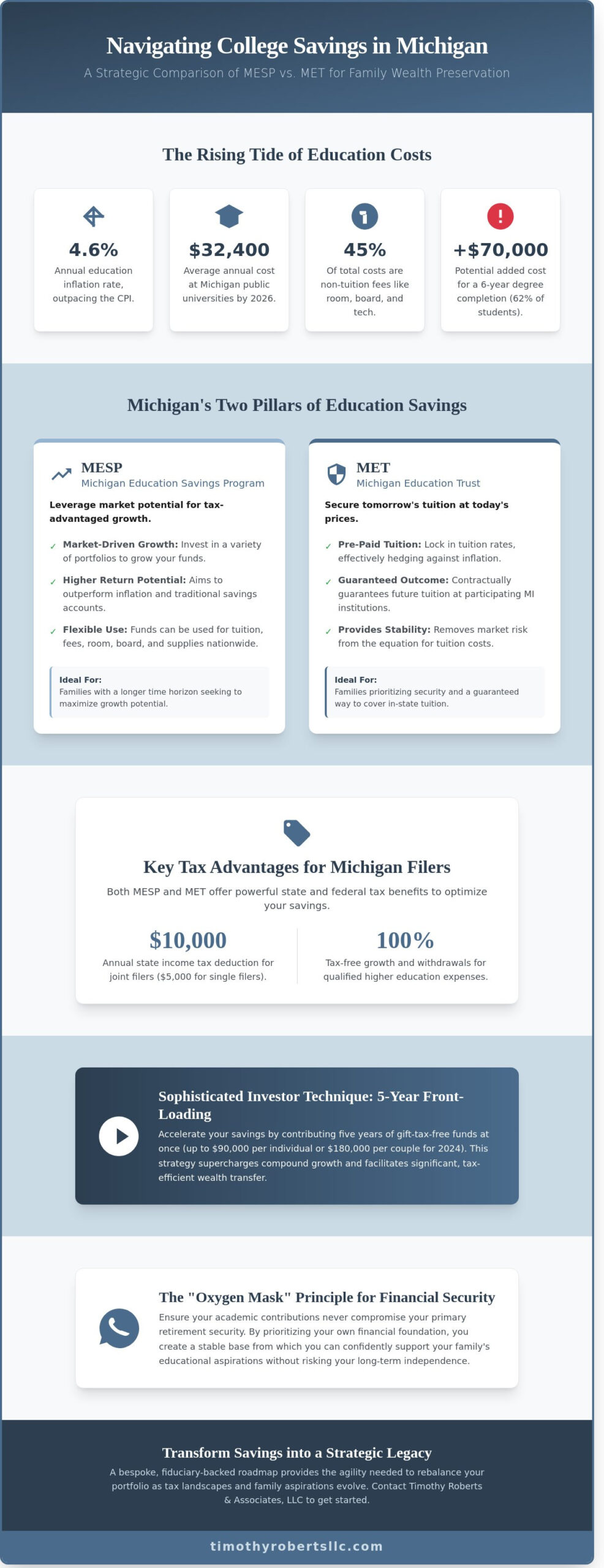
The financial architecture of higher education has undergone a profound transformation. By 2026, the average annual cost of attendance at Michigan public universities has reached $32,400, reflecting a 4.2% increase from the previous year. This persistent inflation requires more than simple savings; it demands a sophisticated approach to education funding strategies michigan families can rely on to preserve generational wealth. Relying on a reactive, pay-as-you-go model often triggers unnecessary capital gains taxes and misses out on the structural benefits of tax-deferred growth.
Understanding the underlying mechanics of state-level funding provides the necessary context for individual planning.
A reactive approach to these costs often results in tax inefficiencies that can erode a portfolio by 15% to 20% over a decade. Engaging a fiduciary advisor allows for the creation of a bespoke roadmap that prioritizes tax-efficient withdrawals and asset location. We define Education Wealth Elevation as the strategic integration of academic funding into a holistic financial plan, ensuring that tuition payments serve as an investment in human capital without compromising long-term liquidity or retirement security.
Projecting Future Academic Liabilities
Families must account for more than just tuition. Room, board, and technology fees now comprise 45% of the total cost of attendance. Data from 2025 indicates that 62% of students require six years to complete a four-year degree, which can increase the total financial liability by over $70,000. In 2026, the education inflation rate is the 4.6% annual appreciation of academic costs that consistently outpaces the broader Consumer Price Index.
The Strategic Importance of Early Intervention
The advantage of early intervention lies in the compounding power of tax-advantaged vehicles. Utilizing the Michigan Education Savings Program (MESP) allows for state tax deductions and tax-free growth, which can outperform traditional brokerage accounts by 25% over an 18-year horizon. This structured approach provides a psychological anchor, replacing the anxiety of looming deadlines with the calm confidence of an automated system. This strategy aligns education goals with broader estate planning, ensuring that education funding strategies michigan residents employ act as a bridge for legacy transfer rather than a drain on family resources.
Strategic Vehicles: Michigan 529 Plans and Beyond
Precision defines a successful portfolio. When evaluating education funding strategies Michigan families utilize to secure their children’s academic futures, the focus must shift from simple saving to sophisticated asset allocation. The state provides two distinct pillars for this journey: the Michigan Education Savings Program (MESP) and the Michigan Education Trust (MET). While both reside under the umbrella of Michigan’s 529 College Savings Programs, they serve vastly different strategic purposes. For the high-net-worth household, these plans aren’t just buckets for cash; they’re tax-advantaged engines that allow for a state tax deduction of up to $10,000 for joint filers as of 2024.
Sophisticated investors often look beyond state borders. While MESP offers diverse investment tiers, an out-of-state 529 might provide access to specific institutional managers or unique ESG portfolios not available domestically. Choosing an out-of-state plan means forfeiting the Michigan tax deduction, yet for portfolios exceeding seven figures, the superior performance of a bespoke manager can outweigh the immediate tax relief. This level of granular analysis is what separates a standard savings plan from a truly bespoke financial strategy.
MESP vs. MET: Choosing the Right Michigan Path
The choice between MESP and MET is a choice between market opportunity and guaranteed outcomes. MESP allows for market-driven growth through various investment portfolios, making it ideal for those with a longer time horizon. Conversely, MET allows families to prepay tuition at today’s rates, effectively hedging against the rising costs of higher education. This “tuition guarantee” provides a level of professional stability that market investments cannot always promise. For a deeper dive into these nuances, consult our Strategic Guide to the Michigan 529 College Savings Plan in 2026.
Alternative Investment Options for Academic Goals
Alternative vehicles offer the flexibility that traditional 529s sometimes lack. A Roth IRA can serve as a secondary funding source, allowing for the withdrawal of original contributions tax-free at any time. For those seeking maximum control, Cash Value Life Insurance provides tax-free growth and a death benefit, while the accumulated cash remains accessible for any purpose, including tuition. Unlike UTMA/UGMA accounts, which become the child’s property at age 18 or 21, these vehicles keep control in the hands of the parents. Explore how these assets compare in our analysis, Elevating the Future: A Strategic Comparison of College Investment Options for 2026.
Refining education funding strategies Michigan residents can trust involves balancing these vehicles against individual risk tolerance and legacy goals. Whether utilizing the SECURE 2.0 Act’s provision to roll over $35,000 of excess 529 funds into a Roth IRA or leveraging the liquidity of a life insurance policy, the objective remains the same: elevating the potential of the next generation through disciplined, visionary planning.
Tax Optimization: The Sophisticated Investor’s Approach
Wealth preservation requires more than simple savings; it demands a surgical approach to the tax code. Michigan residents can deduct up to $10,000 in 529 contributions from their state taxable income annually, effectively subsidizing their legacy through immediate tax relief. This deduction applies to total contributions per year, regardless of the number of accounts, providing a clear path to lower state liabilities while building a robust educational foundation.
High-net-worth families often utilize the “superfunding” provision to accelerate their wealth transfer. This strategy allows a lump-sum contribution of up to $90,000 per donor in a single year by front-loading five years of gift tax exclusions. It’s a powerful tool for moving assets out of a taxable estate while capturing market growth as early as possible. While local options are strong, discerning investors often compare Michigan’s offerings against the Best 529 Plans nationally to ensure their capital is positioned for maximum efficiency and performance.
The “Kiddie Tax” remains a significant hurdle for uncoordinated investment strategies. Once a minor’s unearned income exceeds the $2,600 threshold, it’s taxed at the parents’ marginal rate. Education funding strategies Michigan families employ must prioritize tax-deferred vehicles to avoid these punitive layers. By coordinating education accounts with year-round tax planning, you transform a simple savings goal into a sophisticated tax-reduction engine.
Federal Tax Advantages and Credits
The American Opportunity Tax Credit (AOTC) offers a maximum annual credit of $2,500 per student, while the Lifetime Learning Credit (LLC) provides up to $2,000. These benefits begin to phase out for joint filers once modified adjusted gross income exceeds $160,000, leaving high-earners to seek alternative ways to optimize their returns. Strategic placement of assets is vital to ensure these credits aren’t lost to income limits. Qualified 529 withdrawals remain entirely exempt from federal income tax when utilized for tuition, books, and required equipment.
The SECURE Act 2.0: A New Safety Net
The SECURE Act 2.0 introduced a transformative provision that allows for the rollover of up to $35,000 from a 529 account to a Roth IRA for the beneficiary. This legislative update eliminates the risk of “overfunding” an account, turning potential tax penalties into a tax-free retirement seed. To qualify, the 529 account must have been open for at least 15 years, and the funds being moved must have been in the account for at least five years. This shift elevates the 529 from a narrow education tool into a multi-generational wealth vehicle. It ensures that a bespoke education plan remains a flexible financial asset rather than a restricted liability, providing peace of mind for the long-term investor.
Holistic Integration: Balancing Education and Retirement Security
Effective education funding strategies michigan residents employ must prioritize the long-term stability of the household. Financial stewardship requires a rigorous hierarchy of needs. You’ve likely heard the oxygen mask analogy; you must secure your own future before assisting others. Retirement has no financial aid office. While students can access federal loans or private grants, no such mechanism exists for your post-career years. This fundamental reality dictates that retirement contributions remain the primary pillar of your financial architecture.
Aggressive education funding often creates a hidden opportunity cost. Diverting $1,200 monthly from a diversified brokerage account into a restricted 529 plan trades liquidity for tax perks. While Michigan offers a state tax deduction on contributions up to $10,000 for joint filers, this benefit shouldn’t override the power of unrestricted market reinvestment. For parents starting later in the journey, “mid-stream” funding requires a surgical approach. Utilizing the SECURE 2.0 Act provisions allows for a $35,000 lifetime rollover from a 529 to a Roth IRA, which offers a bespoke safety net if you overfund the account.
Comparing Funding Priorities
You can borrow for a degree, but you can’t borrow for a lifestyle in your 70s. A sliding scale strategy is essential. If you’re 45 with a 10-year horizon for both college and retirement, your contributions should favor the 401(k) until you hit 15% of your gross income. Only after reaching this threshold should you explore Strategic Balance: Funding Education and Retirement Simultaneously in 2026. This ensures your baseline security remains intact while you build a legacy for your children.
Asset Allocation Across the Total Portfolio
Your 529 shouldn’t exist in a vacuum; it’s a component of your total net worth. Your education funding strategies michigan should utilize a “Glide Path” as the matriculation date nears. This involves a calculated transition from aggressive growth to capital preservation. By the time freshman year arrives in 2026, at least 50% of the tuition for the first two years should reside in low-volatility instruments like money market funds or short-term bonds. This protects your principal against a sudden 10% or 15% market correction right when the first tuition bill is due. Coordinating the risk profile of these accounts with your primary investment portfolio prevents you from being over-exposed to equity volatility across your entire estate.
To ensure your family’s growth doesn’t compromise your personal security, schedule a strategic consultation to align your portfolios today.
Designing a Bespoke Education Roadmap
Effective education funding strategies michigan families utilize must transcend basic savings accounts. We move beyond the generic “set it and forget it” mentality. Timothy Roberts & Associates views education as a central pillar of your broader wealth elevation. It’s a strategic intervention designed to preserve capital while maximizing growth. We synthesize your family’s unique timeline with current market realities to build a plan that is as unique as your child’s future. This isn’t just about tuition; it’s about optimizing your entire financial architecture.
Our approach shifts the focus from simple accumulation to intentional wealth management. We analyze the intersection of your cash flow, tax liabilities, and legacy goals. This ensures your education plan doesn’t exist in a vacuum. By coordinating with your estate and tax professionals, we create a unified front that protects your assets from unnecessary exposure. We prioritize a rhythmic, logical flow of capital that supports your lifestyle today while securing their opportunities tomorrow.
The Fiduciary Difference in Education Planning
Choosing a fee-only fiduciary ensures your interests remain the sole priority. Unlike commission-based brokers who might push high-cost products, our bespoke analysis focuses on low-expense ratios and tax efficiency. Research from the Financial Planning Association indicates that high-commission products can erode up to 30% of a portfolio’s potential growth over an 18-year horizon. We eliminate these leaks. We don’t settle for off-the-shelf solutions. We scrutinize every vehicle, from Michigan’s MESP to complex trust structures, to find the perfect fit for your risk profile.
Personalized analysis allows us to pivot when the landscape shifts. We don’t just look at the numbers; we look at the intent behind the investment. This intellectual curiosity drives us to find innovative ways to capture growth while minimizing downside. Our goal is to transform your education savings into a sophisticated engine for family advancement.
Implementing Your Strategy for 2026
The end of 2025 marks the sunset of several Tax Cuts and Jobs Act provisions. This makes 2026 a critical year for rebalancing and strategic adjustments. We implement automated contributions to capture the benefits of dollar-cost averaging. This technique can reduce volatility by approximately 15% compared to inconsistent lump-sum timing. Our process remains steady and deliberate, guiding you through every milestone.
- Annual legislative audits to navigate shifting gift tax exclusions and state-specific credits.
- Dynamic rebalancing of portfolios as your student nears their matriculation date.
- Strategic execution of 529-to-Roth IRA rollovers under the SECURE 2.0 Act guidelines.
Your journey requires a partner who values rigor over convenience. It’s time to move away from generic advice and toward a partnership that values depth and precision. Request a consultation to elevate your education funding strategy and transform your family’s financial trajectory with a visionary approach.
Securing Your Multi-Generational Legacy for 2026
The financial landscape of 2026 demands a departure from traditional savings models. Success now hinges on the precise coordination of Michigan 529 plans with sophisticated tax-loss harvesting and holistic wealth management. By integrating these vehicles, families can protect their retirement security while meeting the projected 4% annual increase in private tuition costs. Developing sophisticated education funding strategies michigan families can rely on requires a fusion of tax intelligence and long-term vision.
At Timothy Roberts LLC, our fiduciary advisors draw upon over 25 years of experience to transform complex financial goals into an actionable roadmap. We specialize in tax-integrated wealth management that’s designed specifically for high-net-worth families who value depth over superficiality. Our approach ensures every dollar works toward a dual purpose, optimizing your current tax position while funding the intellectual growth of the next generation. It’s time to move beyond generic advice and embrace a strategy that’s as unique as your family’s ambitions.
Elevate your family’s future with a bespoke education funding strategy
Your vision for the future is achievable with the right partner by your side.
Frequently Asked Questions
What is the maximum Michigan tax deduction for 529 plan contributions in 2026?
Michigan taxpayers can deduct up to $10,000 for joint filers and $5,000 for single filers from their taxable income for 529 contributions in 2026. This incentive provides a direct reduction in state tax liability, effectively lowering the net cost of your education funding strategies michigan. These limits apply to the total contributions made across all accounts during the calendar year, ensuring a structured approach to tax-advantaged growth and long-term capital preservation.
Can I use a 529 plan for K-12 private school tuition in Michigan?
You can use 529 plan funds for K-12 private school tuition in Michigan up to a limit of $10,000 per student per year. This federal provision, established by the Tax Cuts and Jobs Act of 2017, allows families to deploy capital for primary and secondary education expenses. It’s a versatile tool that transforms the 529 from a long-term university fund into a bespoke solution for immediate academic needs and private school costs.
What happens to my Michigan 529 plan if my child receives a full scholarship?
If your child receives a full scholarship, you can withdraw an equivalent amount from the 529 plan without incurring the standard 10% federal penalty. You’ll still owe income tax on the earnings portion of the withdrawal, but the principal remains tax-free. This flexibility ensures that academic excellence doesn’t result in financial punishment, allowing you to reallocate those funds toward other strategic goals or alternative investment opportunities within your broader portfolio.
How does the 529-to-Roth IRA rollover work under the SECURE Act 2.0?
The SECURE Act 2.0 allows you to roll over up to $35,000 from a 529 plan to a Roth IRA over the beneficiary’s lifetime. To qualify, the account must have been open for at least 15 years, and any contributions made in the last 5 years aren’t eligible for transfer. This mechanism provides a sophisticated exit strategy for overfunded accounts, ensuring your capital continues to build wealth in a tax-free environment for the next generation.
Is it better to choose the Michigan Education Trust (MET) or the Savings Program (MESP)?
Choosing between the Michigan Education Trust (MET) and the Michigan Education Savings Program (MESP) depends on your specific risk tolerance and inflation outlook. The MET functions as a prepaid tuition contract, locking in current rates at Michigan public universities to hedge against rising costs. Conversely, the MESP is a holistic investment vehicle that allows for market-based growth, offering higher potential returns and broader flexibility for various education funding strategies michigan.
How do education savings accounts affect eligibility for federal financial aid (FAFSA)?
Education savings accounts owned by parents have a minimal impact on federal financial aid, typically reducing eligibility by no more than 5.64% of the asset’s value. This is significantly lower than the 20% assessment rate applied to assets held directly in a student’s name. By utilizing these accounts, you optimize your financial profile for the FAFSA, preserving the majority of your aid eligibility while building a robust and intentional education fund for the future.
Can grandparents contribute to a Michigan 529 plan for their grandchildren?
Grandparents can contribute to a Michigan 529 plan and are eligible for the same $5,000 or $10,000 state tax deduction as parents. This allows for a multi-generational approach to wealth transfer and education planning. Under the simplified FAFSA rules implemented in 2024, distributions from grandparent-owned accounts no longer count as student income, removing a previous barrier to strategic family gifting and ensuring a more seamless transition of assets between generations.
What are the tax implications if I use 529 funds for non-qualified expenses?
Using 529 funds for non-qualified expenses triggers a 10% federal penalty and subjects the earnings to both federal and state income tax. In Michigan, you’re also required to pay back the state tax deductions you previously claimed on those specific contributions. This high cost underscores the importance of a disciplined withdrawal strategy to protect the integrity of your bespoke financial plan and avoid unnecessary erosion of your accumulated capital over time.
