

Aug
Ann Arbor Retiree Risk Management & Wealth Guide
Your retirement portfolio is more than a collection of assets; it’s the engine of your future independence. Many high-net-worth individuals find that the strategies used to build wealth are fundamentally different from those required to protect it during the distribution phase. If you’re seeking comprehensive risk management for retirees ann arbor, you likely recognize that a standard, off-the-shelf plan won’t suffice in an era of shifting economic tides. It’s natural to feel a sense of unease regarding the “sequence of returns” risk or the rising costs of medical care that can deplete even the most robust accounts.
You deserve a strategy that functions as a carefully crafted intervention rather than a passive set of holdings. This guide will help you master the sophisticated strategies required to mitigate market volatility, inflation, and longevity risks to secure your retirement income for decades to come. We’ll explore how to synthesize investment logic with tax strategy and legacy preservation. By the end, you’ll have a clear roadmap for a fiduciary-led approach that ensures your financial stability survives any economic downturn and provides the confidence you’ve earned.
Key Takeaways
- Shift your perspective from simple asset accumulation to a holistic strategy designed for the specific challenges of the wealth distribution phase.
- Protect your purchasing power against inflation and market volatility through proactive, strategic rebalancing and consistent portfolio monitoring.
- Understand how a fiduciary-led framework for risk management for retirees ann arbor aligns your advisor’s interests with your long-term wealth preservation.
- Treat tax liability as a controllable risk by integrating year-round planning to enhance your total net income and preserve your capital.
- Secure a seamless wealth transfer by synthesizing risk mitigation with robust estate planning and trust strategies to avoid the complexities of probate.
Beyond Insurance: Redefining Risk Management for the Modern Retiree
Risk management is often mischaracterized as a static insurance policy. In reality, it’s a holistic strategy designed to ensure wealth preservation and income longevity through every market cycle. For those investigating risk management for retirees ann arbor, the focus must shift from basic products to a series of crafted interventions. This approach protects against systemic economic shifts that simpler portfolios cannot withstand. Traditional “buy and hold” strategies are effective during the accumulation phase; however, they’re frequently insufficient during the distribution phase when market downturns can permanently erode your principal.
To visualize how these strategic shifts impact your financial security, watch this helpful video:
The Shift from Accumulation to Distribution
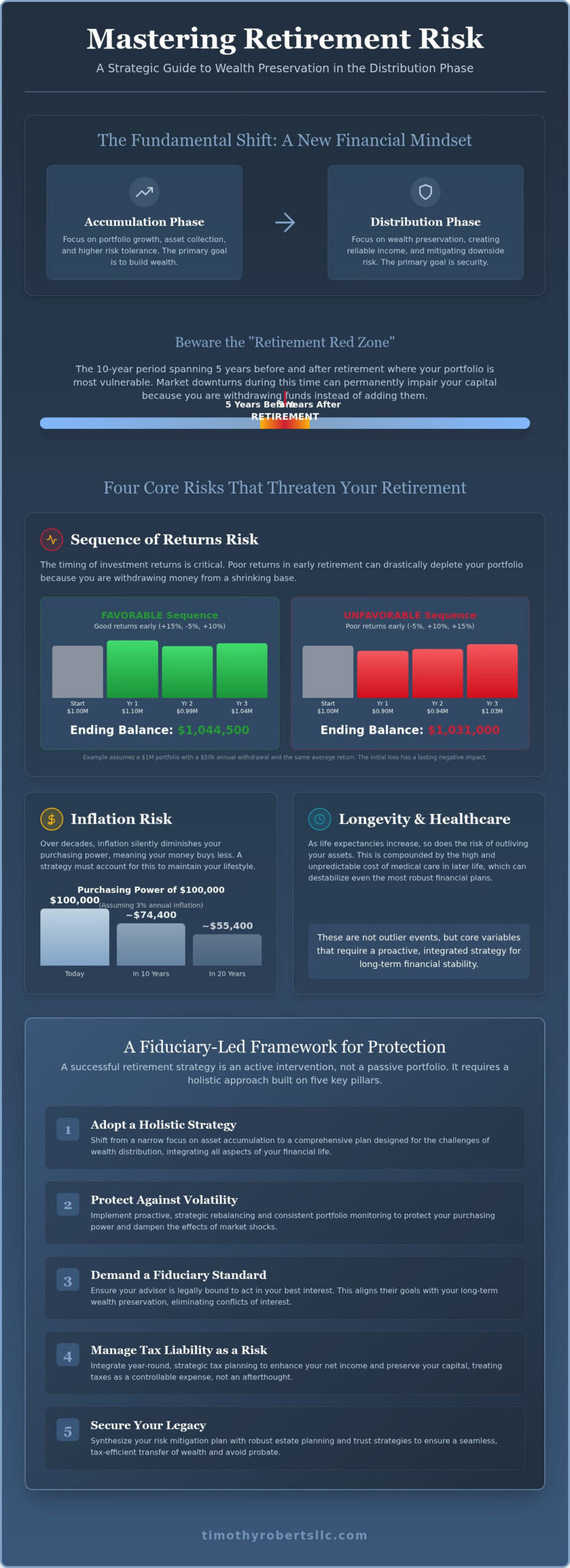
The transition into retirement involves entering what experts call the “retirement red zone.” This period, spanning five years before and after your retirement date, is your point of peak financial sensitivity. You’re navigating a profound psychological shift from growing wealth to sustaining a lifestyle. Your risk tolerance can’t remain static while your cash flow dynamics change. It’s a journey that requires a rigorous assessment of how your assets will support you when market volatility strikes. Without a plan for distribution, you risk liquidating assets at the worst possible time.
Why a Fiduciary Standard Matters in Risk Mitigation
A fiduciary-led strategy is the cornerstone of professional stability. By definition, a fiduciary must act in your best interest at all times. They’re bound to prioritize your success over their own. This eliminates the inherent conflicts found in commission-based models where advisors might favor specific products over strategic results. Through comprehensive retirement planning, you gain a roadmap built on transparency rather than sales targets. It’s the difference between a generic financial product and a sophisticated strategy tailored to your specific legacy. Effective risk management for retirees ann arbor relies on this foundation of trust and business-minded rigor.
Mitigating Systemic and Personal Risks to Retirement Longevity
Longevity risk is the overarching umbrella under which all other retirement threats reside. It is the statistical probability that you will outlive your financial resources, a concern that grows more acute as medical advancements extend life expectancy. Effective risk management for retirees ann arbor requires a deep analysis of these variables, treating health and long-term care costs not as outliers, but as core strategic variables in wealth preservation. These expenses can escalate rapidly, often during the years when your portfolio is most vulnerable. Failing to account for these shifts can destabilize even a well-funded estate, making a proactive approach essential for long-term stability.
The Impact of Sequence of Returns Risk
Sequence of returns risk is the danger of receiving low or negative investment returns during the early years of retirement. When you’re actively withdrawing funds, a market downturn doesn’t just reduce your balance; it forces you to sell more shares to maintain your income, permanently altering your portfolio’s trajectory. This math of loss is difficult to overcome without a structured plan. Tactical rebalancing serves as a vital tool here, allowing you to dampen the effects of market timing by adjusting your exposure before volatility becomes a crisis. It’s a journey of precision that ensures your lifestyle remains unaffected by temporary market fluctuations.
Inflation: The Silent Eroder of Retirement Income
Inflation is a persistent force that compounds over decades, quietly diminishing your purchasing power. A strategy that seems robust today might fail to cover basic expenses in twenty years if it relies solely on fixed-income instruments. Creating a resilient income shield requires a synthesis of asset classes, such as equities or real estate, that historically serve as hedges against rising costs. These investments provide the growth potential necessary to keep pace with the increasing price of goods and services. According to the U.S. Department of Labor’s retirement guide, understanding how different investments react to economic shifts is a fundamental step in protecting your future. Inflation protection isn’t an optional feature; it’s a core requirement for any portfolio intended to last thirty years or more.
By addressing these systemic and personal threats with intellectual curiosity and professional rigor, you transform anxiety into a structured roadmap. If you’re ready to move beyond generic advice, exploring customized retirement income planning can provide the clarity needed to navigate these complex economic waters.
The Fiduciary Advantage in Risk-Adjusted Portfolio Management
A fiduciary standard transforms the relationship between an advisor and a client from a series of transactions into a strategic partnership. Unlike commission-based models that may incentivize specific product sales, asset-based management fees ensure your advisor’s success is directly tied to the preservation and growth of your wealth. This alignment is critical when executing risk management for retirees ann arbor, as it prioritizes long-term stability over short-term gains. Through ongoing portfolio monitoring and strategic rebalancing, a fiduciary ensures your assets remain aligned with your risk tolerance, even as economic conditions shift. It’s a process of continuous refinement rather than a one-time event.
Strategic Asset Allocation vs. Market Timing
Market timing is often driven by emotional reactions to headlines, a path that frequently leads to buying high and selling low. A disciplined allocation strategy, however, relies on data-driven logic to adjust exposure during periods of high volatility. This approach represents the intersection of aesthetics and functionality; your personal goals provide the vision, while financial rigor provides the execution. By focusing on asset classes that behave differently under various market stresses, a sophisticated advisor can dampen overall portfolio beta. This ensures that your roadmap remains steady, regardless of temporary market noise or systemic shifts.
Customized Interventions for High-Net-Worth Portfolios
Generic, off-the-shelf solutions often fail to address the complex organizational evolution of high-net-worth wealth. Your portfolio requires customized interventions that synthesize risk-adjusted growth targets with your specific legacy objectives. This involves the strategic use of alternative assets and non-correlated investments to provide a buffer against systemic shocks. Such precision is a hallmark of professional wealth management, ensuring that every asset serves a distinct purpose in your broader financial architecture. It’s about building a structure that is as resilient as it is progressive.
Fiduciary oversight extends beyond simple investment selection to include estate and trust coordination. When these elements are integrated within a comprehensive retirement income planning framework, the result is a strategy built to survive economic downturns. This level of intellectual curiosity and professional stability is what distinguishes a specialized firm from larger, anonymous entities. It’s about crafting a future where your income remains stable and your legacy is protected through every stage of your retirement journey, ensuring that your upward progression continues even after you stop working.
Strategic Tax Planning as a Risk Mitigation Tool
Tax liability is not merely a seasonal obligation; it’s a controllable financial risk that can profoundly impact your net retirement income. While market volatility is often outside your direct influence, tax efficiency is a variable that responds to sophisticated, year-round strategy. For those prioritizing risk management for retirees ann arbor, treating taxes as a primary risk factor is essential for long-term wealth preservation. This proactive stance involves more than just filing returns. It requires a synthesis of investment logic and forward-looking tax advising to protect your gains from unpredictable legislative shifts.
Required Minimum Distributions (RMDs) represent a significant tax risk for many retirees. Without a carefully crafted plan, these mandatory withdrawals can push you into a higher tax bracket, potentially increasing your Medicare premiums and taxes on Social Security benefits. This “tax torpedo” effect is a common pitfall for those who rely on off-the-shelf solutions. A strategic approach identifies these vulnerabilities years in advance. By implementing interventions such as Roth conversions, you can reduce future RMD liabilities and enhance your financial flexibility. This is where professional expertise in risk management for retirees ann arbor becomes a tangible advantage.
Minimizing the ‘Tax Drag’ on Retirement Assets
Tax-loss harvesting and strategic asset location are foundational tools in a resilient financial roadmap. By placing tax-inefficient assets in sheltered accounts and tax-efficient assets in brokerage accounts, you reduce the annual “drag” on your portfolio’s growth. Each account type, whether Roth, Traditional, or taxable, carries distinct tax risks that must be balanced with precision. Implementing tax-efficient withdrawals is a proven method to extend your portfolio’s longevity by several years by minimizing the amount of principal lost to the government. This level of technical rigor ensures that more of your wealth remains available for your lifestyle and legacy.
Navigating Legislative and Regulatory Risk
The risk of future tax law changes is a constant in retirement planning. Building flexibility into your financial architecture allows you to pivot when federal regulations shift. Professional stability is rooted in rigorous tax compliance, ensuring that your wealth is secure from both economic downturns and regulatory scrutiny. Proactive planning also helps mitigate the impact of taxes on your Social Security benefits, ensuring your baseline income remains stable. If you’re ready to secure your future through a personalized lens, exploring a dedicated wealth management strategy can provide the specialized oversight your portfolio requires.
Securing Your Strategic Legacy through Comprehensive Analysis
Legacy planning is the ultimate expression of a well-executed financial roadmap. It transcends simple asset distribution, requiring a synthesis of risk management with long-term estate objectives to ensure a seamless wealth transfer. For those seeking risk management for retirees ann arbor, the goal is often to protect multi-generational wealth from the erosive effects of probate and unnecessary taxation. Probate is a public, often lengthy risk that can compromise your family’s privacy and deplete assets through administrative costs. Strategic use of trusts functions as a carefully crafted intervention, shielding your estate from these vulnerabilities while maintaining your strategic intent.
Insurance analysis remains a vital component of this broader preservation strategy. It shouldn’t be the sole focus of your plan, but rather a targeted tool used to address specific liquidity needs or legacy gaps. This approach positions your financial strategy as an evolving family office, capable of handling the complexities of organizational evolution. By treating your legacy as a structured business objective, you ensure that your upward progression continues through the next generation. It’s about moving away from generic checklists toward a narrative of shared success and intentional growth.
Coordinating Estate and Risk Strategies
Professional stability requires the meticulous alignment of beneficiary designations with your overall risk management goals. A fiduciary advisor doesn’t work in a vacuum; they coordinate with your legal professionals to ensure that every document reflects your current financial logic. This collaboration prevents the disconnects that often occur with off-the-shelf planning. Charitable giving also serves a dual purpose in this framework. It acts as a powerful legacy tool while simultaneously functioning as a tax-risk mitigation strategy, allowing you to support your values while optimizing your estate’s net value.
The Path Forward: Securing Long-Term Financial Stability
The journey from identifying systemic threats to executing a crafted financial roadmap is one of intellectual curiosity and professional rigor. You’ve explored how to dampen market beta, mitigate the “tax drag,” and protect against the silent eroder of inflation. This comprehensive analysis isn’t a simple transaction; it’s a commitment to your long-term stability. As visionary strategists and expert craftsmen, we believe that your retirement deserves a level of personal attention that matches the depth of your achievements. It’s a journey of partnership that values depth over superficiality.
Securing your future requires a partner who values strategic depth. If you’re ready to transform your anxiety into a resilient roadmap, it’s time for a comprehensive strategy review. We invite you to explore how a specialized approach to wealth management can elevate your financial trajectory. Let’s build a legacy that survives economic downturns and inspires confidence for decades to come.
Elevating Your Retirement through Strategic Resilience
Securing your financial independence requires a fundamental shift from passive accumulation to active, strategic preservation. You’ve seen how sophisticated risk management for retirees ann arbor involves more than just selecting insurance policies; it’s a meticulous synthesis of tax-efficient distribution, market-resilient portfolios, and intentional legacy planning. By addressing these variables as a unified whole, you transform economic uncertainty into a structured roadmap for upward progression. This approach ensures your lifestyle remains unaffected by systemic shifts while your legacy is protected for the next generation.
Timothy Roberts & Associates, LLC provides the visionary strategy and expert craftsmanship your wealth deserves. With over 25 years of strategic experience as fiduciary advisors, we offer a comprehensive integration of tax, investment, and estate planning tailored to your unique objectives. Our personalized interventions aren’t off-the-shelf solutions but carefully crafted plans designed to inspire trust and deliver results. It’s a partnership built on depth, intellectual curiosity, and shared success.
Schedule a strategic consultation with our fiduciary team to review your retirement roadmap.
Your journey toward long-term income stability is a path we’re honored to navigate alongside you, ensuring your wealth continues to evolve and grow with calm confidence.
Frequently Asked Questions
What is the most significant risk to a retiree’s financial plan today?
The most significant risk is often the intersection of longevity and inflation. Outliving your assets is a statistical reality as medical care improves; meanwhile, rising costs erode your purchasing power over a thirty-year horizon. A sophisticated strategy treats these as primary variables. It’s about building a resilient framework that accounts for systemic economic shifts while preserving your capital for the decades ahead.
How does a fiduciary advisor differ from a standard financial planner in managing risk?
A fiduciary advisor is legally bound to act in your best interest at all times, providing a foundation of trust that standard planners may lack. This distinction is critical because it eliminates the conflicts of interest inherent in commission-based models. By utilizing asset-based management fees, a fiduciary ensures their success is directly tied to your wealth preservation. This creates a strategic partnership focused on long-term growth rather than product transactions.
Can risk management strategies help me avoid outliving my money?
Comprehensive risk management for retirees ann arbor is specifically designed to prevent the exhaustion of your financial resources. By synthesizing investment logic with tax-efficient withdrawal strategies, you can significantly extend the longevity of your portfolio. This involves regular rebalancing and monitoring to ensure your income remains stable through varying market cycles. It’s a crafted intervention that provides the clarity and confidence required for a secure future.
Is insurance always necessary for a comprehensive retirement risk plan?
Insurance is a targeted tool within a broader legacy preservation strategy, but it’s not the sole requirement for success. While policies can provide liquidity for estate taxes or long-term care, they shouldn’t overshadow asset management and tax planning. A balanced roadmap prioritizes functionality and personal goals. It uses insurance only when it serves a specific purpose in your overall financial architecture, ensuring your strategy remains efficient and cost-effective.
How does sequence of returns risk specifically affect my first five years of retirement?
Sequence of returns risk is most dangerous during the “retirement red zone,” the five years surrounding your transition from work. Experiencing negative returns during this phase forces you to liquidate assets at lower prices to maintain your income. This can permanently deplete your principal, making it difficult for the portfolio to recover even when markets improve. Proactive risk management for retirees ann arbor focuses on dampening this volatility through tactical asset allocation.
What role does tax planning play in overall financial risk mitigation?
Tax planning functions as a powerful risk mitigation tool by reducing the mandatory “drag” on your retirement assets. Every dollar lost to unnecessary taxation is a dollar that cannot grow or support your lifestyle. By integrating year-round tax advising, you can navigate complex RMD rules and legislative changes that threaten your net income. This proactive stance transforms tax liability from an unpredictable burden into a controllable financial variable.
How often should a retirement risk management strategy be reviewed and adjusted?
Your strategy should undergo a formal review at least once a year or whenever significant economic or personal shifts occur. This ensures your asset allocation remains aligned with your evolving risk tolerance and legacy objectives. Continuous monitoring allows for timely rebalancing, which is essential for maintaining professional stability. It’s a journey of upward progression where your roadmap is refined to meet the practicalities of a changing financial landscape.
What happens to my risk profile if the market enters a prolonged downturn?
During a prolonged downturn, your risk profile is managed through a shift toward defensive positioning and strategic rebalancing. A fiduciary-led approach focuses on protecting your principal while ensuring you have sufficient liquidity to avoid selling assets at a loss. This involves a rigorous analysis of your withdrawal rates and asset location. The goal is to maintain a steady path toward your long-term objectives without succumbing to emotional market reactions.
