

Mar
Strategic Balance: Funding Education and Retirement Simultaneously in 2026
What if the most strategic gift you could offer your children isn’t a paid-in-full diploma, but the absolute guarantee that they’ll never need to subsidize your lifestyle in 2045? By 2026, the average cost of a four-year private degree is projected to exceed $220,000. This reality creates a high-stakes environment where every financial decision feels permanent. You understand that funding education and retirement simultaneously is no longer about simple savings; it’s about sophisticated capital allocation and intentional legacy building.
We recognize the tension between securing your personal future and empowering the next generation. This article provides the holistic frameworks required to transform that anxiety into a disciplined, multi-generational wealth strategy. You’ll gain a bespoke priority list for your surplus income that maximizes growth while aggressively minimizing tax exposure across 529 plans and qualified accounts. We’ll explore how to optimize your portfolio so both goals remain on track, allowing you to lead with confidence rather than compromise.
Key Takeaways
- Navigate the “Dual-Front Challenge” by transforming the perceived zero-sum game into a sophisticated strategy of calm confidence and growth.
- Establish a rigorous “Order of Operations” for your capital to prioritize funding education and retirement simultaneously without sacrificing personal security.
- Unlock the tax-efficient synergy of parallel vehicles, including the strategic use of SECURE 2.0 provisions for 529-to-Roth IRA rollovers.
- Adopt a bespoke “Middle Way” framework to replace generic savings models with a precise, percentage-based approach to wealth allocation.
- Elevate your financial legacy through a holistic, fiduciary-led plan that harmonizes competing goals with professional rigor and intentionality.
The Paradox of Choice: Why Funding Education and Retirement Feels Like a Zero-Sum Game
The Dual-Front Challenge represents a modern financial bottleneck for peak earners. It’s a strategic collision where the high-pressure years of career advancement coincide with the peak costs of private tuition and the urgent need for retirement acceleration. This phenomenon isn’t merely a budgeting hurdle; it’s a profound psychological tension. Parents often feel a primal duty to provide their children with a debt-free start, yet this altruism can compromise their own financial sovereignty. Achieving a balance requires moving past the emotional weight of parental guilt toward a narrative of strategic partnership.
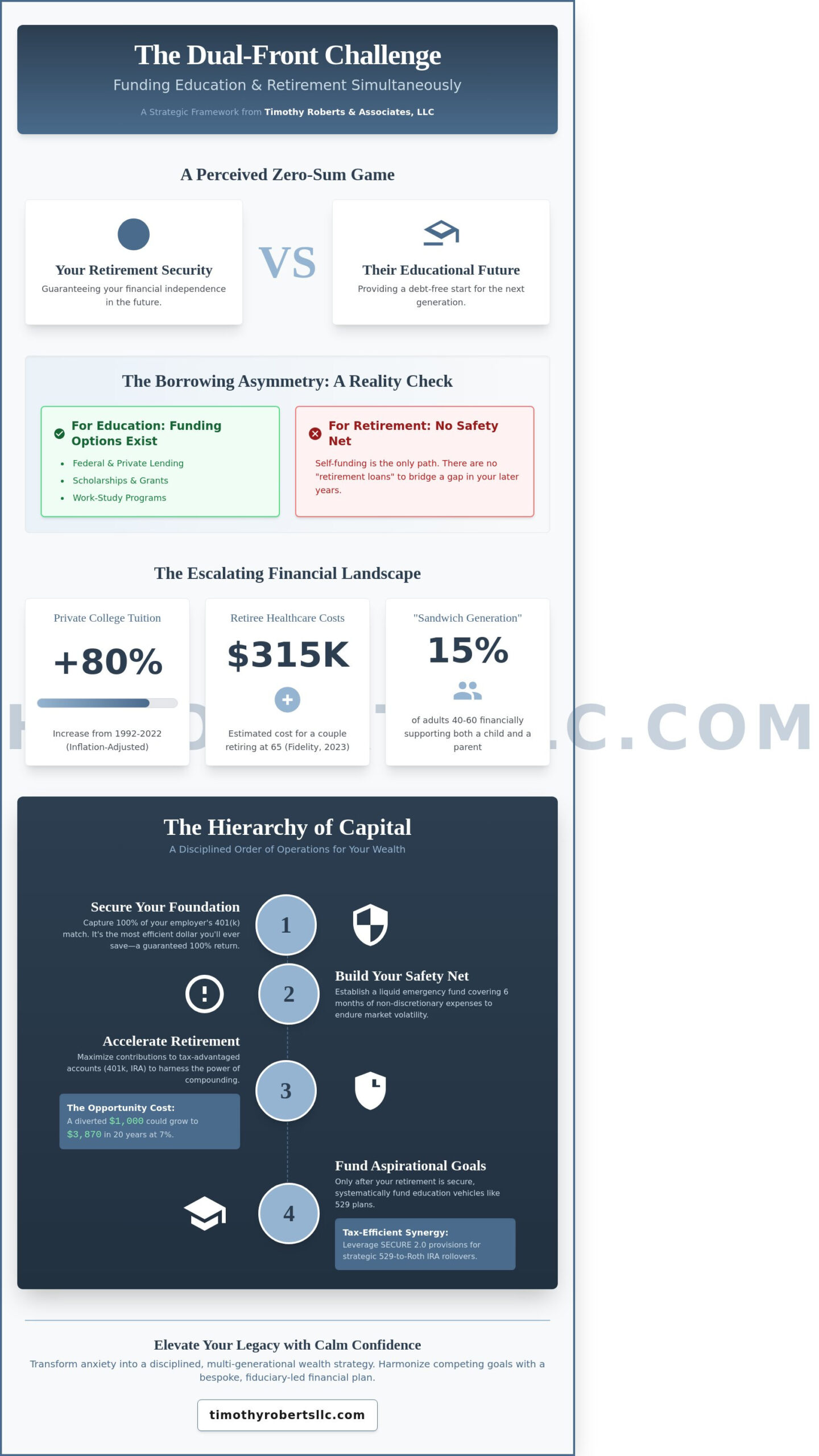
A necessary retirement reality check reveals that your future is the actual foundation for theirs. While the desire to prioritize a child’s degree is noble, it often ignores the borrowing asymmetry inherent in the American financial system. Loans exist for school; they don’t exist for life after work. A student can leverage federal aid, private lending, or work-study programs to bridge a funding gap. A retiree has no such safety net. If you fail at funding education and retirement simultaneously, you risk becoming a financial liability to your children in your later years. True financial self-preservation is a gift to the next generation because it ensures you remain independent.
The Rising Cost of Higher Education vs. Retirement Longevity
Tuition inflation has historically outpaced the Consumer Price Index. Data from the College Board shows that the average cost of tuition and fees at private nonprofit four-year institutions rose from $21,860 in 1992 to $39,400 in 2022, adjusted for inflation. This 80% increase creates a massive capital requirement just as life expectancy is climbing. A 65-year-old couple today must prepare for a retirement that could last 30 years, requiring an estimated $315,000 for healthcare alone according to 2023 Fidelity estimates. Many high earners also fall into the “Sandwich Generation,” with 15% of adults aged 40 to 60 providing financial support to both a child and a parent simultaneously. This triple-pressure environment demands a bespoke investment strategy rather than a reactive one.
The Opportunity Cost of Misaligned Priorities
The cost of miscalculating these priorities is often invisible until it’s too late. Diverting capital away from tax-advantaged growth engines can derail a decade of progress. Consider the impact of moving $1,000 from a retirement account to a college fund. If that $1,000 remained in a diversified portfolio earning a 7% annual return, it would grow to approximately $3,870 over 20 years. By removing it, you lose the initial principal and the exponential power of compounding. These missed years in a 401(k) or IRA are gone forever.
Strategic planners often utilize a 529 plan to create a dedicated education bucket, but this must never happen at the expense of the primary retirement corpus. When funding education and retirement, the goal is to optimize both without sacrificing the long-term resilience of your personal estate. You can’t recover lost time in the market. Every dollar diverted today is a withdrawal from your future freedom, making it essential to treat your retirement as the non-negotiable anchor of your holistic financial plan.
The Hierarchy of Capital: Prioritizing Your Retirement Without Neglecting Their Future
Success in financial planning is rarely about the volume of capital; it’s about the precision of its deployment. Establishing a fiduciary order of operations ensures that your wealth serves your primary needs before addressing secondary legacies. This strategic sequence begins with capturing every available incentive from your employer. If a firm offers a 5% match on 401(k) contributions, that represents a guaranteed 100% return on investment. It’s the most efficient dollar you’ll ever save, and leaving it on the table is a fundamental breach of your own long-term interests.
Before moving toward funding education and retirement simultaneously, you must secure your foundation with a robust emergency fund. This liquid reserve, ideally covering 6 months of non-discretionary expenses, provides the stability required to endure market volatility. Without this grip on your financial ladder, your long-term investments remain vulnerable to short-term shocks. Only once these essentials are satisfied can we transition from defensive savings to what we define as aspirational legacy funding. This transition marks the point where your survival is guaranteed and your focus shifts toward optimization.
Step 1: Maximizing Tax-Advantaged Retirement Vehicles
The internal revenue code provides powerful tools for wealth acceleration that shouldn’t be overlooked. For the 2026 tax year, projected elective deferral limits for 401(k) and 403(b) plans are expected to rise to $24,000 based on recent inflation trends. For professionals over age 50, standard catch-up contributions add another $7,500 of capacity. The SECURE 2.0 Act introduces a bespoke opportunity for those aged 60 to 63; their catch-up limit is now the greater of $10,000 or 150% of the standard catch-up. Individual Retirement Accounts (IRAs) offer a secondary layer, with 2026 limits projected at $7,500. We prioritize these vehicles over 529 plans because retirement has no financing backup. Your children can borrow for a degree, but no bank will underwrite your lifestyle in your eighties.
Step 2: The Strategic Pivot to Education Funding
Identifying the funding threshold is a mathematical exercise rather than an emotional one. We define this pivot point by calculating your retirement number through sophisticated Monte Carlo simulations. If your goal is a $160,000 annual lifestyle, a 4% safe withdrawal rate suggests a target portfolio of $4 million. Once your trajectory toward this figure reaches a 90% probability of success, you can begin Balancing Retirement and Education Savings through a partial funding model. This approach might allocate 70% of surplus cash to retirement and 30% to education, maintaining your velocity while building an educational seed. This ensures you aren’t sacrificing your future security for a four-year credential. To refine your specific allocation, you might explore a bespoke wealth strategy designed for high-impact families. This holistic view transforms funding education and retirement from a zero-sum game into a coordinated march toward multi-generational stability.
Leveraging Parallel Vehicles: 529 Plans, IRAs, and Tax-Efficient Synergy
Strategic wealth management requires a dual-lens approach when funding education and retirement simultaneously. High-net-worth families often view these goals as competing interests, yet the sophisticated use of 529 plans and Roth IRAs creates a holistic ecosystem where capital performs double duty. While 529 plans offer powerful state-level incentives, such as the $10,000 tax deduction for married couples filing jointly in states like New York, they lack the multi-purpose utility of a retirement account. Integrating both vehicles allows you to optimize your tax footprint while ensuring that scholastic funding doesn’t cannibalize your long-term security.
The SECURE 2.0 Act, effective January 2024, introduced a pivotal provision that bridges the gap between these two silos. Investors can now execute a 529-to-Roth IRA rollover, subject to a $35,000 lifetime limit. This policy eliminates the “trapped fund” anxiety that historically deterred aggressive 529 contributions. To qualify, the 529 account must have been open for at least 15 years, and the moved funds must have resided in the account for at least five years. This strategic pivot ensures that any surplus education capital is seamlessly repurposed for retirement growth, maintaining its tax-exempt status throughout the transition.
The Roth IRA as a Stealth Education Fund
The Roth IRA serves as a versatile secondary reserve for funding education and retirement because of its unique withdrawal hierarchy. Internal Revenue Code Section 72(t) allows you to withdraw original contributions at any time without taxes or penalties. If you use these funds for qualified higher education expenses, the 10% early withdrawal penalty on earnings is also waived. However, the opportunity cost is high. Withdrawing $50,000 for tuition today sacrifices approximately $193,000 in potential tax-free growth over 20 years, assuming a 7% annualized return. Additionally, under the FAFSA Simplification Act of 2024, IRA distributions count as untaxed income, which can reduce a student’s financial aid eligibility by up to 50% of the distribution amount.
Bespoke 529 Strategies for High-Net-Worth Families
For families seeking to elevate their estate planning, 529 plans offer a “superfunding” mechanism. In 2024, an individual can front-load five years of gift tax exclusions into a single contribution of $90,000, or $180,000 for married couples. This move accelerates tax-deferred growth and immediately removes the assets from the donor’s taxable estate. The flexibility of these accounts extends across the entire family tree. You can change the beneficiary to a sibling, first cousin, or even yourself if a child receives a scholarship. This “Legacy 529” approach transforms the account into a multi-generational endowment, funding the intellectual pursuits of grandchildren or great-grandchildren while the principal remains shielded from the volatility of shifting tax codes.
The synergy between these accounts relies on precise timing and asset allocation. By utilizing the 529 plan as the primary engine for tuition and the Roth IRA as a strategic safety net, you protect your retirement horizon. This balanced architecture ensures that your family’s educational aspirations and your own financial independence grow in tandem, rather than at each other’s expense.
The “Middle Way” Framework: 4 Strategic Models for Concurrent Funding
Wealth management isn’t a binary choice between your future and theirs. Elite financial architects reject the notion that you must sacrifice personal longevity for your children’s academic pedigree. They instead employ a “Bespoke Balance” framework. This approach treats funding education and retirement as two synchronized gears within a single high-performance engine. It’s about ensuring neither stalls while the other accelerates, creating a holistic trajectory for family wealth that values both current opportunity and future security.
- Model 1: The Percentage Split. This model offers a disciplined, rhythmic cadence. By allocating 70% of surplus cash flow to a 401(k) or IRA and 30% to a 529 plan, you maintain progress on both fronts. This prevents the all-or-nothing trap that often leaves parents with a funded tuition bill but a depleted nest egg.
- Model 2: The Retirement First Cap. Funding retirement accounts to the 2024 limit of $23,000 for 401(k)s or $30,500 for those over age 50 is the priority here. Only after hitting this statutory ceiling do you divert the overflow into education-specific vehicles. It’s a strategic safeguard against the reality that there are no loans for retirement.
- Model 3: The Asset-Targeted Approach. Asset-targeted strategies assign specific revenue streams to specific goals. You might dedicate 100% of annual performance bonuses or K-1 distributions to a 529 plan while your base salary fuels your retirement portfolio. This creates a clear mental and financial boundary between living expenses and legacy goals.
- Model 4: The Loan-Mitigation Strategy. Loan-mitigation strategies focus on maximizing market participation. You keep your capital in the market to capture historical returns of 7% to 10% while planning to use low-interest leverage for tuition. Since 2024 Federal Parent PLUS loan rates sit at 9.08%, this model requires a high-conviction investment strategy to ensure your portfolio’s growth outpaces the cost of debt.
Integrating Life Insurance and Trust Strategies
Cash Value Life Insurance serves as a sophisticated liquidity bridge. By utilizing the cash accumulation within a policy, you create a tax-favored reservoir that remains accessible for tuition without triggering the early withdrawal penalties found in traditional retirement accounts. For those with estates exceeding the $13.61 million exemption, Irrevocable Life Insurance Trusts (ILITs) provide a strategic layer of protection. These structures remove death benefits from the taxable estate, providing a tax-free inheritance that can fund multi-generational funding education and retirement goals simultaneously.
Navigating the 2026 Tax Landscape
The sunset of the Tax Cuts and Jobs Act on December 31, 2025, necessitates a proactive pivot. With the top individual income tax rate scheduled to revert to 39.6%, tax-loss harvesting becomes a vital tool to offset capital gains and preserve capital for tuition payments. Investors should also focus on the Step-Up in Basis rules under Internal Revenue Code Section 1014. By holding highly appreciated assets until transfer, you can effectively eliminate capital gains taxes for your heirs, allowing them to liquidate assets for graduate school with zero tax liability while your retirement corpus remains intact.
Connect with a strategist to design your bespoke funding model today.
Elevating Your Legacy: How Bespoke Financial Planning Harmonizes Competing Goals
Siloed savings accounts often create a zero-sum game where one goal succeeds only at the expense of another. When you isolate tuition funds from retirement assets, you miss the compounding power of a unified balance sheet. At Timothy Roberts & Associates, LLC, we replace this fragmented approach with our core philosophy: Elevation through Strategic Rigor. We view your wealth as a single, interconnected ecosystem where every dollar is assigned a specific, high-performance role.
Our process transforms the stress of funding education and retirement into a calculated journey of growth. We build a custom roadmap that accounts for the 3.8% historical inflation rate of college tuition and the fluctuating volatility of global markets. By integrating tax-advantaged 529 plans with diversified brokerage accounts and robust 401(k) structures, we ensure your liquidity remains high while your long-term security stays protected. This strategic rigor allows us to identify overlaps and efficiencies that a standard, off-the-shelf plan would overlook.
Confidence comes from clarity. We move past the anxiety of “what if” by providing a structured framework that adapts as your life evolves. Whether you’re facing a sudden market correction or a change in your child’s academic path, a bespoke plan provides the agility needed to pivot without compromising your future lifestyle. We don’t just manage assets; we curate a legacy that reflects your values and your vision for the next generation.
The Fiduciary Advantage in Education Planning
Choosing a fiduciary partner means your retirement security is legally prioritized. You can borrow for a degree, but you can’t borrow for your retirement. We maintain this boundary with discipline. As your children approach their college years, we implement a sophisticated rebalancing strategy. This shift protects gains from market swings, ensuring that tuition checks are covered by stable assets rather than devalued equities.
We utilize advanced stress-testing to validate your plan against 1,000 distinct economic scenarios. This includes modeling for events like the 12% inflation spike in the early 1980s or the 2008 financial crisis. By testing these extremes, we ensure your strategy is resilient enough to withstand the unpredictable. Our goal is to provide a sense of calm that only comes from knowing your numbers have been vetted through every possible lens.
Next Steps: Your Personal Strategy Session
To begin the process of funding education and retirement with precision, we invite you to a comprehensive strategy session. This is not a generic sales pitch. It’s a deep dive into the mechanics of your wealth. To make the most of this time, please have the following items ready for review:
- Current investment and 529 plan statements.
- Your most recent three years of federal tax returns.
- Detailed summaries of employer-sponsored benefits.
- A clear list of your top three financial priorities for the next decade.
We offer transparent fee structures tailored to your complexity. You can choose from our Assets Under Management (AUM) model, typically ranging from 0.75% to 1.25% depending on portfolio size, or a fixed-fee engagement for specialized consulting. This flexibility ensures our interests remain perfectly aligned with yours. It’s time to stop reacting to bills and start orchestrating your wealth. Elevate your financial strategy with a bespoke consultation and secure the future your hard work has earned.
Harmonizing Your Legacy for 2026 and Beyond
The financial landscape of 2026 demands a shift from binary choices to integrated solutions. You don’t have to sacrifice your golden years to secure their academic success. By implementing the “Middle Way” framework, you can leverage 529 plans and IRAs to create a tax-efficient synergy that protects your wealth. Balancing the complex demands of funding education and retirement requires a move beyond off-the-shelf products toward a holistic, bespoke strategy. This dual-track approach ensures your capital works twice as hard, providing a stable foundation for your lifestyle while opening doors for the next generation.
Timothy Roberts LLC brings over 25 years of fiduciary expertise to Michigan families who refuse to settle for compromise. We specialize in sophisticated tax-minimization strategies that transform competing financial obligations into a unified path for growth. For Michigan residents specifically, implementing targeted education funding strategies Michigan families can leverage provides additional state-specific advantages that enhance your overall wealth strategy. It’s time to elevate your financial trajectory with a partner who understands that your legacy is built on both security and opportunity. Your vision for the future is entirely achievable with the right structural discipline.
Secure your future and theirs with a strategic consultation
Frequently Asked Questions
Is it better to fund a 529 plan or a Roth IRA if I can only afford one?
Prioritize the Roth IRA because it offers unparalleled flexibility for both your future and your child’s tuition. You can withdraw your original contributions at any time without taxes or penalties, providing a strategic safety net. In 2024, the contribution limit is $7,000, or $8,000 for those over age 50. This bespoke approach ensures your security remains the primary focus while keeping educational options accessible.
Can I use my 401(k) to pay for my child’s college education without penalties?
You cannot withdraw 401(k) funds for education expenses without a 10% early withdrawal penalty if you’re under age 59.5. Unlike IRAs, 401(k) plans don’t offer a specific penalty waiver for higher education. A 401(k) loan is a common alternative, allowing you to borrow up to $50,000 or 50% of your vested balance. This path requires caution; leaving your job often triggers a full repayment requirement within 60 days.
How does saving for college in a 529 plan affect my child’s financial aid eligibility?
A parent-owned 529 plan reduces financial aid eligibility by a maximum of 5.64% of the asset’s value. This rate is significantly lower than the 20% assessment applied to assets held directly in a student’s name. Under the FAFSA Simplification Act effective in 2024, distributions from grandparent-owned accounts no longer count as untaxed income. This shift optimizes your strategy for funding education and retirement by protecting more of your financial aid package.
What happens to the money in a 529 plan if my child doesn’t go to college?
You can change the beneficiary to another qualifying family member or rollover up to $35,000 into a Roth IRA for the original beneficiary. Changing the beneficiary is a tax-free event that preserves capital for future generations. If you choose a non-qualified withdrawal, you’ll owe income tax and a 10% penalty on the earnings portion only. These options ensure your capital remains a productive part of your holistic financial ecosystem.
How much should I have saved for retirement before I start a college fund?
You should aim to contribute at least 15% of your gross annual income to retirement accounts before allocating funds to a college account. Financial advisors recommend securing your own future first because there are no loans available for retirement. If your employer offers a 401(k) match, capture that 100% return immediately. Balancing these priorities requires a disciplined approach, which includes managing other large purchases wisely; for instance, when the time comes for a teenager’s first car, you can check out Stone Road Auto to find a reliable used vehicle and preserve capital for your primary goals.
Are there tax-efficient ways for grandparents to fund education without affecting estate taxes?
Grandparents can utilize the superfunding rule to contribute up to $90,000 in a single year without triggering gift taxes. This 5-year front-loading strategy, based on the 2024 gift tax exclusion of $18,000, removes assets from the taxable estate immediately. It accelerates tax-free growth while maintaining control over the funds. This bespoke method provides a sophisticated way to elevate a grandchild’s future while optimizing the family’s broader wealth transfer goals.
Can I still fund my retirement if I start saving at age 45?
Yes, you can still achieve a secure retirement by utilizing catch-up contributions and high savings rates. At age 50, the IRS allows an additional $7,500 in 401(k) contributions and $1,000 in IRAs. If you save $2,500 monthly with a 7% annual return, your portfolio could grow to $1.3 million by age 65. This journey requires a focused, strategic intervention to transform your current trajectory into a robust financial legacy.
What is the 529-to-Roth rollover and how do I qualify for it in 2026?
To qualify for the $35,000 lifetime rollover limit, the 529 account must have been open for at least 15 years. The SECURE 2.0 Act established this provision, and the first transfers became eligible in early 2024. Funds moved must have been in the account for at least 5 years. This mechanism allows you to pivot unused education savings into a retirement vehicle, ensuring your capital is always working toward your most vital objectives.
