

May
Strategic Asset Allocation in Retirement: Elevating Your Decumulation Strategy for 2026
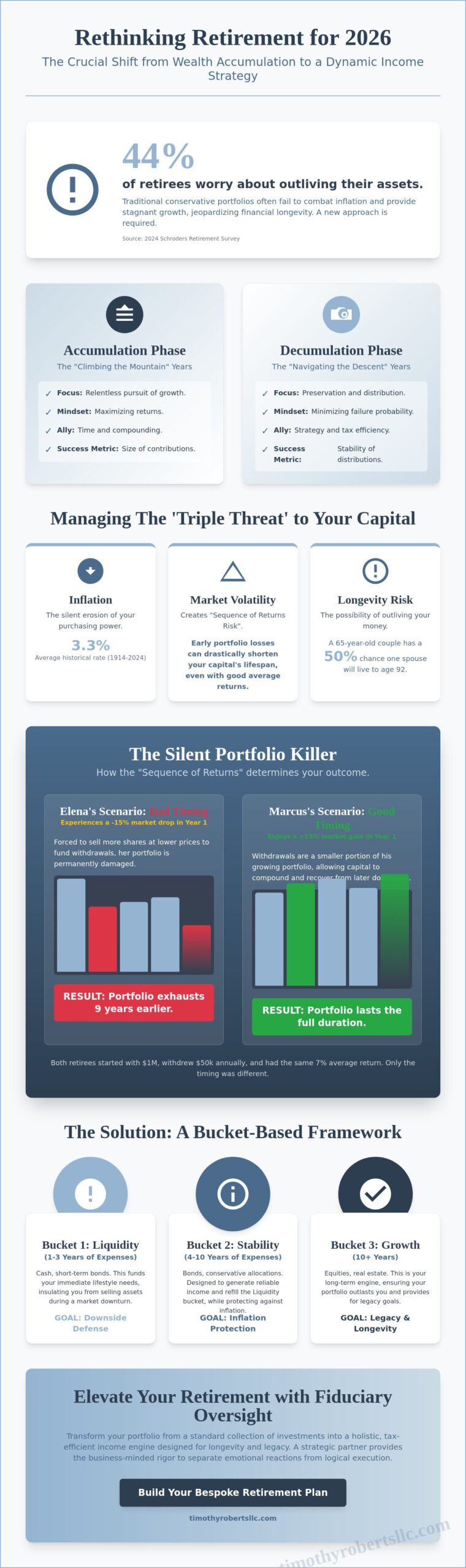
The traditional wisdom of shifting toward a conservative, fixed-income heavy portfolio as you age might actually be the greatest threat to your financial longevity. While a defensive stance feels safe, recent data from the 2024 Schroders Retirement Survey indicates that 44% of retirees worry about outliving their assets due to inflation and stagnant growth. A static approach to asset allocation in retirement often fails to account for the nuanced realities of the decumulation phase, leaving your hard-earned capital vulnerable to market shifts and tax inefficiencies.
It’s natural to feel a sense of hesitation as you transition from the accumulation years to a period of withdrawal. You’ve spent decades disciplined in your savings; now, you deserve a strategy that offers both predictable income and the preservation of your principal. This guide will show you how to elevate your portfolio into a bespoke, dynamic income engine designed for the specific economic landscape of 2026. We will explore a holistic framework that optimizes your withdrawals across various account types while ensuring your legacy remains intact and recession-proof for the years ahead.
Key Takeaways
- Learn to navigate the fundamental shift from wealth accumulation to a sophisticated decumulation strategy that prioritizes sustainable distribution and long-term preservation.
- Discover how to insulate your portfolio against the “Triple Threat” of inflation, market volatility, and the unique dangers posed by sequence of returns risk.
- Evaluate why the traditional 60/40 rule may be obsolete and how to refine your asset allocation in retirement using a more intuitive, bucket-based framework.
- Unlock “tax-alpha” by mastering the intersection of asset location and allocation, ensuring your wealth is positioned for maximum efficiency across all account types.
- Understand the value of bespoke fiduciary oversight in transforming a standard investment portfolio into a holistic engine for both personal longevity and family legacy.
The Paradigm Shift: Why Asset Allocation in Retirement Requires a New Lens
For decades, the primary objective of your financial journey was simple: the relentless pursuit of growth. As you approach 2026, that objective undergoes a fundamental transformation. Strategic asset allocation in retirement represents the intentional distribution of wealth to balance long-term capital appreciation with the immediate necessity of sustainable income. It’s the difference between climbing a mountain and successfully navigating the descent.
The accumulation phase is defined by a growth-focused mindset where time is your greatest ally. Decumulation is different. It’s preservation-focused and distribution-oriented. We refer to this shift as Strategic Elevation. It’s the process of moving beyond generic savings targets toward a bespoke income roadmap. The market conditions of 2026, marked by fluctuating interest rates and evolving global trade dynamics, mean a “set it and forget it” strategy is no longer viable. You need a more active, sophisticated approach to manage asset allocation in retirement to protect your purchasing power.
To better understand this concept, watch this helpful video:
The Psychology of the Transition
Turning off the faucet of earned income is a profound emotional hurdle. For 40 years, you’ve measured success by the size of your contributions. Now, you must measure it by the stability of your distributions. This transition requires moving from a mindset of maximizing returns to one of minimizing the probability of failure. Nearly 60% of pre-retirees express significant anxiety about outliving their assets. This is a vulnerable period where a fiduciary perspective becomes essential. An advisor acts as a strategic partner, providing the business-minded rigor necessary to separate emotional reactions from logical execution.
Defining the Decumulation Mandate
The decumulation mandate centers on three pillars: inflation protection, downside defense, and immediate liquidity. You need protection against the 3.4% average inflation rate seen between 2021 and 2024 to maintain your lifestyle. While a total return approach seeks to harvest gains from a diversified portfolio, an income-only approach relies solely on yields and dividends. Finding the right balance is the core of sophisticated retirement income planning. This framework ensures your lifestyle remains unaffected by short-term market corrections while still participating in long-term growth opportunities. Your asset allocation in retirement must be as dynamic as the economic landscape of 2026.
Managing the ‘Triple Threat’: Inflation, Volatility, and Longevity Risk
The transition from accumulation to decumulation requires a strategic shift in mindset. Retirees face a “Triple Threat” that can dismantle even the most disciplined savings plans: persistent inflation, market volatility, and longevity risk. While inflation averaged 3.3% between 1914 and 2024, recent spikes remind us that purchasing power is never guaranteed. Simultaneously, a 65-year-old couple today has a 50% chance that at least one spouse will live to age 92. This extended timeline demands a sophisticated approach to asset allocation in retirement to ensure capital outlasts the individual.
Sequence of Returns: The Silent Portfolio Killer
Timing isn’t just a factor; it’s the primary determinant of portfolio survival. Consider two retirees, Elena and Marcus, each starting with $1,000,000 and withdrawing $50,000 annually. Both experience a 7% average annual return over 20 years. However, Elena suffers a 15% market drop in her first year, while Marcus enjoys a 15% gain. Because Elena must sell more shares at lower prices to fund her lifestyle, her portfolio exhausts 9 years earlier than Marcus’s. Sequence risk is the vulnerability of a portfolio to the timing of withdrawals during market declines. To mitigate this, we often recommend maintaining 24 months of liquid cash reserves. This buffer allows you to elevate your strategy by avoiding asset liquidation during a temporary downturn.
The Inflation Hedge: Why You Still Need Equities
Retreating entirely into “safe” assets like Treasury bonds is a strategic error. In a 3% inflation environment, $100,000 loses nearly $26,000 of value in just a decade. A holistic portfolio must include growth-oriented assets to maintain purchasing power. According to the SEC guide to asset allocation, balancing different asset classes is essential for managing these conflicting risks. For 2026, projections suggest a focus on high-quality dividend equities and infrastructure sectors, which historically outpace consumer price increases. Modern asset allocation in retirement requires a blend of 45% to 60% equities to offset the 3.8% projected core inflation rates expected in the mid-2020s. This balance ensures your income stream grows alongside the cost of living.
Safe withdrawal rates are no longer static. The traditional 4% rule, established in 1994, is being re-evaluated for the 2026 economic climate. Many strategists now suggest a flexible withdrawal rate between 3.2% and 3.5% to account for high equity valuations and the potential for lower bond yields. By optimizing your weighting toward income-producing assets like REITs or blue-chip stocks, you create a resilient framework. This bespoke approach transforms a standard retirement plan into a durable legacy.
Strategic Frameworks: Beyond the Traditional 60/40 Rule
The 60/40 split is a relic of a simpler financial era. For high-net-worth individuals, this rigid ratio often ignores the complexities of tax efficiency and longevity risk inherent in modern markets. A sophisticated asset allocation in retirement demands a shift from static percentages to dynamic, purpose-driven frameworks. We move away from off-the-shelf solutions toward a “Floor-and-Upside” model. This strategy secures your essential lifestyle costs through low-risk instruments, creating a foundational “floor” of certainty. The remainder of the portfolio is then free to pursue aggressive, aspirational growth. It’s a method that prioritizes personal peace of mind over arbitrary benchmarks.
The Three-Bucket Strategy for 2026
The bucket approach transforms abstract market volatility into a tangible timeline. It allows retirees to ignore short-term market noise because their immediate needs are already funded. This framework segments capital based on when it’s needed, providing a clear psychological advantage during periods of turbulence:
- Bucket 1 (The Liquidity Reserve): This contains 1 to 2 years of living expenses in cash or cash equivalents. It acts as a financial buffer, ensuring you don’t have to sell assets during a market downturn.
- Bucket 2 (The Income Engine): Targeted at the 3 to 10-year horizon, this bucket utilizes fixed income, municipal bonds, and moderate-growth assets to replenish the first bucket.
- Bucket 3 (The Growth Catalyst): This is dedicated to long-term legacy and inflation protection. It holds diversified equities and alternative investments that won’t be touched for at least a decade.
Dividend-Growth vs. Fixed-Income Ladders
Choosing between dividend-paying stocks and bond ladders isn’t a binary decision; it’s a matter of strategic balance. Dividend-growth stocks provide a natural hedge against inflation, as high-quality companies often increase payouts over time. Conversely, fixed-income ladders provide a predictable schedule of maturing principal, ensuring liquidity at specific intervals. Professional investment portfolio management optimizes these selections by analyzing the post-tax yield and the underlying health of each asset.
In 2026, we also see an increased role for alternative investments, such as private credit or real assets, which offer non-correlated returns to traditional markets. A bespoke asset allocation in retirement integrates these diverse streams to create a resilient, high-performance decumulation engine that adapts as your life evolves. This tailored approach ensures that your wealth remains a tool for freedom rather than a source of stress.
The Tax-Alpha Intersection: Integrating Asset Location and Allocation
True portfolio optimization extends beyond selecting the right mix of stocks and bonds. It requires a sophisticated understanding of asset location. This strategy involves placing specific investments into the most tax-advantaged account types to maximize net returns. While asset allocation in retirement determines your risk profile, asset location determines how much of your growth you actually keep. By shielding high-yield bonds or actively managed funds within tax-deferred accounts and holding tax-efficient index funds in taxable accounts, you create “tax alpha.” This excess return doesn’t require taking on additional market volatility; it’s a direct result of precise, strategic tax advising that recognizes the nuances of the decumulation phase.
The interplay between Required Minimum Distributions (RMDs) and rebalancing is a critical component of this strategy. Under the SECURE 2.0 Act, RMDs now begin at age 73 or 75, depending on your birth year. These mandatory withdrawals often disrupt a carefully crafted portfolio. Smart investors use these distributions as a natural rebalancing tool. Instead of selling assets within a taxable account and triggering capital gains, you can satisfy your RMD by withdrawing from overweight asset classes. This maintains your target asset allocation in retirement while satisfying federal mandates. It’s a holistic approach that treats tax liabilities as a manageable expense rather than an inevitable drain on wealth.
Roth Conversion Guardrails
The year 2026 represents a significant horizon for tax planning. With the scheduled sunset of the Tax Cuts and Jobs Act (TCJA), many investors face the prospect of returning to higher individual tax brackets. This makes the current window ideal for strategic Roth conversions. By converting traditional IRA assets to a Roth IRA during lower-income years, you lock in current rates and eliminate future RMD pressure. This move elevates the long-term legacy value of your portfolio, as Roth assets pass to heirs income-tax-free. It’s a bespoke maneuver that requires calculating the exact “fill” of your current tax bracket to avoid unintended spikes in your effective rate.
Tax-Efficient Rebalancing Protocols
Maintaining a disciplined allocation requires periodic adjustments, yet every trade in a taxable account has potential tax consequences. Sophisticated rebalancing protocols prioritize tax-loss harvesting to offset realized gains. In 2024, investors can use capital losses to offset up to $3,000 of ordinary income, with the remainder carrying forward. However, you must navigate the “Pro-Rata” rule when dealing with multiple IRA accounts to avoid unexpected tax hits on conversions. Professional oversight ensures that these movements remain compliant while keeping your portfolio’s risk profile aligned with your decumulation goals.
Ready to optimize your portfolio’s tax efficiency for the 2026 transition? Connect with Timothy Roberts LLC to refine your decumulation strategy today.
Elevating Your Retirement: The Role of Fiduciary Oversight
The shift from wealth accumulation to strategic decumulation requires more than just a software update. It demands a sophisticated partner. Generic automated solutions often overlook the nuance of individual legacy goals and the specific tax implications of 2026. A holistic approach to asset allocation in retirement ensures that every decision serves a broader purpose. Our firm acts as a visionary strategist, blending intellectual curiosity with the disciplined execution of an expert craftsman. We provide the professional stability necessary to transform financial complexity into a clear, actionable path forward.
The Value of Bespoke Management
A truly customized portfolio is never static. It must breathe and evolve alongside your life changes. While robo-advisors rely on rigid algorithms, our bespoke management style prioritizes personal attention. This ensures your strategy remains aligned with shifting market conditions and personal milestones. Timothy Roberts & Associates brings over 25 years of experience to the table, having guided clients through the dot-com bubble, the 2008 financial crisis, and the recent inflationary spikes of 2022. This depth of perspective allows us to anticipate challenges before they disrupt your lifestyle.
We believe that an investment strategy is only as strong as its conclusion. This is why we integrate your portfolio with long-term objectives like estate planning. By treating your assets as a strategic legacy rather than just a balance sheet, we help you optimize the transfer of wealth to the next generation. Our role is to ensure that your asset allocation in retirement doesn’t just fund your years; it secures your family’s future influence and stability.
Your Next Strategic Step
The transition into the 2026 fiscal environment isn’t a time for guesswork. It’s a time for a rigorous professional audit. We invite you to step away from the anxiety of market noise and enter a space of calm confidence. Our process begins with a comprehensive review of your current allocations, identifying where generic models might leave you exposed to unnecessary risk or tax drag.
- Initial Analysis: We dissect your current holdings to see how they align with 2026 projections.
- Strategic Optimization: We refine your decumulation sequence to maximize tax efficiency.
- Holistic Roadmap: We deliver a clear, high-end strategy that bridges your current needs with your ultimate legacy.
True financial peace comes from knowing your strategy was built by hand, not by a template. It’s time to elevate your expectations and partner with a firm that values depth over superficiality. Schedule a consultation with Timothy Roberts & Associates today to begin your journey toward a more intentional and secure retirement.
Mastering the Decumulation Decade: Your Path to 2026 and Beyond
The transition from wealth building to strategic distribution requires more than a simple shift in mindset; it demands a technical recalibration of your financial architecture. As we look toward 2026, the traditional 60/40 model often struggles to counter the triple threat of inflation and market volatility, such as the 19 percent decline seen in the 2022 S&P 500 index. Success now relies on a holistic framework that prioritizes the intersection of tax-alpha and a sophisticated asset allocation in retirement. By moving beyond generic benchmarks, you’ll transform your portfolio into a dynamic engine for long-term security.
Timothy Roberts & Associates provides over 25 years of fiduciary wealth management experience to guide this complex transition. We offer integrated tax and investment strategies designed for maximum efficiency within a boutique environment. It’s about pairing high-level expertise with the personal attention your legacy deserves. Our firm focuses on bespoke solutions that adapt to your evolving needs rather than relying on off-the-shelf products.
Elevate your retirement strategy with a bespoke portfolio review from Timothy Roberts & Associates.
The path to a secure future is built on intentional, strategic choices that stand the test of time.
Frequently Asked Questions
How often should I rebalance my asset allocation in retirement?
You should rebalance your portfolio once per year or whenever your target weightings drift by more than 5%. Maintaining a disciplined asset allocation in retirement prevents unintended risk exposure during volatile cycles. A 2023 Vanguard study indicates that annual rebalancing reduces volatility compared to monthly adjustments. This systematic approach ensures your strategy remains aligned with your 2026 goals without overtrading.
Is the 4% rule still valid for retirement withdrawals in 2026?
The 4% rule remains a foundational benchmark, though Morningstar research from 2023 suggests a safe starting rate of 4.0% for a 30 year horizon. Market conditions in 2026 require a dynamic approach rather than a static percentage. You’ll need to adjust your withdrawals based on actual portfolio performance and current inflation rates. Flexibility allows you to preserve capital during unexpected market downturns.
What is the difference between asset allocation and asset location?
Asset allocation defines your mix of stocks and bonds, while asset location determines which specific accounts hold those investments. Placing tax inefficient assets like corporate bonds in a 401(k) can increase your after tax returns by 0.5% annually according to Russell Investments. This strategic distinction optimizes your decumulation efficiency. It’s a bespoke way to minimize the tax drag on your total wealth.
How much of my retirement portfolio should be in cash?
Hold 12 to 24 months of liquid expenses in a cash reserve to avoid selling assets during a market dip. This bucket strategy provides a psychological and financial buffer against short term volatility. Financial planners often recommend keeping 5% of a total portfolio in high yield savings or money market funds. This liquidity ensures you don’t have to liquidate equities at a loss during 2026.
Can I manage my own asset allocation, or do I need a fiduciary?
You can manage your own portfolio, but a fiduciary provides a legal standard of care that self management often lacks. A 2022 Vanguard report estimates that professional advice can add roughly 3% in net returns through behavioral coaching and tax optimization. Selecting a fiduciary ensures your asset allocation in retirement is handled with objective rigor. It transforms a complex chore into a strategic partnership.
What happens to my asset allocation if the stock market crashes right after I retire?
A market crash in your first two years of retirement creates sequence of returns risk, which can deplete a portfolio 10 years earlier than planned. To mitigate this, implement a bond ladder or a cash cushion before your 2026 retirement date. This defensive posture protects your principal during the critical transition phase. It allows your equity portion the time it needs to recover without forcing liquidations.
How do high interest rates in 2026 affect my bond allocation?
High interest rates in 2026 mean new bond purchases offer higher yields, often exceeding 4.5% for 10 year Treasuries. While rising rates lower the price of existing bonds, the increased income eventually offsets the capital loss. You should favor shorter duration bonds to minimize price sensitivity during this period. This adjustment stabilizes your fixed income return in a shifting economic environment.
How does my asset allocation impact my estate and legacy planning?
Your allocation dictates the tax burden your heirs will face, as stocks receive a step up in basis at death under current IRS code. Holding growth assets in taxable accounts can save beneficiaries 15% to 20% in capital gains taxes. Conversely, IRAs are often the least efficient assets to pass down to the next generation. A holistic strategy ensures your wealth transition is as seamless as its accumulation.
