

May
How to Feel in Control of Your Financial Future: A Strategic Framework for 2026
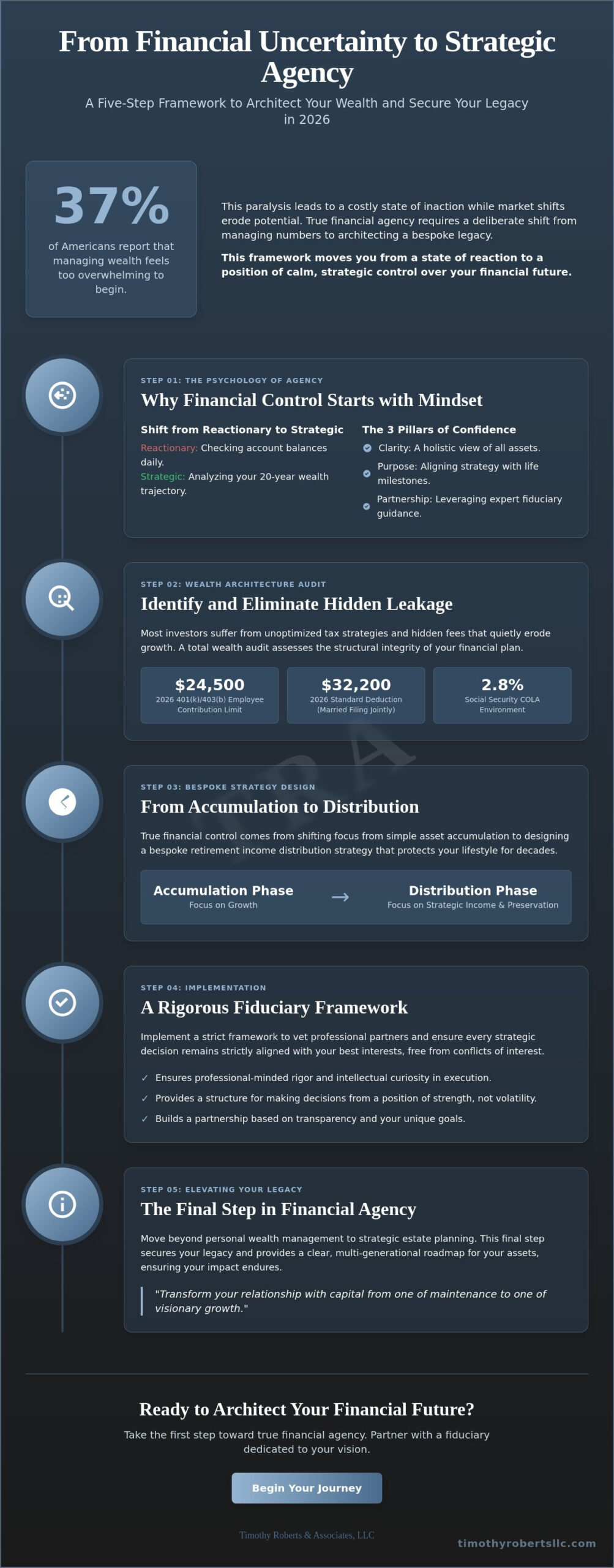
In 2026, 37% of Americans report that managing their wealth feels too overwhelming to even begin; this leads to a costly state of inaction while market shifts erode potential. If you feel buried under fragmented accounts and conflicting headlines, you aren’t alone in wondering how to feel in control of your financial future amidst such complexity. True financial agency isn’t found in reactive choices or off-the-shelf products. It requires a deliberate shift from managing numbers to architecting a bespoke legacy.
You likely recognize that a collection of accounts is not the same thing as a cohesive strategy. We’ve crafted a sophisticated, five-step approach to move you from financial uncertainty to a state of calm, strategic agency over your wealth. This framework reveals how to elevate your portfolio through fiduciary partnerships, optimize your 2026 tax strategy using updated $24,500 401(k) contribution limits, and create a holistic view of your assets that protects your lifestyle for the next twenty years.
Key Takeaways
- Transform your relationship with wealth by defining financial agency as the ability to make decisions from a position of strength rather than reacting to market volatility.
- Conduct a comprehensive audit of your wealth architecture to identify and eliminate hidden leakage within your current tax and fee structures.
- Discover how to feel in control of your financial future by shifting your focus from simple accumulation to a bespoke retirement income distribution strategy.
- Implement a rigorous fiduciary framework to vet professional partners and ensure every strategic decision remains strictly aligned with your best interests.
- Elevate your impact through strategic estate planning that secures your legacy and provides a clear, multi-generational roadmap for your assets.
The Psychology of Agency: Why Financial Control Starts with Mindset
Financial agency is the ability to make decisions from a position of absolute strength rather than reacting to external pressures. It’s the difference between being a passenger in your economic life and being the architect of your own wealth. While 37% of Americans reported in 2026 that managing their money felt too overwhelming to even begin, true agency replaces that paralysis with a calm, strategic confidence. Understanding how to feel in control of your financial future begins by recognizing that your mindset is the foundation upon which all other wealth structures are built.
Modern market volatility creates a persistent “noise” that erodes even the most disciplined confidence. With prices having climbed approximately 25% since 2020, many high-earners feel a sense of phantom scarcity despite their success. This psychological friction often leads to reactionary choices that favor short-term comfort over long-term trajectory. To counter this, we introduce the concept of “Wealth Elevation.” This isn’t a simple transaction; it’s a journey that transforms your relationship with capital from one of maintenance to one of visionary growth.
To better understand the psychological shift required for true agency, watch this helpful video:
Traditional, restriction-based budgeting often fails high-earners because it focuses on what you can’t do. It treats wealth as a finite resource to be guarded rather than a dynamic tool to be optimized. Sophisticated personal financial planning moves beyond these limitations. Instead of tracking every minor expense, we focus on wealth architecture that aligns your lifestyle with your most ambitious goals, ensuring every dollar has a strategic purpose.
Moving from Reactionary to Strategic Thinking
Checking your account balances daily is a reactionary habit; analyzing your twenty-year wealth trajectory is a strategic one. Fragmented financial management, where accounts and advisors don’t communicate, carries a heavy emotional cost. It creates a “fear of the unknown” that persists regardless of your net worth. By adopting a holistic view, you eliminate the blind spots that cause anxiety, replacing them with a clear roadmap for the decades ahead.
The Three Pillars of Financial Confidence
- Clarity: Knowing exactly where every asset resides and how each component of your portfolio interacts with the others.
- Purpose: Aligning your bespoke investment strategies with specific life milestones, from education funding to legacy planning.
- Partnership: Leveraging expert fiduciary guidance to ensure your strategy is executed with professional-minded rigor and intellectual curiosity.
Auditing Your Wealth Architecture for 2026
Wealth architecture is the structural alignment of investments, taxes, and estate goals. This framework serves as the blueprint for your economic stability. To understand how to feel in control of your financial future, you must first strip away the complexity of modern finance and look at the raw integrity of your current plan. Most investors suffer from “leakage,” where unoptimized tax strategies and hidden investment fees quietly erode growth. In 2026, with the standard deduction for married couples filing jointly reaching $32,200, a passive approach to tax planning is no longer sufficient to protect your purchasing power.
A total wealth audit involves a rigorous assessment of several key areas:
- Contribution Optimization: Evaluating 401(k) and 403(b) contributions against the $24,500 employee limit to maximize tax-deferred growth.
- Fee Transparency: Analyzing investment portfolio management fees to ensure that the value provided by your current institutions aligns with their cost.
- Resiliency Check: Verifying that your asset allocation remains resilient against a 2.8% Social Security COLA environment and persistent inflationary pressures.
- Account Consolidation: Identifying “orphaned” retirement accounts from previous employers that lack a cohesive investment strategy.
Mapping Your Asset and Liability Landscape
Strategic agency requires a clear distinction between liquid and illiquid assets. While liquidity provides the agility to capitalize on market shifts, illiquid assets often form the bedrock of long-term growth. We view debt not as a burden to be feared, but as a strategic lever. For instance, managing a low-interest mortgage while maximizing retirement income strategies can be more beneficial than aggressive repayment. Consolidating fragmented IRAs into a single, bespoke structure reduces administrative friction and provides the holistic view necessary for sophisticated decision-making.
The Role of Cash Flow in Strategic Planning
Moving beyond a basic budget allows you to focus on net cash flow, which is the true engine of wealth elevation. Understanding the difference between discretionary and non-discretionary spending in a high-net-worth context ensures that your lifestyle doesn’t accidentally outpace your growth. Automated wealth building, where contributions to SEP IRAs or brokerage accounts are treated as non-negotiable expenses, creates a passive sense of control. This systematic approach allows you to focus on your professional passion while your capital works in the background. If you’re ready to move from a collection of accounts to a unified strategy, exploring retirement income planning can provide the clarity you need to move forward with confidence.
Designing a Bespoke Retirement Income Strategy
For decades, the standard financial narrative has focused almost exclusively on accumulation. However, the true test of how to feel in control of your financial future occurs when you transition from building a nest egg to harvesting it. This shift from accumulation to distribution planning requires a fundamental change in perspective. You aren’t just managing a balance; you’re engineering a sustainable, multi-decade paycheck from your private capital. This transition is where many high-earners feel the most friction, as the strategies that built their wealth are rarely the ones that preserve it.
A sophisticated approach often utilizes a “Bucket Strategy” to segment wealth based on specific time horizons. The first bucket holds liquid cash for 12 to 24 months of immediate expenses. The second contains fixed-income assets for the mid-term. The third focuses on long-term growth. This structure creates profound emotional stability. When you know your immediate needs are secured, you can maintain a higher risk tolerance in your growth portfolio. This allows you to weather market corrections without the panic that leads to poor decision-making. Central to this elevation is retirement income planning, which acts as the cornerstone of future agency.
Diversification Beyond Simple Asset Classes
True diversification in 2026 extends far beyond a 60/40 stock and bond split. It’s about the strategic intersection of Social Security benefits, which received a 2.8% COLA increase this year, private pensions, and bespoke investments. A “one-size-fits-all” portfolio ignores these nuances, creating a risk to your long-term control. Incorporating risk management ensures that your income stream remains resilient against longevity risks. Using a comprehensive financial planning guide helps identify these structural gaps before they compromise your lifestyle milestones.
Tax Strategy as a Wealth Preservation Tool
Tax drag is a silent predator that can erode your purchasing power over time. While most people view taxes as an annual obligation to be prepared, strategic tax advising treats it as a primary wealth preservation lever. Proactive planning differs from simple preparation by looking forward rather than backward. It involves managing the timing of withdrawals and Roth conversions to stay within favorable 2026 brackets, such as the 24% threshold for income up to $201,775 for single filers. Tax-efficient withdrawals can extend portfolio longevity by several years. This foresight ensures you don’t just survive your retirement years; you thrive with a strategy designed for your specific vision.
Implementing a Fiduciary Framework for Decision Making
Achieving true financial agency is impossible if you’re second-guessing the motives behind your advisor’s recommendations. In 2026, the distinction between a broker and a fiduciary is the most critical factor in how to feel in control of your financial future. A fiduciary isn’t a suggestion; it’s a legal mandate. This standard ensures that every trade executed and every risk mitigated is done with the sole purpose of advancing your specific objectives rather than generating a commission. When your interests are perfectly aligned with your partner’s, the “black-box” of finance disappears, replaced by a transparent, collaborative process.
Transparency in fee structures is the bedrock of this trust. Whether you utilize an asset-based fee or a fixed-fee arrangement, you should understand exactly what you’re paying for and why. Sophisticated investment portfolio management should never feel like a hidden cost. Instead, it should be viewed as a strategic investment in your wealth’s architecture. This clarity allows you to evaluate performance based on net results, ensuring that your growth isn’t being quietly eroded by undisclosed layers of expense.
Selecting Your Strategic Partners
The process of finding a financial advisor requires a blend of rigorous due diligence and cultural alignment. You’re selecting a long-term partner for a 20-plus year journey. We recommend a five-step vetting framework to ensure a high-level fit:
- Verify Fiduciary Status: Confirm in writing that the firm operates as a Registered Investment Advisor (RIA) at all times.
- Review Form ADV: Examine Part 2A of their SEC filing to identify any potential conflicts of interest or disciplinary history.
- Audit the Compensation Model: Ensure they don’t receive third-party incentives for recommending specific products.
- Assess Holistic Capabilities: Confirm they offer integrated tax and estate strategy, not just stock selection.
- Test for Communication Style: Evaluate if their rhythm of reporting matches your need for clarity and depth.
Establishing a Review Cadence
A static plan is a failing plan. To maintain control, you must establish a steady review cadence that moves beyond the traditional annual check-in. Quarterly strategic reviews allow you to pivot based on life changes or shifts in the 2026 economic environment. These sessions shouldn’t just be about performance numbers; they should focus on your trajectory toward specific milestones. By utilizing a “Wealth Dashboard,” you gain real-time clarity into your total net worth, transforming fragmented accounts into a single, actionable vision. If you’re ready to transition to a partnership built on this level of transparency, you can schedule a strategic consultation with Timothy Roberts & Associates, LLC to begin your journey toward elevated wealth management.
Elevating Your Legacy: The Final Step in Financial Agency
Legacy is the ultimate expression of financial agency, extending your influence far beyond your own timeline. While previous chapters focused on the immediate architecture of your wealth, true mastery of how to feel in control of your financial future requires a multi-generational perspective. By engaging in strategic estate planning, you ensure that your capital continues to reflect your values, providing a structured foundation for heirs while minimizing the administrative friction that often follows a wealth transfer.
The emotional security derived from a well-protected family is the pinnacle of the Wealth Elevation journey. In an era where economic shifts can be sudden, creating a fortress around your family’s future provides a profound sense of calm. Timothy Roberts & Associates, LLC acts as a visionary strategist in this process, moving away from generic document checklists toward bespoke interventions that honor your unique professional and personal journey. This intentional approach ensures that your legacy is defined by clarity rather than complexity.
Coordinating Wealth and Estate Goals
A common failure in wealth management is the disconnect between current investment strategies and eventual estate objectives. You might have optimized your 401(k) to the current limits, but without aligned beneficiary designations, those assets may not reach their destination efficiently. Multi-generational wealth transfer requires a holistic view that includes education funding strategies to secure the intellectual capital of your successors. Every detail, from trust structures to gifting strategies, should serve the larger narrative of your family’s upward journey.
Partnering for a Secure Future
The journey from financial uncertainty to strategic agency is a deliberate process. It begins with an audit of your current wealth architecture, moves through the design of bespoke income streams, and settles into a fiduciary partnership that prioritizes your best interests. This is not a simple transaction; it’s a professional consultancy where personal attention meets high-level expertise. Timothy Roberts & Associates, LLC guides you from the practicalities of 2026 tax brackets to the profound peace of a protected legacy.
Control is the result of perfect alignment. When your investments, tax strategies, and estate goals move in unison, the noise of external market volatility begins to fade. We invite you to experience a bespoke consultation where we can begin the work of transforming your wealth into a source of enduring stability. Elevate your financial strategy with Timothy Roberts & Associates, LLC and claim the agency your success deserves.
Architecting Your Economic Sovereignty
True financial agency is the result of aligning bespoke wealth architecture with a fiduciary-led strategy. Throughout this framework, we’ve explored the transition from reactive account-checking to visionary legacy planning. By addressing the psychological barriers of market volatility and implementing structural audits, you move toward a state of calm, strategic agency. Understanding how to feel in control of your financial future isn’t about restriction; it’s about the freedom that comes from knowing every asset is optimized for your specific milestones.
Timothy Roberts & Associates, LLC brings over 25 years of fiduciary expertise to this upward journey. We specialize in comprehensive wealth management and tax integration, crafting strategies that respect your unique risk tolerance and professional ambitions. Our boutique approach ensures your plan is never an off-the-shelf solution but a carefully crafted intervention designed for long-term stability. We focus on the intersection of aesthetics and functionality to highlight the tangible impact of our work.
Begin Your Journey to Financial Elevation with a Bespoke Consultation at Timothy Roberts & Associates, LLC. Step into a future where your wealth is an engine for growth and a fortress for your legacy.
Frequently Asked Questions
How do I start feeling in control of my money today?
You can begin by consolidating your fragmented financial views into a single, holistic dashboard to gain immediate clarity. This act of organization directly addresses the 37% of Americans who feel too overwhelmed to start managing their wealth. By identifying every account, from your 401(k) to your private brokerage holdings, you move from a state of reactionary stress to one of strategic agency. It is the essential first step in learning how to feel in control of your financial future.
What is the difference between a financial planner and a fiduciary?
A fiduciary is legally and ethically mandated to put your interests above their own at all times, while a financial planner may only be held to a lower “suitability” standard. This distinction is non-negotiable for high-end wealth management. While many professionals offer general advice, only a fiduciary eliminates the conflict of interest inherent in commission-based models. This partnership ensures that every strategic choice is a bespoke intervention designed solely for your growth and security.
Is it possible to feel in control during a market downturn?
Maintaining control during volatility is the direct result of rigorous stress-testing and the “Bucket Strategy” used to segment your assets. When you have 24 months of liquid cash secured, short-term market corrections don’t compromise your immediate lifestyle. This structural resilience allows you to view downturns as potential opportunities for rebalancing rather than threats to your longevity. It transforms market noise into a manageable component of your broader, long-term wealth architecture.
How much does professional financial planning typically cost?
Industry data for 2026 indicates that professional fees typically range from 0.50% to 1.50% of assets under management, or fixed project fees starting around $2,500 for complex plans. These structures vary based on the depth of your tax integration and estate goals. Transparent, asset-based or flat-fee models are preferred by sophisticated investors because they align the advisor’s success with the portfolio’s growth. This clarity ensures your partnership is built on shared success rather than hidden costs.
Can I manage my own financial future without an advisor?
While self-management is possible, the increasing complexity of 2026 tax brackets and $24,500 401(k) contribution limits often leads to costly “leakage” for high-earners. Professional intervention provides the intellectual curiosity and technical rigor needed to optimize multi-generational wealth transfer. Most successful individuals find that the time saved and the strategic elevation provided by a boutique firm far outweigh the cost of managing complex, moving parts without expert guidance.
What are the first steps in creating a retirement income plan?
You start by calculating your net cash flow needs and identifying all guaranteed income sources, including Social Security benefits which saw a 2.8% COLA increase for 2026. This shift from simple saving to distribution engineering is the cornerstone of how to feel in control of your financial future. You must then layer in your private investments and risk management analysis to ensure a sustainable, tax-efficient paycheck that supports your vision for the next 20 or 30 years.
How does tax planning improve my sense of financial control?
Tax planning provides certainty by ensuring you aren’t surprised by large liabilities when you eventually withdraw capital. By proactively managing 2026 brackets, such as the 37% threshold for single filers with income over $640,600, you keep more of what you’ve earned. This preservation acts as a force multiplier for your portfolio. It allows you to make lifestyle decisions based on net income rather than gross estimates, giving you a predictable roadmap for spending.
What documents do I need for a comprehensive wealth audit?
A thorough audit requires your most recent tax returns, brokerage statements, and retirement plan summaries for accounts like 401(k)s or SEP IRAs. You should also gather insurance policies, education funding statements, and any existing estate documents. Having these organized in a central location provides the raw data needed to transform fragmented assets into a single, actionable vision. It is the technical foundation required for your upward journey toward total financial agency.
