

Oct
Talking to Your Spouse About a Financial Advisor
What if talking about a financial advisor wasn’t a judgment on past choices, but a chance to shape what comes next together? If you’re wondering how to talk to your spouse about getting a financial advisor, start with shared goals rather than a pitch. One of you may feel ready for guidance while the other has reasonable questions about trust, fees, or whether advice is necessary. Make room for those concerns instead of trying to settle them before the conversation begins.
You don’t have to decide immediately. A respectful discussion can help you identify what you both want to accomplish, where you feel uncertain, and whether professional guidance could bring greater clarity. An advisor can help connect decisions about investments, retirement income, taxes, and legacy planning to your household’s priorities, with a strategy tailored to your goals and risk tolerance.
This article offers practical ways to raise the topic without blame, weigh what you hope to gain against what gives you pause, and agree on a next step. You’ll also find questions and preparation tips to help both partners take part in an introductory conversation.
Key Takeaways
- Keep the conversation focused on shared goals, not blame or a review of past financial decisions.
- To understand how to talk to your spouse about getting a financial advisor, invite their concerns and reflect them back before responding.
- Compare managing finances yourselves, seeking targeted guidance, and ongoing planning against the specific areas where you want support.
- Agree on a few meeting goals and questions together. Your finances don’t need to be perfectly organized to start a conversation.
- Choose a next step together: explore an introductory conversation, gather more information, or revisit the discussion later.
Discussing a Financial Advisor Without Tension
Couples can share a life and still have different comfort levels with money, planning, and outside advice. One partner may welcome another perspective; the other may prefer to manage finances privately or wonder whether help is necessary. If you’re considering how to talk to your spouse about getting a financial advisor, make it an invitation to explore, not a verdict on decisions you’ve already made.
Begin with something you both care about, such as feeling prepared for retirement. A financial plan can bring different priorities and resources into view. This overview explains what a financial plan entails.
For another perspective on discussing money as a couple, watch this video:
Choose the right moment and start with a shared goal
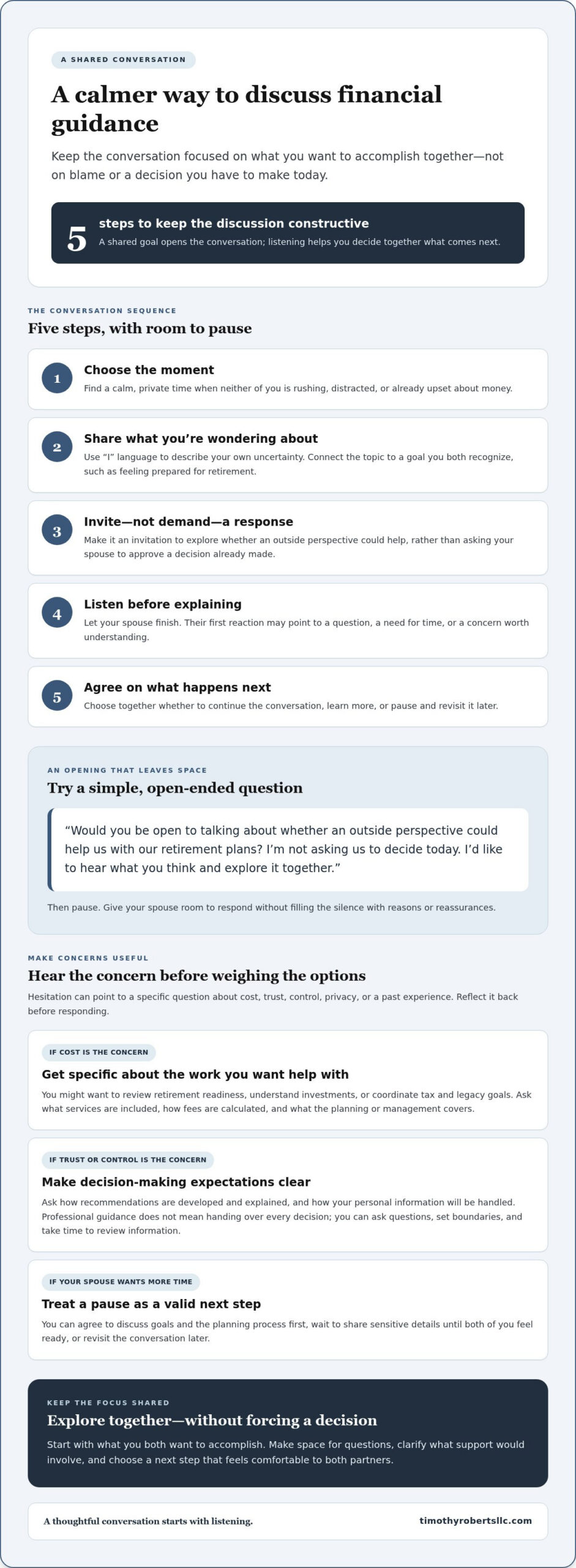
Choose a calm, private time when neither of you is rushing, distracted, or already upset about money. Connect the topic to a goal you both recognize instead of starting with a problem one partner supposedly caused. Use first-person language to describe your own uncertainty, such as, “I’ve been thinking about whether we’re on track for retirement, and I’m not sure how best to assess it.”
A productive advisor conversation is mutual exploration, not one partner asking the other to approve a decision already made. Before you talk, consider which shared goal is prompting the discussion and what you hope an outside perspective might clarify.
What can I say to bring up a financial advisor?
Keep the opening simple and open-ended. You could say:
“Would you be open to talking about whether an outside perspective could help us with our retirement plans? I’m not asking us to decide today. I’d like to hear what you think and explore it together.”
Then pause. Resist filling the silence with reasons or reassurances. Give your spouse room to respond fully, and listen for what sits behind the first reaction. They may want more information, need time to consider the idea, or feel ready to explore it.
Use this five-step sequence to keep the exchange constructive:
- Choose timing: Find a calm moment with privacy and few distractions.
- Share your concern: Describe what you’re wondering about using “I” statements.
- Ask: Invite your spouse to explore the possibility without demanding a decision.
- Listen: Let them finish before responding or offering explanations.
- Agree on a next step: Decide together whether to continue the conversation, learn more, or pause.
How to Listen and Address Your Spouse’s Concerns About a Financial Advisor
Hesitation isn’t a rejection of your shared goals. It may point to a specific concern about trust, cost, control, privacy, or a past experience. When considering how to talk to your spouse about getting a financial advisor, treat that reaction as useful information, not a problem to overcome.
Reflect the concern before responding. If your spouse says, “I don’t want someone telling us what to do,” try: “It sounds like keeping control of our decisions matters to you. Is that right?” Then ask what would help them feel comfortable exploring the idea. This keeps the exchange curious rather than defensive. Fidelity also offers suggestions to talk about finances better with your partner, including making space for each other’s perspectives.
If your spouse says an advisor costs too much
Acknowledge that fees matter. Before weighing the value of advice, get specific together about the work you want help with: perhaps reviewing retirement readiness, understanding investments, or coordinating tax and legacy goals. This can help you distinguish a focused question from a need for ongoing planning.
Before deciding to proceed, make sure you both understand the scope of services and how the advisor is compensated. Ask what work is included, how fees are calculated, and what the planning or management covers. If the explanation isn’t clear to both of you, ask for clarification or take time to consider it.
If your spouse worries about trust or losing control
Concerns about pressure, financial incentives, privacy, or decision-making authority deserve a direct response, not dismissal. Agree on questions you both want answered, such as how recommendations are developed, how they’ll be explained, and how your personal information will be handled. Each partner should have room to understand the approach and raise concerns.
Professional guidance doesn’t mean handing over every decision. A conversation can help you understand possible recommendations without committing to them. You can set boundaries around what you’re comfortable discussing, ask for time to review information, and pause before taking a next step. Either partner can request that clarity.
For example, you might agree to discuss your goals and the planning process first, while waiting to share sensitive details until you both feel ready. If you’d like to explore how financial planning can connect retirement, investments, taxes, and legacy priorities, an introductory financial planning conversation can be a starting point for questions, not a commitment to a particular course of action.
How Couples Can Decide Whether a Financial Advisor Fits Their Needs
There isn’t one right level of support for every household. You might manage your finances yourselves, seek targeted help with a particular decision, or consider ongoing advice that connects retirement, investments, taxes, and legacy priorities. The useful question isn’t simply whether you need an advisor. It’s whether outside guidance could help with a specific shared need.
Financial information helps you understand options; personalized financial advice considers how those options fit your household’s goals and circumstances. As you discuss how to talk to your spouse about getting a financial advisor, name the decisions that feel unclear or difficult to coordinate. That can help you assess fit without assuming comprehensive, ongoing advice is the only answer.
What financial questions could an advisor help a couple organize?
Consider whether you want to understand how savings could support retirement income, review investment decisions against your goals and risk tolerance, or coordinate tax planning with longer-term priorities. You may also want to see how these pieces relate rather than treating each decision in isolation. Estate and legacy planning can address financial priorities and coordination; drafting legal documents is a separate matter.
Use this map to identify what you’d want help exploring:
| Household need | Possible advisor role | Question to discuss together |
|---|---|---|
| Retirement income | Explore how savings and income sources relate to retirement goals | What would help us feel more prepared for retirement? |
| Investments | Review portfolio decisions in light of goals and risk tolerance | Are we comfortable with how our investments support our plans? |
| Taxes | Consider tax planning as part of broader financial decisions | Are tax questions affecting choices we’re making? |
| Estate and legacy priorities | Coordinate financial goals and identify questions for appropriate professionals | Do our plans reflect what we want to provide or pass on? |
How can couples assess an advisor’s approach together?
Before moving ahead, compare the kind of planning you want, how you prefer to communicate, how compensation works, and how recommendations are presented. Both partners should feel able to ask questions, understand the proposed scope, and take time to consider what they hear.
If fiduciary status matters to you, ask what it means in the context of the services being discussed, when it applies, and how potential conflicts are addressed. Don’t rely on a label alone; seek a clear explanation of its scope. An introductory conversation can help you understand the approach and decide together whether it addresses the needs you identified.
How to Prepare for a First Financial Advisor Conversation as a Couple
Preparation can make an initial conversation more useful, but you don’t need every statement sorted or every decision settled. The goal is to explain what matters to you, identify where you’d like clarity, and understand how a planning process might address those priorities. If you’re discussing how to talk to your spouse about getting a financial advisor, agree first on what you both hope to learn from the meeting.
Checklist item: Both partners should be able to state what they want clarified. Your questions may differ, and that’s fine. Share them in advance so each person has room to raise what matters.
What should couples bring or review before a meeting?
Start with a high-level picture, not a paperwork project. You might review the types of accounts and income sources you have, significant debts or financial obligations, and upcoming decisions, such as a retirement transition, education costs, or a change in work. Estimates and a written list of questions can be enough to guide an initial discussion.
- Your main financial priorities and any decisions on the horizon
- A general inventory of accounts, income sources, and debts
- Questions or concerns each partner wants addressed
- How you prefer to communicate and make decisions together
Agree on what you’re comfortable sharing before the meeting. Don’t send sensitive documents through unsecured channels; ask about an appropriate way to provide detailed information if it’s needed later. An introductory conversation can help clarify what information would be useful next, so there’s no need to gather everything upfront.
Which questions should both spouses ask an advisor?
Use your shared priorities to guide the discussion. Ask how planning can connect investments, retirement income, taxes, and other household goals rather than treating each decision separately. Then explore the practical details: what the planning scope includes, how compensation works, how you’ll communicate, and how recommendations will be explained so both partners can understand the reasoning.
You can also ask what happens after the initial conversation and what information would be needed to develop a tailored approach. Notice whether both of you have space to speak and whether the explanations address your questions. The meeting is a chance to learn, not a requirement to make an immediate commitment.
Once you’ve identified the questions you want answered, consider exploring a financial planning conversation together. Bring your goals, concerns, and preferred communication style; the discussion can help clarify how planning might connect your priorities.
How to Agree on Next Steps After Discussing a Financial Advisor
A good conversation doesn’t have to end with a yes or no. It can end with a shared next step that respects both partners’ comfort levels and keeps your common goals in view. You might schedule an exploratory conversation, gather more information about the planning process, or agree to revisit the topic at a specific time.
Set a decision rule together: either partner can ask questions, request clarification, or pause before moving forward. That keeps the choice collaborative rather than turning one person’s readiness into pressure on the other.
What if one spouse is ready and the other is not?
Make the next step smaller. You could each write down questions, identify the concern that still feels unresolved, or choose a date to talk again. If your spouse asks for time, respect that request without treating it as a rejection of your shared plans. Avoid deadlines or fear-based arguments. The goal is to keep the conversation open, not to win agreement in one sitting.
How can couples make an informed next-step decision?
After discussing the idea or meeting with an advisor, take stock together. Did the conversation address both partners’ priorities and main concerns? Do you understand the proposed planning scope, how communication would work, and how compensation is explained? If something remains unclear, identify what you need explained before making another decision.
An initial discussion can help clarify your household’s needs and the kind of support that may fit, without requiring you to commit to ongoing services. You may find that a focused question is all you want to address, or that broader planning could be useful. The right next step depends on your shared circumstances and preferences.
Personalized financial planning can connect retirement income, investments, tax considerations, and estate and legacy priorities in a coordinated view. Timothy Roberts & Associates, LLC provides retirement income planning and can discuss an approach tailored to your goals. If you’re ready to explore that possibility, consider doing so together: explore personalized financial planning.
Take the Next Step Together
The most constructive way to talk about an advisor is to keep the decision shared. Start with the goals you both care about, listen for what’s behind any hesitation, and agree on a next step that leaves room for questions. You might explore a conversation, gather more information, or give the topic time.
Knowing how to talk to your spouse about getting a financial advisor doesn’t mean persuading them to say yes. It means making space to decide whether guidance fits your needs. If it does, personalized planning can connect retirement income, investments, taxes, and estate priorities, with strategies shaped around your goals and risk tolerance. Timothy Roberts & Associates, LLC brings more than 25 years of experience to this work.
Explore a thoughtful financial planning conversation together. A considered first step can help you move forward with greater clarity, as a team.
Frequently Asked Questions
How do I bring up getting a financial advisor with my spouse?
Choose a calm, private moment and connect the idea to a goal you share, such as preparing for retirement. You might say, “I’ve been wondering whether outside guidance could help us understand our options. Would you be open to exploring that together?” If you’re considering how to talk to your spouse about getting a financial advisor, ask rather than announce a decision, then pause and give your partner room to respond.
What if my spouse does not want to work with a financial advisor?
Start by asking what’s behind the hesitation instead of trying to persuade them immediately. The concern might involve cost, privacy, trust, or a preference for handling finances independently. Reflect what you hear and ask what information might help. If your spouse still isn’t ready, agree on a smaller step, such as writing down questions or choosing a time to revisit the subject. A pause doesn’t have to end the discussion.
Can a financial advisor work with both spouses?
Yes, couples can discuss their shared financial priorities with an advisor together. A joint conversation can help each partner explain their goals, concerns, and preferences, while creating a fuller picture of household decisions. For example, you might discuss how retirement income, investments, taxes, and legacy priorities relate. Both spouses should have the opportunity to ask questions and understand how planning recommendations connect to their circumstances.
Is getting a financial advisor worth it for a couple?
It depends on your needs, the questions you want answered, and the value you place on professional guidance. Some couples prefer to manage finances themselves; others seek help with a particular decision or broader planning across retirement, investments, taxes, and estate priorities. Discuss what you hope to clarify and understand the scope and compensation before deciding. An advisor isn’t necessary for every couple, and the choice can be made together.
What should couples ask a financial advisor at the first meeting?
Ask what planning could cover, how recommendations are developed and explained, how you’ll communicate, and how compensation works. You can also ask how the advisor would connect your priorities across retirement income, investments, tax planning, and other financial goals. Before the meeting, each partner can name one question they want answered. Clear responses help you assess whether the approach fits, without requiring an immediate commitment.
How do you talk about financial planning when spouses disagree?
Slow the conversation down and separate the shared goal from the different opinions about how to reach it. Each partner can explain what matters most and what feels uncertain, without assigning blame. Reflect each other’s concerns before debating solutions. If you can’t agree on a decision, identify what information is missing and choose a manageable next step, such as gathering answers or setting a time to continue the discussion.
Do both spouses need to attend a financial advisor meeting?
It can be helpful for both spouses to attend, especially when the conversation involves shared goals or household decisions. Each partner can hear the same explanations, raise questions, and describe their priorities directly. If one person can’t attend or isn’t ready, agree together on how to share what was discussed and what should wait until both can participate. Make sure neither partner feels excluded from decisions that affect them.
