

Oct
Building a Resilient Investment Portfolio for Retirement in 2026
What if a market decline early in retirement doesn’t have to derail your plans? The answer often lies not in a single investment choice, but in how your portfolio works alongside withdrawals, cash needs, and other income sources. A thoughtful approach to building a resilient investment portfolio for retirement starts with this wider view.
It’s understandable to worry about selling investments after a downturn, balancing growth with access to cash, or managing taxes across different retirement accounts. These decisions are connected. Treating them as parts of one plan can help you respond more deliberately as markets and personal circumstances change.
This article explains the roles different investments can play and how to align them with retirement income needs and risk tolerance. You’ll also learn how to organize withdrawals, liquidity, rebalancing, and portfolio reviews, while accounting for taxes. Resilience doesn’t mean avoiding every loss. It means having a framework for making decisions as your needs and market conditions evolve.
Key Takeaways
- Building a resilient investment portfolio for retirement starts with matching investments to your goals, risk capacity, and expected withdrawals.
- Stocks, bonds, and cash can contribute to growth, diversification, or liquidity, but each comes with trade-offs and risks.
- Compare total-return and income-oriented approaches by how well they support your spending plan. Dividends and interest are not automatically safer.
- Organize your accounts, holdings, income sources, and cash needs before making portfolio decisions.
- Ongoing monitoring and rebalancing can help keep investments aligned with your plan and tax considerations.
Why a resilient investment portfolio matters more once retirement withdrawals begin
During the saving years, contributions can continue through market downturns. Retirement changes the equation: withdrawals may require selling investments while prices are down, leaving fewer assets invested for a potential recovery. The timing and source of withdrawals can therefore matter as much as the portfolio’s long-term mix.
A resilient retirement portfolio is a deliberately coordinated mix of investments, cash resources, and withdrawal decisions designed to support personal goals and risk capacity through changing markets. Resilience isn’t a promise of steady returns, and it doesn’t mean avoiding every decline. It means reviewing how the portfolio supports your spending needs and adjusting thoughtfully as circumstances change.
How retirement changes an investment portfolio’s job
Accumulation often emphasizes growth over time. In retirement, investments may need to support spending, maintain growth potential, and provide access to money for near-term needs. Those roles must work together. Holding only conservative investments may reduce some exposure to market swings, but it can also limit growth potential over a retirement that may span multiple decades.
Start with the broader income picture: expected sources of income, planned withdrawals, and when you may need cash. These details help give each part of the portfolio a purpose. Frameworks such as Modern Portfolio Theory explore how investments can be combined in relation to expected risk and return. A retirement portfolio also needs to reflect actual spending needs and personal circumstances.
Which risks should a retirement portfolio address?
Several risks can interact. Market risk is the chance that investments will decline. Withdrawal-timing risk arises when withdrawals coincide with a downturn, potentially reducing the assets left to participate in a rebound. Volatility describes price movement. It isn’t the same as a permanent loss, which can occur when an investment’s value is impaired or it’s sold at a loss.
Inflation risk is the possibility that rising prices reduce what savings can buy. Longevity risk is the possibility of outliving assets, while liquidity risk concerns whether funds are accessible when needed without an unfavorable sale. Diversification, an appropriate allocation, and planned access to cash may help manage some exposures, but no allocation can eliminate every risk or control market outcomes.
Assess both risk capacity and emotional comfort with volatility. Risk capacity reflects how much financial loss your plan could withstand; comfort reflects how you might react to falling account values. A portfolio that looks suitable on paper may be difficult to maintain if its fluctuations prompt reactive decisions. Building a resilient investment portfolio for retirement means considering both, alongside income needs and withdrawal timing.
How to structure retirement investments for growth, stability, and liquidity
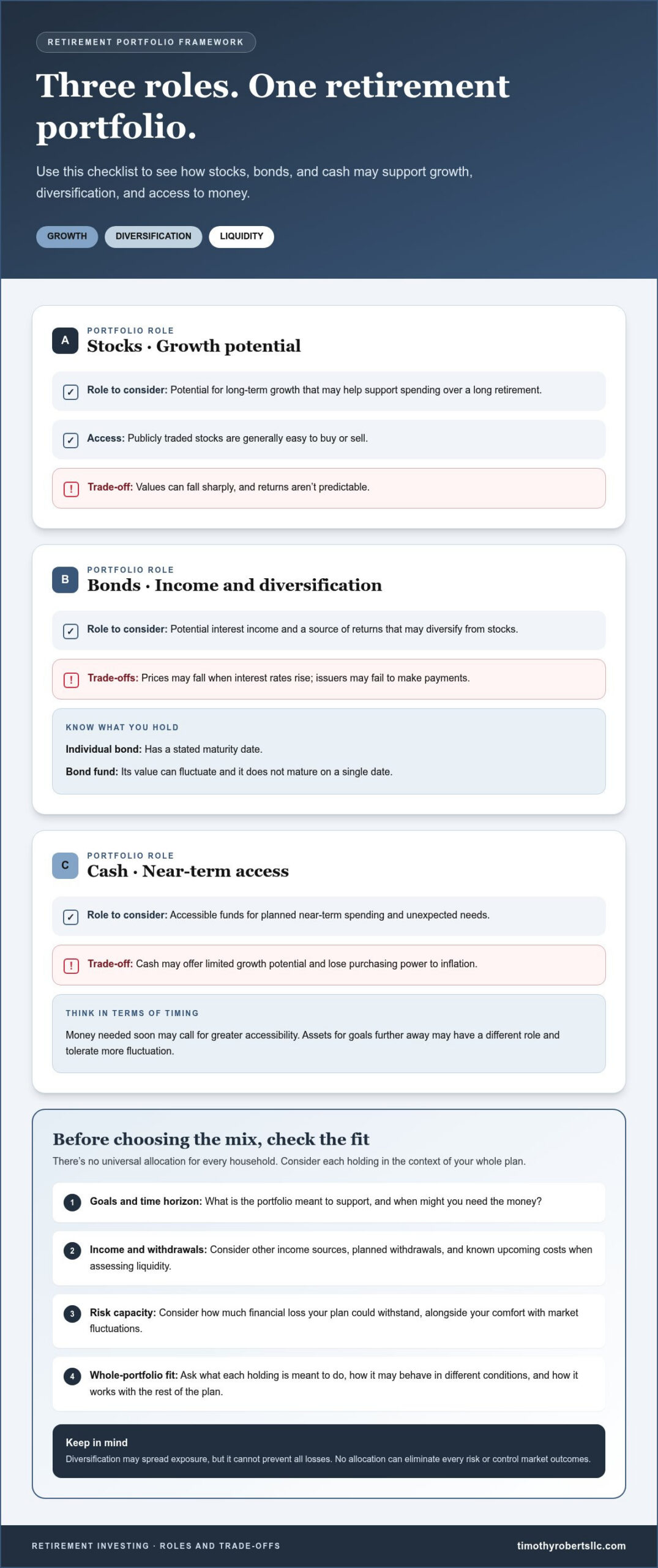
A retirement portfolio can serve several purposes at once: supporting long-term growth, helping moderate fluctuations, and keeping money accessible for planned spending. The right mix depends on your goals, time horizon, other income sources, and capacity to absorb losses. There’s no universal allocation that fits every household. When comparing options, consider what each holding is meant to do, how it behaves in different conditions, and how it fits with the rest of your plan.
| Asset category | Potential role | Trade-offs and risks |
|---|---|---|
| Stocks | Growth potential over longer periods; generally easy to buy or sell in public markets | Values can fall sharply, and returns aren’t predictable |
| Bonds | Potential interest income and diversification from stocks | Prices may fall as interest rates rise; issuers may fail to make payments |
| Cash and cash equivalents | Accessible funds for near-term spending and unexpected needs | May offer limited growth potential and lose purchasing power to inflation |
What roles can stocks and bonds play in retirement?
Stocks can help a portfolio pursue growth that may support spending over a long retirement, but they expose investors to market declines. Bonds may provide interest and diversify sources of return, yet they carry both interest-rate and credit risk. Individual bonds and bond funds also behave differently: an individual bond has a stated maturity date, while a bond fund’s value can fluctuate and it doesn’t mature on a single date. Diversification can spread exposure across investments, but it can’t prevent all losses.
Cash can help cover planned near-term expenses without requiring a sale of longer-term investments during a downturn. But keeping too much in cash may limit growth and purchasing power. Set liquidity needs in context by considering regular spending, expected income, and known upcoming costs, rather than relying on a fixed reserve rule.
How much liquidity might a retiree need?
Think in terms of timing. Money needed soon may call for greater accessibility; assets for goals further away may have a different investment role and tolerate more fluctuation. The balance depends on your withdrawal plan and income sources. If you hold investments in an employer-sponsored retirement plan, the IRS guidance on retirement plan fiduciary responsibilities offers context on fiduciaries’ responsibilities for those plans.
Building a resilient investment portfolio for retirement means assigning each asset a purpose without treating any category as risk-free. Reviewing investments, withdrawals, and broader financial goals together can clarify the trade-offs. Retirement investment planning can be part of that wider strategy.
Which retirement portfolio approach fits your withdrawal needs and risk tolerance?
Two retirees with similar savings can need different portfolio structures. One may have reliable income covering most routine expenses and feel comfortable with market swings. Another may depend more heavily on withdrawals or prefer less fluctuation. The useful question isn’t simply which approach pays more income. It’s how the strategy supports spending while balancing flexibility, risk, and long-term goals.
Income-focused and total-return approaches: what differs?
An income-oriented approach emphasizes cash flows such as bond interest and stock dividends. Those payments can make expected income easier to see, but they aren’t guaranteed and don’t protect principal from losses. Pursuing higher distributions can also concentrate a portfolio in certain investments or sectors, while inflation may erode the purchasing power of fixed payments.
A total-return approach considers both investment income and changes in asset value. Spending can be funded by dividends, interest, or selling investments, depending on the plan and market conditions. Selling shares isn’t automatically worse than receiving a distribution: the investment’s value and the portfolio’s overall mix matter either way. A total-return strategy can offer flexibility, but withdrawals still need to be coordinated with market performance and spending needs.
No single portfolio structure suits every retiree because income sources, withdrawal timing, goals, and comfort with volatility differ. If other income covers essential expenses, you may be better positioned to tolerate fluctuations in assets earmarked for longer-term goals. If portfolio withdrawals must cover near-term spending, access to cash and the effect of selling after a decline may carry greater weight.
Active and passive investing in a retirement portfolio
Active management selects investments with the aim of outperforming a benchmark or responding to changing conditions. It involves ongoing decisions and may carry higher costs; those decisions don’t ensure better results. Passive management generally seeks to track a market index, often through a more systematic approach, but it still exposes investors to market declines and the risks of the index it follows.
Neither approach is automatically right for retirement. Compare fees, diversification, tax implications, and the oversight required. Active and passive investments can both be part of a broader portfolio, provided their roles are clear and the combined holdings remain aligned with the withdrawal plan. Tax consequences may differ depending on the account and transactions, so include them in the overall strategy.
Past performance doesn’t establish future results. Building a resilient investment portfolio for retirement means evaluating how an approach fits your plan, not choosing a strategy based solely on recent returns or advertised distributions. Regular review can help determine whether the portfolio still reflects your needs as spending, income, and circumstances change.
How to build and maintain a resilient retirement portfolio step by step
A sound process turns broad retirement goals into practical investment and withdrawal decisions. Building a resilient investment portfolio for retirement is not a one-time exercise. It means establishing a plan you can revisit as your needs, income, and circumstances evolve.
- Map spending and goals. Separate essential expenses from discretionary goals, then note potential one-time costs. This helps clarify which needs require dependable access to funds and which goals have a longer time horizon.
- List expected income. Document Social Security, pensions, planned retirement-account withdrawals, and other expected income sources. Compare these with anticipated spending to understand how much the portfolio may need to provide, and when.
- Inventory accounts and investments. Record account types, holdings, balances, and where accessible cash is held. Include workplace plans, IRAs, and taxable accounts. A consolidated view can reveal overlapping investments, concentrated exposure, or gaps in liquidity.
- Set an allocation around your plan. Choose a mix of growth-oriented, income-producing, and liquid investments that reflects your time horizon and risk capacity. Diversified investments can spread exposure across different holdings, but diversification can’t eliminate market losses. A guide to building a diversified portfolio can help explain the underlying principle; your retirement plan should determine how it’s applied.
- Coordinate withdrawals. Decide how portfolio withdrawals will work alongside other income and spending needs. Consider which accounts withdrawals may come from and how transactions could affect taxes. The sequence and timing should fit your circumstances rather than follow a generic rule.
- Define review and rebalancing rules. Choose a scheduled review cadence or allocation thresholds that prompt a review. Rebalancing brings a portfolio back toward its intended mix when market movements cause it to drift. It’s a disciplined way to maintain the plan, not a method for predicting market highs or lows.
Review the whole picture together: withdrawals, account balances, allocation drift, tax considerations, and changes in goals or income. A written response plan can help you avoid rushed decisions during volatile markets. It might state which parts of the plan to reassess, what would justify a change, and which decisions should wait for a full review.
Investment portfolio management can connect your holdings with retirement income needs and personal goals.
How fiduciary retirement income planning can connect portfolio decisions
Investment choices don’t stand apart from retirement income decisions. The mix of assets, timing of withdrawals, and tax treatment of different accounts can all shape how a plan supports your goals. Fiduciary advice brings these considerations into one planning conversation, with recommendations grounded in personal circumstances, risk tolerance, and income needs rather than a one-size-fits-all allocation.
At Timothy Roberts & Associates, LLC, fiduciary advisors draw on more than 25 years of experience to develop personalized financial strategies. That experience informs the planning process, not investment results. Ongoing portfolio monitoring and rebalancing can help keep investments aligned with a client’s intended strategy as markets and personal circumstances change. These are deliberate planning decisions, not a way to prevent losses or predict market movements.
Coordinate portfolio withdrawals with taxes and income planning
Retirement assets may be held in taxable, tax-deferred, and tax-free accounts, and withdrawals from each can have different tax consequences. The order and amount of withdrawals may affect taxable income, so consider account choices alongside other income sources, spending plans, and investment decisions. Tax treatment depends on individual circumstances and current rules.
For a closer look at how investments and taxes intersect, consult the article on the tax implications of an investment portfolio. Individual withdrawal and investment decisions may call for personalized tax and financial guidance.
When a personalized portfolio review may help
A review can be useful when retirement timing shifts, income or spending changes, a large withdrawal is approaching, or investments have drifted persistently from their intended allocation. An advisor can examine holdings alongside withdrawal needs and risk tolerance, then help assess whether the current strategy still fits. The goal is a coordinated plan, not a guarantee against market declines.
Building a resilient investment portfolio for retirement is an ongoing process. Retirement income planning, investment management, and tax considerations work best when decisions are viewed together and revisited as circumstances evolve. Personalized retirement income planning can help shape a coordinated strategy around your goals and risk tolerance.
Make your retirement portfolio part of a thoughtful income plan
Building a resilient investment portfolio for retirement means looking beyond investment mix alone. Align your holdings with spending needs, expected income, time horizon, and comfort with risk. Then revisit withdrawals, taxes, and allocation as your circumstances evolve. A disciplined process can support informed decisions through changing markets, though it can’t eliminate investment risk or guarantee results.
At Timothy Roberts & Associates, LLC, fiduciary advisors tailor strategies to individual goals and risk tolerance. With more than 25 years of experience, the firm brings retirement income planning, investment management, and tax advising into the broader planning conversation. The aim is a coordinated approach shaped around your priorities.
Explore a personalized retirement income strategy and take a considered next step toward a portfolio plan that reflects your life and goals.
Frequently Asked Questions
What makes an investment portfolio resilient for retirement?
A resilient retirement portfolio is designed to support personal goals, spending needs, risk capacity, and planned withdrawals, with regular review as circumstances change. Building a resilient investment portfolio for retirement doesn’t mean avoiding every market decline or guaranteeing returns. It means coordinating investments, liquidity, and income decisions so the plan can respond thoughtfully to changing markets, expenses, and priorities while recognizing that investment risk remains.
How should I structure my portfolio when I retire?
Structure your portfolio around expected spending, income sources, time horizon, and ability to tolerate investment losses. Identify which expenses may need portfolio withdrawals and when, then consider how stocks, bonds, and liquid assets could serve different purposes. Account types and tax considerations also matter. There’s no universal allocation, so a suitable mix depends on your household’s complete retirement income plan and circumstances.
Should retirees hold stocks in their investment portfolios?
Stocks may have a role in retirement portfolios because they offer potential for long-term growth, which can matter when retirement may span many years. They also carry market risk, and their value can fall, sometimes sharply. The appropriate amount depends on your goals, time horizon, income needs, and risk capacity. Consider stock exposure alongside other investments and a withdrawal plan.
Are bonds safer than stocks for retirement?
Bonds generally have different risks from stocks, but they aren’t automatically safer in every circumstance. Bond prices can decline when interest rates rise, and issuers may fail to make payments. Individual bonds and bond funds can also behave differently, particularly around maturity. Bonds may contribute income and diversification, but evaluate their role within the portfolio rather than treating them as protection from every loss.
How often should I rebalance a retirement portfolio?
There’s no single review schedule that suits every retiree. Some investors review on a regular calendar, while others use allocation thresholds to prompt a check when holdings drift from their intended mix. Rebalancing is meant to restore the portfolio’s planned structure, not predict market movements. Consider withdrawals, taxes, changed goals, and risk tolerance as part of the review, and avoid making decisions based only on short-term market reactions.
Can a retirement portfolio protect against market downturns?
No portfolio can guarantee protection from market downturns or eliminate investment losses. Diversification may spread exposure across different investments, while liquidity planning may reduce the need to sell long-term holdings to meet near-term spending. These tools can help manage certain risks, but they don’t control market outcomes. A thoughtful plan also sets expectations for volatility and outlines how you’ll review decisions during unsettled markets.
How do retirement withdrawals affect portfolio resilience?
Withdrawals during a market decline can leave fewer assets invested to participate in a potential recovery. The effect depends on the amount and timing of withdrawals, market performance, and other income sources. A plan that coordinates spending needs with liquid assets and account withdrawals can help make those decisions more deliberate. Tax treatment varies by account and personal circumstances, so consider withdrawal choices within your broader income and tax plan.
