

Oct
Michigan Estimated Tax Payments: A 2026 Guide to Rules, Due Dates, and Planning
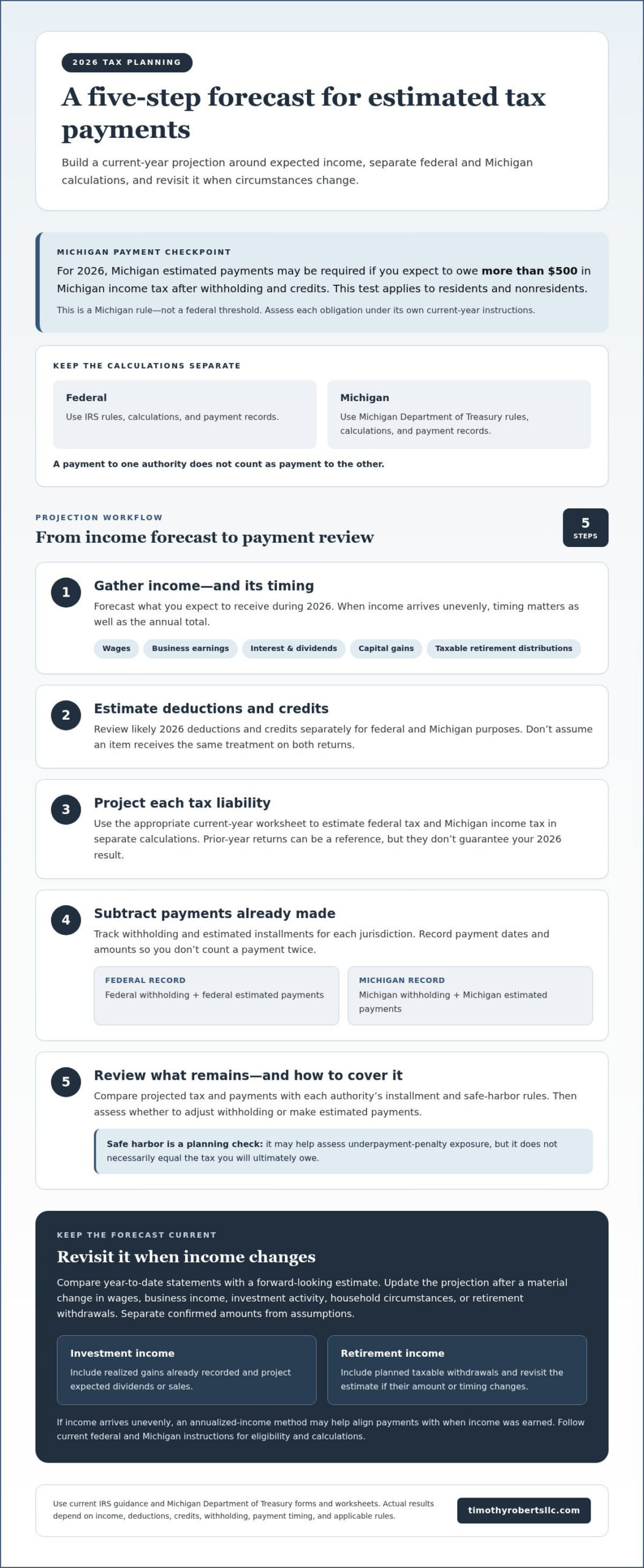
What if the biggest estimated-tax surprise isn’t how much you owe, but when your income arrives? For 2026, michigan estimated tax payments may be required if you expect to owe more than $500 in Michigan income tax after withholding and credits. That can matter when investment gains, retirement withdrawals, or business income arrive unevenly.
Paycheck withholding or a federal payment plan may not cover the full picture. Federal and Michigan requirements are separate, even when their estimated-payment due dates align. A year-round approach can help you set payments around expected income, review withholding, and avoid leaving tax planning until filing season.
This guide explains who may need to pay, how Michigan rules differ from federal requirements, and how to estimate and schedule payments using current guidance. You’ll also find the 2026 due dates and payment options, plus practical ways to coordinate tax payments with retirement income, investments, or changing business cash flow.
Key Takeaways
- Assess federal and Michigan tax obligations separately. Meeting one set of requirements doesn’t automatically satisfy the other.
- Michigan estimated tax payments may apply when withholding and credits aren’t expected to cover your state tax bill.
- Use current income projections, deductions, credits, and withholding to estimate payments, then revisit the calculation as circumstances change.
- Plan around the 2026 installment schedule and verify payment details with the appropriate tax authority.
- Coordinate estimated payments with investment income and retirement distributions as part of a year-round cash-flow plan.
Michigan estimated tax payments: who may need to pay in 2026?
Estimated tax payments are periodic payments toward income tax that wage or other withholding isn’t expected to cover. They are separate from the balance due with a filed tax return. Your return reconciles the year’s tax with payments already made. If those payments fall short, you may still have a balance due, whether or not estimated installments were required.
For 2026, Michigan taxpayers generally need to make estimated payments if they expect to owe more than $500 in Michigan income tax after subtracting withholding and credits. This test applies to residents and nonresidents. It is separate from the federal test, so assess each obligation using the applicable year’s official instructions.
Which income sources can create an estimated-tax need?
Self-employment income, business earnings, investment income, and taxable retirement distributions can add tax without enough withholding to cover it. The income source alone does not determine whether you need to pay estimates. The key question is whether your projected tax, after withholding and credits, meets the applicable payment rules.
Adjusting withholding may be an alternative to making separate estimated installments. Someone receiving wages or pension income might be able to change withholding through an employer or payer. Whether that works depends on the full income picture and the rules that apply. For example, an investor with a large gain should include it in the projection even if regular wages are already subject to withholding.
How Michigan and federal estimated taxes differ
Federal and Michigan obligations use separate tax calculations, authorities, and payment systems. The IRS administers federal income tax and estimated payments; the Michigan Department of Treasury administers Michigan income tax and state estimates. A payment made to one does not count as payment to the other.
For federal reporting, Form 1040 is the individual income tax return used to report federal tax and payments, including withholding and estimated payments. Michigan has its own return and payment process. Even when income is the same for both calculations, deductions, credits, withholding, and payment requirements may differ.
Before deciding whether to pay, review the official 2026 instructions from both the IRS and the Michigan Department of Treasury. Confirm the current eligibility tests, thresholds, and treatment of withholding and credits instead of relying on a prior-year assumption. For example, a retiree who changes the amount or timing of taxable distributions may need to revise the estimate. Regular tax-planning reviews help keep payment assumptions aligned with changing income.
How to estimate your 2026 federal and Michigan tax payments
Start with a forecast, not a guess based only on last year’s bill. Prior-year returns provide a reference for income, deductions, credits, and payments, while current-year projections account for what has changed. Neither guarantees your 2026 result. Keep separate federal and Michigan worksheets so each calculation uses the appropriate rules and tracks payments to the right authority.
Estimated payments should reflect your expected annual tax and the safe-harbor rules that apply to your circumstances. A safe harbor may help you assess underpayment-penalty exposure, but it does not necessarily equal the tax you will ultimately owe. For federal requirements, use current IRS instructions and the Internal Revenue Service (IRS) guidance. For Michigan, use the Department of Treasury’s current 2026 forms and worksheets.
A practical projection workflow
- Gather income. Project wages, business earnings, interest, dividends, capital gains, and taxable retirement distributions. Account for when income is expected, not just the annual total.
- Estimate deductions and credits. Review likely 2026 deductions and credits separately for federal and Michigan purposes. Don’t assume an item receives the same treatment on both returns.
- Project each tax liability. Use the appropriate current-year worksheet to estimate federal tax and Michigan income tax in separate calculations.
- Subtract payments already made. Include withholding and estimated installments credited to each jurisdiction. Record dates and amounts to avoid counting a payment twice.
- Review the remaining amount. Compare projected tax and payments with each authority’s installment and safe-harbor rules. Then determine whether to adjust withholding or make estimated payments.
Build in changing income
Compare year-to-date statements with a forward-looking estimate. An investor can include realized gains already recorded and project expected dividends or sales. A retiree can include planned taxable withdrawals. Separate confirmed amounts from assumptions, then update the forecast when circumstances change.
Revisit the projection after a material change in wages, business income, investment activity, household circumstances, or retirement withdrawals. If income arrives unevenly, an annualized-income method may help align payments with when income was earned. Eligibility and calculations depend on the applicable rules, so follow current federal and Michigan form instructions rather than improvising a schedule.
No single estimate fits every taxpayer. Results depend on income, deductions, credits, withholding, payment timing, and applicable safe harbors. A structured review can connect tax planning and cash-flow decisions, especially when investment income or retirement distributions change during the year.
When are Michigan estimated tax payments due, and how do you pay?
Put each installment on your calendar separately, even when federal and state deadlines align. For calendar-year filers, the 2026 installment dates are the same for both systems. The IRS and Michigan Department of Treasury process payments independently, so use the correct payment route and identify the right tax year and payment type for each.
A 2026 estimated-payment calendar for Michigan taxpayers
| Installment | Federal, IRS | Michigan, Department of Treasury |
|---|---|---|
| First | April 15, 2026 | April 15, 2026 |
| Second | June 15, 2026 | June 15, 2026 |
| Third | September 15, 2026 | September 15, 2026 |
| Fourth | January 15, 2027 | January 15, 2027 |
These dates are for calendar-year filers. If a deadline falls on a weekend or legal holiday, the due date may shift. Check the current IRS and Michigan Treasury calendars and instructions before scheduling a payment, particularly if you use a fiscal tax year or a special filing rule. Verify any deadline adjustment against the official calendar.
How to submit and track each payment
For federal estimates, the IRS accepts electronic payments through IRS Direct Pay or the Electronic Federal Tax Payment System (EFTPS). Card payments may also be available through IRS-authorized processors, which can charge a fee. You can also mail a check or money order with the applicable Form 1040-ES voucher. Follow current IRS instructions for the correct method and mailing details.
Michigan estimated tax payments can be made through Michigan Treasury eServices by direct debit from a checking or savings account, or by debit or credit card. The state also accepts mailed payments with the MI-1040ES voucher. For a mailed payment, use the address printed on the current official voucher or provided in the Michigan Department of Treasury’s instructions.
In either online system, select the estimated-payment option and the 2026 tax year. A payment posted to the wrong year or tax type can complicate reconciliation. Save confirmation numbers, bank records, copies of vouchers, and mailing evidence. Later, compare your records with each agency’s account history and reconcile all installments against the filed federal and Michigan returns.
For each payment, log the date, amount, jurisdiction, tax year, and confirmation or check number. Keep federal and state records distinct, and update the ledger promptly after each transaction.
What if your income changes or you miss a Michigan estimated payment?
An uncertain income stream is a reason to revisit estimates, not abandon them. A projection made early in the year is a working plan. Update it when income, withholding, or expected deductions change, then assess what remains due under current rules.
Consider two taxpayers. One receives steady wages and has consistent withholding throughout the year. Another earns business income unevenly and realizes an investment gain late in the year. The first may need fewer adjustments; the second may need to recalculate after the income arrives. Neither situation alone determines the final payment requirement or any penalty.
Responding to a missed or insufficient installment
If an installment was missed or may have been too small, compare your payment records with the relevant federal or Michigan account history. Then review the current agency instructions to understand how timing and amounts are treated. A later payment can reduce what remains unpaid, but it may not erase a shortfall from an earlier installment period. The result depends on the applicable rules and your payment history.
Federal and Michigan consequences are separate. The IRS may assess an underpayment penalty under federal rules. Michigan may assess a penalty for failing to file required estimates or for paying too little or late. State instructions describe different penalty treatments for those circumstances, and interest may also apply. These outcomes aren’t automatic in every case. Review current instructions and your specific facts before assuming a payment will eliminate a potential charge.
Review whether adjusting wage or pension withholding could help cover the remaining projected tax, alongside any estimated installments still due. A withholding change may affect the overall payment picture, but it is not a universal fix for a missed installment. Consider the timing of income and payments for both jurisdictions before making an adjustment.
Handling irregular income and retirement distributions
A business receipt, bonus, investment sale, or one-time retirement withdrawal can change a forecast that earlier installments were based on. Update the projection when the income occurs, note how much withholding accompanied it, and compare the revised estimate with payments already credited. Don’t count the same withholding or installment twice.
Retirees can coordinate the timing and amount of taxable distributions with withholding and estimated payments as part of a broader withdrawal strategy. A retirement income plan can help frame how withdrawal decisions fit with other income. For guidance that connects retirement distributions with tax considerations, explore personalized tax planning.
Make Michigan estimated payments part of a year-round tax plan
Estimated payments work best as part of an ongoing plan, not a task revisited only as a deadline approaches. Forecast income and tax, make payments using current guidance, document each payment, and update the projection when circumstances materially change. This keeps payment decisions connected to current cash flow instead of assumptions that may no longer hold.
A practical review checklist for each payment period
Before each installment, review the moving parts together. Keep separate federal and Michigan projections, and use current official worksheets and rules for each. This checklist can make the review more consistent:
- Compare year-to-date income with your latest forecast, including wages, business receipts, interest, dividends, and realized gains.
- Review withholding and prior estimated payments, confirming amounts are credited to the correct tax year and jurisdiction.
- Reassess expected deductions and credits using current-year information rather than assuming last year’s treatment will carry forward.
- Record the assumptions behind revised estimates, along with payment dates, amounts, and confirmation details.
Then compare the updated projection with what you have already paid and what remains for the year. If income changes, note what changed and when. That record helps explain why an estimate was adjusted and gives you a clearer starting point for the next review or tax return.
Tax advising can connect estimated-payment decisions with other financial priorities. A consistent review brings Michigan estimated tax payments into the larger plan instead of treating each installment as a standalone transaction.
Connect tax payments with retirement and wealth decisions
Investment activity and retirement income can change projected tax and available cash. A planned investment sale may create realized gains, while the timing or size of a taxable retirement distribution can affect the year’s projection. Reviewing those decisions alongside withholding and estimated payments helps clarify how much cash to reserve and when payments may need adjustment.
A tax estimate is one part of a wider strategy. Investment decisions influence income, withdrawal decisions shape cash flow, and withholding and estimates help address the resulting tax obligations. Investment portfolio management can provide context when investment income is part of the picture.
Personalized tax and financial planning can help align payment assumptions with income, portfolio activity, and retirement distributions. Explore tax and financial planning support to build a coordinated approach that can be reviewed as your circumstances evolve.
Build a tax plan that can adapt with you
Your financial picture can change as work, investments, and retirement income evolve. Treat michigan estimated tax payments as one part of that picture, and reassess assumptions when your plans or income shift. You don’t need to predict every change perfectly. Make deliberate decisions with current information and keep tax payments connected to cash flow.
Tax advising and tax preparation can complement broader wealth planning by bringing payment decisions into the same conversation as investment activity and retirement distributions. Timothy Roberts & Associates, LLC’s fiduciary advisors develop personalized financial strategies based on each client’s circumstances, connecting near-term tax considerations with longer-term priorities.
Ready to turn payment estimates into a more coordinated plan? Explore personalized tax and financial planning with Timothy Roberts & Associates, LLC.
Frequently Asked Questions
Do I have to make estimated tax payments in Michigan?
Not automatically. For 2026, Michigan generally requires estimated payments if you expect to owe more than $500 in state income tax after withholding and credits. The test applies to residents and nonresidents. Compare your projected Michigan tax with payments expected through withholding and credits, then confirm the result using current Michigan Department of Treasury instructions. An income source, such as investments or self-employment, doesn’t by itself determine whether estimates are required.
When are Michigan estimated tax payments due in 2026?
For calendar-year filers, the 2026 Michigan installment dates are April 15, June 15, and September 15, 2026, followed by January 15, 2027. The dates align with federal estimated-tax installments, but each payment goes to a different authority. Michigan also allows taxpayers to avoid the fourth installment by filing the 2026 return and paying the full amount due by February 1, 2027. Check official instructions for applicable adjustments.
How do I pay Michigan estimated taxes online?
Use Michigan Treasury eServices and select the estimated-income-tax payment option for the correct tax year. You can pay by direct debit from a checking or savings account, or by debit or credit card. Direct debit is free; card payments carry a fee. Review the payment summary before submitting, then save the confirmation number and bank record. Keeping those details together makes it easier to verify that the payment was applied correctly.
Can I change my estimated tax payments if my income changes?
Yes. Recalculate your projection when income or withholding changes, then adjust later installments or withholding as appropriate under current instructions. A large investment sale or a change in planned retirement withdrawals may affect your estimate for the rest of the year. Note when the change occurred and how it affected your calculation. If income arrives unevenly, review whether an annualized-income method is available and follow the relevant form instructions.
What happens if I miss a Michigan estimated tax payment?
A missed or insufficient installment may result in a Michigan penalty or interest, depending on the circumstances and payment timing. State guidance describes a 25% penalty, with a $25 minimum, for failing to file required estimated payments, and a 10% penalty, with a $10 minimum, for insufficient or late payments. Review your account records and current Treasury instructions promptly. A later payment may reduce an outstanding amount but might not erase an earlier-period shortfall.
Are Michigan estimated tax payments separate from federal estimated taxes?
Yes. Federal and Michigan estimated taxes are separate obligations, calculated under different rules and paid through different systems. A federal payment won’t be credited as a Michigan installment, or vice versa, even if both cover income earned during the same period. Keep distinct records for each jurisdiction, including confirmation details and tax year. Review federal requirements through the IRS and Michigan requirements through the Department of Treasury rather than assuming one calculation settles both.
Do retirees need to make estimated tax payments in Michigan?
Some retirees may, but retirement status alone doesn’t determine whether estimates are needed. Consider taxable pension or retirement-account distributions, investment income, and withholding from each source when projecting Michigan tax. A retiree whose withholding adequately covers the expected liability may not need separate installments; another with sizable distributions and little withholding may need to assess the state rules. Michigan’s 2026 retirement-income deductions may affect the calculation for qualifying taxpayers, so use current forms and instructions.
