

Oct
Questions to Ask a Potential Wealth Manager About Their Philosophy
What if an advisor’s polished pitch sounds reassuring but leaves you unsure how they’ll make decisions when markets shift or your priorities change? The questions to ask a potential wealth manager about their philosophy should reveal more than investment preferences. They should clarify how an advisor translates principles into portfolio choices and keeps your goals at the center.
Investment language can be difficult to evaluate, especially when fees, fiduciary duties, and long-term planning are discussed separately. This practical checklist will help you assess whether an advisor’s approach fits your goals, time horizon, and comfort with risk. It also covers what to ask about compensation, communication, and ongoing oversight.
Timothy Roberts & Associates, LLC expresses its philosophy as “Your Interest is Our Only Interest.” The firm follows a fee-only approach, with no commissions, and its fiduciary advisors are legally bound to act in clients’ best interests. The information in this material is not intended as tax or legal advice. Please consult legal or tax professionals for specific information regarding your individual situation. This site is published for residents of the United States only. Not all of the products and services referenced on this site may be available in every state and through every advisor listed. Securities offered through Cetera Financial Specialists LLC (doing insurance business in CA as CFGFS Insurance Agency), member FINRA/SIPC. Advisory services offered through Cetera Investment Advisers LLC. Cetera entities are under separate ownership from any other named entity.
Key Takeaways
- Look for a philosophy that explains how an advisor turns principles into portfolio and planning decisions, rather than relying on market predictions or performance promises.
- Use the questions to ask a potential wealth manager about their philosophy to explore how your goals, time horizon, and comfort with risk shape the approach.
- Clarify how fiduciary responsibility applies to recommendations and ongoing oversight, and how compensation relates to potential conflicts of interest.
- Assess whether the advisor connects investment management with the broader financial picture, including retirement, tax, and estate planning priorities.
- Timothy Roberts & Associates, LLC follows a fee-only approach with no commissions. Its fiduciary advisors are legally bound to act in clients’ best interests, guided by the philosophy “Your Interest is Our Only Interest.”
Why a Wealth Manager’s Philosophy Matters Before You Commit
An investment philosophy is the set of principles an advisor uses to guide portfolio choices and broader planning decisions. It should help you understand not only what an advisor recommends, but why that recommendation fits your circumstances. Wealth management can extend beyond investments to include retirement, tax, and legacy priorities. For context, see What is wealth management?
A coherent philosophy is not a forecast about what markets will do next or a promise of investment performance. It is a decision-making framework that an advisor can explain in practical terms. Your goals, time horizon, risk tolerance, income needs, and personal circumstances should shape how that framework is applied. Someone saving for a distant goal may have different planning needs from someone approaching retirement and expecting to draw income from their assets.
A useful wealth management philosophy explains how decisions are made and how the advisor remains accountable to the client’s interests. A confident explanation of investment beliefs is only one part of understanding the advisory relationship. You should also be able to ask how recommendations are reviewed, how compensation works, and how the plan can adapt as your needs change.
What should an advisor’s philosophy explain?
Ask how the advisor approaches portfolio construction and diversification, and what role your goals and risk tolerance play in those decisions. Then ask how the stated principles guide action when markets change or your needs shift, such as a new income requirement or a revised retirement timeline. The answer should describe a process, not promise a particular result. Look for reasoning you can connect to your own plan.
- How do you decide which investments and asset mix fit my objectives?
- How does diversification factor into portfolio construction?
- What would prompt you to revisit a recommendation if my circumstances changed?
How does fiduciary responsibility fit into that philosophy?
Fiduciary responsibility adds a standard of accountability to an advisor’s stated beliefs. Fiduciary advisors are legally bound to act in the client’s best interest. Ask how that commitment informs recommendations and applies to the services being discussed. A clear answer should explain the advisor’s responsibility, not rely only on general assurances about trust or being client-focused.
Timothy Roberts & Associates, LLC summarizes its philosophy with the phrase “Your Interest is Our Only Interest.” The firm offers fee-only financial planning and wealth and investment management, with no commissions. Understanding the principles behind an approach, as well as the responsibilities that guide recommendations, gives you a stronger basis for deciding whether the relationship fits your priorities.
Questions to Ask About Investment Beliefs and Decision-Making
A useful conversation about investment beliefs focuses on the advisor’s reasoning, not a prediction about next month’s market. Ask questions that invite a clear explanation of how recommendations connect to your circumstances. The questions to ask a potential wealth manager about their philosophy should help you judge whether the answers are specific enough to guide real decisions.
Questions about portfolio construction and risk
Begin by asking how the advisor connects your goals and time horizon to portfolio construction. A portfolio intended to support near-term income may involve different considerations from one built around a longer-term goal. Ask how your comfort with risk informs those choices, and how the advisor discusses the possibility of losses as well as potential growth.
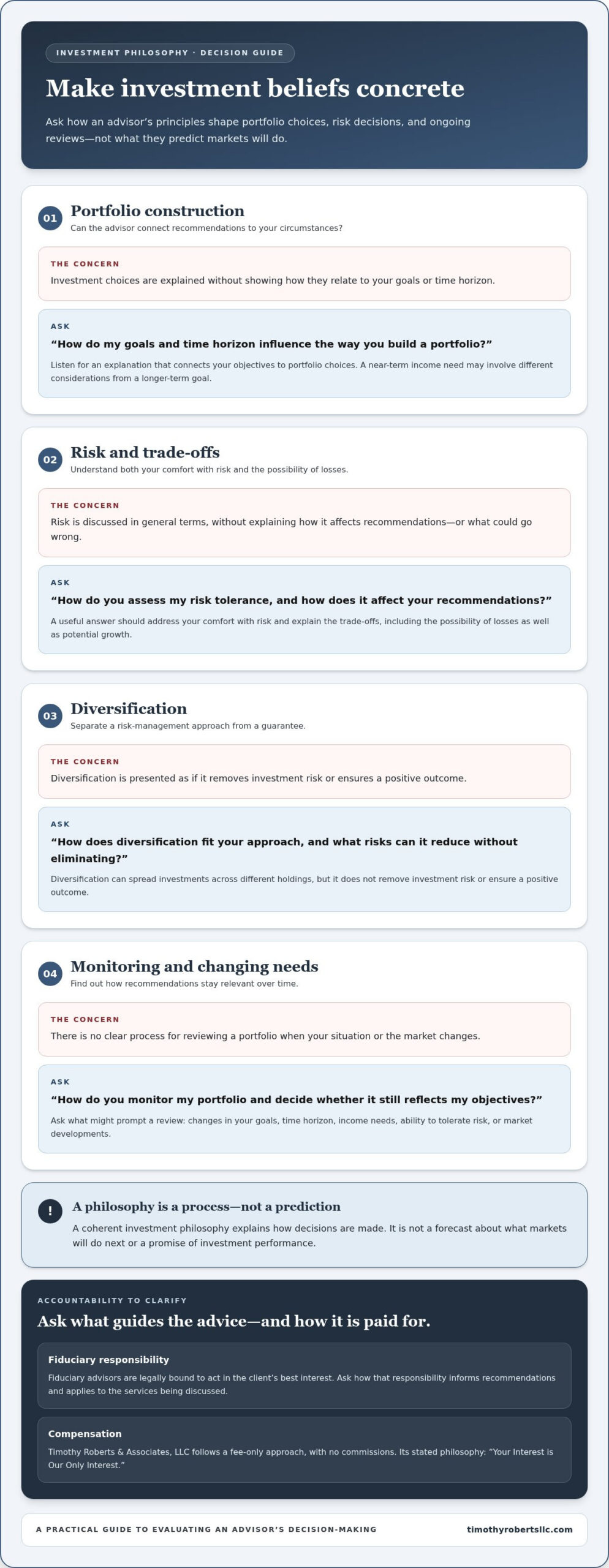
- How do my goals and time horizon influence the way you build a portfolio?
- How do you assess my risk tolerance, and how does it affect investment recommendations?
- How does diversification fit your approach, and what risks can it reduce without eliminating?
- How do you monitor a portfolio and decide whether it still reflects my objectives?
Pay attention to whether the advisor explains trade-offs. Diversification can spread investments across different holdings, but it does not remove investment risk or ensure a positive outcome. A substantive answer should describe how the approach relates to your objectives, rather than presenting diversification as a guarantee.
Questions about changing markets and recommendations
Ask what circumstances might prompt a recommendation review. Changes in your goals, time horizon, income needs, or ability to tolerate risk may matter alongside market developments. The point is not to seek a forecast. It is to understand how the advisor distinguishes the principles guiding a long-term plan from short-term reactions.
- What changes in my circumstances could lead you to revisit an investment recommendation?
- How do you decide whether a market development calls for action or continued adherence to the plan?
- How will you explain the reasoning behind a recommendation and any trade-offs involved?
An advisor should be able to explain the reasoning behind a recommendation in plain language. Listen for an answer that lays out the factors considered, how they relate to your priorities, and what could prompt a reassessment. Be cautious of assurances about future performance in place of an explanation. No philosophy can remove uncertainty from investing.
These questions are most useful when you bring your own priorities into the discussion. Timothy Roberts & Associates, LLC tailors its approach to individual goals and risk tolerance. Its fiduciary advisors are legally bound to act in clients’ best interests, guided by the philosophy “Your Interest is Our Only Interest.” Explore the firm’s wealth and investment management approach to consider how investment decisions can fit into a broader financial plan.
How to Judge Whether a Wealth Manager’s Philosophy Fits Your Situation
A philosophy fits when its principles can be applied to your priorities, not just described in broad terms. Use the questions to ask a potential wealth manager about their philosophy to compare the advisor’s reasoning with what matters in your life. General claims about performance are less useful than a clear explanation of how your goals, risk tolerance, and time horizon shape decisions.
Does the approach reflect your goals and risk tolerance?
Notice what the advisor asks before discussing recommendations. Do they take time to understand what you are planning for, when you may need the money, and how much uncertainty you can accept? Comfort with risk and financial capacity to withstand losses are related, but not identical. A thoughtful discussion should recognize both and explain how your priorities may influence portfolio decisions.
Capture the conversation in a simple comparison. Write down your priority, the advisor’s answer, and any point that remains unclear. This helps distinguish a tailored explanation from a general assurance.
Your priority: Near-term retirement income
The advisor’s answer: How the investment approach relates to your expected income needs and time horizon
What remains unclear: How a change in your plans would prompt a review
Your priority: Comfort with investment risk
The advisor’s answer: How your risk tolerance informs recommendations and portfolio decisions
What remains unclear: How the advisor distinguishes your comfort with risk from your ability to absorb a loss
Adapt the prompts to your circumstances. The purpose is not to score an advisor against a universal template. It is to identify whether their reasoning addresses your actual priorities.
Does the philosophy connect with broader financial planning?
Investment decisions can affect other parts of a financial plan. If retirement is a priority, ask how investment management relates to your retirement goals and anticipated income needs. If tax considerations are relevant, ask how they are considered in the planning process and coordinated with your tax professional. For estate priorities, explore how those goals fit into the overall picture while distinguishing financial planning from legal services.
Consider whether the advisor can explain these connections without implying that every concern can be solved through portfolio changes. Comprehensive financial planning can help frame investment decisions alongside retirement, tax, and estate priorities. If retirement income is central to your goals, consider how retirement income planning fits into that picture.
Timothy Roberts & Associates, LLC takes a client-centered approach tailored to individual goals and risk tolerance. Its fiduciary advisors are legally bound to act in clients’ best interests. “Your Interest is Our Only Interest” is the firm’s stated philosophy.
A Meeting Checklist: Questions About Fiduciary Duty, Fees, and Oversight
Use this checklist to clarify responsibilities and expectations, not to seek a promise about investment returns. The questions to ask a potential wealth manager about their philosophy should help you understand who is responsible for recommendations, how the advisor is compensated, and what ongoing oversight involves. Clear answers should identify responsibilities, compensation structure, and review practices.
Questions about fiduciary responsibility and compensation
Ask whether the advisor acts as a fiduciary when providing advisory services, and how that responsibility informs recommendations. Fiduciary advisors are legally bound to act in the client’s best interest. A direct answer should explain how the commitment applies to the work being discussed, rather than relying only on broad statements about trust or service.
- Do you act as a fiduciary when providing advisory services, and what does that mean for your recommendations?
- How are you compensated for the services you provide?
- Are commissions part of your compensation model?
- Are there other potential conflicts of interest I should understand?
Compensation is part of the relationship, not a side detail. Ask for a plain-language explanation of how the advisor is paid and how that model relates to the recommendations you receive. Timothy Roberts & Associates, LLC follows a fee-only approach with no commissions. Its stated philosophy is “Your Interest is Our Only Interest.” Understanding the compensation structure can help you assess how the firm’s principles connect with its advisory relationship, without assuming a particular investment outcome.
Questions about communication and ongoing oversight
Next, clarify how the advisor stays engaged after recommendations are made. Ask how portfolio reviews are handled, what information is considered when assessing whether your plan still fits, and how changes in your goals or circumstances enter the conversation. The answers should give you a sense of how the working relationship continues over time.
- How do you communicate recommendations and review my portfolio?
- What information do you use to assess whether my plan remains aligned with my goals?
- How do changes in my circumstances affect the review process?
- How will you explain a recommendation or a proposed change in terms I can understand?
For investment-management context, Timothy Roberts & Associates, LLC provides investment portfolio management through a fiduciary approach. Learn how the firm’s fee-only planning and investment oversight are structured by reviewing its wealth management approach.
What a Client-Centered Wealth Management Philosophy Looks Like in Practice
A client-centered philosophy should be visible in the way an advisor listens, explains recommendations, and adapts planning to individual priorities. It is not a one-size-fits-all portfolio or a promise about results. It is a considered process for connecting financial decisions with your goals, risk tolerance, and changing circumstances.
How the firm describes its advisory approach
Timothy Roberts & Associates, LLC describes its model as independent, proactive, comprehensive, and client-centered. Its stated philosophy is “Your Interest is Our Only Interest.” The firm provides fee-only financial planning and wealth and investment management, with recommendations tailored to individual goals and risk tolerance. The firm has more than 30 years of financial-management experience.
In practice, the discussion should begin with your financial picture, not a predetermined solution. Retirement timing, investment priorities, tax considerations, and estate goals may each inform the broader plan in their appropriate contexts. The questions to ask a potential wealth manager about their philosophy can help you explore how principles shape recommendations and how the advisor explains the reasoning behind them. The aim is a plan that reflects your circumstances, without implying that any approach can guarantee a particular investment outcome.
A considered next step after the conversation
Before an initial discussion, write down your most important goals, concerns about risk, expected time horizon, and questions about how an advisor works. Bring those priorities into the conversation and notice whether the explanations address your needs clearly. Reviewing financial advisor guidance can also help you prepare for a discussion about planning and wealth management.
If the firm’s approach aligns with the kind of relationship you are seeking, consider whether its client-centered wealth management approach fits your financial priorities.
Choose a Partnership That Supports Your Next Chapter
Let your next conversation move beyond polished language. Bring the questions to ask a potential wealth manager about their philosophy, along with the priorities you want your financial plan to serve. A useful discussion should help you decide whether the advisor’s way of working feels clear, considered, and aligned with your needs.
Timothy Roberts & Associates, LLC offers fee-only financial planning with no commissions. Its fiduciary advisors are legally bound to act in clients’ best interests, and the firm has more than 30 years of financial-management experience. Its philosophy is expressed as “Your Interest is Our Only Interest.”
To take a practical next step, explore Timothy Roberts & Associates’ client-centered wealth management approach and consider how it aligns with your financial priorities.
Frequently Asked Questions
Is a wealth management philosophy the same as an investment strategy?
No. A philosophy describes the principles that guide financial decisions, while an investment strategy applies those principles to a particular portfolio or goal. For example, a manager’s philosophy may emphasize tailoring recommendations to a client’s circumstances; the strategy is how that principle informs specific portfolio choices. The questions to ask a potential wealth manager about their philosophy can help you understand the reasoning behind an approach, not just its investment components.
Can a wealth manager guarantee investment returns?
No. A wealth manager can explain the intended purpose of an investment approach and the risks involved, but should not promise a specific return. Investment values can rise or fall, and past results do not establish what will happen next. If you hear a return guarantee, ask exactly what is being promised, by whom, and under what terms. Focus on understanding the risks, assumptions, and possible outcomes rather than relying on a promised result.
How can I tell whether a wealth manager is a fiduciary?
Ask directly whether the advisor acts as a fiduciary for the services you are considering, and ask what that responsibility means for recommendations. Timothy Roberts & Associates, LLC’s fiduciary advisors are legally bound to act in clients’ best interests. The firm’s advisory services are offered through Cetera Investment Advisers LLC, and Cetera entities are under separate ownership from any other named entity.
Does fee-only mean a wealth manager does not charge fees?
No. Fee-only means the advisor is compensated through fees rather than commissions, not that financial planning or portfolio management is free. Ask how compensation works, what services it covers, and how the arrangement is documented before deciding to proceed. Timothy Roberts & Associates, LLC follows a fee-only model with no commissions. Review the terms carefully so you understand the relationship and services involved.
What if my goals or risk tolerance change after I hire a wealth manager?
Tell your advisor when a meaningful change occurs, such as a revised retirement date, a new income need, or a shift in how much investment fluctuation you can tolerate. Those changes may affect whether your existing plan still reflects your priorities. Ask how the advisor will incorporate updated information into recommendations and what decisions may need to be revisited. Keeping your financial picture current helps make planning discussions more relevant as circumstances evolve.
Should a wealth manager coordinate with my tax or legal professionals?
Coordination can help keep financial planning decisions connected to your broader circumstances, particularly when a tax or estate matter affects your goals. Ask how the advisor communicates with your tax or legal professionals and what information you may need to share. A financial advisor does not replace those professionals.
Can I work with a wealth manager if I live outside the United States?
This site is published for residents of the United States only. That statement should not be taken as an indication that the firm works with people living outside the country. Not all products and services may be available in every state and through every advisor, so residency and availability restrictions matter when considering services.
