

Nov
Fee-only financial planning services in Plymouth
Fee-only financial planning through Timothy Roberts & Associates, LLC brings comprehensive financial planning, retirement planning, and investment management together around your unique needs. Fee-only advisors are compensated directly by clients rather than through commissions from product sales or referrals. Separately, fiduciary advisors are legally bound to act in their clients’ best interests.
It helps to look beyond a single investment question: retirement income, taxes, risk, and legacy goals can all influence a holistic plan. This article explains what financial advisors commonly do, how comprehensive planning connects key decisions, and how fee-only compensation differs from other models. You’ll also find practical criteria for assessing an advisor and deciding whether the planning relationship fits your priorities.
Key Takeaways
- Separate how an advisor is paid from the fiduciary standard, then consider what each means for the advice you receive.
- Assess investment management as part of your broader goals, risk preferences and financial timeline.
- Compare planning approaches and communication styles to identify an advisor relationship that fits your needs.
- See how retirement income, estate considerations and risk management can come together in a comprehensive financial plan.
Fiduciary financial advisors in Plymouth County
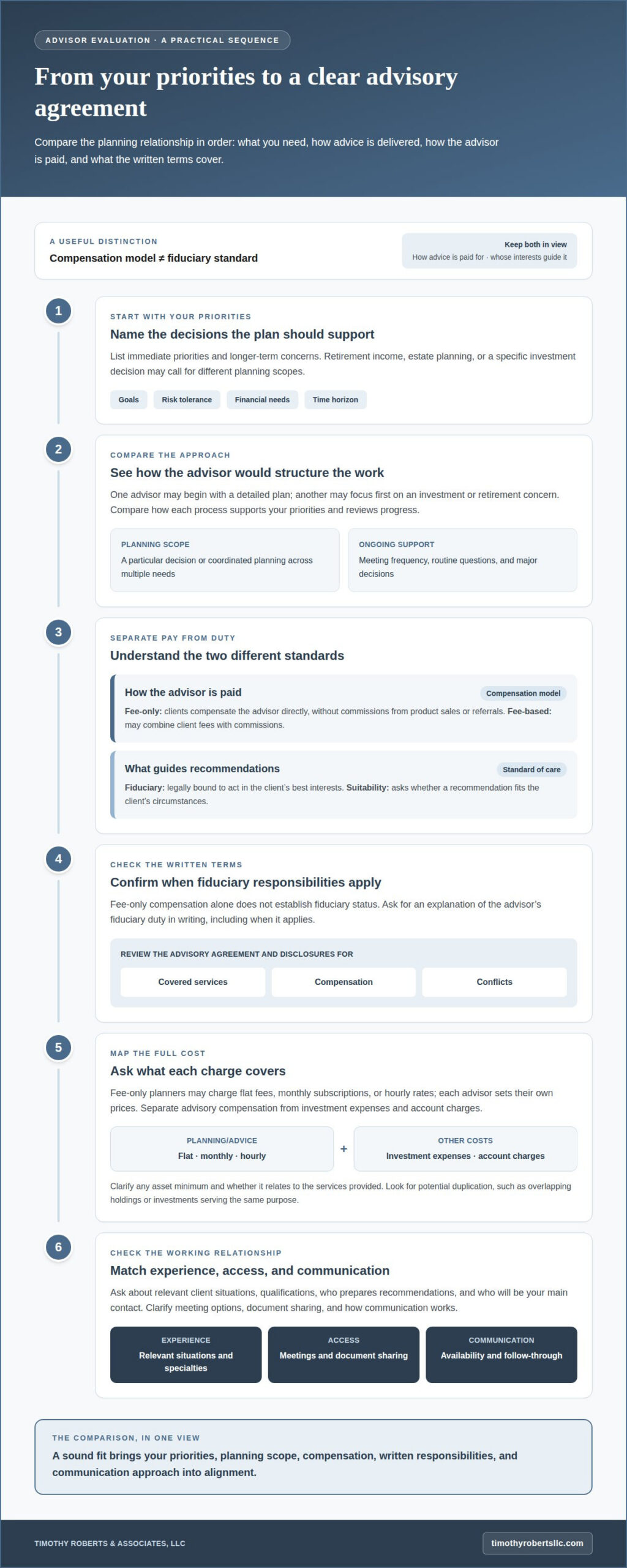
When assessing fee-only financial planning, distinguish the advisor’s compensation model from the standard guiding recommendations. Fee-only means clients compensate the advisor directly, without commissions from product sales or referrals. A fiduciary is legally bound to act in the client’s best interests.
Fiduciary Duties and Suitability Standards
Fiduciary duties focus on putting the client’s interests first. Suitability, by contrast, asks whether a recommendation fits the client’s circumstances. When reviewing advice, ask how the advisor considers your goals, risk tolerance, and financial needs. For example, retirement recommendations should account for the income you want your savings to support, rather than focusing only on an investment’s features. Tax considerations can also shape planning decisions. For tax year 2026, the Massachusetts Department of Revenue lists 5.00% for long term capital gains from dividends, interest, wages, and other income.
Verifying Fiduciary Status
Fee-only compensation alone does not establish fiduciary status. Ask the advisor to explain their fiduciary duty in writing and clarify when it applies. Review the advisory agreement and disclosures for covered services, compensation, and conflicts. XYPN advisors sign a Fiduciary Oath intended to separate sales from advice. An oath can illustrate a commitment, but the terms of your own advisory relationship matter most.
Fee-Only and Fee-Based Advice
Fee-only advisors are compensated by clients, without commissions from product sales or referrals. Fee-based advising may combine client fees with commissions, so ask how the advisor is paid for each service and whether product sales generate additional compensation. Compare the explanation with the written agreement. Clear terms help you understand whether advice about investments, retirement, or estate priorities is independent of commissions or connected to a product transaction.
What are some popular services for financial advising?
Financial advice often brings investment management together with retirement planning and broader wealth decisions. A tailored portfolio should reflect your goals, time horizon, cash needs, and comfort with market changes. For example, someone approaching retirement may need to weigh accessible savings differently from someone investing toward a more distant goal. Considering these needs together clarifies what each investment is intended to support.
Investment management can involve developing a portfolio strategy, reviewing its allocation, and adjusting it as circumstances change. Start by identifying the outcome your investments should support, then consider what level of risk aligns with that goal. A risk assessment can account for income needs, other assets, planned withdrawals, and how a market decline might affect your decisions. This context can guide portfolio choices more effectively than any single measure.
Review costs by separating advisory compensation from investment expenses and account charges. Ask what services each charge covers, then look for potential duplication, such as overlapping holdings or investments serving the same purpose. Any changes should still reflect your goals, risk preferences, and tax considerations. A lower expense alone does not make an investment the right fit for your portfolio.
Fee-only financial planners may charge flat fees, monthly subscriptions, or hourly rates, with each advisor setting their own prices. The right structure depends on the scope of advice and whether you need ongoing management or help with a specific planning question.
Minimum investment assets also vary by advisor and service model. Clarify whether an asset minimum applies and how it relates to the services provided. Some advice addresses a particular decision, while comprehensive financial planning may coordinate investment management with retirement income, education funding, and estate priorities. Compare the planning scope, portfolio responsibilities, and communication approach to find a structure suited to your needs.
Finding financial advisors in Plymouth, Massachusetts
Compare advisors based on relevant experience, planning specialties, and how their process supports your decisions. A focused interview can reveal more than an assets-under-management figure alone.
Advisor Experience and Client Reviews
Ask about client situations the advisor has handled, such as retirement transitions or estate planning priorities. Look for a clear match between your needs and the advisor’s stated specialties. Client reviews can add context: note whether comments describe communication, follow-through, or planning support rather than focusing only on ratings. Treat assets under management as context, not a stand-alone measure of advice quality.
Qualifications and Office Locations
Ask which qualifications inform the advisor’s work and which services they relate to. Clarify who will prepare recommendations and who will be your main contact. For meetings and document sharing, ask what options are available and how communication works. These practical details help you assess access and working style without assuming that proximity alone determines suitability.
Approaches and Availability
Compare more than one advisor by discussing planning approach, availability, and communication style. Ask how often you’ll meet, how quickly routine questions are handled, and what happens when a major financial decision arises. One advisor may begin with a detailed plan; another may focus first on a specific investment or retirement concern. The useful comparison is how each process supports your priorities and keeps decisions moving.
Matching Planning Needs
Before an interview, list your immediate priorities and longer-term concerns. Someone balancing retirement income with estate planning, for example, may need coordinated advice, while another person may want help with a single investment decision. Ask how the advisor would structure the work and review progress. Clarify whether fiduciary responsibilities apply to the services discussed and how they are documented. A precise fit makes financial decisions easier to evaluate.
Comprehensive financial planning
Comprehensive planning connects decisions that might otherwise be handled separately. A change in retirement timing can affect income needs, portfolio withdrawals, tax planning, and estate priorities. The benefit is seeing how one choice affects another, then setting a sequence that supports your financial future. For example, a planned career change may call for reviewing savings, expected income, and retirement contributions together.
A practical plan begins by defining priorities, then organizing the information behind them. List current income sources, major expenses, savings, debts, and upcoming decisions. Next, identify where timing matters: retirement, education costs, a home purchase, or a family legacy goal. This gives trusted guidance a clear starting point and helps turn broad interests into decisions that can be revisited as circumstances change.
- Cash flow: Map income and expenses against planned milestones.
- Retirement planning: Connect expected income with withdrawal needs.
- Tax planning: Consider tax effects when comparing financial choices.
- Estate priorities: Clarify how intended assets fit your legacy goals.
Coordination matters because one asset may serve several purposes. A retirement account, for instance, can support future income while also shaping current savings choices. A comprehensive review considers each account’s role, the timing of withdrawals, and how changes may interact with other goals. It also makes commissions or other incentives part of the discussion, keeping the advice and its context clear.
Make the plan useful beyond its first meeting. Set a review process around meaningful changes, such as a new job, approaching retirement, or a shift in family responsibilities. Bring updated account details and a short list of decisions to each review. This keeps guidance connected to real choices rather than a static document. For coordinated support across retirement, tax, and estate priorities, explore comprehensive financial planning as a next step.
Timothy Roberts & Associates: Retirement Income Planning
Timothy Roberts & Associates offers Retirement Income Planning to connect retirement income decisions with your wider financial priorities. This service can help when you’re preparing to draw on savings or want a clearer view of how retirement income relates to your goals.
Planning can also include Investment Portfolio Management, Estate & Legacy Planning, and Risk Management & Insurance Analysis. These services address how investments support income needs, how legacy priorities shape your plans, and how risk factors into financial decisions. The focus is on coordinating these considerations around your circumstances rather than treating each choice in isolation.
If you’re ready to discuss retirement income planning in the context of your financial goals, contact Timothy Roberts & Associates or visit timothyrobertsllc.com.
Shape your next financial decision with intention
Your next step can be specific: identify the financial decision you want to make clearer, then consider what information would help you move forward. A fee-only financial planning relationship in Plymouth can provide a structured setting for discussing priorities and aligning decisions with the future you want to build. Bring the questions that matter most to you, whether they concern a transition, a goal, or how separate choices fit together.
An initial conversation can turn broad intentions into a practical direction. Explain what you’re working toward and discuss how planning support may fit your needs. You don’t need every detail resolved in advance. Thoughtful planning is a process, and a clear starting point makes it easier to approach the decisions ahead with purpose.
Contact Timothy Roberts & Associates to begin a conversation about your financial priorities. A considered next step can help you move toward your future with greater clarity.
Frequently Asked Questions
What does a financial planner do?
A financial planner helps organize financial choices around your goals and circumstances. For example, they can help you assess how a career change affects savings, retirement timing, or education plans for your family. Depending on the engagement, planning may involve reviewing income, assets, risk, and priorities, then outlining practical actions. The goal is to make connected decisions easier to understand and manage over time.
Which fee-only financial planners serve Plymouth, Massachusetts?
Timothy Roberts & Associates, LLC is a Michigan-based firm offering fee-only financial planning and fiduciary services. Its philosophy is expressed as “Your Interest is Our Only Interest.” This site is published for residents of the United States only. Not all of the products and services referenced on this site may be available in every state and through every advisor listed. Confirm that an advisor is registered for your situation.
What services do fee-only financial planners in Plymouth offer?
Services include financial planning, retirement income planning, investment portfolio management, estate and legacy planning, and risk management and insurance analysis. Someone reviewing a retirement date, for instance, may need to consider portfolio strategy alongside future income needs. Before beginning, identify whether you need help with one decision or coordination across several priorities.
How can I check a Plymouth financial planner’s credentials, disciplinary history, and Form ADV?
Review the advisor’s stated credentials, disciplinary disclosures, and Form ADV, then compare them with the services and compensation discussed. Ask for explanations of unfamiliar terms and any conflicts described in the documents. Securities offered through Cetera Financial Specialists LLC (doing insurance business in CA as CFGFS Insurance Agency), member FINRA/SIPC. Advisory services offered through Cetera Investment Advisers LLC. Cetera entities are under separate ownership from any other named entity.
How do I choose and hire a fee-only financial planner in Plymouth?
Start by writing down the decision you want help with, such as retirement timing or coordinating investment and estate priorities. Compare planning scope, communication approach, compensation structure, and how recommendations will be reviewed. Ask who will work with you and what information they need to understand your circumstances. The information in this material is not intended as tax or legal advice. Please consult legal or tax professionals for specific information regarding your individual situation.
