

Nov
How to stop worrying about spending from your retirement portfolio
A market drop can make a sound retirement plan feel unsafe. Learning how to stop worrying about your retirement portfolio starts with a written withdrawal strategy, not a daily reaction to market swings. The 4% rule offers one familiar framework: withdraw 4% of total retirement savings in the first year of retirement, then adjust that amount for inflation in each following year.
It’s understandable to feel cautious when savings need to support decades of living expenses. But avoiding every withdrawal can limit the life your savings are meant to support, while spending without a plan can increase uncertainty. A sustainable withdrawal rate often falls between 3% and 5%, depending on your circumstances, so the right approach balances income needs, investment risk, and flexibility. This article explains how stress can shape investment decisions, how structured withdrawals work, and how to build confidence spending retirement savings. You’ll also find practical ways to revisit your plan as markets, priorities, and expenses change.
Key Takeaways
- Separate near-term spending money from longer-term investments to reduce pressure to sell assets during a downturn.
- Use a withdrawal approach that can adapt to market conditions, income needs, and changes in spending over time.
- Build confidence by testing planned spending gradually and noticing how your comfort changes with experience.
- Give savings a clear purpose by connecting withdrawals to the expenses, priorities, and security you want retirement to support.
1. How does stress affect investment decisions?
A sharp market decline can make a long-term plan feel suddenly fragile. Stress may prompt investors to sell after prices fall, locking in losses and missing a later recovery. Stock valuations can add unease: the cyclically adjusted price-to-earnings ratio is currently 40, its highest level since its late-1990s record of 45. High valuations signal risk, not a reliable timetable for market declines. Responding to a valuation reading alone can disrupt a portfolio built to provide income, growth, and resilience.
Sequence-of-returns risk makes withdrawals especially sensitive to early losses. If investments fall while you’re withdrawing money, selling assets can leave fewer shares to participate in a recovery. One practical buffer is to hold six to 12 months of planned portfolio withdrawals in cash or cash equivalents. That reserve can cover near-term spending without requiring an immediate sale during a downturn. A retirement savings rule of thumb suggests six years of income saved by retirement, but the amount needed depends on spending, housing costs, guaranteed income, and portfolio design.
Fees and investment costs reduce the amount of your savings that stays invested. Over time, ongoing charges also reduce what can compound, so review account statements and understand how each cost affects your plan. To manage the effects of market downturns and inflation, diversify investments and consider a bond or CD ladder alongside a cash reserve. The Social Security Administration describes Social Security as inflation-adjusted, government-backed retirement income. Include it in your income picture, then assess how much your investments may need to provide as prices rise.
Longevity risk can intensify worry because retirement may span decades. Someone retiring at age 65 may need to fund potentially decades of living expenses, making overly cautious investing a risk too: insufficient growth can make later income harder to sustain. Balance investment risk by matching near-term withdrawals with liquid reserves while keeping longer-term investments positioned for growth. A clear spending plan can show which assets support housing and essentials, which fund flexible goals, and how your wealth can serve you across retirement.
2. Sustainable retirement withdrawal rates
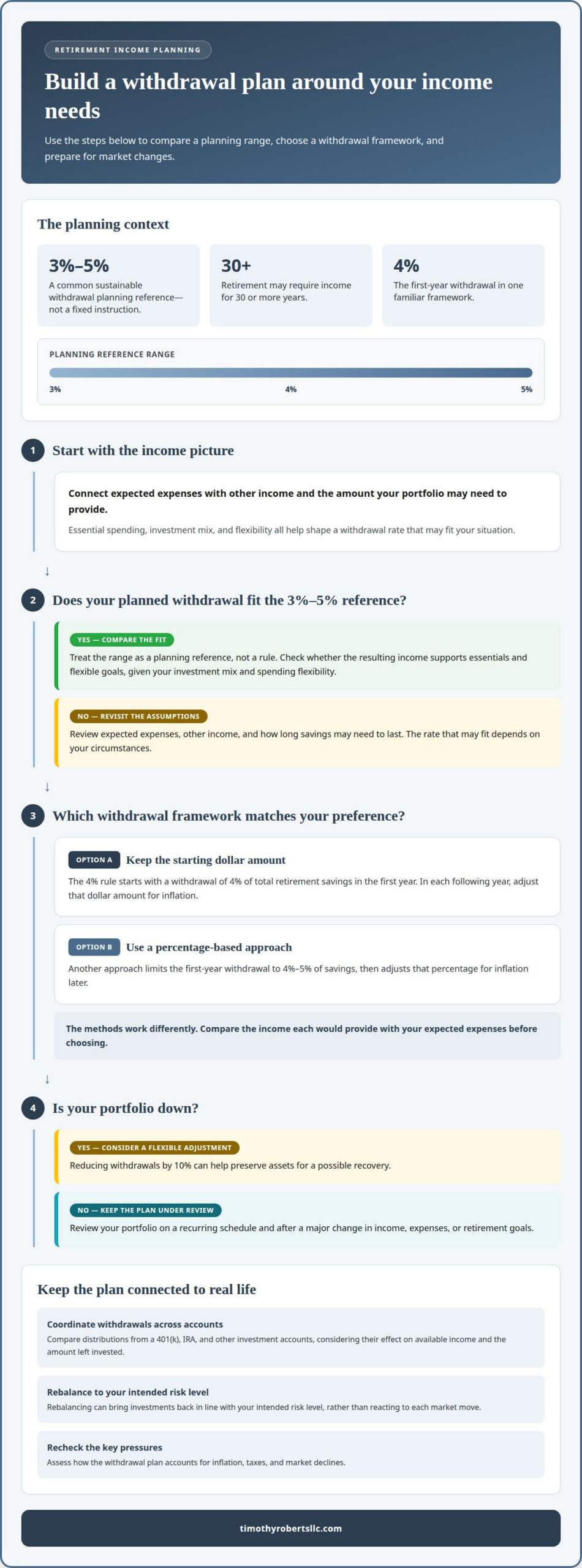
A withdrawal plan should connect portfolio income with expenses, other income, and how long savings may need to last. Retirement can require 30 or more years of income, so a sustainable withdrawal rate often falls between 3% and 5%, depending on the retiree’s situation. That range is a planning reference, not a fixed instruction: essential spending, investment mix, and flexibility all shape the rate that may fit.
The 4% rule offers one starting framework. It advises withdrawing 4% of total retirement savings in the first year, then adjusting that dollar amount for inflation in each following year. Another approach limits the first year’s withdrawal to 4%-5% of savings, then adjusts that percentage for inflation later. These methods work differently, so compare the resulting income with expected expenses before choosing. If a portfolio is down, reducing withdrawals by 10% can help preserve assets for a possible recovery.
Tax-aware withdrawal strategies coordinate distributions across retirement accounts and taxable investments. For example, compare withdrawals from a 401(k), IRA, and other investment accounts, considering how each affects available income and the amount left invested. A structured sequence can help manage taxes while meeting spending needs. A fiduciary financial advisor can help assess the trade-offs; costs vary with the scope of advice, portfolio complexity, and service arrangement, with the price provided after a quote request.
Review your portfolio on a recurring schedule and after a major change in income, expenses, or retirement goals. Rebalancing can bring investments back in line with your intended risk level, rather than reacting to each market move. If you consult an advisor, ask how the withdrawal plan accounts for inflation, taxes, and market declines. Thoughtful Retirement Income Planning can connect portfolio withdrawals with your broader income needs.
3. Gradually building comfort with spending
Start with a modest, planned discretionary expense, then record how it affects your budget and comfort. For example, schedule a hobby purchase within your monthly spending plan rather than waiting for perfect market returns. Compare the decision with your written income plan, not the latest economic headline. This deliberate test makes spending a repeatable choice instead of a reaction to short-term market movements.
Your retirement spending capacity can change across a lifetime. A retiree’s discretionary needs at age 65 may differ from needs at age 85. Travel, hobbies, dining out, and maintaining multiple homes typically decrease as people age. Review these categories alongside housing, healthcare, and other essential expenses. A plan that separates essentials from flexible goals can help you see which spending choices may adjust as priorities change.
Build flexibility into your plan before a downturn arrives. Decide which discretionary expenses you could pause or scale back if portfolio returns weaken, while protecting essential costs. For example, postpone a major trip before cutting a recurring housing or healthcare expense. This gives you a clear response to changing market conditions without treating every decline as a reason to abandon your long-term plan.
If you’re learning how to stop worrying about your retirement portfolio, use a written spending plan and review it at set intervals instead of reacting to every market update. Compare actual spending with planned expenses, available income sources, and portfolio withdrawals. A clear record can show whether your concern reflects a real budget gap or discomfort with using savings. It also points to a practical next step, such as adjusting flexible spending or revisiting your income plan.
Comfort often grows through practice, not a single calculation. Choose one planned expense, make the decision within your budget, then note what felt manageable. Revisit that experience when assessing your retirement spending capacity. This practical process can help you stop worrying about your retirement portfolio while connecting your wealth to its purpose: supporting the life you want, with room to adapt as your priorities and circumstances evolve.
4. Why retirement money is stressful even for savers
More than half of middle-income older adults believe their savings won’t last through retirement. That fear can persist even after years of consistent saving, because a portfolio balance alone doesn’t show how reliably it can fund future expenses. Give your savings specific roles: supporting essential costs, personal priorities, and later-life care. A clear purpose makes each withdrawal part of a plan, not evidence that the plan is failing.
A rule of thumb suggests having about four years of income saved at age 50 and six years of income by retirement. It suggests accumulating the remaining two years during roughly the last 15 years of working life. These milestones offer context, not a personal spending target. Your savings goal also depends on expected expenses, other income, and how long your retirement may last. A written estimate can make progress easier to assess than comparing your balance with someone else’s.
Saving can feel difficult when current needs compete with a future that seems distant. Make the next step automatic: schedule a transfer into retirement savings when income arrives, then review the amount as your expenses or earnings change. This reduces repeated decisions and gives saving a defined place in your routine. For healthcare planning, a health savings account offers three tax advantages: pretax contributions, tax-free growth, and federally tax-free withdrawals for qualified medical expenses.
Psychology matters in retirement, too. A market decline can make withdrawals feel dangerous, especially when losses and spending occur in sequence. Separate the emotional signal from the financial decision: write down what the money is meant to fund, then compare that purpose with your income plan. An annuity may convert a lump sum into a steady income stream, often for life, but can involve the possibility of losing money. Weighing the trade-offs alongside your savings and expenses can clarify what role, if any, an annuity should serve.
Timothy Roberts & Associates: Retirement Income Planning
Timothy Roberts & Associates can help connect retirement withdrawals with your income needs, spending priorities, and investment approach. Its Retirement Income Planning and Investment Portfolio Management services address practical questions behind a retirement strategy: how savings support ongoing expenses, how the portfolio fits your risk tolerance, and how the plan can adapt as circumstances change.
Consider this support if you’re unsure whether your planned spending fits your portfolio or market changes have made your current approach difficult to follow. Estate & Legacy Planning and Risk Management & Insurance Analysis may also be relevant when retirement decisions involve broader family or risk considerations.
Contact Timothy Roberts & Associates to discuss your retirement income planning needs.
Make your next decision with intention
Retirement confidence isn’t measured by how often you check your account balance. It grows when financial choices reflect what you want your time, energy, and resources to make possible. Consider a meaningful priority you’ve postponed, then decide what information would help you evaluate it: expected spending, timing, or how it fits your broader goals. That turns unease into a practical question you can work through.
Learning how to stop worrying about your retirement portfolio isn’t about eliminating every uncertainty. It’s about building a relationship with your plan that leaves room for thoughtful decisions as life changes. A clear conversation can help you identify what needs attention now and what can remain part of your longer-term strategy.
Contact Timothy Roberts & Associates to discuss your retirement goals. A considered next step can help make retirement feel more like a life you’re shaping, and less like a balance you’re guarding.
Frequently Asked Questions
How does stress affect investment decisions?
Stress can narrow your attention to immediate losses and make a long-term strategy feel unsafe. For example, after seeing a sharp decline, an investor might sell holdings without considering how that decision affects future income needs. Before changing investments, write down your concern, the action you’re considering, and how it supports your financial goals. That pause can help distinguish a deliberate choice from a fear-driven reaction.
What are some practical ways to gauge the health of your retirement fund?
Compare expected income with planned expenses, then note where they don’t align. Include Social Security, pension income if applicable, account withdrawals, and recurring costs such as housing and healthcare. Review whether your investments still match your intended risk level and whether withdrawals follow your plan. Repeating this review after a major life change can reveal a developing shortfall before it becomes urgent.
What is the root cause of financial stress, both before and during retirement?
Financial stress often grows from uncertainty about whether available resources can meet future needs. Before retirement, competing priorities such as housing costs and saving for later can make progress feel slow. During retirement, fluctuating investment values and unfamiliar withdrawal decisions may raise new concerns. Identifying the specific pressure, such as rising expenses or unclear income expectations, turns a broad worry into a question you can address.
Why does thinking about money in retirement feel so stressful, even for people who’ve saved enough?
Saving focuses on building a balance, while retirement requires deciding how that balance will support everyday life. That shift can make each withdrawal feel like a permanent loss, even when spending is planned. Future expenses can also be difficult to predict, particularly healthcare needs or support for family members. Naming what your savings are meant to fund can connect decisions to your priorities rather than to an account balance alone.
How do you create a retirement income plan from savings and Social Security?
Start by listing your expected expenses and income sources, including retirement accounts and Social Security. The Social Security Administration provides benefit information that can help you estimate that part of your income. Compare your income sources with essential costs first, then decide how savings may cover remaining needs and discretionary goals. Keep the estimate current as your spending, benefit timing, or household circumstances change.
How do you choose a retirement portfolio asset allocation based on age and risk tolerance?
Age can inform the decision, but it shouldn’t determine your allocation by itself. Consider when you’ll need each portion of your savings, how much market fluctuation you can tolerate, and whether other income covers essential expenses. Someone relying on near-term withdrawals may prioritize stability for that portion, while longer-term savings may serve a different role. Review the overall mix as your goals, income, and comfort with risk evolve.
