

Nov
Strategies for Inflation Protection for Workers and Retirees
Inflation can quietly reduce the value of a steady paycheck and a carefully built portfolio. In the 12 months ending in March 2026, the Consumer Price Index rose 3.3%, according to the U.S. Bureau of Labor Statistics. Effective strategies to protect your portfolio from inflation in 2026 pair investments that may respond to rising prices with enough stability to support your time horizon and financial needs.
If you’re concerned that everyday costs are rising faster than your income or savings, the trade-off is real: investments that may help hedge inflation can also fluctuate more in price. The right balance depends on when you’ll need the money, how your income may change, and whether you’re still building savings or drawing on them in retirement.
This article explains how inflation erodes purchasing power and how inflation-protected bond funds, bond duration, volatility, and life stage affect portfolio decisions. You’ll see why no single holding suits every investor and how a considered mix can balance inflation resilience with broader financial goals.
Key Takeaways
- Inflation-protected bond funds can adjust with rising prices, but their role depends on your income needs and investment horizon.
- Balance potential inflation hedges with stability and liquidity, since assets that respond to inflation can also add volatility.
- Use bond duration to understand how interest-rate changes may affect bond prices and portfolio fluctuations.
- Align portfolio protection with your life stage, distinguishing between long-term growth needs and retirement income needs.
1. What Are Inflation-Protected Bond Funds?
Inflation-linked Treasury securities, called Treasury Inflation-Protected Securities (TIPS), adjust their principal with the Consumer Price Index. The U.S. Bureau of Labor Statistics reported that inflation reached 9.1% in June 2022. It also reported that U.S. CPI rose 3.3% in the 12 months ending in March 2026. These changes matter because a fixed dollar amount buys less when prices rise.
TIPS pay interest every six months, calculated as a percentage of inflation-adjusted principal. For example, a $100 principal becomes $103 after 3% inflation. TIPS are issued with 5-, 10-, and 30-year maturities. A fund pools securities, but its value can still change as interest rates shift. Inflation protection does not remove market risk.
When reviewing the Vanguard Inflation-Protected Securities Fund, consider its stated objective, holdings, duration, and how it maintains exposure to inflation-linked securities. These details help show how the fund may behave alongside other assets. Series I Savings Bonds offer a separate Treasury inflation-protection mechanism: their inflation-adjusted rate resets twice a year.
Tax treatment depends on the asset and how it is held. TIPS, I Bonds, commodities, and real estate can generate different types of income or gains, with different tax consequences. Tax planning is therefore relevant when weighing inflation exposure, cash flow, and estate goals.
Historically, equity returns have outpaced inflation over the long term, but stocks, including value stocks, can behave differently across inflationary periods. Real estate may appreciate or generate rental income that rises with inflation, though neither result is assured. A company’s pricing power may weaken when its costs rise faster than its prices. These differences make protected securities one part of a broader approach, not a complete portfolio solution.
2. Do inflation hedges increase volatility?
They can. Real estate investment trusts (REITs) may track inflation, but their market prices fluctuate. Commodities can also move sharply as economic conditions change. Weigh that volatility against each holding’s role rather than treating every inflation hedge as a substitute for stable investments.
A portfolio review starts with the purpose of the money: long-term growth, income, liquidity, stability, or protection against rising prices. A mix of stocks, bonds, real estate, and commodities can reduce the chance that all investments respond alike to market conditions. Rebalancing brings allocations back toward target ranges by trimming assets that have outperformed and adding to those that have lagged. Diversification does not prevent losses, but it can reduce reliance on a single source of return.
Your time horizon shapes the risk decision. Money needed within three to five years can be held in safer investments, such as Treasury bills or short-term bonds, rather than exposed to larger price swings. For longer-term goals, an adviser may preserve growth investments while assessing how much inflation-sensitive exposure fits your capacity for volatility.
Retirement adds a cash-flow dimension. Consider planned withdrawals, dependable income sources, and how much principal needs to remain invested to support future purchasing power. The balance differs for someone drawing income now and a worker accumulating assets for retirement. Changes should follow a review of goals, time horizon, market conditions, and existing portfolio risk, not a reaction to a single inflation report.
Risks include interest-rate sensitivity, market volatility, and limited liquidity in some holdings; transaction or fund fees can also reduce net returns. A professional assesses those trade-offs alongside the expected role of each investment. Frequent strategy changes can lock in losses, disrupt income planning, or leave a portfolio poorly aligned with its goals. A considered investment portfolio review can help connect inflation exposure with income needs and time horizon.
3. Bond duration and interest-rate sensitivity
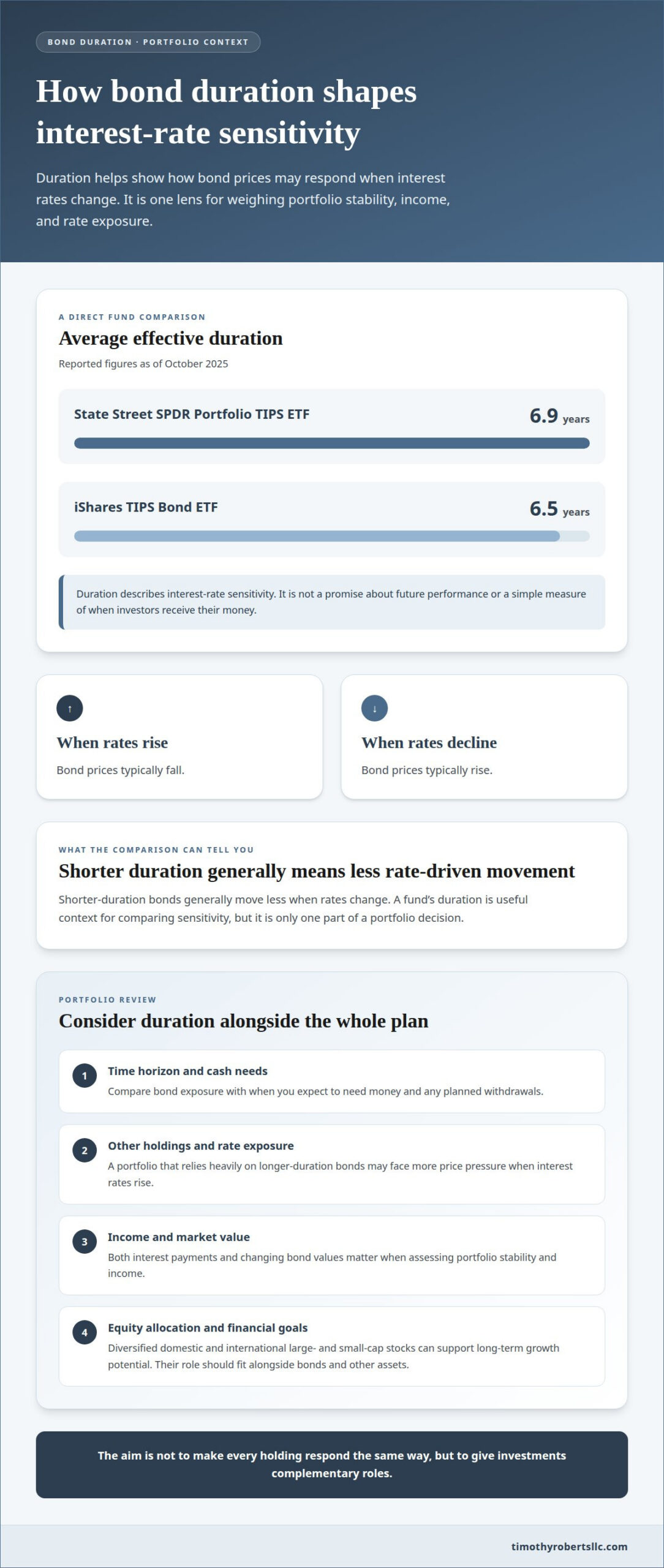
Bond duration measures how sensitive a bond’s price is to interest-rate changes. Shorter-duration bonds generally move less when rates change. Bond prices typically fall when interest rates rise and rise when rates decline. Duration helps assess how government securities and bond funds may affect portfolio stability, income, and exposure to changing rates.
Fund duration gives a practical comparison. As of October 2025, the State Street SPDR Portfolio TIPS ETF had an average effective duration of 6.9 years. The iShares TIPS Bond ETF had an average effective duration of 6.5 years. These figures describe rate sensitivity, not a promise about future performance or a simple measure of when investors receive their money.
In a portfolio review, consider duration alongside your time horizon, withdrawal needs, and other assets. If a portfolio relies heavily on longer-duration bonds, rising interest rates can put more pressure on prices. Shorter-duration holdings generally move less when rates change, though they play a different role in income and inflation exposure. Both interest payments and market value matter.
Equities add another dimension. A diversified allocation across domestic and international large- and small-cap stocks can support long-term growth potential and help offset the effect of rising consumer prices. A professional assesses how that growth exposure fits with bonds, real estate, and the investor’s financial goals. The objective is not to make every holding respond identically, but to assign investments complementary roles.
Duration is a portfolio-level decision, not a fund label to consider in isolation. Compare bond exposure with expected cash needs, interest-rate sensitivity, and equity allocation, then adjust the mix as goals evolve. This integrated view helps workers and retirees weigh income today against preserving purchasing power over a longer horizon.
4. Inflation protection for workers and retirees
Workers and retirees face different inflation pressures. A worker earning $50,000 who receives the same salary next year has less purchasing power if prices rise. The Consumer Price Index tracks changes in consumer prices, though personal expenses can move differently. Housing, food, healthcare, and transportation affect household budgets in distinct ways. A useful way to frame strategies to protect your portfolio from inflation in 2026 is to connect investment returns with the expenses they must support.
For workers, the central question is how savings can grow while keeping pace with rising costs. Strategies to protect your portfolio from inflation in 2026 should reflect the years remaining until retirement, workplace retirement assets, and the balance between growth investments and stable holdings. A planning horizon may span 10, 20, or 30 years, so one year’s economic conditions shouldn’t dictate the entire approach. A reserve for a few months of living expenses can also help avoid selling long-term investments for immediate needs.
Retirees face a different sequence of decisions. Retirement savings may need to provide income for 20 or 30 years or longer, while withdrawals reduce the amount left invested. A professional evaluates expected spending, income sources, and which assets can support near-term cash flow. This connects inflation protection to withdrawal planning, not simply to choosing securities with an inflation-linked feature or a particular maturity.
The practical distinction is clear: workers generally focus on building future purchasing power, while retirees balance current income with preserving assets for later years. Both groups need an approach that can adjust as goals, expenses, and time horizons change. For workers, that may mean reviewing whether savings remain aligned with retirement plans. For retirees, it means coordinating investments with spending needs and legacy priorities. Discuss retirement-focused portfolio planning to align inflation exposure with your income needs and long-term goals.
Timothy Roberts & Associates: Investment Portfolio Management
Timothy Roberts & Associates, LLC helps workers and retirees shape investment decisions around inflation exposure, risk tolerance, income needs, and long-term goals, offering effective strategies to protect your portfolio from inflation 2026. Its Investment Portfolio Management brings those considerations together, including the roles of bonds, equities, and other assets within a broader plan.
For someone approaching retirement, the focus may be coordinating portfolio risk with future withdrawals. For retirees, Retirement Income Planning connects investment decisions with ongoing cash-flow needs. Estate & Legacy Planning can help align wealth decisions with the priorities you want to carry forward. Consider seeking guidance when inflation, changing income needs, or a major life transition calls for a more integrated view of your portfolio.
Contact Timothy Roberts & Associates, LLC to discuss an investment strategy shaped around your goals.
Make Your Next Portfolio Decision With Purpose
Inflation planning is not a one-time adjustment. It is an ongoing decision about how your resources can support the life you want as income needs and priorities evolve. Start by defining what your investments need to accomplish, then consider whether your current strategy still serves those aims.
This perspective can turn market uncertainty into a more deliberate planning conversation. No portfolio allocation can eliminate investment risk, so decisions should reflect your goals, time horizon, and comfort with volatility. A measured review can also connect investment choices with retirement income and the legacy you hope to leave.
For a conversation about shaping that next step, contact Timothy Roberts & Associates, LLC. A thoughtful strategy can give your financial decisions greater direction as your plans move forward.
Frequently Asked Questions
How Does Inflation Affect Your Money?
Inflation reduces what your money can buy when prices rise faster than your income or investment returns. For example, an unchanged salary may cover fewer household expenses as rent, groceries, or services become more costly. Comparing portfolio growth with inflation helps show whether an account is gaining purchasing power or simply increasing in dollar terms.
What About Gold?
Gold may hold value independently of a currency, making it a potential diversifier during inflationary conditions. However, its price can fluctuate, and it does not generate interest or rental income. Its role differs from that of TIPS, bonds, or real estate. Consider gold as one asset among others, not as a complete inflation solution.
What Are Inflation-Protected Bond Funds?
Inflation-protected bond funds hold bonds designed to adjust principal in response to inflation, giving investors exposure through a pooled investment. A fund’s value can still change with market prices and interest rates, so its account value may rise or fall. Before deciding whether a fund fits, review its holdings, duration, and role alongside other portfolio assets.
Which Investments May Help During Inflation?
Stocks, commodities, and real estate may each serve a different role. A diversified mix of domestic and international large- and small-cap stocks can offer long-term growth potential. Commodities such as oil, crops, and industrial metals may move alongside inflation, while real estate can generate rental income. Performance varies, so suitability depends on your goals, time horizon, and capacity for risk.
Are TIPS always effective against inflation?
No. TIPS adjust principal with inflation, but their market prices can fall when interest rates rise. They may also yield less than other bonds when inflation remains low. The inflation adjustment alone does not determine an investor’s total return. Maturity, purchase price, interest rates, and the timing of a sale can all affect how TIPS perform within a portfolio.
Do inflation hedges increase volatility?
Some can. REITs and commodities may experience significant price swings, even when they offer potential inflation exposure. Consider each investment’s market behavior, liquidity, and role in the broader allocation. Diversifying across assets with different economic roles can reduce reliance on one market driver, but it does not guarantee a profit or protect against loss of principal.
