

Nov
Estate planning for blended families with adult children: which plans apply
The estate plan that once seemed clear may no longer reflect a blended family’s intentions. With estate planning for blended families with adult children, an older will or trust may still determine who receives the assets it covers, while beneficiary designations can direct other accounts elsewhere. If no written plan addresses an asset, state law may determine who inherits it.
It’s easy to assume a will or trust tells the whole story. In practice, retirement accounts, insurance policies, and some transfer-on-death or payable-on-death accounts may pass directly to named beneficiaries, leading to outcomes that differ from the broader plan.
This article explains how to review an existing plan, coordinate beneficiary designations, and understand the roles trusts and probate may play. It also covers risks traditional plans can create for blended families, including unintentionally excluding adult children or leaving a surviving spouse without intended support. The goal is to clarify which arrangements may apply and where coordination matters.
Key Takeaways
- Identify which parts of an older will or trust still reflect your wishes, and where family circumstances may call for a fresh review.
- See why beneficiary designations can direct assets differently from a will, and how coordinated planning can reduce that mismatch.
- Understand how trust choices and probate can shape support for a surviving spouse while preserving intended inheritances for adult children.
- Recognize risks traditional plans may create for blended families and how coordinated estate and financial planning can address them.
1. Does an Old Will, Old Trust, or Previous Estate Plan Apply in a Blended Family?
An older will or trust may still govern the assets it covers, but it may not reflect later marriages, changed relationships, or current inheritance priorities. Begin a review with existing wills, trust documents, beneficiary forms, divorce decrees, and marital agreements. Name stepchildren specifically if you intend them to inherit. Otherwise, they may be excluded.
When no written estate plan governs an asset, state law may determine who inherits. State law may also give a surviving spouse an elective share, reducing the assets intended for children. Applicable rules depend on the state and the property involved.
Address housing explicitly. A life estate can let a surviving spouse remain in the family home while directing it to adult children or other named beneficiaries after the spouse dies. The arrangement can assign property taxes, insurance, and maintenance to the spouse, and specify whether the home should be sold later.
Trusts can balance support and inheritance by setting who receives assets, when distributions occur, and who manages them. For example, a trust may provide income to a spouse while preserving principal for children. Retirement accounts need separate attention. The SECURE Act took effect on January 1, 2020, according to U.S. Congress.
A prenuptial or postnuptial agreement can define separate property, asset division, and inheritance intentions. Coordinating its terms with the estate plan helps align property provisions with intended transfers at death.
Estate-planning costs depend on the case and are given after a quote request. Complexity, the assets involved, and the documents requiring coordination shape the scope.
An estate planner can guide a focused conversation about priorities before documents are revised. Spouses can clarify the survivor’s support, assets reserved for children, and responsibility for maintaining the home. Discussing these expectations can reduce misunderstandings and help keep the plan aligned as family circumstances change.
How a professional coordinates retirement, insurance, and TOD/POD beneficiaries
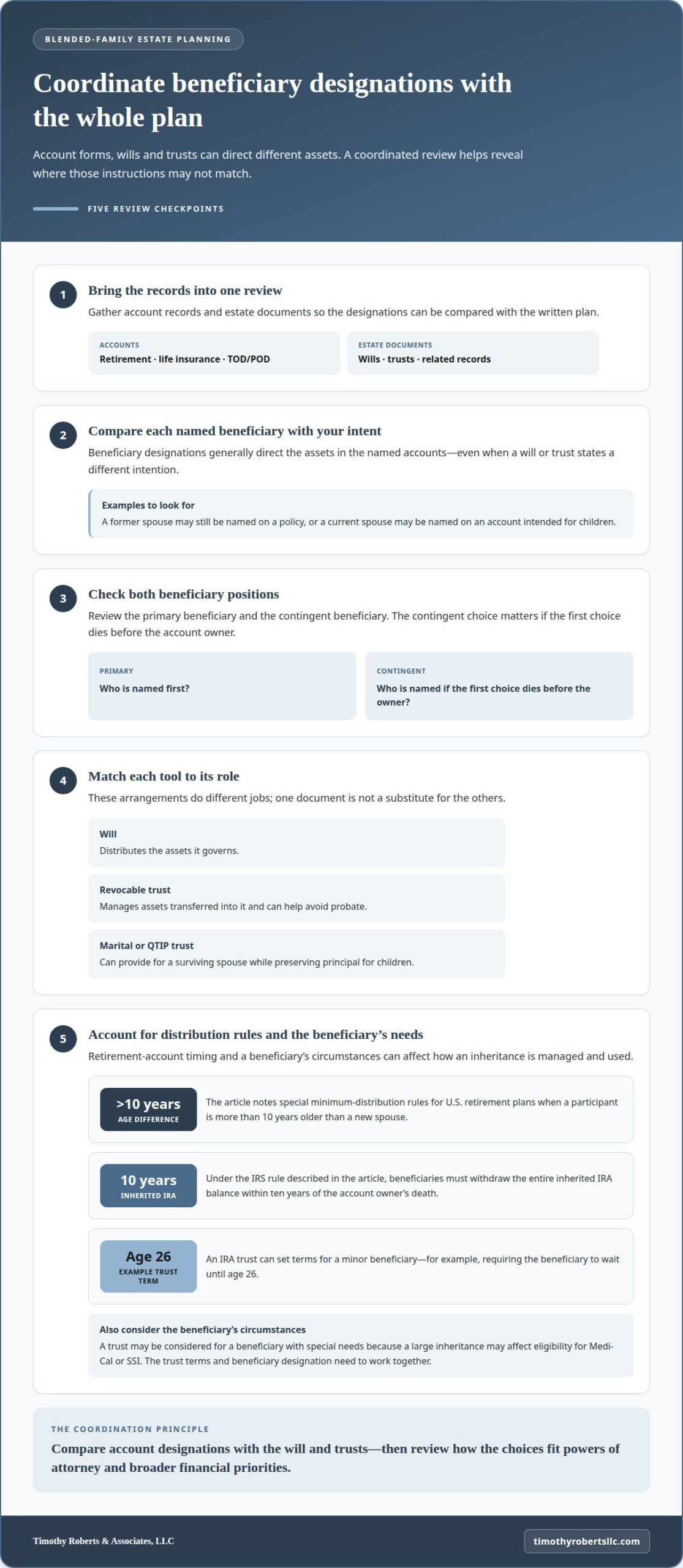
A professional can bring account records and estate documents into one coordinated review, comparing retirement accounts, life insurance, and transfer-on-death or payable-on-death designations with the will and trusts. This may reveal a former spouse still named on a policy or a current spouse named on an account intended for children. Both primary and contingent beneficiaries matter if the first choice dies before the account owner.
Beneficiary designations generally direct assets in the named accounts, even when a will or trust states a different intention. A will distributes assets it governs; a revocable trust manages assets transferred into it and can help avoid probate. A marital trust can provide for a surviving spouse while preserving principal for children. These tools have different roles, so a professional can help align them rather than treating one document as a substitute for another.
Retirement account details also affect the review. According to the Internal Revenue Service, U.S. retirement plans have special minimum-distribution rules when the participant is more than 10 years older than the participant’s new spouse. Under the Internal Revenue Service rule described for inherited IRAs, beneficiaries must withdraw the entire account balance within ten years of the account owner’s death. Distribution timing can affect how an inheritance supports a beneficiary.
For a minor beneficiary, an IRA trust can set terms for managing and distributing inherited assets; one example requires the beneficiary to wait until age 26. A trust may also be considered when a beneficiary has special needs, since a large inheritance may affect eligibility for Medi-Cal or SSI. The trust’s terms and beneficiary designation must work together.
A professional also reviews how account decisions fit with powers of attorney and the family’s broader financial priorities. For households balancing retirement income and intended inheritances, retirement income planning can bring those decisions into a more coherent strategy.
3. Revocable living trusts and probate
A revocable living trust can direct how assets are managed during life and distributed after death. Assets transferred into the trust can generally avoid probate, helping keep family matters private and reducing delays. For example, its terms can give a surviving spouse the right to live in the family home for life, then pass the home to children from previous marriages. The trust can also define an occupancy period or leave decisions to a trustee.
A Qualified Terminable Interest Property (QTIP) trust offers another structure: it can provide regular income for a surviving spouse while preserving trust principal for children. This can balance the spouse’s ongoing needs with the inheritance intended for other family members. Tax implications for remarried couples depend on asset ownership, trust terms, and applicable federal and state rules. An irrevocable life insurance trust may provide liquidity for estate taxes when an estate includes illiquid assets.
Minor children need a clear plan for managing inherited property. A parent can name a trustee to manage a child’s inheritance rather than leave management to the default under state law. The trustee’s role is distinct from choosing who should care for the child. Naming the intended decision-makers clarifies responsibilities if a parent dies and provides a more specific framework than an informal assumption.
Life insurance can also fund an intended inheritance for children while other assets support a spouse. An irrevocable life insurance trust can hold a policy and direct its proceeds according to written terms. In a family with a closely held business or property that can’t easily be sold, that liquidity may help address estate-tax obligations without forcing a sale. The trust’s terms should align with the broader plan, including who receives support, who manages assets, and when beneficiaries receive them.
4. Risks of using traditional estate plans in blended families
A plan built around one marriage may not account for children from previous relationships. For example, a will leaving everything to a spouse can give that spouse control over assets later intended for stepchildren. If the surviving spouse remarries or revises their own plan, those children may receive nothing from the inheritance their parent hoped to preserve. The issue is not simply outdated paperwork, but a mismatch between the plan’s assumptions and the family’s current circumstances.
State law can add another layer. In the United States, a surviving spouse may claim a statutory elective share of a deceased spouse’s estate, potentially reducing assets left to children. The rules depend on the state and the assets involved. A careful review considers both the intended inheritance and the spouse’s legal rights, rather than assuming a will alone resolves every conflict.
Leaving assets outright to adult children can also create a different imbalance. The children may receive their inheritance immediately, while the surviving spouse lacks enough resources to maintain the home or meet ongoing needs. Long-term care expenses can further reduce an estate; one example describes medical bills of $10,000 per month. A plan needs to consider how assets support the spouse and what remains for children.
Traditional plans can also overlook who controls life insurance and other assets directed by beneficiary designations. A former spouse may remain named on a policy, or a current spouse may inherit an account and later change its beneficiaries. An attorney can assess legal documents and state-specific rights; financial planning can align asset choices with family priorities.
A careful review brings the documents, beneficiary choices, and family expectations into one picture. That process can identify conflicts before they shape an inheritance. Review your estate and legacy plan as family relationships and priorities evolve.
Timothy Roberts & Associates, LLC: Estate & Legacy Planning
Timothy Roberts & Associates, LLC helps families connect estate and legacy priorities with their broader financial picture. Its Estate & Legacy Planning can help clarify how intended inheritances, retirement income, investments, and risk management fit together, especially when an older plan no longer reflects current relationships or priorities.
This coordinated perspective can be useful when a family is balancing support for a surviving spouse with inheritances for adult children, or aligning beneficiary choices with long-term goals. Retirement Income Planning, Investment Portfolio Management, and Risk Management & Insurance Analysis can inform those financial decisions. Legal documents and state-specific inheritance rules remain important parts of the overall picture.
For a thoughtful review of how your financial priorities fit together, contact Timothy Roberts & Associates, LLC.
Build a legacy that can evolve with your family
Family relationships continue to change as adult children form households, careers shift, and a surviving spouse’s needs evolve. Review a durable plan when these changes affect what you want your legacy to accomplish. The aim isn’t to predict every future circumstance, but to make your priorities clear enough to guide decisions as life unfolds.
A thoughtful approach to estate planning for blended families with adult children connects family intentions with the financial choices that support them. Consider what you want your plan to provide for the people who matter and whether it still reflects your values. Revisiting that purpose can help keep decisions coherent as relationships and priorities develop.
If you’re ready to bring your financial priorities into clearer focus, contact Timothy Roberts & Associates, LLC to discuss a path forward. A deliberate next step can help your legacy reflect the care behind it.
Frequently Asked Questions
Does an Old Will, Old Trust, or Previous Estate Plan Apply in a Blended Family?
An older will or trust may still govern the property and situations it addresses, but later events can leave important gaps. A move to another state, a new marriage, or a major change in family assets can affect how well its provisions fit. For instance, a document naming a former spouse for a decision-making role may no longer reflect current wishes.
What estate planning challenges are unique to blended families with adult children?
Estate planning for blended families with adult children often means balancing expectations across several family relationships. Adult children may have different financial needs, histories, or understandings of a parent’s intentions. A useful plan distinguishes emotional fairness from equal dollar amounts and explains why decisions were made. Clear communication can reduce misunderstandings, especially when a parent’s wishes differ from family members’ assumptions.
How can spouses provide for each other while preserving inheritances for children from prior marriages?
Spouses can set separate goals for immediate support and eventual inheritance. For example, a plan might give a surviving spouse access to income or use of selected property while setting clear terms for what children receive later. The right structure depends on assets, income needs, and family priorities. Discussing the spouse’s practical needs alongside children’s expectations can bring trade-offs into view before decisions are finalized.
How can parents divide an estate fairly among biological, step, and adopted adult children?
Fairness can mean equal shares, needs-based distributions, or different treatment of specific assets. A parent might divide financial assets evenly while leaving a family business to the child involved in operating it. The plan should name each intended beneficiary and explain how valuable or sentimental property will be handled. Specific instructions can clarify the parent’s reasoning and reduce competing interpretations among siblings.
What should a blended family provide to a professional to create or update wills, trusts, and beneficiary designations?
Provide existing estate documents, account and insurance records, beneficiary information, and relevant divorce or marital agreements. A family overview should identify spouses, biological and adopted children, stepchildren, and intended beneficiaries outside the immediate household. Describe priorities too, such as support for a spouse or a planned gift to a child. These details help a professional identify inconsistencies and clarify which decisions need attention.
What risks arise when adult children are named trustees, executors, or agents for a stepparent?
An adult child serving a stepparent may face divided loyalties, especially if the child also expects an inheritance. Other relatives may question decisions about spending, records, or asset distribution, even when the child acts responsibly. Consider whether the person can communicate impartially, manage administrative duties, and work with other family members. Naming a suitable alternate can provide continuity if the original choice cannot serve.
