

Mar
Building a Diversified Portfolio in Michigan: A Strategic 2026 Guide
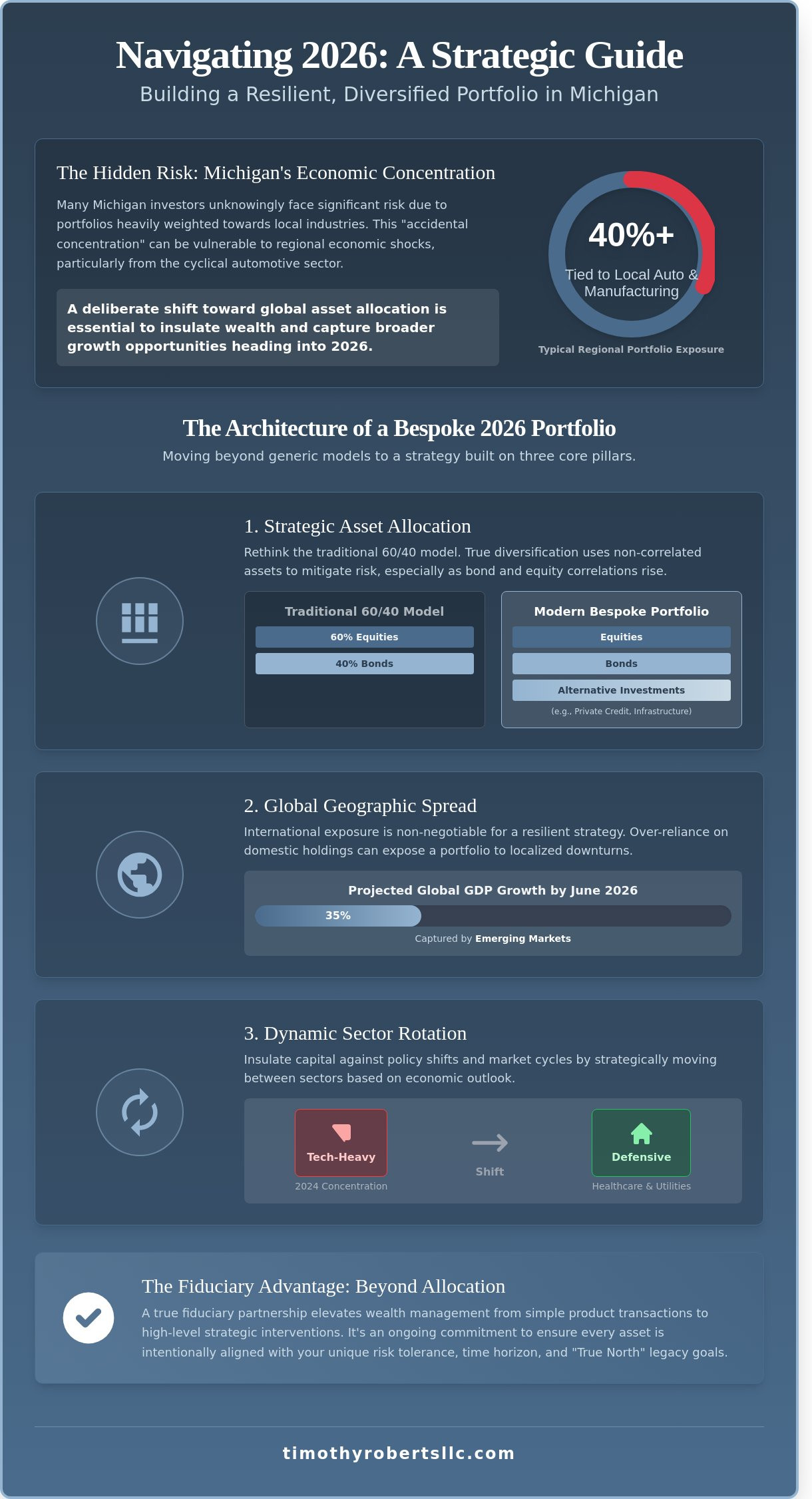
What if the very industries that built Michigan’s past are the ones quietly eroding your financial future? Many regional investors currently hold portfolios where over 40% of their total equity exposure remains tethered to the automotive sector or local manufacturing. Building a diversified portfolio in Michigan requires a deliberate shift from this accidental concentration toward a more holistic, global asset allocation. You likely understand that the projected 2026 market shifts demand a strategy far more bespoke and sophisticated than a generic, off-the-shelf model.
It’s natural to feel a sense of caution as inflation forecasts for 2026 suggest a volatile transition for traditional domestic holdings. We’ll help you elevate your investment approach by insulating your wealth from local economic shocks and aligning your assets with broader growth opportunities. This strategic guide offers a clear roadmap to optimize your risk profile. You’ll gain the clarity needed to ensure your retirement remains a source of calm confidence rather than regional anxiety.
Key Takeaways
- Rethink the traditional 60/40 model to transform diversification from a simple safety net into a sophisticated tool for mitigating 2026 market volatility.
- Move beyond generic financial models by constructing a bespoke portfolio architecture that mirrors your unique emotional risk tolerance and long-term aspirations.
- Learn to navigate regional economic concentration by building a diversified portfolio in Michigan that investors can rely on to withstand the specific cyclical pressures of the local auto industry.
- Execute a comprehensive strategic audit of your current accounts to ensure every asset is intentionally aligned with your “True North” legacy goals.
- Discover how a fiduciary partnership provides the high-level strategic interventions necessary to elevate your wealth management beyond mere product transactions.
Rethinking Diversification: More Than Just “Not Putting Eggs in One Basket”
True diversification transcends the elementary concept of variety. It functions as a precision instrument for risk mitigation rather than a simple safety net for the cautious. For those focused on building a diversified portfolio michigan markets require a strategy that acknowledges the shifting paradigms of 2026. The traditional 60/40 portfolio, which sustained wealth for decades, faces unprecedented pressure. As we enter the first quarter of 2026, bond yields and equity prices move in tandem more frequently than they did during the 1990s. This shift demands a move away from superficial variety toward true mathematical non-correlation.
Strategic wealth management relies on the foundational principles of Modern Portfolio Theory to assemble assets that don’t just sit together, but work together. It’s about how different pieces of a portfolio interact under stress. We view the fiduciary standard as the absolute baseline for this process. It’s not a luxury; it’s a requirement. This standard ensures that bespoke portfolio construction remains untainted by the generic, off-the-shelf solutions that often fail when market volatility spikes. Precision matters. It’s the difference between a collection of assets and a unified engine for growth.
The Core Pillars of a Diversified Strategy
Success in building a diversified portfolio michigan requires a holistic view of asset allocation. High-net-worth individuals must balance standard equities with alternative investments like private credit or infrastructure, which often provide more stable cash flows. Geographic spread is equally vital. By June 2026, emerging markets are projected to capture 35% of global GDP growth, making international exposure a non-negotiable component of a resilient strategy. Sector rotation is the final pillar. We’re seeing a strategic move away from the tech-heavy concentrations of 2024 toward defensive positions in healthcare and utilities to insulate capital against domestic policy shifts.
Understanding Correlation in 2026
Correlation is the hidden thread that can either strengthen or unravel your financial future. When assets move in opposite directions, they stabilize your long-term returns by smoothing out the peaks and valleys of market cycles. Negative correlation occurs when rising 2026 interest rates cause a decline in traditional bond prices while simultaneously driving up the returns on floating-rate private debt instruments. This mathematical relationship is the primary defense against systemic shocks. For an investor with significant Farmington Hills real estate holdings, an “all-weather” strategy is essential. It uses liquid, non-correlated global assets to offset localized property market cooling. This approach ensures that a dip in Michigan’s housing sector doesn’t paralyze your entire net worth. We focus on optimizing these connections to elevate your portfolio’s performance beyond the reach of localized economic trends.
The Architecture of a Bespoke Portfolio: Beyond the Basics
Standard investment models often fall short because they treat every investor as a data point rather than a person with unique ambitions. Building a diversified portfolio michigan starts with a holistic roadmap that aligns your capital with your lifestyle. It’s not just about asset classes; it’s about the emotional capacity to endure volatility. A 15% market dip in 2022 taught many that their theoretical risk tolerance didn’t match their actual reaction. True strategy requires an honest assessment of how you’ll respond when the market fluctuates, ensuring your plan remains intact during periods of high stress.
When we examine Michigan’s economic outlook, we see a state transitioning through industrial shifts and technological growth. This macroeconomic data informs how we balance immediate cash flow with long-term capital appreciation. A bespoke plan doesn’t rely on off-the-shelf templates. It’s a carefully crafted intervention designed to optimize your wealth for the specific challenges of the 2024 economic environment.
Time horizons in Southeast Michigan vary significantly based on professional background. A retiree in Rochester Hills, perhaps drawing from a 30-year career in manufacturing, requires a strategy focused on capital preservation and consistent payouts. In contrast, a 32-year-old tech professional in Ann Arbor’s AI or biotech sectors can afford to look toward 2050. These differing timelines dictate whether the portfolio prioritizes aggressive growth or stable liquidity. Integrating these cash flow needs with long-term objectives ensures that your daily life is funded while your future legacy is secured.
Equities: Navigating Growth and Value
A strategic equity split is essential for long-term success. We balance large-cap stability, often found in the S&P 500, with the high-growth potential of small-cap stocks. In 2024, dividend-paying stocks remain a cornerstone for Michigan retirement income, providing a yield that often outpaces inflation. Looking ahead, the 2026 outlook for global emerging markets suggests a 5.1% earnings growth advantage over domestic markets. This geographic diversification protects your wealth from being too heavily concentrated in a single economy, allowing you to capture growth in rapidly industrializing nations.
Fixed Income and Alternatives
Bonds have re-emerged in 2024 as a legitimate yield source. We’ve seen 10-year Treasury yields hover near 4.2%, providing a buffer that was largely absent for the previous decade. This renewed yield allows us to build a more resilient foundation for your wealth. To further elevate the plan, we integrate alternatives like private equity, commodities, or Detroit-based real estate. These assets don’t always move in lockstep with the broader stock market. By including assets that offer 7% to 9% target returns with lower correlation to equities, we effectively lower the overall volatility of a Detroit-based portfolio. This sophisticated approach ensures your wealth is not just growing, but is also protected against systemic shocks.
Navigating Michigan’s Economic Concentration Risks
Investors often fall into the trap of home bias, a psychological tendency to over-allocate capital toward familiar local companies. While supporting the Great Lakes State feels intuitive, building a diversified portfolio michigan requires a cold, analytical look at geographic concentration. When your zip code matches your stock ticker, you aren’t just investing; you’re doubling down on a single regional economy. This familiarity creates a false sense of security that can lead to significant volatility during localized downturns.
Michigan’s economic identity remains inextricably linked to the manufacturing sector, which accounted for approximately 18.3% of the state’s total GDP in 2023 according to the Bureau of Economic Analysis. This concentration creates a ripple effect. A downturn in vehicle sales doesn’t just hit the Big Three directly; it cascades through a network of 1,700 automotive-related manufacturing establishments across the state. True wealth preservation demands a bespoke strategy that looks beyond the state line to capture growth in sectors like global technology, renewable energy, or international healthcare. By elevating your perspective to a global level, you insulate your capital from the specific cyclicality of the Midwest industrial corridor.
The Auto Industry Hedge
Many Michigan professionals carry hidden exposure to the auto sector through indirect channels. You might work for a logistics firm, a legal practice, or a consultancy that derives 60% of its revenue from automotive contracts. If your salary and your retirement account both rely on the health of the Detroit automotive ecosystem, a single industry contraction can jeopardize your entire financial foundation. The 2023 UAW strikes, which resulted in an estimated $1.1 billion loss for the Big Three in just two weeks, illustrated how quickly local stability can shift. Strategic rebalancing is essential. We often see portfolios heavily weighted in Employee Stock Ownership Plans (ESOPs) from Ford or GM. To optimize your risk profile, you must treat these shares as a concentrated position and diversify into non-correlated assets like international small-cap stocks or emerging market debt.
Michigan Real Estate and Your Net Worth
Your primary residence is likely your largest illiquid asset. In 2023, the Michigan Realtors reported a 6.4% increase in median sales prices, yet this local growth doesn’t track perfectly with global markets. When building a diversified portfolio michigan, you should view your home as a long position in the local economy. To balance this, we recommend diversifying your real estate exposure through Real Estate Investment Trusts (REITs) that target multi-family housing in the Sunbelt or data centers in Northern Virginia. This holistic approach ensures that a local property market stagnation doesn’t paralyze your total net worth. By pairing local real estate with liquid, global assets, you transform a vulnerable concentration into a structured, resilient wealth engine. This deliberate pacing of asset allocation protects you from the risk of having too much capital tied to the same soil you walk on every day.
A Strategic Roadmap to Portfolio Construction
Creating a resilient investment structure requires more than just picking winners; it demands a disciplined framework that aligns every asset with your long-term vision. This process begins with a rigorous five-step roadmap designed to transform fragmented accounts into a unified engine for growth. Building a diversified portfolio michigan investors can rely on involves a shift from reactive trading to intentional, strategic orchestration.
- Step 1: Conduct a comprehensive audit of all current accounts, including 401ks, IRAs, and taxable brokerage holdings, to view your wealth as a single ecosystem.
- Step 2: Define your True North financial goals, focusing on the specific capital requirements for a 30-year retirement and the legacy you intend to leave for the next generation.
- Step 3: Implement a tax-efficient location strategy to ensure high-growth assets and income-producing vehicles are housed in the correct account types.
- Step 4: Establish a disciplined rebalancing schedule, triggered when asset classes drift more than 5% from their target weights, to maintain your desired risk profile.
- Step 5: Partner with a fiduciary to provide the objective oversight and sophisticated adjustments necessary as global market conditions and personal circumstances evolve.
The Audit: Finding Hidden Overlaps
Most investors accumulate assets over decades without realizing they’ve created “closet indexing.” This occurs when multiple mutual funds or ETFs hold the same underlying stocks, such as the top seven technology giants, leading to unintended concentration. A professional investment portfolio review Bloomfield Hills can reveal these inefficiencies; often, a 2024 analysis might show that 38% of a client’s “diversified” holdings are actually redundant. Beyond overlap, we scrutinize fee structures. Reducing an internal expense ratio from 1.1% to 0.32% can save a family over $240,000 in lost returns over a 20-year horizon.
Tax-Efficient Execution
Success is measured by what you keep, not just what you earn. A holistic strategy differentiates between tax-exempt, tax-deferred, and taxable accounts to optimize net returns. Michigan’s 4.25% flat income tax makes certain municipal bonds particularly attractive for high-earning residents seeking to lower their state tax burden. We also look toward the 2026 sunset of current federal tax provisions, planning for shifts in capital gains rates by utilizing tax-loss harvesting today. By capturing losses in volatile sectors, you can offset up to $3,000 of ordinary income or unlimited capital gains, directly improving your bottom line. Building a diversified portfolio michigan residents trust means anticipating these legislative shifts before they impact your wealth.
This level of precision ensures that your capital is never stagnant. It moves with purpose, guided by data rather than emotion. If you’re ready to move beyond generic advice and embrace a tailored investment philosophy, we’re here to lead the way. Schedule a bespoke portfolio consultation to begin your journey toward strategic clarity.
Beyond Allocation: The Fiduciary Advantage in Michigan
True wealth management transcends the mechanical act of asset selection. For high-net-worth individuals in Metro Detroit, the distinction between a broker and a fiduciary defines the trajectory of their legacy. Brokers often focus on transactional volume; fiduciaries prioritize your net-of-fee, net-of-tax returns. This legal standard ensures every decision serves your specific goals rather than a corporate sales quota. At Timothy Roberts & Associates, LLC, we don’t sell off-the-shelf financial products. We provide bespoke strategic interventions that align your capital with your long-term values through a lens of intellectual curiosity and business-minded rigor.
The standard of wealth management in Southeast Michigan is elevated when tax preparation and investment advisory services work in tandem. Hidden management fees, which can erode up to 31% of your potential wealth over twenty years, become transparent when subjected to a comprehensive investment portfolio review Bloomfield Hills professionals conduct. This diagnostic approach transforms your assets into a coordinated, tax-optimized engine for growth rather than a collection of disconnected accounts.
The Path to Michigan Market Resilience
Navigating the 2026 economic landscape requires more than traditional asset allocation. It demands a holistic understanding of Southeast Michigan’s unique concentration risks and the foresight to hedge against regional volatility. By integrating tax preparation with investment advisory, you transform a standard brokerage account into a resilient financial engine. Building a diversified portfolio michigan investors can rely on involves moving beyond broad indices and into bespoke strategies that reflect your specific long term goals.
At Timothy Roberts LLC, we leverage over 25 years of fiduciary wealth management experience to optimize your capital. Our Farmington Hills team specializes in crafting these interventions, ensuring every decision is backed by two decades of market rigor and a commitment to your shared success. We don’t offer off the shelf products; we provide high level expertise designed to elevate your wealth. It’s time to transition from simple savings to a sophisticated, strategic legacy.
Request a Strategic Portfolio Consultation with our Farmington Hills Team
Your financial growth is a journey worth taking with a partner who values depth over superficiality.
Frequently Asked Questions
What is the ideal number of stocks for a diversified portfolio in 2026?
Holding between 20 and 30 individual stocks provides the optimal balance of risk reduction and manageable oversight. Modern Portfolio Theory demonstrates that the benefits of diversification plateau once you exceed 30 unique holdings. By 2026, increased market volatility will reward investors who maintain a concentrated selection of high-quality assets across 11 distinct economic sectors.
How does Michigan’s state tax impact my investment choices?
Michigan’s flat income tax rate of 4.25% directly reduces your net investment yields on taxable accounts. You can optimize your returns by incorporating Michigan municipal bonds, which offer interest income that’s exempt from both federal and state taxes. Strategic asset location ensures you don’t lose a portion of your wealth to preventable tax liabilities each April.
Can I build a diversified portfolio using only index funds?
You can achieve total market exposure by utilizing a simple three-fund strategy consisting of total domestic, international, and bond market indices. This methodology is a cornerstone of building a diversified portfolio michigan investors use to keep internal expense ratios below 0.07%. It’s an elegant solution that prioritizes broad exposure over the risks associated with individual stock selection.
How often should I rebalance my investment portfolio?
Rebalance your accounts annually or whenever a specific asset class drifts more than 5% from its original target allocation. This disciplined approach forces you to sell high and buy low, maintaining your intended risk profile regardless of market swings. Systematic rebalancing prevented significant capital erosion during the market shifts of 2022 and remains a vital strategic tool.
What is “Home Bias” and why is it common among Detroit investors?
Home Bias is the psychological tendency to over-invest in familiar, local corporations like Ford, General Motors, or Rocket Companies. Many Detroit portfolios carry a 35% or higher concentration in the automotive and mortgage sectors, which creates dangerous localized risk. If the regional economy faces a downturn, your employment and your investment capital could decline simultaneously. Learning to manage market volatility Metro Detroit investors face requires understanding these emotional biases and implementing strategic diversification beyond local markets.
How do I know if my current financial advisor is a fiduciary?
Confirm a fiduciary relationship by reviewing the advisor’s Form ADV Part 2A filing on the SEC’s Investment Adviser Public Disclosure website. A true fiduciary is legally obligated to put your interests first 100% of the time, unlike brokers who only follow a suitability standard. Ask for a written fiduciary oath to ensure your partnership is built on transparency rather than commission-based sales.
What are the best alternative investments for Michigan residents?
Multi-family real estate in the Grand Rapids corridor and Michigan-based private equity funds offer sophisticated ways to diversify beyond traditional markets. Grand Rapids saw a 7.2% increase in property values in 2023, making it a robust location for tangible asset growth. These alternatives provide a necessary hedge against equity market volatility and inflation.
How much does a professional portfolio management service cost?
High-end portfolio management typically costs between 0.85% and 1.25% of assets under management annually. For a $1.5 million account, this investment provides bespoke strategy, tax-loss harvesting, and holistic financial planning that often offsets the fee itself. Building a diversified portfolio michigan requires this level of professional rigor to ensure your long-term growth remains consistent and protected.
