

Apr
Charitable Giving Strategies for Southeast Michigan: Elevating Your Philanthropic Legacy in 2026
What if your most generous intentions are actually creating a tax liability rather than a lasting legacy? As we approach 2026, the 0.5% AGI floor established by the Omnibus Budget and Benefit Act of 2025 has introduced a new layer of complexity for high-net-worth families. You likely feel that your contributions should do more than just reach a recipient; they should serve as a cornerstone of your financial architecture. Implementing sophisticated charitable giving strategies requires a shift from reactive gifting to intentional, strategic philanthropy that honors your family’s history.
You’ve likely felt the frustration of seeing potential deductions vanish, the anxiety of navigating shifting tax codes, and the weight of managing multi-generational wealth. It’s a common concern among those who value both impact and efficiency. We promise to help you transform your generosity into a sophisticated tax-optimization strategy through bespoke fiduciary guidance. This guide provides a clear framework for tax-efficient giving, the confidence to choose between Donor-Advised Funds and Private Foundations, and a roadmap to elevate your philanthropy within a holistic estate plan.
Key Takeaways
- Master the shifting 2026 tax landscape by learning how the One Big Beautiful Bill Act and the new AGI floor impact your ability to claim sophisticated deductions.
- Evaluate the strategic advantages of Donor-Advised Funds versus Private Foundations to select a vehicle that balances administrative ease with bespoke control.
- Discover why Qualified Charitable Distributions remain the premier tool for retirees to optimize tax efficiency while implementing charitable giving strategies southeast michigan families trust to offset RMDs.
- Leverage complex legacy instruments like CRTs and Lead Trusts to create sustainable income streams and reduce tax burdens for your future heirs.
- Move beyond transactional giving toward a holistic, fiduciary-led roadmap that transforms your generosity into a meticulously crafted philanthropic legacy.
The Evolution of Philanthropy: Navigating the 2026 Tax Landscape
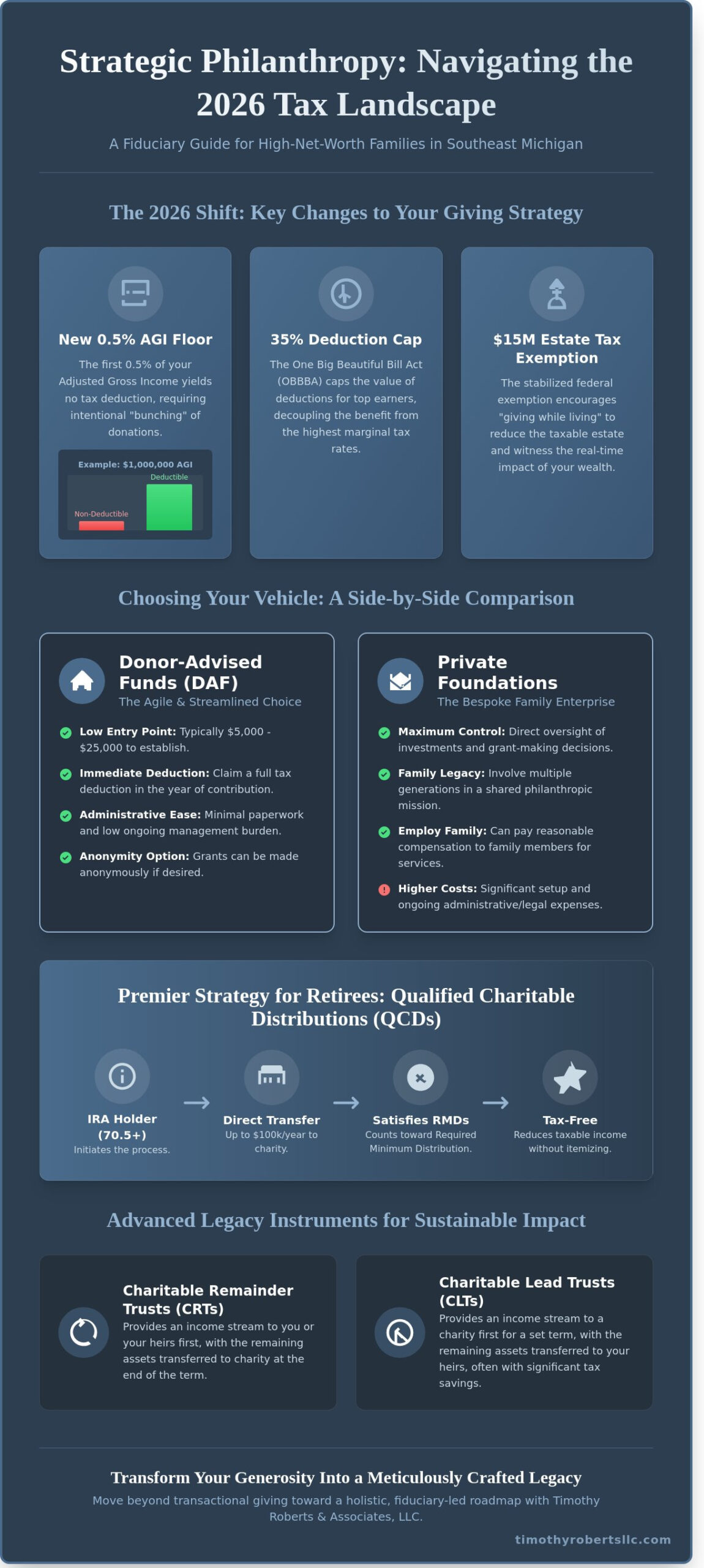
Philanthropy in Southeast Michigan is undergoing a fundamental transformation. The introduction of the One Big Beautiful Bill Act (OBBBA) in 2026 has redefined how high-net-worth individuals approach their annual contributions. It is no longer about simple generosity; it is about architectural precision. For those developing charitable giving strategies southeast michigan, the OBBBA introduces a 35% cap on the value of deductions for individuals in the highest tax brackets, effectively decoupling the tax benefit from the top marginal rate. This requires a shift toward a more strategic, holistic view of asset distribution.
To better understand how these shifts impact your personal legacy, watch this insightful discussion on making philanthropy a family tradition:
This legislative shift forces a move from impulsive checkbook giving to a structured, multi-year model. Donors must now account for a new 0.5% Adjusted Gross Income (AGI) floor. This means the first half-percent of your income yields no tax benefit, a hurdle that requires intentionality. By understanding the nuances of charitable contribution deductions, you can optimize your portfolio to ensure every dollar serves both your community and your financial objectives.
The Rise of the $15 Million Exemption
The permanent federal estate tax exemption, now stabilized at $15 million per individual, has altered the urgency of legacy planning. High-end asset management now favors “giving while living” to witness the impact of wealth in real time. This strategy reduces the size of the taxable estate while providing immediate support to local institutions. The OBBBA significantly raises the standard deduction for 2026, making itemized charitable claims less accessible for the average donor while simultaneously restricting the ceiling for the affluent.
Tax Thresholds and the 0.5% AGI Floor
Calculating your specific giving floor is the first step in a bespoke philanthropic plan. If your AGI is $1,000,000, your first $5,000 in donations will not provide a deduction. This change triggers a psychological shift; smaller, scattered gifts may lose their tax potency compared to previous years. To overcome this, many families are “bunching” their donations. This involves concentrating several years of giving into a single tax year to exceed the new thresholds and maximize the 2026 tax benefits. Effective charitable giving strategies southeast michigan now prioritize these larger, periodic infusions over traditional annual patterns.
Strategic Vehicles: Comparing Donor-Advised Funds and Private Foundations
Choosing the right vehicle for your philanthropy is a decision that balances administrative simplicity with the desire for absolute control. For high-net-worth individuals exploring charitable giving strategies southeast michigan, the choice often narrows down to Donor-Advised Funds (DAFs) or Private Foundations. Each offers a bespoke path toward impact, yet they function with distinct operational rhythms. A DAF provides a streamlined, turn-key solution. In contrast, a foundation offers a robust platform for those who view their giving as a family enterprise requiring direct oversight.
The Agility of Donor-Advised Funds
Donor-Advised Funds act as a sophisticated holding tank for your charitable capital. They’ve become the preferred choice for modern donors due to their low-cost entry point and minimal paperwork. While a foundation might require several million dollars to justify its existence, many DAFs can be established with as little as $5,000 to $25,000. This vehicle allows you to claim an immediate tax deduction, adhering to IRS guidelines on charitable contributions, while providing the flexibility to distribute those funds over many years.
DAFs offer several strategic advantages for the privacy-conscious donor:
- Total anonymity for grants, shielding your identity from public databases.
- Zero annual tax filings or excise taxes for the individual donor.
- Seamless integration with your investment portfolio management Detroit to ensure assets grow tax-free before distribution.
This agility makes the DAF an ideal tool for those who want to optimize their tax position during high-income years without the burden of immediate grant-making decisions.
Private Foundations for Legacy Control
When the goal is to create a permanent family legacy, a private foundation is the superior instrument. It provides a level of control that a DAF cannot replicate. Foundations allow you to hire family members, run your own charitable programs, and control the narrative of every grant. This structure is particularly effective for multi-generational wealth transfer, as it involves the next generation in the family’s mission through board seats and leadership roles.
However, this control comes with rigorous compliance. Foundations must navigate a 5% annual payout requirement and a flat 1.39% excise tax on net investment income. When developing charitable giving strategies southeast michigan, it’s vital to recognize that a foundation is a long-term commitment to transparency and governance. It transforms your wealth into a public-facing entity that can shape community outcomes for decades. If you’re seeking a bespoke wealth strategy that aligns your financial power with your personal values, the complexity of a foundation is often a worthwhile investment.
The decision ultimately rests on whether you value the quiet efficiency of a DAF or the authoritative presence of a private foundation. Both vehicles, when managed with precision, elevate your status from a mere donor to a strategic philanthropist.
Qualified Charitable Distributions (QCDs): The Fiduciary Tool for Retirees
For high-net-worth individuals in the Detroit metro area, QCDs represent the pinnacle of charitable giving strategies southeast michigan. This mechanism allows retirees aged 70.5 or older to transfer funds directly from their Individual Retirement Account (IRA) to a qualified 501(c)(3) organization. It’s the gold standard for tax efficiency because the distribution never touches your personal bank account, meaning it isn’t recorded as taxable income. This distinction is vital for those who have spent decades accumulating wealth and now face the tax implications of mandatory withdrawals.
The strategic power of the QCD lies in its ability to manage the “income trap” associated with Medicare. If your Adjusted Gross Income (AGI) exceeds specific thresholds, you trigger the Income Related Monthly Adjustment Amount (IRMAA), which significantly increases your Medicare Part B and Part D premiums. By utilizing a QCD, you satisfy your philanthropic goals while keeping your AGI lower, effectively avoiding these surcharges. For the 2024 tax year, the annual limit for a QCD is $105,000 per individual. Married couples who both have IRAs can double this impact, directing up to $210,000 annually toward their chosen causes without increasing their tax liability.
QCDs vs. Traditional Deductions
The landscape of itemized deductions changed significantly with the 2017 tax reforms, which nearly doubled the standard deduction. Most donors no longer receive a tax benefit for charitable gifts because their total deductions don’t exceed the standard threshold. A QCD bypasses this hurdle entirely. It functions as an “above-the-line” exclusion rather than an itemized deduction. By directing a QCD to a nonprofit, you satisfy your annual Required Minimum Distribution without adding a single dollar to your taxable income for the year. This strategy ensures your generosity provides a 100% tax benefit, regardless of whether you itemize.
Implementation in Retirement Planning
Executing a QCD requires meticulous timing and technical precision. The most common pitfall is taking the distribution yourself with the intent to write a personal check to the charity later. This mistake renders the distribution taxable. To qualify, the IRA custodian must issue the payment directly to the charitable entity. Strategic donors often align these transfers with their broader retirement income planning Ann Arbor goals to ensure the timing maximizes their cash flow and tax position for the fiscal year.
Consulting local resources for Planned Giving Strategies can help you identify which Southeast Michigan organizations are best equipped to receive these direct transfers. When you integrate these distributions into a holistic financial plan, you transform a mandatory tax obligation into a bespoke legacy. It’s about moving from passive compliance to active, strategic stewardship of your retirement assets.
Complex Legacy Instruments: Charitable Remainder Trusts (CRTs) and Lead Trusts
Sophisticated philanthropic planning requires more than a simple checkbook. For families seeking advanced charitable giving strategies southeast michigan, split-interest trusts offer a bespoke path to balance personal financial security with meaningful community impact. These instruments act as the strategic workhorse for high-level estate planning Farmington Hills residents utilize to optimize their long-term wealth. By decoupling the use of assets from their eventual ownership, donors can achieve specific tax outcomes that aren’t possible through direct donations.
Charitable Remainder Trusts (CRTs)
A CRT allows you to donate highly appreciated assets, such as real estate or stock, into a trust that pays you an income stream for a set term or for life. Because the trust is tax-exempt, it can sell these assets without immediate capital gains tax. This often preserves 20% to 37% more of the principal for reinvestment compared to a private sale. You must choose between a Charitable Remainder Annuity Trust (CRAT), which provides a fixed annual payment, or a Charitable Remainder Unitrust (CRUT), where payments fluctuate based on the trust’s annual valuation. When weighing trusts vs wills Michigan donors find that CRTs provide a level of control and tax efficiency that a standard will cannot match. The remainder of the trust assets passes to your chosen charity only after the income term concludes.
Charitable Lead Trusts (CLTs)
While a CRT pays you first, a Charitable Lead Trust (CLT) prioritizes the charity. The trust makes annual payments to a 501(c)(3) organization for a specified period; after that, the remaining assets pass to your heirs. This “front-loading” of the charitable gift can drastically reduce the gift and estate tax liability on the eventual transfer. In high-interest-rate environments, such as those seen throughout 2023 and 2024, certain CLTs become even more powerful. If the trust’s actual growth exceeds the IRS Section 7520 rate, that excess growth passes to heirs entirely tax-free. Beyond the tax math, these trusts serve as a vehicle for avoiding probate Ann Arbor estates require while instilling philanthropic values in the next generation.
Effective charitable giving strategies southeast michigan rely on the precise timing and selection of these instruments. Whether you’re looking to liquidate a business or transfer a family legacy, the choice between a CRT and a CLT depends on your specific cash flow needs and your vision for the future. These trusts aren’t just legal documents; they’re strategic interventions designed to transform your financial success into a lasting legacy.
Designing a Bespoke Charitable Strategy: The Fiduciary Path
Generic financial products often fail to address the nuance of a significant legacy. Elevating your philanthropy requires moving beyond simple transactional donations toward a custom-crafted roadmap. At Timothy Roberts & Associates, LLC, we utilize the fiduciary standard to ensure every recommendation serves your best interests exclusively. This intellectual rigor transforms charitable giving strategies southeast michigan from a year-end obligation into a sophisticated engine for wealth elevation and community impact.
A bespoke strategy begins with a holistic view of your balance sheet. We don’t just look at cash flow; we analyze the underlying architecture of your assets. By applying a strategic lens to your portfolio, we identify the most efficient vehicles, whether that involves a donor-advised fund, a private foundation, or a charitable remainder trust. This partnership ensures that your vision is supported by business-minded logic and creative passion. It’s about creating a narrative of shared success between your family and the causes you champion.
The Discovery Process
Meaningful philanthropy starts with a deep dive into the intersection of your financial requirements and your personal vision. We evaluate the suitability of diverse assets, including real estate holdings in Oakland County or concentrated stock positions that have seen 200% growth over the last decade. Donating appreciated securities often allows for a full fair market value deduction while bypassing capital gains taxes, a move that optimizes your total contribution. We work to set measurable impact goals that reflect your values with precision.
- Asset Suitability: Analyzing business interests and illiquid assets for donation potential.
- Impact Benchmarks: Establishing measurable goals, such as funding 50 scholarships or protecting 100 acres of local greenspace.
- Compliance: Ensuring every move aligns with the latest IRS guidelines to protect your tax standing.
Continuous Optimization
The financial landscape is never static. Tax laws, such as the 2017 Tax Cuts and Jobs Act, have fundamentally shifted how high-net-worth individuals approach deductions. We review your strategy annually to adjust for market shifts and legislative updates. Coordinating with your tax advising Ann Arbor team is a critical component of this process, ensuring that your charitable vehicles remain compliant and efficient as your wealth grows. This high-level coordination prevents the friction often found in fragmented financial planning.
Trust assets require active management to maintain their long-term viability and purchasing power. Engaging a financial advisor Bloomfield Hills provides the oversight necessary to balance investment growth with your distribution requirements. This collaborative approach allows you to finalize your charitable giving strategies southeast michigan with calm confidence. We move from vision to execution with a steady rhythm, turning your aspirational goals into a tangible, enduring legacy of success that lasts for generations.
Architecting Your Generational Contribution
The 2026 tax landscape represents a pivotal shift for high-net-worth individuals. With the sunset of several key provisions from the Tax Cuts and Jobs Act of 2017, the window to optimize your impact is narrowing. Successful wealth preservation requires more than just intent; it demands precision. By integrating sophisticated vehicles like Charitable Remainder Trusts or utilizing Qualified Charitable Distributions, you can transform potential tax liabilities into lasting community value.
Developing effective charitable giving strategies southeast michigan families trust requires a blend of creative vision and technical rigor. At Timothy Roberts LLC, we leverage over 25 years of wealth management expertise to craft bespoke tax-minimization roadmaps. Our fiduciary-led strategic planning ensures your contributions align with your personal values while maximizing every available fiscal advantage. Don’t leave your legacy to chance. It’s time to refine your approach with a partner who understands the intersection of aesthetics and functionality in financial design.
Elevate your legacy with a bespoke charitable strategy session.
Your commitment to the region’s future deserves a strategy as enduring as the impact you intend to make.
Frequently Asked Questions
What is the 0.5% AGI floor introduced in 2025, and how does it affect my 2026 taxes?
The 0.5% AGI floor is a specific threshold for Michigan state tax credits reinstated for donations to community foundations. When you file your 2026 taxes, this floor dictates the minimum contribution required to trigger specific state-level offsets. It transforms a simple donation into a strategic tax pivot. This mechanism ensures that your philanthropic impact in Detroit or Ann Arbor remains both measurable and tax-efficient for your overall portfolio.
Can I still use a Qualified Charitable Distribution (QCD) if I don’t itemize my deductions?
You can absolutely utilize a Qualified Charitable Distribution without itemizing your deductions on your federal tax return. Since the QCD amount is excluded from your adjusted gross income entirely, it provides a tax benefit even if you take the standard deduction. This is a cornerstone of effective charitable giving strategies southeast michigan donors use to minimize their tax exposure while supporting local non-profits and community initiatives.
What is the primary difference between a Donor-Advised Fund and a Private Foundation in 2026?
The primary distinction in 2026 lies in the deduction limits and administrative complexity. Donor-Advised Funds allow for a bespoke approach with an AGI deduction limit of up to 60% for cash contributions. Private foundations are capped at 30% for similar gifts. Choosing a DAF optimizes your immediate tax relief while removing the 1.39% excise tax often levied on foundation investment income. It’s a more streamlined path to impact.
How much can I donate through a QCD in 2026 without paying income tax on the distribution?
You can donate up to $112,000 through a QCD in 2026 without paying income tax on the distribution. This figure reflects the IRS inflation adjustments mandated by the SECURE 2.0 Act of 2022. It’s a powerful tool for those over age 70.5 to satisfy their Required Minimum Distributions. By directing these funds to a 501(c)(3) organization, you effectively lower your taxable income dollar-for-dollar and elevate your philanthropic reach.
Is it better to donate cash or appreciated securities to a charitable trust?
Donating appreciated securities to a charitable trust is almost always more strategic than giving cash. When you transfer stock held for over one year, you bypass the 20% capital gains tax and receive a deduction for the full fair market value. This holistic approach allows you to elevate your gift’s impact. It ensures the charity receives the full asset value rather than a sum diminished by taxes you’d otherwise owe.
What happens to a Charitable Remainder Trust (CRT) after the non-charitable income period ends?
The remaining assets in a Charitable Remainder Trust transfer to your chosen charity once the income period concludes. IRS regulations require that the projected remainder interest must be at least 10% of the initial fair market value. This transition marks the final step in a strategic life cycle. It ensures your legacy continues to fund essential community initiatives after providing you with a steady, bespoke income stream for many years.
How do the new 2026 tax brackets affect the value of my charitable deductions?
The return of the 39.6% top tax bracket in 2026 significantly increases the value of every dollar you donate. Under the sunsetting TCJA rules, the top rate was 37%. This shift means a $10,000 donation will save a high-earner $3,960 in taxes rather than $3,700. It’s a strategic window to reconsider your annual charitable giving strategies southeast michigan to optimize your net wealth while supporting the region’s long-term growth.
Can I name a charity as a beneficiary of my 401(k) or IRA to avoid estate taxes?
Naming a charity as your 401(k) or IRA beneficiary is a highly effective way to eliminate both estate and income taxes. Heirs often lose up to 40% of inherited retirement accounts to federal taxes, but charities receive 100% of the balance tax-free. This bespoke estate planning tactic preserves your hard-earned capital. It transforms a potential tax liability into a lasting legacy for the Southeast Michigan organizations you value most.
