

Mar
Elevating Your Retirement: Strategic Social Security Strategies for Michigan Residents in 2026
What if your Social Security check wasn’t just a monthly payment, but a high performance engine capable of shielding your wealth from the 2026 federal tax shifts? Many Michigan residents fear that claiming benefits early will leave over $100,000 on the table during their lifetime. It’s a valid concern, especially as you manage the complexities of the 2024 pension tax rollbacks and the looming federal tax torpedo. You’ve worked decades to build your legacy, and you deserve a retirement that reflects that level of dedication rather than one that’s diminished by avoidable fiscal leaks.
Refining your social security strategies michigan transforms a basic government promise into a bespoke financial asset. We’re going to explore how to align your claiming age with Michigan’s unique tax landscape to significantly lower your lifetime liabilities. This journey isn’t about following generic advice; it’s about crafting a strategic roadmap that maximizes your income while ensuring a 100% survivor benefit for your partner. We’ll break down the precise maneuvers required to elevate your retirement from a period of uncertainty into a masterclass in wealth preservation.
Key Takeaways
- Re-envision Social Security as a sophisticated, inflation-adjusted annuity rather than a mere monthly check to better protect your long-term purchasing power.
- Discover the mathematical advantage of the 8% annual deferral increase and how bespoke social security strategies michigan professionals employ can maximize survivor benefits.
- Navigate the “tax torpedo” by understanding how federal provisional income formulas and the Michigan tax landscape impact your net retirement wealth.
- Learn to coordinate your benefits with Michigan-based employer pensions and private portfolios to ensure Social Security serves as a resilient, strategic asset.
- Transition from generic online calculators to a bespoke roadmap that elevates your retirement through fiduciary-led precision and holistic integration.
Beyond the Basics: Why Michigan Social Security Planning Requires a Strategic Lens
For high-achieving professionals spanning the corridor from Ann Arbor to Detroit, retirement income is often viewed through a narrow lens. Most see a monthly check. In reality, Social Security functions as a sophisticated, inflation-protected annuity that requires meticulous calibration to perform alongside a private portfolio. Effective social security strategies michigan residents employ must move beyond simple age-based decisions to consider the broader economic topography of the Great Lakes State. We view this process as an elevation of your financial baseline, transforming a standard government benefit into a high-performance asset.
The U.S. Social Security system provides the foundational framework for this income, yet the rules are often rigid and impersonal. Southeast Michigan’s unique professional landscape, defined by high-level consultancy and executive roles, creates specific friction points. When your retirement involves complex tax considerations and legacy planning, a generic approach fails to capture the nuances of your total net worth. We focus on the intersection of aesthetics and functionality, ensuring your claiming strategy feels as polished and intentional as the rest of your financial life.
To better understand the depth of these high-level frameworks, watch this detailed analysis of modern claiming concepts:
The 2026 Landscape for Michigan Retirees
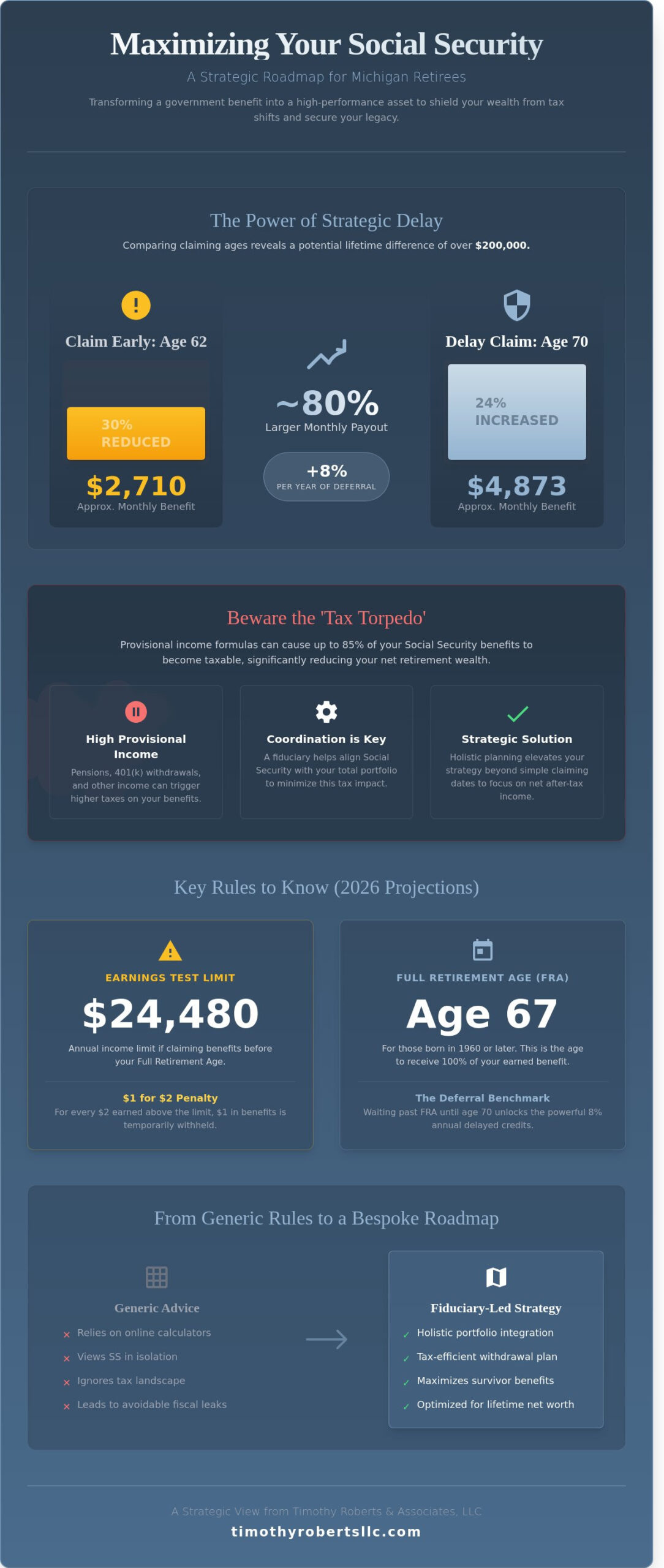
The regulatory environment is shifting rapidly. By 2026, the earnings test limit for individuals below their Full Retirement Age is projected to reach $24,480. This specific threshold creates a significant hurdle for Michigan’s growing demographic of “active longevity” retirees. These are the engineers, medical professionals, and educators who choose to consult or lead non-profits well into their sixties. If you earn a single dollar over that $24,480 limit, the Social Security Administration withholds $1 for every $2 earned. Full Retirement Age for individuals born in 1960 or later is 67. Understanding these dates and data points is essential to avoid the “tax torpedo” that often blindsides the unprepared.
Fiduciary Duty vs. Generic Advice
Relying on the Social Security Administration for advice is a common tactical error. SSA employees are trained to provide the rules; they aren’t authorized to provide a strategy tailored to your specific tax bracket or investment goals. They don’t look at your 401(k) balances in Bloomfield Hills or your real estate holdings in Birmingham. A bespoke approach requires a fiduciary who views your entire asset base through a holistic lens. At Timothy Roberts & Associates, LLC, we apply a rigorous framework to social security strategies michigan families can rely on for generational stability. We don’t just look for the highest monthly number. We optimize for the highest net-after-tax outcome over a thirty-year horizon. This level of intellectual curiosity and business-minded rigor ensures that your claiming decision supports your broader journey toward shared success and financial clarity.
Optimizing the Timeline: Advanced Claiming Strategies for High-Net-Worth Michiganders
High-net-worth retirement isn’t about basic survival; it’s about the sophisticated orchestration of cash flow. For those exploring social security strategies michigan offers a unique backdrop where tax-efficient distribution meets long-term wealth preservation. Many affluent residents view these benefits as an afterthought, yet the mathematical difference between a reactive claim and a strategic delay can exceed $200,000 over a 30-year retirement horizon.
The Power of Delay: Moving from 62 to 70
A maximum earner reaching age 62 in 2026 faces a stark choice. Claiming early results in a monthly payment of approximately $2,710. By delaying until age 70, that same individual elevates their monthly benefit to roughly $4,873. This 8% annual increase in delayed retirement credits represents a guaranteed, inflation-adjusted return that private markets rarely replicate with such certainty. To bridge the gap, strategic planners often utilize a “Social Security bridge” by drawing from traditional IRAs or 401(k)s. This tactic reduces future Required Minimum Distributions while allowing the Social Security floor to grow. Overcoming the emotional hurdle of “leaving money on the table” requires a shift in perspective. You aren’t losing benefits; you’re purchasing a larger, government-backed annuity at a deeply discounted rate.
Spousal and Survivor Benefit Coordination
The landscape of Official Social Security retirement benefits changed significantly for those born after January 2, 1954. The “restricted application” loophole has sunset, but coordination remains a vital lever for Metro Detroit couples. The primary goal for a high-earning household is to maximize the survivor benefit. When one spouse passes, the smaller of the two monthly checks disappears, and the survivor keeps the larger one. By ensuring the higher earner waits until 70, you’re effectively buying life insurance for the surviving spouse. For divorced individuals in Oakland County who were married for at least 10 years, claiming based on an ex-spouse’s record can provide a bespoke income stream without impacting the ex-spouse’s own benefit. This is a crucial, often overlooked component of a holistic financial plan.
The “Breakeven” Myth remains one of the most persistent obstacles to sound planning. Most retirees focus on the age where the cumulative total of late claiming surpasses early claiming, usually between 78 and 82. This focus is a strategic error. Social Security shouldn’t be viewed as a standard investment return. It’s longevity insurance. If you die at 75, your financial plan succeeded regardless of your claim date. If you live to 98, that maximized monthly check becomes the most valuable asset in your portfolio. It protects your lifestyle against the depletion of liquid assets during the final decades of life.
- Case Study: An Ann Arbor couple, both 62, with a $4.5 million portfolio.
- The Strategy: The primary earner delays until 70 while the lower earner claims at 67.
- The Impact: This approach allows their equity portfolio to compound for eight additional years while securing a permanent inflation hedge.
Implementing these social security strategies michigan residents can transform a standard government benefit into a tool for strategic wealth elevation. This level of intentionality ensures that your retirement income remains as resilient as the legacy you’ve built. Pacing your claims with your broader tax and investment goals creates a steady, logical flow of capital that supports even the most ambitious post-career visions.
Navigating the Michigan Tax Landscape: Social Security, Pensions, and the ‘Tax Torpedo’
The most frequent concern among high-net-worth retirees in Bloomfield Hills is the fear that their benefits will simply be taxed away. This isn’t just a pessimistic outlook; it’s a legitimate strategic hurdle. At the federal level, the IRS uses a specific formula called provisional income to determine how much of your benefit is taxable. This calculation includes your adjusted gross income, tax-exempt interest, and 50% of your Social Security benefits. If this total exceeds $34,000 for individuals or $44,000 for joint filers, up to 85% of your Social Security income becomes subject to federal income tax. Without a bespoke plan, you risk losing a significant portion of your liquidity to avoidable levies.
Effective social security strategies michigan residents employ must account for the “Tax Torpedo.” This phenomenon occurs when an extra dollar of traditional IRA or 401(k) income triggers taxation on an additional 85 cents of Social Security benefits. This creates a combined taxable impact where $1 of income results in $1.85 of taxable exposure. For a couple in the 22% federal bracket, this effectively spikes their marginal tax rate to over 40%. It’s a hidden trap that can devastate a retirement budget if your withdrawal sequence isn’t meticulously orchestrated. Strategic positioning of assets is the only way to lower your effective tax rate and protect your lifestyle.
Michigan’s Evolving Retirement Tax Laws
Michigan’s tax environment is currently undergoing a transformative shift that benefits retirees. Following the 2023 legislative changes, the state is phasing out the “pension tax” through 2026. For the 2024 tax year, retirees can choose between the existing tiered system or a new, broader set of deductions. By the 2026 tax year, the law will allow for a 100% deduction of private and public pension income for most residents. You can find the specific details in Michigan’s official retirement tax rules to see how these tiers apply to your birth year. Michigan remains one of the more favorable states for Social Security, as it’s currently 100% exempt from state-level taxation regardless of your income level. This allows us to focus our strategic efforts entirely on minimizing the federal bite.
Defusing the Tax Torpedo
To neutralize the Tax Torpedo, we often look toward Roth conversions performed early in retirement. By paying taxes now at a known rate, you reduce the size of future Required Minimum Distributions (RMDs) that would otherwise inflate your provisional income. This creates a holistic shield around your Social Security benefits. Another powerful tool is the Qualified Charitable Distribution (QCD). For those age 70.5 or older, a QCD allows you to send up to $105,000 annually directly from an IRA to a charity. This move satisfies your RMD requirements without adding a single cent to your adjusted gross income, keeping your Social Security taxation at the lowest possible level. While municipal bond interest remains free from federal income tax, it’s still included in the provisional income calculation that determines how much of your Social Security is subject to taxation. Sophisticated social security strategies michigan residents use prioritize these nuances to elevate their total after-tax wealth.
The Holistic Integration: Coordinating Social Security with Your Broader Portfolio
Retirement planning for the Michigan executive requires a fundamental shift in perspective. Social Security isn’t a standalone check; it’s the final structural element in a bespoke financial architecture. Treating these benefits as the lead asset often leads to suboptimal outcomes. Instead, the most effective social security strategies michigan residents employ involve positioning this income as the ultimate safety net. By delaying claims until age 70, you capture a guaranteed 8% annual increase in benefit value. This strategic delay transforms a standard government benefit into a high-yield asset that private markets rarely match with such consistency.
The sequence of withdrawals dictates the longevity of your total wealth. Tapping into taxable brokerage accounts or specific 401(k) assets during the “bridge years” between retirement and age 70 allows your Social Security credits to compound. This approach preserves the principal of your private investments while maximizing the inflation-adjusted floor provided by the Social Security Administration. It’s a calculated move. You’re trading liquid assets now for a higher, permanent income stream that remains immune to the fluctuations of the Dow Jones or the cyclical nature of the Michigan automotive sector.
The Pension-Social Security Intersection
Michigan public employees and University of Michigan faculty must navigate the Windfall Elimination Provision (WEP). Established in 1983, this federal law can reduce Social Security benefits by up to 50% of the non-covered pension amount for those with fewer than 30 years of substantial earnings. Professionals in Farmington Hills managing 403(b) or 401(k) plans must balance these fixed pensions with the 3.2% Cost-of-Living Adjustment (COLA) seen in 2024. Success lies in timing distributions to prevent “tax torpedoes” where RMDs push Social Security income into higher tax brackets.
Asset Allocation and Longevity Risk
View your Social Security benefit as the “fixed income” or bond portion of a diversified portfolio. If your projected benefit is $45,000 annually, you effectively hold a $1.1 million bond at a 4% withdrawal rate. This realization allows for a more growth-oriented investment posture in your other accounts. A high Social Security floor provides the confidence to maintain equity exposure in Metro Detroit’s volatile market. It mitigates the risk of outliving your assets. Living to age 95 becomes a testament to your health rather than a threat to your balance sheet. For those seeking additional guaranteed income streams to complement Social Security, exploring strategic annuities michigan options can provide another layer of financial security.
Of course, a long and fulfilling retirement is not just about financial health, but physical well-being too. To help ensure your physical health matches your financial preparedness, Michigan residents can check out Optima Physical Therapy for specialized care.
Managing market volatility in Southeast Michigan requires a buffer. When the market contracts, your Social Security income remains a constant, allowing you to avoid selling equities at a loss to cover living expenses. This preservation of capital during downturns is essential for long-term portfolio health. It’s about creating a rhythmic cash flow that supports your lifestyle without compromising your legacy.
Partnering for Precision: How a Fiduciary Elevates Your Retirement Roadmap
The transition from basic claiming to strategic wealth elevation represents the defining moment of a successful retirement. Most individuals treat Social Security as a standalone check, yet it functions most effectively when treated as one integrated component of a larger financial engine. It’s time to move beyond the limitations of generic online calculators. These automated tools lack the nuance required to account for the interplay between Michigan property taxes, specific municipal pension offsets, and complex family dynamics. A bespoke financial roadmap replaces guesswork with a calculated trajectory toward growth.
The Timothy Roberts & Associates Difference
For 25 years, Timothy Roberts & Associates has served as a dedicated fiduciary partner for families in Ann Arbor and Detroit. This role is distinct because it requires a legal and ethical commitment to prioritize your interests above all else. Our methodology thrives at the intersection of tax preparation and investment management. This dual focus is critical as we approach 2026, the year the sunsetting of provisions from the 2017 Tax Cuts and Jobs Act will likely shift tax brackets back to higher levels. Effective social security strategies michigan residents utilize must account for these fluctuating rates to prevent the “tax torpedo” that can subject up to 85% of benefits to federal income tax. We provide ongoing monitoring to ensure your plan remains optimized as these laws evolve.
Your Next Strategic Move
Transitioning from uncertainty to clarity requires a coordinated approach and a commitment to detail. When you visit our offices for a consultation, bringing your most recent Social Security Administration statements and your last two years of tax returns allows us to build a high-fidelity model of your future. We analyze the 2,732 rules governing Social Security to find the exact combination that maximizes your lifetime household income. This process identifies opportunities that generic advisors often overlook, such as the strategic timing of Roth conversions to lower future required minimum distributions. The peace of mind that comes from a coordinated plan is invaluable. You can schedule a portfolio review in Bloomfield Hills to begin this transformation today.
Our firm views retirement as a period of strategic optimization rather than a simple withdrawal phase. We pair short, punchy tactical moves with a long-term vision to protect the assets you’ve spent decades building. By integrating your social security strategies michigan with your broader estate and tax goals, we help create a legacy that lasts. This is the difference between simply retiring and retiring with a position of absolute strength. We invite you to experience a partnership where personal attention meets high-level expertise.
Success in retirement isn’t accidental; it’s engineered. It requires a strategist who understands that your situation is unique and deserves more than an off-the-shelf solution. We take the time to solve complex problems, guiding you from a high-level vision down to the practicalities of execution. The result is a polished, intentional plan that inspires trust and fosters aspirational growth. Let’s elevate your retirement roadmap together.
Architecting Your 2026 Michigan Retirement Legacy
Retirement isn’t a static event; it’s a dynamic evolution that requires meticulous precision. Navigating the 2026 tax landscape means addressing the ‘Tax Torpedo’ while optimizing your claiming timeline for maximum cumulative impact. When you integrate these benefits with your broader portfolio, you transform a standard government payout into a sophisticated strategic asset. It’s about moving beyond basic survival to achieve true financial elevation through intentional planning.
Implementing the advanced social security strategies michigan families require demands a holistic view of your entire financial ecosystem. Our fiduciary advisors bring over 25 years of local experience to every consultation. From our offices in Ann Arbor, Detroit, and Farmington Hills, we provide the high-level expertise needed to harmonize your pension, investments, and tax obligations. We don’t just plan for your future; we architect a legacy built on business-minded rigor and creative passion. For those seeking comprehensive retirement income planning services ann arbor professionals trust, our integrated approach ensures every aspect of your financial transition is optimized for long-term success.
Elevate your retirement strategy with a bespoke Social Security analysis today.
Your vision for a refined and secure retirement is entirely within reach. We’re ready to help you navigate these complexities with the calm confidence you deserve.
Frequently Asked Questions
Is Social Security income taxable in the state of Michigan in 2026?
No, Michigan does not tax Social Security benefits, and this remains the law for the 2026 tax year. Under the state’s current tax code, 100% of your Social Security income is exempt from Michigan state income tax. This allows you to retain more of your retirement distributions for personal use. While federal taxes may still apply to 50% or 85% of your benefits, Michigan’s policy provides a strategic advantage for those optimizing their long-term wealth.
What is the “Tax Torpedo” and how can Michigan residents avoid it?
The Tax Torpedo is a sharp spike in marginal tax rates that occurs when additional income triggers the taxation of up to 85% of your Social Security benefits. This often happens when IRA distributions push your provisional income above the $34,000 threshold for individuals or $44,000 for couples. You can avoid this by using a bespoke strategy involving Roth conversions or managing capital gains. This approach ensures your withdrawals don’t inadvertently elevate your tax liability during your retirement years.
Can I work in Detroit and still collect Social Security benefits before age 67?
You can work in Detroit while receiving benefits, but the Social Security Administration will reduce your payments if you earn more than the annual limit. For 2026, if you’re under the full retirement age of 67, the government deducts $1 for every $2 you earn above the established threshold. This limit is projected to be approximately $23,400 based on current inflationary trends. These withheld funds aren’t lost; they’re recalculated into your benefit once you reach full retirement age.
How do Michigan’s recent pension tax changes affect my Social Security strategy?
Michigan’s repeal of the pension tax, finalized through Public Act 4 of 2023, allows you to exclude more private and public pension income from state taxes. This change means you can potentially delay Social Security to age 70 while living off your pension, as the state no longer penalizes those withdrawals as heavily. Integrating these new rules into your social security strategies michigan planning helps you maximize your net cash flow. It’s a holistic shift in how we view retirement income.
What happens to my Social Security if my Michigan-based employer pension is reduced?
If your Michigan employer pension is reduced, your Social Security benefits remain stable unless the pension was from “non-covered” employment subject to the Windfall Elimination Provision. For those in the Michigan Public School Employees Retirement System, a lower pension might actually reduce the WEP penalty, slightly increasing your Social Security payout. We analyze these variables to ensure your total income remains optimized. This level of detail is essential for a secure and predictable transition into your retirement years.
How much more will I get if I wait until age 70 to claim Social Security in 2026?
Waiting until age 70 increases your monthly benefit by 24% compared to claiming at your full retirement age of 67. This 8% annual increase is a guaranteed credit that compounds your lifetime purchasing power. For a resident expecting a $3,000 monthly benefit at 67, delaying until 2026 or beyond results in a $3,720 monthly check. This strategic delay serves as a powerful hedge against inflation and longevity risks. It’s a premium way to elevate your financial floor.
Do I need a financial advisor in Ann Arbor to help with my Social Security claim?
Engaging a financial advisor in Ann Arbor provides a sophisticated layer of customization for your social security strategies michigan roadmap. While you can file independently, a professional ensures you navigate local tax nuances and complex filing tactics like the restricted application if you’re eligible. Our goal is to transform a standard government claim into a high-performing asset. This partnership focuses on long-term wealth preservation rather than just a simple transaction, ensuring every decision is intentional.
