

Sep
Financial Planning for Physicians in Michigan with High Student Loan Debt
What if the best student loan strategy isn’t the one that gets your balance down fastest? For physicians searching “financial planning for physicians michigan,” the bigger challenge is coordinating repayment with taxes, savings, and the financial decisions that shape life beyond residency.
It’s understandable to feel pulled in several directions. A strong income may still leave little room to maneuver once loan payments, taxes, and household costs are accounted for. Employer benefits, changing compensation, and career transitions can add complexity. Choosing a repayment path without considering those factors may make it harder to understand how today’s decisions affect future options.
This article explains how loan choices can interact with retirement contributions, cash reserves, investment priorities, tax planning, and financial protection. You’ll find a framework for deciding what to prioritize and practical questions to ask when comparing financial planning professionals. The goal is a coordinated plan that reflects your career, obligations, and long-term goals, rather than a series of disconnected decisions.
Key Takeaways
- Start with a coordinated view of debt, career stage, benefits, and personal goals before deciding what to prioritize.
- Review loan terms and repayment options step by step, then revisit the plan as circumstances change.
- Weigh repayment, retirement contributions, cash reserves, and tax considerations together. The right balance depends on your circumstances and on details that need verification.
- For financial planning for physicians michigan, assess how a planning professional connects student debt with taxes, investing, retirement, and protection.
- Review your plan after major transitions, such as completing residency, changing jobs, starting a practice, or growing your family.
Financial planning for physicians michigan: why the whole picture matters
Coordinated physician financial planning connects debt repayment, taxes, savings, protection, and long-term goals in one adaptable strategy. Income alone doesn’t show how much financial flexibility a physician has. Loan payments, the transition from training to practice, tax obligations, family priorities, and employer benefits all affect what can reasonably be set aside and when.
That’s why comprehensive financial planning for physicians should begin with the full financial picture, not a single balance or investment account. Financial planning coordinates decisions; investment management focuses on a portfolio, tax preparation reports tax information, and loan servicing handles account administration. These functions may inform one another, but they aren’t interchangeable.
For a concise introduction to a planning framework for doctors, watch this video:
Why a physician’s income alone does not determine financial readiness
A physician may earn more after training while also facing loan payments, taxes, and goals that were postponed during school or residency. Housing, family plans, and retirement saving can all compete for the same monthly cash flow. A plan helps clarify those trade-offs rather than assuming higher earnings automatically resolve them.
Hypothetical example: A physician finishing residency is considering a higher-paying job while choosing a loan repayment approach, building cash reserves, and deciding how much to contribute to a workplace retirement plan. The best next step depends on loan terms, available benefits, household needs, and the expected career path, not salary alone.
High earnings and financial flexibility aren’t synonymous. Flexibility depends on how income is allocated across obligations and goals.
Which financial decisions should be planned together?
Review repayment alongside emergency savings, retirement contributions, insurance needs, taxes, and family goals. For background on differences between federal and private borrowing, see this overview of student loans in the United States. A repayment choice can affect cash available for reserves. Retirement contributions may affect taxable income, depending on the account and applicable rules.
There’s no universal priority order. The right balance depends on individual loan terms, employment, benefits, goals, and current rules. Revisit the plan when those details change, and verify loan-specific decisions with current official sources and the relevant servicer through Timothy Roberts & Associates, LLC.
How physicians can coordinate student loan repayment with long-term goals
Repayment is part of a larger financial strategy. Federal and private loans can have different terms, borrower protections, and repayment options, so start with the details of your own loans rather than assuming one approach fits every physician. For financial planning for physicians michigan, compare those details alongside career plans, benefits, cash needs, and long-term priorities.
What to gather before comparing repayment approaches
Build a clear loan inventory before weighing options. For each loan, record the balance, interest rate, type, payment terms, and current repayment status. Add employer benefit details, household cash flow, and likely career or family changes. Flag any federal program eligibility and tax treatment for verification with current official sources or a qualified specialist. If you may qualify for a state or federal program, confirm its current terms directly. The Michigan State Loan Repayment Program is one resource to review for eligibility and program details.
How to weigh repayment against saving and investing
Use a repeatable process to turn the information you’ve gathered into a decision:
- Inventory loans. Separate federal and private debt, and record the terms for each loan.
- Clarify goals. Identify priorities such as building liquidity, saving for retirement, or preparing for a career or family transition.
- Compare options. Review repayment approaches against loan terms, protections, and any verified program eligibility.
- Model trade-offs. Consider interest costs, cash available for emergencies, time horizon, risk tolerance, tax implications, and employer retirement benefits.
- Review periodically. Revisit the strategy when income, employment, benefits, household needs, or applicable rules change.
Paying debt faster can reduce the time interest accrues, but directing every available dollar to loans may leave less cash for emergencies or retirement saving. Investing instead involves uncertainty and depends on your time horizon and risk tolerance. Employer retirement benefits may also affect the comparison, so review the plan’s actual terms before deciding how much to contribute. No single debt-first or investing-first rule works for everyone.
Once you’ve gathered the facts and clarified the trade-offs, coordinated financial planning can help connect loan decisions with tax, investment, and retirement priorities. You can explore coordinated financial planning as one way to consider how these decisions fit together.
How to compare repayment, retirement saving, and tax trade-offs
A useful comparison considers more than the monthly payment. Review how each choice may affect liquidity, interest costs, retirement progress, taxes, and future flexibility. Education Data Initiative provides context on average medical school debt, but an individual physician’s loan balance and terms should guide personal decisions, not a national average.
The right balance depends on loan terms, goals, benefits, and risk capacity. The table offers a planning framework, not a prediction or recommendation. General trade-offs can help frame questions; tax outcomes, loan program eligibility, and repayment rules require current, individual verification.
| Option | Potential benefit | Trade-offs and key unknowns | Review when |
|---|---|---|---|
| Repayment | Paying more toward principal may reduce interest over time. | Extra payments can limit liquidity; terms and protections differ by loan type. | Loan terms, repayment status, or program eligibility changes. |
| Retirement saving | Contributions can support long-term goals and may make use of workplace plan features. | Money committed to a plan may be less accessible; investment returns aren’t guaranteed. | Check plan eligibility, contribution rules, and whether the employer offers matching. |
| Cash reserves | Accessible savings can help absorb unexpected expenses or income changes. | Cash held aside isn’t directed toward debt reduction or invested for long-term growth. | Household expenses, job stability, or family needs shift. |
| Tax planning | Coordinated decisions may help account for potential tax effects across choices. | Results depend on income, filing status, loan type, and current rules; don’t assume a deduction or specific outcome. | Income, filing status, or applicable tax and loan rules change. |
How employer retirement plans may affect the decision
Review the plan documents before deciding how much to contribute. Confirm eligibility, contribution rules, and whether matching is available. Not every employer offers matching, and terms vary. A careful review of retirement income planning strategies can put current contributions in context with longer-term needs.
Where tax planning belongs in the comparison
Tax effects aren’t universal. Income, filing status, loan type, and current tax rules can all matter, so verify potential treatment with an appropriate tax professional before acting. Coordinating loan choices with coordinated tax advising can help keep assumptions visible and decisions connected, without treating an unverified tax outcome as certain.
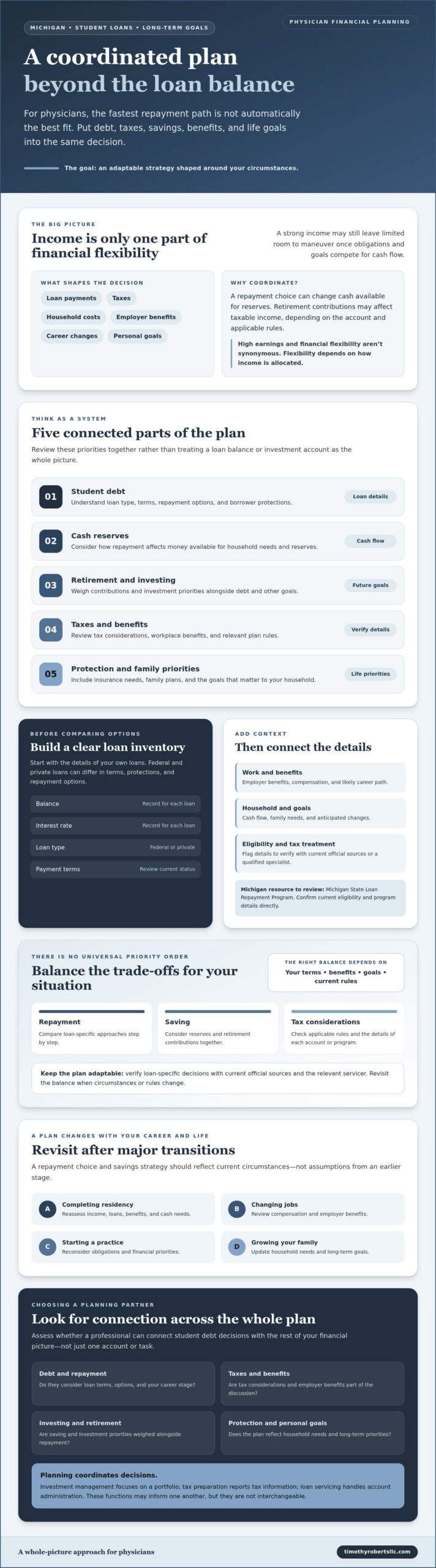
How physicians can build a practical financial plan around career and life changes
A practical plan should be clear enough to act on and flexible enough to evolve. For financial planning for physicians michigan, coordinate cash flow, debt, retirement, protection, taxes, and estate considerations as career and household needs shift, rather than treating each as a separate task.
Use this checklist to identify areas that may need attention:
- Cash reserves: Assess whether accessible savings fit your household expenses, obligations, and tolerance for unexpected costs.
- Debt review: Recheck loan balances, terms, repayment status, and any program eligibility that requires current verification.
- Retirement: Review available accounts, contribution rules, and how saving fits alongside debt and other priorities.
- Insurance: Consider income protection and life insurance needs, and compare them with existing workplace coverage.
- Taxes: Revisit withholding, estimated payments, and planning assumptions as income or circumstances change. Confirm tax questions against current rules.
- Estate coordination: Review whether your existing arrangements reflect your wishes and household needs. Financial planning can support coordination, but the firm does not draft legal documents. Consult an attorney about creating or updating them.
After reviewing these priorities, you can discuss your financial planning priorities as part of a broader conversation about connecting debt, tax, investment, retirement, and protection decisions.
Which protections and planning documents deserve a review?
Check how much of your income depends on continued work, what coverage your employer provides, and whether that coverage aligns with your needs. For estate coordination, consider how financial accounts, insurance, and other arrangements relate to documents prepared with legal counsel. Exploring estate and legacy planning considerations can help surface questions to discuss with the appropriate financial and legal professionals.
When should a physician revisit the plan?
Major transitions can change the assumptions behind a plan. Completing residency, changing employers, becoming a practice owner, or experiencing a family change may affect income, benefits, cash needs, and priorities. Changes in debt circumstances or financial goals can also prompt a review. Revisit repayment and tax assumptions when relevant rules change, and verify current requirements through official sources or qualified professionals.
Financial planning can help coordinate these choices, but it doesn’t replace a loan servicer for account-specific servicing questions or an attorney for legal advice and document preparation. The aim is a connected framework that reflects your circumstances, with each professional’s role kept clear.
How to choose a financial planning partner for physicians with high student loan debt
The right planning partner should help you understand how financial decisions connect while being clear about what falls within their role. As you compare professionals for financial planning for physicians michigan, look beyond titles. Understand the services offered, how advice is delivered, and whether the professional’s experience fits the questions you need to address.
Questions to ask before engaging a financial planner
Use an initial conversation to clarify the relationship before sharing sensitive information or committing to ongoing work. Ask direct questions and look for answers you can understand.
- Fiduciary responsibility: Will you act as a fiduciary, and when does that responsibility apply? Ask what it covers and how potential conflicts are disclosed.
- Compensation: How are you compensated? What services are included in ongoing or project-based fees, and are there other costs or compensation arrangements to understand?
- Scope of services: Which areas do you advise on directly, such as financial planning, taxes, investment management, retirement, or insurance analysis? What falls outside your scope?
- Student loan guidance: Who reviews loan program rules and eligibility? How do you coordinate loan decisions with tax, investing, retirement, and protection priorities, and when would you involve a qualified outside specialist?
- Relevant experience: What experience do you have with clients whose career paths or compensation structures resemble mine? If you work with physicians, what does that experience involve?
Don’t assume physician-specific expertise based on a firm’s general financial planning experience. Ask for a clear description of relevant work and how the planner will learn the details of your employment, benefits, debt, and goals. Confirm current program rules with official sources or an appropriately qualified specialist before relying on loan-specific guidance.
How Timothy Roberts & Associates may fit into a coordinated plan
Timothy Roberts & Associates, LLC reports more than 25 years of experience and was founded in 1998. The firm describes its advisors as fiduciaries and offers financial planning, tax advising, investment portfolio management, retirement income planning, estate and legacy planning, and risk management. These services may be relevant if you’re seeking to connect financial priorities, but the firm’s stated services do not identify a physician-specific specialty.
Use a conversation to explore fit: explain the decisions you’re weighing, ask how the firm would coordinate the relevant planning areas, and clarify what it does not handle. The goal is to understand whether its approach and scope align with your needs, not to assume a particular outcome.
If you’d like to discuss how your priorities fit together, start a conversation about your financial plan.
Build a financial plan that can grow with you
Student debt doesn’t have to be managed at the expense of every other goal. A thoughtful plan connects repayment choices with savings, retirement, taxes, and protection, then adapts as your career and life change. The central question isn’t simply how quickly to pay down debt, but how to make decisions that support your priorities together.
That’s the purpose of financial planning for physicians michigan: creating a coordinated framework shaped by your loan terms, employment, benefits, and long-term goals. Timothy Roberts & Associates, LLC offers financial planning, tax advising, investment portfolio management, and retirement income planning. Founded in 1998, the firm reports more than 25 years of experience and describes its advisors as fiduciaries. Consider asking how its services and approach align with the questions you need to resolve.
Explore a coordinated approach to your financial plan. With a clearer view of how each decision fits, you can move forward with greater confidence and make room for the future you’re building.
Frequently Asked Questions
How should physicians with high student loan debt prioritize repayment and retirement saving?
Compare loan terms, household cash needs, career goals, and workplace retirement plan details before setting priorities. For financial planning for physicians michigan, an initial review might include required loan payments, accessible savings, and available retirement contributions, including whether the employer offers matching. The appropriate balance depends on personal circumstances, not a universal debt-first or investing-first rule. Verify loan program eligibility and tax treatment using current official sources.
Should a physician pay off student loans before investing?
Not necessarily. Paying loans faster may reduce interest over time, while investing can support long-term goals but involves risk and uncertain returns. Compare the loan’s interest rate and terms with your time horizon, cash reserves, risk tolerance, and any employer retirement benefits. Consider whether extra payments could leave you short on accessible savings. The decision should reflect your full financial picture rather than a single rule of thumb.
Can student loan repayment options affect a physician’s financial plan?
Yes. Repayment choices can change monthly cash flow and affect how much is available for savings, retirement contributions, or other priorities. Federal and private loans may have different terms, protections, and options, and program eligibility can depend on individual circumstances. Before making a change, verify current rules with official sources or a qualified specialist, and consider how the choice fits your employment, tax situation, and longer-term goals.
What financial planning services do physicians with student debt need?
Useful services may include financial planning that coordinates student debt with tax advising, investment portfolio management, retirement income planning, and risk management. Estate and legacy planning or education funding strategies may also matter, depending on household goals. Not every physician needs the same combination. Clarify which services a professional provides directly, what falls outside their scope, and whether you’ll need a loan specialist, tax professional, or attorney for questions they don’t handle.
When should a physician speak with a financial planner about student loans?
Consider speaking with a planner when loan decisions begin competing with other goals, or before a major transition such as completing residency, changing jobs, starting a practice, or adjusting household plans. Early coordination can help you identify what information to gather and which assumptions need verification. You don’t need to wait until your loans are paid down or your finances feel settled to ask how debt fits into your broader plan.
How can physicians compare a financial planner’s fees and services?
Ask how the planner is compensated, what ongoing or project-based fees include, and whether other compensation or costs may apply. Compare the scope of services, such as financial planning, tax advising, investment management, or retirement planning, rather than relying on a title alone. Ask how loan questions are addressed and when outside specialists are involved. Request a clear explanation of fiduciary responsibilities, potential conflicts, and the relationship’s scope.
Does Timothy Roberts & Associates specialize in financial planning for physicians?
The firm’s stated services do not identify a physician-specific specialty. Timothy Roberts & Associates, LLC reports more than 25 years of experience, was founded in 1998, and describes its advisors as fiduciaries. Its services include financial planning, tax advising, investment portfolio management, and retirement income planning. Ask directly about relevant experience and how the firm would address your particular student loan and career considerations.
