

Apr
How to Not Run Out of Money in Retirement: A Strategic Framework for 2026
According to the 2024 Employee Benefit Research Institute survey, 27% of retirees now report that their living expenses are significantly higher than they originally anticipated. It’s natural to feel a quiet sense of unease when you realize that a 20% market correction during your first thirty-six months of retirement could permanently compromise your financial independence. You’ve spent a lifetime accumulating wealth. Now, the challenge shifts to the art of sustainable decumulation. Understanding how to not run out of money in retirement requires a move away from generic rules toward a more intentional, strategic approach.
This article provides a bespoke framework for 2026 designed to elevate your financial security and protect your lifestyle against the dual pressures of market volatility and shifting tax codes. We’ll master the complexities of sequence-of-returns risk and create a predictable income stream that remains resilient even if inflation mirrors the 3.4% levels seen in recent years. You’ll discover a holistic hierarchy for tax-efficient withdrawals that minimizes your liability while ensuring your legacy remains fully intact for the next generation.
Key Takeaways
- Shift from a simple accumulation mindset to a strategic distribution framework to effectively mitigate the risks of longevity and inflation.
- Discover how to not run out of money in retirement by implementing a bespoke bucket strategy that segments your assets by time horizon and risk.
- Evolve beyond the rigid 4% rule by adopting dynamic guardrails that allow for strategic spending adjustments based on real-time market performance.
- Protect your capital from unnecessary depletion by mastering a holistic tax decumulation hierarchy across taxable, deferred, and tax-free accounts.
- Elevate your long-term stability by leveraging the fiduciary advantage and behavioral coaching to maintain discipline during periods of market volatility.
Understanding the New Landscape of Longevity Risk
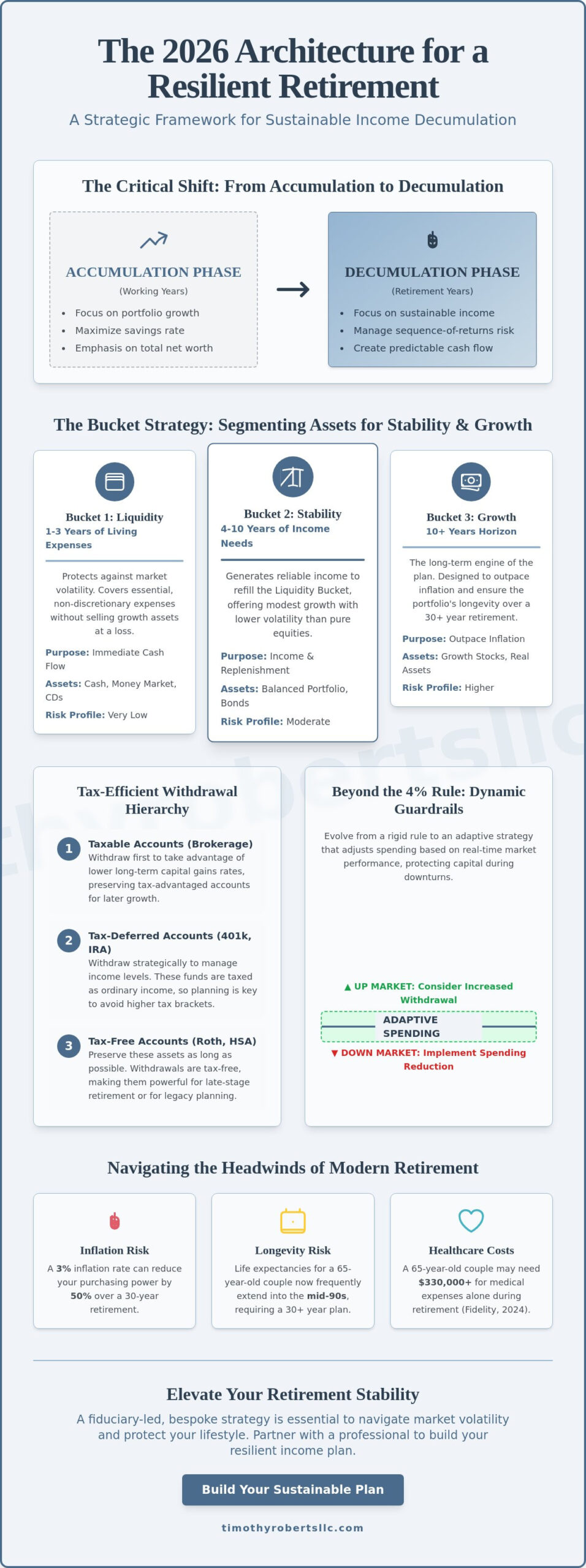
Retirement isn’t a static destination; it’s a dynamic phase of life that requires a total recalibration of your financial philosophy. Longevity risk represents the mathematical probability that you’ll outlive your financial resources during a period of sustained high inflation. As life expectancies for a 65-year-old couple now frequently extend into the mid-90s, the challenge of how to not run out of money in retirement has evolved from a simple savings goal into a complex engineering problem. It requires a move away from generic templates toward a bespoke strategy that accounts for three decades of economic shifts.
The transition from an accumulation mindset to a distribution mindset is often the most difficult hurdle for high-net-worth individuals. While your working years focused on growth and gross asset totals, your retirement years demand a focus on sustainable extraction. By 2026, healthcare costs are projected to consume a larger portion of the average retiree’s principal balance. Data from the 2024 Fidelity Retiree Health Care Cost Estimate suggests a 65-year-old couple may need $330,000 for medical expenses alone; a figure that will likely climb as we approach 2026. Securing objective advice requires a fiduciary standard. This legal obligation ensures your strategy is built on your best interests rather than commission-driven products.
The Shift from Net Worth to Cash Flow
A high net worth provides a foundation, but it doesn’t guarantee a sustainable lifestyle. You can’t pay for groceries with a deed to a house or a volatile stock portfolio. Success requires a “Retirement Paycheck” strategy. This involves a Retirement planning process that transforms illiquid or volatile assets into predictable, monthly distributions. Sequence of Returns Risk is the danger that market losses early in your retirement will permanently deplete your portfolio’s ability to recover. This risk makes the timing of your withdrawals just as important as the size of your nest egg.
The Hidden Erosion: Inflation and Purchasing Power
Inflation is the silent thief of retirement security. Even a moderate 3% inflation rate can reduce your purchasing power by 50% over a 30-year span. Many investors retreat to cash and “safe” bonds when markets get volatile, yet these assets often increase the risk of running out of funds because they fail to outpace rising costs. To protect your lifestyle, you must focus on Real Return, which is your gain after subtracting inflation, rather than Nominal Return. A bespoke portfolio must balance growth and stability to ensure your how to not run out of money in retirement strategy remains resilient against the rising cost of living.
The Architecture of a Sustainable Retirement Income Plan
A sophisticated retirement plan isn’t a static document; it’s a dynamic architecture designed for resilience. To master how to not run out of money in retirement, you must categorize wealth into three distinct streams: guaranteed cash flow, investment-driven distributions, and supplemental income. This holistic approach ensures your lifestyle remains insulated from the erratic rhythms of global markets. Determining how to not run out of money in retirement requires a fundamental shift from a growth mindset to a strategic distribution mindset.
The “Bucket Strategy” acts as the structural foundation of this framework. By segmenting assets into tiers based on time horizons, you protect immediate liquidity while allowing long-term capital the space to compound. This method transforms a generic portfolio into a disciplined sequence of cash flow. Integrating Investment Portfolio Management into this broader distribution framework allows for a bespoke transition from wealth accumulation to strategic decumulation.
The Income Floor: Guaranteed Sources
Your income floor is the bedrock of financial stability. Strategic timing of Social Security remains the most effective tool for building this base. Delaying benefits beyond your full retirement age maximizes the 8% annual delayed retirement credits, providing a stream that lasts a lifetime. It’s essential to prepare for retirement by identifying your Essential Expense Ratio. This calculation ensures that 100% of your non-negotiable costs, such as property taxes and healthcare premiums, are met by non-market-correlated sources like pensions or highly rated annuities.
The Growth Engine: Portfolio Withdrawals
The investment portfolio serves as the engine for long-term purchasing power. Even in distribution, maintaining equity exposure is vital to hedge against an average historical inflation rate of 3.3%. We use systematic rebalancing to harvest gains during market peaks, which maintains your targeted risk profile without emotional interference. To mitigate sequence of returns risk, a “Cash Buffer” technique utilizes two to three years of liquid reserves to prevent the forced liquidation of depressed assets during bear markets.
This strategic orchestration allows you to elevate your financial legacy through intentional design rather than chance. By aligning your cash flow with your values, you create a sustainable path forward.
Static vs. Dynamic Withdrawal Strategies: Beyond the 4% Rule
The 4% rule, established by William Bengen in 1994, served as a foundational benchmark for decades. However, the economic landscape of 2026 demands a more sophisticated approach. Relying on a fixed percentage adjusted for inflation creates a rigid framework that fails to account for market volatility or sequence of returns risk. To truly master how to not run out of money in retirement, investors must transition from static models to dynamic, responsive architectures. This evolution allows for a strategy that respects market realities rather than ignoring them.
The Risks of Static Withdrawal
Blindly adhering to inflation adjustments during a market downturn can accelerate portfolio depletion. Consider a retiree who experiences a 20% market correction in their first year of retirement. If they continue to withdraw a fixed, inflation-adjusted amount from a shrinking base, they effectively sell low. This locks in losses and significantly shortens the portfolio’s lifespan. This phenomenon, known as sequence of returns risk, is the primary catalyst for premature exhaustion. Additionally, bull markets often create a wealth illusion. During these periods, retirees might feel overconfident and increase spending, failing to recognize that these gains are necessary to buffer against future contractions. Without a mechanism to temper this behavior, the long-term health of the portfolio is compromised.
Implementing Dynamic Guardrails
The Guyton-Klinger rules offer a strategic alternative by establishing upper and lower guardrails. This method creates a bespoke spending plan that reacts to actual portfolio performance. If your portfolio performs exceptionally well and your withdrawal rate drops below a certain threshold, you increase your spending to enjoy your wealth. Conversely, if the market dips and your withdrawal rate exceeds a lower guardrail, you reduce spending to protect the principal. Research indicates that these dynamic adjustments can allow for a higher initial withdrawal rate, often starting near 5% or 5.2% rather than the conservative 4%.
This holistic approach aligns with the U.S. Department of Labor’s retirement planning guide, which emphasizes the need for flexible, informed decision-making. Utilizing such a framework provides more than just financial security; it offers psychological peace. Knowing exactly when and how to adjust spending removes the emotional weight of market fluctuations. A fiduciary advisor plays a critical role here, monitoring these guardrails and executing adjustments with precision. This ensures your strategy remains optimized for long-term growth while addressing the fundamental question of how to not run out of money in retirement. By elevating the conversation from simple percentages to strategic guardrails, you transform your financial future into a resilient, self-correcting engine.
Elevating Returns Through Strategic Tax Decumulation
Tax-blind withdrawals represent a silent predator in a retirement portfolio. They can strip 20% to 30% of your purchasing power before you realize the damage. To master how to not run out of money in retirement, you must move beyond simple asset allocation into the sophisticated world of tax-aware decumulation. This requires a strategic approach to wealth elevation that treats every dollar as a tax-sensitive unit of energy rather than a static balance.
The Withdrawal Hierarchy
Traditional wisdom often suggests spending taxable brokerage accounts first to allow tax-deferred IRAs and 401(k)s more time to compound. This isn’t a universal rule. If you’re in the 12% bracket now but expect Required Minimum Distributions (RMDs) to push you into the 22% or 24% bracket later, taking some income from deferred accounts early is often the superior move. You must also account for the “Tax Torpedo.” This phenomenon occurs when your provisional income exceeds certain thresholds ($34,000 for individuals or $44,000 for joint filers), causing up to 85% of your Social Security benefits to become taxable. This effectively creates a marginal tax rate that can spike unexpectedly. Strategic planning turns RMDs from a tax burden into a predictable floor for your lifestyle, ensuring you don’t over-withdraw from tax-free buckets before it’s mathematically necessary.
Roth Conversions and Legacy Planning
The “window of opportunity” typically opens between your retirement date and age 73 or 75, when mandatory RMDs begin. During these low-income years, you can systematically convert traditional IRA assets to Roth IRAs at today’s known tax rates. This move eliminates future tax liabilities and removes those assets from RMD calculations entirely. It’s a cornerstone of elevating your strategic legacy because your heirs will eventually receive these Roth assets completely tax-free. Tax-loss harvesting serves as a precision tool for offsetting realized capital gains by selling underperforming assets, which reduces the annual tax drag on your portfolio growth. This level of holistic management is essential for anyone solving the puzzle of how to not run out of money in retirement while maximizing the value of their estate.
Precision in your withdrawal sequence can add years of longevity to your accounts. To protect your nest egg from unnecessary erosion, explore our bespoke tax advising frameworks designed for high-net-worth retirees.
The Fiduciary Advantage: Partnering for Long-Term Stability
Choosing a partner for your financial journey requires a clear distinction between transaction-based sales and high-level strategy. A broker typically operates under a suitability standard, which often prioritizes product placement over your specific needs. In contrast, a fiduciary advisor adheres to a legal mandate to act in your best interest at all times. This distinction is the cornerstone of understanding how to not run out of money in retirement. When your advisor is a fiduciary, their success is inextricably linked to the longevity of your portfolio.
Beyond technical asset allocation, a fiduciary provides essential behavioral coaching. Markets don’t destroy wealth; emotional reactions to market volatility do. During the 2022 market downturn, investors who lacked a disciplined framework often sold assets at the bottom, missing the subsequent recovery. A strategic partner keeps you focused on the long-term horizon, preventing the impulsive decisions that erode capital. Your Retirement Income Plan acts as a living document. It’s designed to evolve as you transition through different life stages, ensuring your distributions remain sustainable regardless of economic shifts.
The Complexity of Modern Retirement
DIY planning often falters because it treats financial variables in isolation. The intersection of estate laws, investment risk, and the projected sunset of the Tax Cuts and Jobs Act provisions in late 2025 creates a complex landscape for the unassisted. A successful 30-year retirement journey requires more than a “set it and forget it” mentality. Continuous monitoring allows for tactical adjustments that protect your purchasing power against inflation. Professional oversight grants you time freedom, which is the ultimate luxury in retirement. You’ve spent decades building your wealth; you shouldn’t spend your retirement managing the minutiae of tax-loss harvesting or rebalancing.
Your Strategic Roadmap for 2026
Securing your future requires immediate, intentional action. You must adopt a holistic view that integrates all assets, including private business interests and real estate, into a single, cohesive vision. This high-level synthesis ensures that every dollar in your portfolio has a specific purpose. Moving from a state of financial anxiety to one of elevated confidence is a deliberate journey. It starts with a commitment to bespoke planning and a refusal to settle for generic, off-the-shelf solutions. Elevate your retirement strategy with a professional consultation and transform your financial vision into a resilient, lasting reality.
Elevate Your Financial Future for 2026 and Beyond
The retirement landscape of 2026 demands a shift from static savings to dynamic, holistic management. Success requires more than the traditional 4% rule established in 1994; it demands a sophisticated architecture that integrates tax efficiency and adapts to market shifts in real time. By prioritizing tax-integrated decumulation and leveraging a fiduciary partnership, you transform a simple portfolio into a lasting legacy. Understanding how to not run out of money in retirement isn’t about a single transaction. It’s a continuous process of elevation and strategic optimization that requires a visionary approach to wealth.
Timothy Roberts & Associates brings over 25 years of fiduciary expertise to this complex journey. We don’t offer off-the-shelf solutions. Instead, we provide a bespoke framework tailored to your specific vision of the future. Your wealth deserves a strategy as refined as the life you’ve built. Our approach synthesizes personal legacy goals with rigorous wealth management to ensure your capital remains resilient through every market cycle.
Schedule a Bespoke Retirement Income Review with Timothy Roberts & Associates to begin your strategic transformation. The path to long-term stability is built on intentional, expert-led decisions that protect your peace of mind.
Frequently Asked Questions
What is the “4% Rule” and is it still relevant for retirement in 2026?
The 4% Rule provides a baseline for sustainable withdrawals, though its 1994 origins require modern refinement. Bill Bengen’s original study suggested a 4% initial withdrawal rate adjusted for inflation ensures a 30-year portfolio lifespan. In 2026, a dynamic approach’s better for most investors. Morningstar research from 2023 indicates a starting rate between 3.3% and 4.5% is more realistic for current market yields. This bespoke adjustment helps you understand how to not run out of money in retirement.
How do I protect my retirement savings from high inflation?
Protecting your purchasing power requires a strategic blend of equities and Treasury Inflation-Protected Securities (TIPS). The Bureau of Labor Statistics reported significant CPI fluctuations recently, making fixed-income alone a risky bet. You should maintain a 40% to 60% equity allocation to outpace rising costs. This holistic strategy ensures your capital continues to grow while hedging against the 3.5% average annual inflation rate seen in historical cycles.
Which accounts should I withdraw from first to minimize taxes?
A tax-efficient withdrawal sequence typically begins with taxable brokerage accounts, followed by tax-deferred IRAs, and finally tax-exempt Roth accounts. This preserves your tax-free growth for as long as possible. The 2026 expiration of the Tax Cuts and Jobs Act provisions makes this timing critical. By optimizing your distributions, you can potentially lower your effective tax rate by 5% or more over the course of your retirement.
What happens if the stock market crashes right after I retire?
A market downturn in early retirement, known as sequence of returns risk, can be managed with a two-year cash bucket. Keeping 24 months of living expenses in liquid accounts prevents you from selling assets at a loss. Historical data from the S&P 500 shows that markets typically recover within three to five years. This buffer allows your portfolio to rebound so it doesn’t compromise your long-term security or your overall strategic framework.
How much money do I actually need to retire without running out?
Most financial experts recommend saving 25 to 30 times your annual expected expenses to ensure longevity. Fidelity’s 2023 guidelines suggest aiming for an 80% income replacement ratio to maintain your lifestyle. If you plan to spend $100,000 annually, a $2.5 million portfolio is your baseline. Mastering how to not run out of money in retirement involves balancing these benchmarks with your unique lifestyle goals and healthcare requirements.
Can I still work part-time in retirement without affecting my plan?
Working part-time is a viable way to supplement income, but you must watch Social Security earnings limits. In 2024, the Social Security Administration set an earnings limit of $22,320 for those under full retirement age. Exceeding this threshold results in a $1 deduction for every $2 earned. Once you reach full retirement age, these limits disappear. This flexibility allows you to stay engaged while reinforcing your financial foundation.
What are Required Minimum Distributions (RMDs) and how do they work?
Required Minimum Distributions are mandatory annual withdrawals from tax-deferred accounts that start at age 73 or 75. The SECURE Act 2.0 updated these timelines, requiring those born between 1951 and 1959 to begin at 73. If you were born in 1960 or later, your RMD age is 75. Failing to take these distributions results in a 25% excise tax on the amount not withdrawn, making proactive planning essential.
How does healthcare and long-term care planning fit into my income strategy?
Healthcare planning is a central pillar of a sophisticated retirement strategy. Fidelity’s 2023 Retiree Health Care Cost Estimate suggests a 65-year-old couple may need $315,000 for medical expenses throughout retirement. You should consider a Health Savings Account (HSA) or long-term care insurance to mitigate these costs. Integrating these protections prevents medical emergencies from depleting your principal and ensures your wealth remains dedicated to your aspirational growth.
