

Apr
Retirement Income Calculator: Beyond the Digits to a Bespoke Strategy
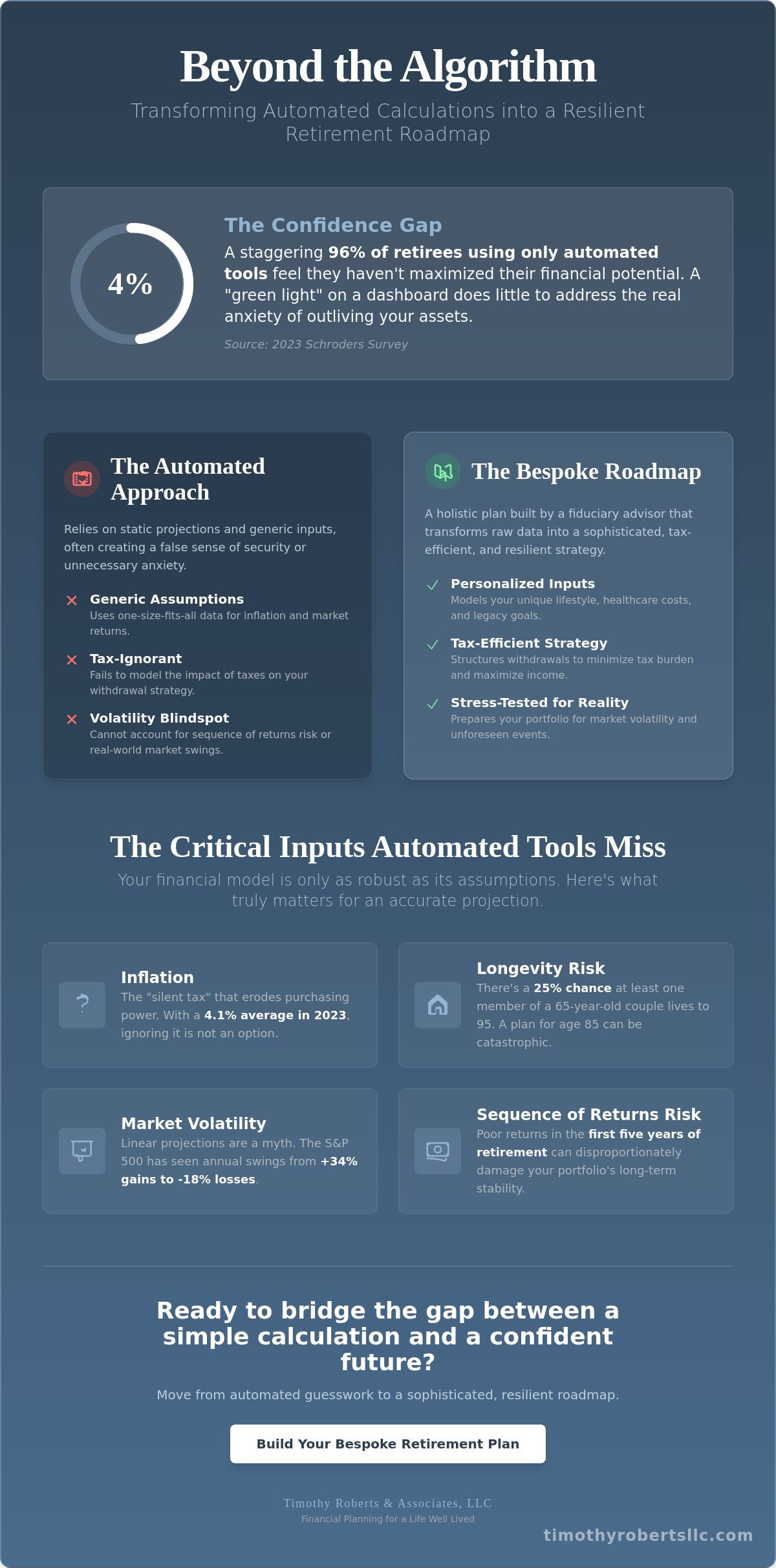
A digital interface cannot account for the nuance of a life well lived. While a standard retirement income calculator provides a necessary baseline, relying solely on its output is like navigating a complex coastline with a hand-drawn map. You likely recognize that a simple percentage or a “green light” on a dashboard does little to soothe the genuine anxiety of outliving your assets or facing the 18% market volatility seen in recent cycles. It’s a common sentiment; according to a 2023 Schroders survey, only 4% of retirees feel they’ve maximized their financial potential through automated tools alone.
You deserve a plan that moves beyond the generic to the exceptional. This article reveals how to transform raw data into a bespoke, tax-efficient strategy that accounts for sequence of returns risk and your unique lifestyle aspirations. We’ll explore how to bridge your financial gap and elevate your retirement from a series of automated calculations to a sophisticated, resilient roadmap. We’re moving away from mere survival toward a future of intentional, strategic growth and absolute confidence in your withdrawal strategy.
Key Takeaways
- Learn how to utilize a retirement income calculator as a sophisticated diagnostic tool to establish a baseline for your future cash flow.
- Identify the critical inputs, such as healthcare inflation and longevity risks, that are essential for elevating the accuracy of your financial modeling.
- Navigate the “average return” myth by understanding why the first five years of your retirement are the most critical window for long-term stability.
- Master the strategic levers—from asset allocation to spending adjustments—required to bridge the gap between static projections and bespoke realities.
- Discover how the intellectual rigor of a fiduciary advisor transforms automated software algorithms into a holistic, tax-efficient roadmap.
The Role of a Retirement Income Calculator in Modern Wealth Planning
A retirement income calculator functions as a baseline diagnostic tool, mapping the trajectory of future cash flow against the backdrop of current assets. It moves beyond simple arithmetic to offer a preliminary glimpse into how wealth translates into daily life. For those seeking a calm, confident transition to post-career life, starting with hard data is essential. It replaces guesswork with a structured reality, allowing for a more intentional approach to wealth management. This initial assessment provides the clarity needed to transform a collection of accounts into a cohesive financial legacy.
To better understand how these calculations influence your withdrawal strategy, watch this helpful video:
There is a fundamental distinction between saving for a specific number and planning for a sustainable income. While many investors focus on the total balance of their 401(k) or IRA, the true objective is ensuring that capital generates a consistent stream of liquidity. A retirement income calculator serves as a strategic starting point for fiduciary planning by aligning current assets with future liquidity requirements. This process begins with understanding retirement plans and their unique tax implications, which is a critical step in transforming a static portfolio into a dynamic income engine. Relying on a single lump sum figure ignores the complexities of inflation, which averaged 4.1% in 2023, potentially eroding purchasing power over a 30 year retirement horizon.
Why Static Projections Often Fall Short
Linear growth assumptions rarely survive the reality of a non-linear market. Most basic algorithms assume a steady 7% annual return, yet the S&P 500 has seen annual fluctuations ranging from 34% gains in 1995 to 18% losses in 2022. A one-size-fits-all algorithm cannot account for bespoke legacy goals or complex tax structures. Moving from automated calculations to intentional planning ensures that your strategy reflects your specific values rather than a generic average. High-level wealth planning requires an acknowledgment that markets move in cycles, not straight lines.
The Psychology of the Retirement Gap
The gap between “the number” on a screen and the reality of a desired lifestyle often triggers significant anxiety. A retirement income calculator acts as a catalyst for professional wealth elevation, turning the fear of the unknown into a structured financial roadmap. It bridges the divide between accumulation and distribution. By visualizing the cash flow early, investors can shift their mindset from scarcity to abundance, viewing their wealth as a tool for lifestyle design rather than a source of stress. This transition is vital for maintaining psychological well-being during the first 1,000 days of retirement, a period often marked by significant lifestyle shifts.
Critical Inputs: Elevating the Accuracy of Your Projections
Financial modeling rests on a fragile foundation: the quality of your data. If you treat a Forbes retirement calculator as a crystal ball without vetting your inputs, you risk a strategy built on sand. This “garbage in, garbage out” reality means your projections are only as robust as your assumptions. A bespoke strategy requires moving beyond generic averages to reflect the nuances of your specific lifestyle and the current economic climate.
Many retirees plan for a lifespan ending at age 85; however, the Society of Actuaries reports a 25% chance that at least one member of a 65-year-old couple lives to 95. Underestimating longevity by a decade can be catastrophic. Similarly, using historical 10% market returns is often reckless in a high-valuation environment. With the S&P 500 cyclically adjusted price-to-earnings (CAPE) ratio sitting near 34 in early 2024, a more conservative real return of 4% to 5% provides a necessary margin for error. Success isn’t about the most optimistic outcome; it’s about the most resilient one.
Accounting for the Silent Erosion of Inflation
General inflation, often measured by the Consumer Price Index (CPI), rarely reflects the actual spending patterns of a high-net-worth household. While the Federal Reserve targets a 2% rate, healthcare costs have historically risen at roughly 5% annually since 2000. A 3% sustained inflation rate erodes purchasing power by 55% over a 30-year retirement. Your retirement income calculator must distinguish between basic cost-of-living increases and the specific inflation of luxury goods and medical services. Building inflation-protected income streams, such as dividend-growth equities or Treasury Inflation-Protected Securities (TIPS), ensures your standard of living doesn’t vanish over time.
The Tax Factor: Calculating Net Spendable Income
A $5 million portfolio is not actually $5 million if a large portion sits in a Traditional IRA. You’re essentially co-owning that account with the IRS, and your share depends entirely on future legislation. Neglecting the impact of Required Minimum Distributions (RMDs) can push you into a 37% tax bracket unexpectedly during your 70s. True wealth elevation requires a shift from gross totals to net spendable income. Engaging in Strategic Tax Advising allows you to optimize withdrawals across Roth, Traditional, and taxable accounts to minimize the “tax drag” on your legacy.
Once you’ve refined these critical inputs, the next step is to stress-test your plan against market volatility. If you want to ensure your projections align with your long-term vision, consider how a bespoke financial review can transform these raw numbers into a sophisticated roadmap for success.
Static Projections vs. Strategic Realities: Navigating Market Volatility
While a standard retirement income calculator provides a baseline, it often relies on the dangerous myth of the “average return.” Real market performance is never a straight line. For example, the S&P 500 delivered a total return of 26.29% in 2023, yet this followed a staggering 18.11% decline in 2022. A static projection assumes a steady 7% or 8% growth every year, failing to account for the jarring reality of annual fluctuations. If your plan doesn’t account for these swings, you risk making irreversible decisions based on a mathematical fantasy.
The first five years of your retirement represent a fragility zone where your long term success is most vulnerable. A bespoke strategy moves beyond the limitations of a retirement income calculator by stress-testing your plan against 1,000 different market scenarios. This level of rigor ensures that your lifestyle remains sustainable even if you retire into the teeth of a bear market. High net worth individuals require this level of intentionality to transform a collection of assets into a resilient income stream.
The Risk of Sequence of Returns
Sequence of returns risk occurs when negative market performance coincides with the initial phase of portfolio withdrawals; this phenomenon can reduce a 30 year retirement fund’s longevity by more than 13 years compared to a portfolio that experiences the same average return but witnesses losses later in the cycle. Two investors can start with $5 million and average 6% returns over two decades, yet one may run out of capital while the other thrives, simply because of the order in which those returns arrived.
To mitigate this, we implement sophisticated tactics such as “cash buckets” or volatility buffers. By maintaining 24 to 36 months of spending in highly liquid, non-correlated assets, you avoid selling equities during a downturn. Professional oversight ensures these buckets are replenished strategically during market peaks, protecting your core portfolio from being cannibalized when prices are low.
Dynamic Spending vs. The 4% Rule
The traditional 4% rule, established by William Bengen in 1994, is increasingly viewed as an outdated relic for modern high net worth retirees. In an era of shifting bond yields and global economic shifts, a rigid withdrawal rate lacks the agility required for complex estates. We favor a “guardrails” approach, which allows for higher spending during periods of market growth while providing clear, pre-defined triggers for modest adjustments during contractions.
This dynamic model optimizes withdrawals by prioritizing tax efficiency and asset location. By integrating Investment Portfolio Management into your spending plan, you can elevate your strategy from simple decumulation to a sophisticated wealth preservation engine. This proactive methodology ensures that your spending remains aligned with both your personal goals and the shifting pulse of the global markets.
Bridging the Gap: From Calculator Results to a Bespoke Roadmap
A raw number on a screen is merely a starting point. When a retirement income calculator reveals a projected shortfall, it shouldn’t be viewed as a definitive outcome, but as a strategic invitation to refine your trajectory. High-net-worth individuals often face complex variables that standard algorithms fail to capture. Transitioning from a digital estimate to a functional reality requires a nuanced adjustment of specific financial levers. It’s about moving beyond the math to find a balance between your current lifestyle and your future security.
Strategic levers provide the flexibility needed to close the gap. Extending a career by just 24 months can significantly alter a portfolio’s longevity by allowing for additional contributions and reducing the total years of portfolio depletion. Adjusting discretionary spending or rebalancing asset allocations to favor dividend-growing equities can also provide the necessary lift. Every adjustment must be intentional. We focus on creating a “floor” of guaranteed income that covers essential expenses, ensuring that market volatility never threatens your fundamental standard of living.
Optimizing Social Security and Pension Integration
Social Security isn’t just a monthly check; it’s a strategic asset that requires sophisticated coordination. For high-earners, the decision to claim at age 62 versus age 70 isn’t just about timing. It’s about a 76% difference in the monthly benefit amount. Delaying benefits past full retirement age provides a guaranteed 8% annual increase, a return that’s difficult to replicate in the private markets with zero risk. We integrate these fixed streams into a comprehensive retirement income plan to ensure that spousal benefits and pension elections are synchronized for maximum tax efficiency and survivor protection.
The Holistic View: Estate and Legacy Considerations
Preservation of wealth is often as vital as the generation of income. A bespoke strategy ensures that your desire for a vibrant retirement doesn’t erode the inheritance intended for the next generation. We balance your immediate cash flow needs with Strategic Estate Planning to protect assets from unnecessary tax exposure. This requires a fiduciary perspective that values multi-generational growth. By structuring withdrawals strategically, we help you maintain your lifestyle while solidifying a legacy that lasts for decades. Your roadmap should reflect your values, not just your balance sheet.
Ready to transform your digital projections into a resilient, high-level strategy? Connect with Timothy Roberts LLC to begin your bespoke planning journey today.
The Fiduciary Advantage: Why Customization Beats Automation
Algorithms excel at computation but fail at context. While a retirement income calculator provides a useful starting point, it operates within a vacuum of historical averages and linear projections. A fiduciary advisor at Timothy Roberts & Associates brings the intellectual rigor necessary to interpret those digits. We don’t just look at what the math says; we look at what the math means for your specific legacy. This distinction marks the transition from a passive, automated output to a dynamic, high-end strategy.
Our approach replaces the “set it and forget it” mentality with a commitment to strategic intervention. We focus on two critical pillars: proactive tax planning and disciplined portfolio rebalancing. For instance, the implementation of the SECURE 2.0 Act in 2023 altered the timeline for required minimum distributions, a nuance that static tools often overlook. We ensure your plan evolves alongside shifting federal regulations and market volatility. This partnership offers a level of oversight that software simply cannot replicate.
- Intellectual Rigor: We apply deep business-minded analysis to every projection.
- Proactive Tax Strategy: We look for opportunities to optimize your liabilities before year-end.
- Dynamic Rebalancing: Our team adjusts your holdings based on real-time economic shifts rather than fixed calendar dates.
Bespoke Strategies for Complex Financial Lives
High-net-worth individuals often face challenges that software isn’t programmed to solve. We specialize in managing the complexities of business succession and concentrated stock positions, which can represent over 40% of a client’s total assets. Our team crafts bespoke solutions that mitigate risk without sacrificing the potential for aspirational growth. This high-end planning experience provides the calm confidence you need to enjoy your wealth rather than constantly managing it. We elevate your journey by treating your portfolio as a unique ecosystem rather than a data point.
Your Next Step Toward Financial Elevation
Now is the moment to validate your findings. A retirement income calculator can show you a destination, but it can’t navigate the terrain. A strategic consultation with our team offers a professional review of your current trajectory. We identify gaps in your planning and optimize your tax efficiency to ensure every dollar serves your long-term vision. Expect a transparent, sophisticated dialogue that prioritizes your goals over generic benchmarks.
Secure Your Legacy with Strategic Precision
A retirement income calculator provides a foundational baseline, but it’s merely the first step in a much larger journey. Navigating the intersection of market volatility and tax efficiency requires a transition from automated data to a nuanced, holistic strategy. At Timothy Roberts & Associates, we move beyond the limitations of static projections to build a framework that accounts for the complexities of modern wealth. Our approach integrates comprehensive wealth management with tax optimization; this ensures every financial lever works in harmony with your enduring vision.
With over 25 years of fiduciary expertise, our firm specializes in crafting bespoke strategies that reflect your specific risk tolerance and lifestyle goals. We believe that true financial leadership combines intellectual curiosity with the disciplined execution of a seasoned advisor. You’ve spent decades building your capital; now is the time to optimize its impact through a partnership rooted in trust and professional rigor. We transform accumulated assets into a sustainable, high-end legacy that supports your most ambitious goals.
Elevate your retirement strategy with a bespoke income roadmap from Timothy Roberts & Associates
Your path toward a refined and confident future begins with a single, intentional decision today.
Frequently Asked Questions
How accurate are retirement income calculators for high-net-worth individuals?
Standard calculators often lack the sophistication required for high-net-worth individuals because they fail to model complex tax structures and private equity holdings. A 2023 study by the Financial Planning Association found that 65% of mass-market tools cannot account for sophisticated trust distributions or alternative investments. For those with assets exceeding $5 million, these digital tools serve as a baseline rather than a final blueprint. You require a bespoke strategy that integrates estate planning to ensure true accuracy.
Should I include my home equity in my retirement income calculations?
You should only include home equity if you intend to monetize the asset through a sale, downsizing, or a reverse mortgage. According to 2022 data from the U.S. Census Bureau, the median home equity for those aged 65 and older is approximately $250,000. If your residence is a legacy asset intended for your heirs, excluding it from your liquid projections provides a more conservative and realistic view of your spendable wealth. It’s a strategic choice based on your long-term family goals.
What is a realistic inflation rate to use in my retirement planning?
A realistic inflation rate for long-term planning is 3.1%, which reflects the average annual increase in the Consumer Price Index from 1913 to 2023. While the Federal Reserve targets a 2% rate, historical data suggests a higher buffer is necessary to protect your purchasing power over several decades. Planning for a 3% to 4% range ensures your portfolio remains resilient against the rising costs of healthcare and lifestyle maintenance. This foresight helps you elevate your strategy beyond simple averages.
Can a retirement calculator account for tax-loss harvesting or Roth conversions?
Most basic tools cannot model the nuanced benefits of tax-loss harvesting or Roth conversions effectively. A sophisticated retirement income calculator might allow for basic tax inputs, but it rarely captures the 15% to 20% increase in after-tax wealth that strategic conversions can generate over two decades. These maneuvers require a holistic approach where tax professionals and wealth advisors coordinate to optimize your annual withdrawal sequence. It’s about moving from generic digits to a polished financial intervention.
How often should I update my retirement income projections?
You must update your projections at least once every 12 months or immediately following a major life event. Market volatility in 2022, where the S&P 500 dropped nearly 20%, demonstrated how quickly financial assumptions can shift. Regular reviews allow you to pivot your strategy, ensuring your lifestyle goals remain aligned with your current asset base. This iterative process transforms a static number into a dynamic roadmap for growth. We treat this as a continuous journey of optimization.
Is the “4% Rule” still a safe withdrawal rate for 2026?
The 4% Rule is no longer a universal standard; Morningstar’s 2023 report suggests a starting rate closer to 3.3% for a 50% probability of success over 30 years. Low bond yields and high equity valuations make the traditional 1994 Bengen model less reliable for the 2026 economic environment. A bespoke strategy often utilizes a “guardrails” approach, adjusting withdrawals based on annual portfolio performance rather than adhering to a fixed percentage. This flexibility is essential for maintaining your desired lifestyle.
What happens if the market crashes right after I retire?
A market crash in the early years of retirement creates “sequence of returns risk,” which can deplete a portfolio 10 years earlier than projected. Research from the Journal of Financial Planning shows that a 20% decline in year one requires an immediate adjustment in spending to avoid permanent capital impairment. To mitigate this, we recommend maintaining a cash reserve equivalent to 24 months of expenses to avoid selling assets at a loss. This protective layer provides calm confidence during periods of market instability.
How do I integrate my Social Security benefits into a retirement calculator?
You integrate Social Security by inputting your Primary Insurance Amount from your latest Social Security Administration statement into your retirement income calculator. For 2024, the maximum monthly benefit for those retiring at age 70 is $4,873. It’s vital to model different claiming ages, as delaying benefits from age 62 to 70 increases your monthly check by 8% annually. This guaranteed, inflation-adjusted income serves as the foundation of your broader distribution strategy. We use these figures to craft a truly strategic vision.
