

Aug
Strategic Backdoor Roth IRA Guidance for Investors in Michigan: 2026 Tax Planning
High-income status shouldn’t be a barrier to tax-free retirement growth, yet for many Michigan investors, it feels like a glass ceiling. The 2026 tax landscape has transformed the Roth IRA from a simple savings vehicle into a mandatory strategic pivot for those seeking to preserve their wealth. If you’ve been told your income disqualifies you from Roth benefits, you’re likely facing the looming shadow of high tax liabilities on your future distributions. It’s a frustrating position, especially when complex IRS regulations like the pro-rata rule seem designed to penalize proactive planning.
This article provides the clarity you need to master the backdoor roth ira michigan strategy with surgical precision. You’ll learn how to navigate the 2026 contribution limits and leverage Michigan’s unique retirement income deductions to fortify your long-term legacy. By synthesizing federal compliance with local tax advantages, we’ll outline a path toward a retirement defined by tax-free distributions and the total elimination of future Required Minimum Distributions. We’ll move beyond basic definitions to explore the sophisticated execution required to transform your current portfolio into a streamlined, tax-efficient engine for growth.
Key Takeaways
- Discover how to bypass restrictive income limits by utilizing a precise two-step process to secure tax-free growth and distributions.
- Master the 2026 tactical framework for non-deductible contributions and timely conversions to minimize market volatility and tax exposure.
- Navigate the complexities of the IRS pro-rata rule while leveraging the backdoor roth ira michigan strategy to optimize state-level retirement income deductions.
- Evaluate the strategic arbitrage of locking in 2026 tax rates to permanently eliminate future Required Minimum Distributions and legacy tax burdens.
- Understand the critical role of integrated tax advising and fiduciary wealth management in ensuring a seamless, compliant conversion process.
Understanding the Backdoor Roth IRA Strategy in Michigan
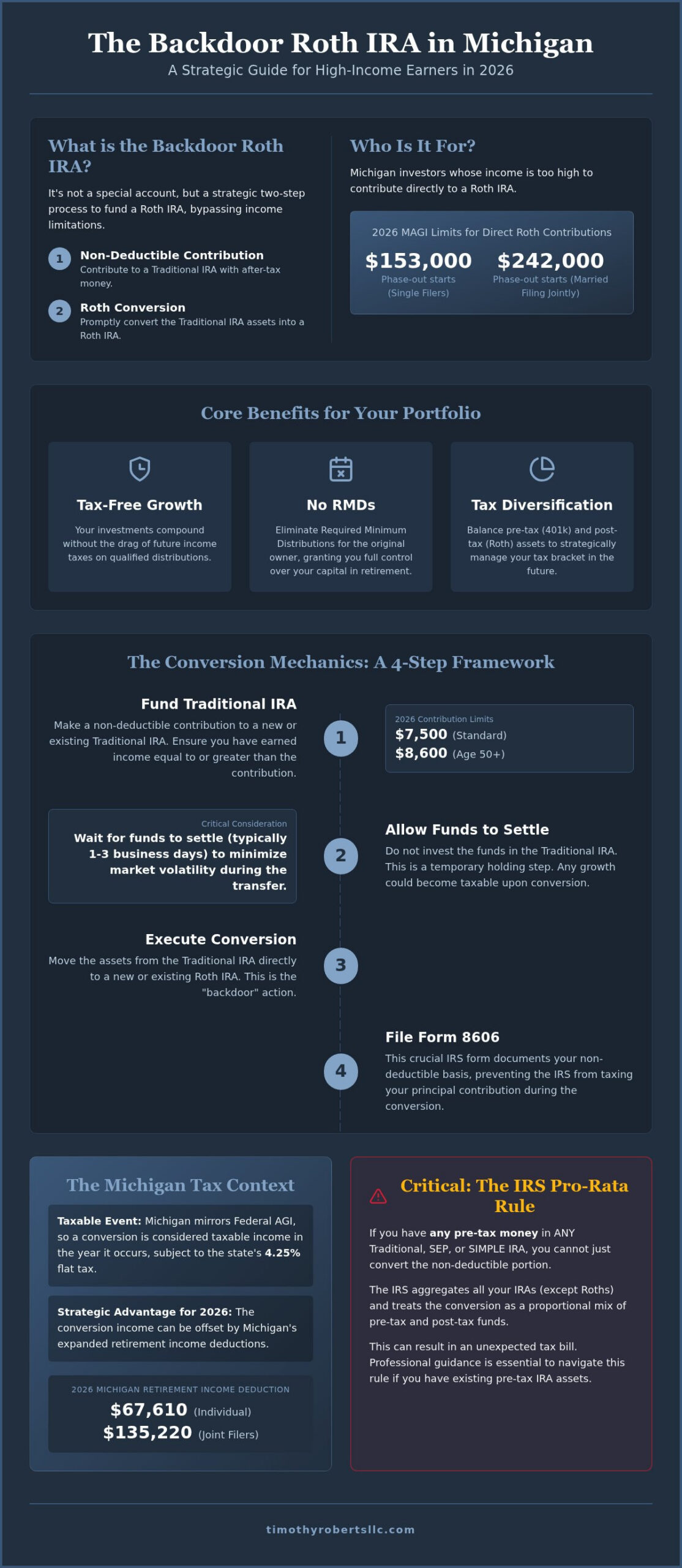
The backdoor roth ira michigan strategy represents a sophisticated pivot for investors whose income exceeds traditional thresholds. It isn’t a singular financial product but a calculated two-step sequence. First, an investor makes a non-deductible contribution to a Traditional IRA. Second, they convert those assets into a Roth IRA. This maneuver effectively bypasses the Modified Adjusted Gross Income (MAGI) limits that otherwise bar direct contributions. For 2026, these limits start phasing out at $153,000 for single filers and $242,000 for those married filing jointly. By Understanding the Backdoor Roth IRA mechanics, high-net-worth individuals can secure the same tax advantages available to lower-income savers.
2026 marks a critical juncture for this strategy. It’s the final year of the four-year phase-in for Michigan’s expanded retirement income deduction. Simultaneously, the SECURE 2.0 Act’s “Rothification” mandates begin to squeeze high earners. Investors must distinguish between the initial contribution and the subsequent conversion. The IRS treats the contribution as a neutral event if it’s non-deductible, while the Michigan Department of Treasury views the conversion as a taxable event that adds to your annual income. This distinction is the bedrock of compliant wealth evolution.
The Core Benefits for High-Income Earners
The primary allure is the architecture of tax-free growth. Compounding is a powerful force; compounding without a 20% to 37% future tax drag is transformative. Beyond growth, the elimination of Required Minimum Distributions (RMDs) grants you total sovereignty over your capital. You decide when to withdraw, not the government. This creates a vital layer of tax diversification. By balancing pre-tax 401(k) holdings with post-tax Roth assets, you gain the agility to manage your future tax brackets with precision. It’s about maintaining control as your wealth matures.
The Michigan Tax Context
Michigan’s fiscal environment adds a unique layer to this strategy. Our state generally mirrors federal Adjusted Gross Income (AGI), meaning a conversion that triggers federal tax will likely trigger the state’s 4.25% flat tax. However, the 2026 tax year offers a significant reprieve. Michigan taxpayers can deduct retirement and pension income up to $67,610 for individuals or $135,220 for joint filers. While we operate with a national perspective, we recognize that state-level compliance is where many high-level strategies succeed or fail. A conversion is seen as income in the year it occurs, making the timing of your backdoor roth ira michigan move essential for maximizing these specific state deductions.
The Mechanics of the Conversion: A Step-by-Step Tactical Framework
Executing a backdoor roth ira michigan strategy requires more than just moving money; it demands a disciplined sequence to ensure IRS compliance. The process begins by establishing a non-deductible Traditional IRA and funding it with the maximum allowable contribution for the 2026 tax year. Once these funds settle, you’ll initiate the conversion by moving assets directly into a Roth IRA. This transition must be handled with care to minimize the impact of market fluctuations during the transfer. It’s a precise intervention that transforms taxable potential into tax-free reality.
Proper documentation is the final, often overlooked safeguard in this architecture. You must file IRS Form 8606 to establish your non-deductible basis; this prevents the IRS from taxing your principal a second time upon conversion. Finally, coordinating these moves with a strategic tax advising partner ensures that both federal and Michigan state returns accurately reflect the non-taxable nature of the contribution. This level of oversight is essential for maintaining a clean audit trail as your wealth scales.
Contribution Limits and Eligibility for 2026
For the 2026 tax year, the standard IRA contribution limit is $7,500. Investors aged 50 and older can utilize an additional $1,100 catch-up contribution, bringing their total capacity to $8,600. Eligibility hinges on having earned income that equals or exceeds the contribution amount. High-MAGI earners don’t qualify for deductible contributions, so they must explicitly designate these funds as non-deductible. This clear distinction is a prerequisite for a successful backdoor Roth IRA strategy and avoids unnecessary complications during the conversion phase.
The Timing Debate: When to Convert?
Historically, some advisors suggested a waiting period to avoid the Step Transaction Doctrine, a legal theory where the IRS collapses multiple steps into one. Modern consensus, however, favors converting as soon as funds settle. Converting quickly minimizes any interest earned while the money sits in the Traditional IRA. If your account gains even a few dollars in value before the conversion, those earnings are taxable. Precision is paramount. Utilizing automated wealth management tools can help execute these conversions with minimal delay, ensuring your backdoor roth ira michigan implementation remains as efficient as possible. If you’re seeking a partner to oversee this financial evolution, exploring professional Retirement Income Planning can provide the structural stability your portfolio requires.
Navigating the Pro-Rata Rule and Tax Implications
The IRS doesn’t permit investors to cherry-pick which dollars they convert. When executing a backdoor roth ira michigan, the Pro-Rata Rule dictates that the IRS views all your Traditional, SEP, and SIMPLE IRAs as a single, collective pool of assets. This “Aggregation Rule” often catches high earners off guard, especially those with dormant rollover IRAs from previous employers. If you attempt to convert a $7,500 non-deductible contribution while holding $92,500 in a pre-tax rollover account, the IRS treats only a small fraction of that conversion as tax-free. The Pro-Rata calculation is the ratio of non-deductible to total IRA assets. A single forgotten account can trigger a significant, unexpected tax liability, turning a strategic maneuver into a costly oversight.
Strategies to Mitigate the Pro-Rata Impact
Clearing the “IRA pool” is a prerequisite for a tax-efficient conversion. One effective intervention is the “Reverse Rollover,” where pre-tax IRA assets are moved into an active 401(k) or 403(b) plan. Since employer-sponsored plans aren’t included in the Pro-Rata calculation, this move effectively isolates your non-deductible contribution. Timing is equally critical; the IRS evaluates your total IRA balance on December 31st of the conversion year. This means your “cleanup” must be completed before the calendar year ends. Sophisticated investment portfolio management must be meticulously coordinated with tax planning to ensure these assets are moved without disrupting your broader market exposure or liquidity needs.
Federal vs. Michigan State Tax Treatment
A Roth conversion is a taxable event that increases your federal Adjusted Gross Income (AGI). Because Michigan’s individual income tax return uses federal AGI as its baseline, the converted amount flows directly into your state tax obligation. Michigan’s flat tax rate of 4.25% applies to the taxable portion of the conversion, though for 2026, this income may be partially or fully offset by the state’s retirement income deduction of up to $67,610 for single filers. For substantial conversions, relying on annual withholding isn’t enough. You must plan for estimated tax payments at both the state and federal levels to avoid underpayment penalties. Balancing these immediate costs against the long-term benefit of tax-free growth is the hallmark of a disciplined wealth strategy.
Strategic Evaluation: Is a Backdoor Conversion Right for Your Portfolio?
Deciding to execute a backdoor roth ira michigan maneuver requires a cold-eyed analysis of tax arbitrage. You’re essentially choosing to pay taxes at today’s known rates to shield yourself from the volatility of future legislative changes. For many, the 2026 tax environment, coupled with Michigan’s 4.25% flat tax, presents a compelling entry point for conversion. However, this isn’t a universal solution. Finding the precise break-even point where tax-free growth compensates for the upfront cost requires comprehensive retirement income planning that accounts for your projected longevity and lifestyle needs.
Liquidity is the other half of the equation. The 5-Year Rule mandates that converted funds remain in the account for at least five tax years before earnings can be withdrawn tax-free. If you anticipate needing these specific assets for a major purchase or medical expense in the near term, a conversion could inadvertently trigger penalties. It’s a long-term commitment to asset preservation rather than a short-term liquidity play. You must ensure your broader portfolio can sustain the tax payment without compromising your immediate financial stability.
When the Strategy May Not Be Optimal
A conversion might actually erode your wealth in specific circumstances. If you plan to relocate to a state with no income tax during retirement and expect to be in a significantly lower federal bracket, paying taxes now at a higher rate is counterproductive. Additionally, if you don’t have the cash on hand to pay the conversion tax from outside your retirement accounts, you’re forced to use IRA assets. This reduces the amount of capital available for tax-free compounding, often negating the primary benefit of the strategy. Investors with a time horizon shorter than five to seven years should also proceed with caution as the tax-free growth period may be too brief to offset the initial tax hit.
The Multi-Generational Perspective
Beyond your own retirement, a backdoor roth ira michigan serves as a potent tool for a tax-free legacy. The SECURE Act 10-year rule requires most non-spouse beneficiaries to empty inherited IRAs within a decade. Inheriting a traditional IRA can push your heirs into their highest-ever tax brackets, whereas an inherited Roth IRA provides them with a tax-free windfall. This strategy also mitigates the “widow’s tax,” where a surviving spouse faces higher single-filer tax rates on future distributions. Integrating this into your broader estate planning ensures your wealth evolves into a lasting family resource. If you’re ready to define your strategic break-even point, connect with our team for a personalized portfolio assessment.
Integrated Wealth and Tax Management: The Timothy Roberts Approach
Navigating the delicate intersection of IRS regulations and Michigan tax law requires more than just a calculator; it demands a fiduciary partnership. At Timothy Roberts & Associates, LLC, we view the backdoor roth ira michigan not as an isolated transaction, but as a carefully crafted intervention within your broader financial evolution. With over 25 years of experience in integrated tax preparation and wealth management, we move beyond off-the-shelf financial products to design personalized roadmaps that prioritize tax efficiency. Our approach begins with a comprehensive analysis of your total asset architecture. We examine every account, from dormant rollovers to active employer plans, to ensure your conversion doesn’t trigger unnecessary tax drag. This level of intentionality ensures that your strategy remains compliant while maximizing long-term efficiency.
Synthesis of Tax Advising and Investment Strategy
The traditional silo effect, where tax advisors and investment managers operate in isolation, often leads to missed opportunities or costly errors. Our firm eliminates this friction by synthesizing tax advising with investment strategy under one roof. This integrated perspective is vital for identifying reverse rollover opportunities that clear the pro-rata pool, a step that is essential for high-net-worth investors. We ensure that your backdoor roth ira michigan maneuver isn’t just a tax play, but a strategic move that aligns with your education funding goals and multi-generational legacy plans. Post-conversion, our team provides ongoing monitoring and rebalancing. This steady, logical rhythm of management ensures your new Roth assets continue to serve your aspirational growth targets even as market conditions shift.
Taking the Next Step Toward Upward Progression
True wealth management is a journey of upward progression, moving from a transactional view of retirement to a results-driven narrative of success. It’s about shifting from simple saving to sophisticated strategizing. Our personality as visionary strategists means we value depth over superficiality, providing the personal attention required to solve complex problems rather than rushing to generic conclusions. If you’re ready to move beyond generic advice and explore a high-end partner for your financial future, it’s time to initiate a comprehensive review of your current retirement income plan. We invite you to Schedule a consultation with Timothy Roberts & Associates, LLC to evaluate your 2026 tax strategy and secure your legacy.
Mastering Your Financial Evolution for 2026 and Beyond
The 2026 tax landscape offers a distinct opportunity for high-income investors to redefine their retirement trajectory. By mastering the backdoor roth ira michigan strategy, you transform future tax liabilities into permanent, tax-free growth. We have detailed how precise timing and a thorough understanding of the pro-rata rule are essential to safeguard your wealth from unnecessary friction. Success in this maneuver depends on a synthesis of tactical execution and long-term vision. It’s about more than moving assets; it’s about making a calculated pivot toward a more resilient financial future.
At Timothy Roberts & Associates, LLC, we bring over 25 years of strategic retirement planning to every client engagement. Our fiduciary oversight of investment portfolios and specialized expertise in integrated tax and wealth management provide the structural stability your legacy deserves. It’s time to move beyond standard solutions and embrace a partnership built on depth and intellectual rigor. Secure Your Retirement Legacy with Strategic Tax Planning. Your journey toward tax-free growth is a deliberate progression, and the right guidance makes all the difference in achieving your aspirational goals.
Frequently Asked Questions
Is the Backdoor Roth IRA still legal for Michigan residents in 2026?
Yes, the backdoor roth ira michigan strategy remains a fully compliant maneuver in 2026. While direct Roth contributions have strict income thresholds, the IRS has implicitly permitted the two-step conversion process. This allows high earners to access tax-free growth regardless of their annual compensation. It’s an essential tool for investors who’ve surpassed the standard phase-out ranges of $153,000 for single filers or $242,000 for those married filing jointly.
What are the income limits for a Backdoor Roth IRA conversion?
There are no income limits for performing a Roth conversion. The Modified Adjusted Gross Income limits only restrict who can contribute directly to a Roth account. In 2026, anyone with earned income can contribute to a Traditional IRA and subsequently convert those funds. This lack of a ceiling makes the strategy a cornerstone of wealth management for high-net-worth individuals who would otherwise be locked out of tax-free retirement benefits.
How does the Pro-Rata rule affect my Michigan state taxes?
The Pro-Rata rule dictates how much of your conversion is subject to Michigan’s 4.25% flat tax. Because Michigan calculates state tax based on your federal Adjusted Gross Income, any portion of the conversion deemed taxable by the IRS will increase your state liability. If you hold pre-tax assets in other IRAs, a percentage of your backdoor roth ira michigan move will be taxed as ordinary income at the state level.
Can I do a Backdoor Roth if I already have a 401(k) at work?
You can absolutely execute a backdoor Roth while participating in a workplace 401(k). In fact, employer-sponsored plans are beneficial because they aren’t included in the Pro-Rata “IRA pool” calculation. Having a 401(k) usually makes your Traditional IRA contribution non-deductible, which is exactly what’s required to initiate the backdoor sequence. It’s a powerful way to maximize total retirement savings across multiple account types without triggering unnecessary tax penalties.
What is the deadline for making a Backdoor Roth contribution for the 2026 tax year?
The deadline for making your 2026 Traditional IRA contribution is April 15, 2027. While you can contribute up until the tax filing deadline, the actual conversion to a Roth IRA can take place at any time. Most strategic investors prefer to convert immediately after the contribution settles. This minimizes the time funds spend in a taxable Traditional IRA and simplifies the reporting process on your federal and state tax returns.
Do I need to file a special form with the Michigan Department of Treasury for a conversion?
Michigan doesn’t require a specific state-level form to report a Roth conversion. The taxable amount is captured through your federal Adjusted Gross Income, which flows into your MI-1040 return. You’ll primarily focus on federal IRS Form 8606 to track your non-deductible basis. Ensuring this federal form is accurate is the best way to prevent the Michigan Department of Treasury from over-taxing your retirement income distributions in the future.
How many times can I perform a Backdoor Roth conversion in one year?
There’s no limit on how many conversions you can perform in a single tax year. You could theoretically convert assets every month if your cash flow allows. However, most investors find it more efficient to perform a single, maximum contribution of $7,500, or $8,600 for those 50 and older, followed by one conversion. This streamlined approach reduces administrative complexity while still achieving the desired tax-free growth outcomes for your portfolio.
What happens if I accidentally contribute more than the limit to my Traditional IRA?
Over-contributions trigger a 6% excise tax penalty for every year the excess remains in the account. To correct this, you must withdraw the excess amount and any associated earnings before the tax filing deadline. If you’ve already performed a conversion, the process becomes significantly more complex. It’s vital to coordinate with a tax advisor to remove the funds properly to avoid compounding penalties and ensure your 2026 tax strategy remains intact.
