The closest financial advisor to your front door isn’t necessarily the one best equipped to protect your future legacy. While a search for investments near me might yield a map full of local offices, geographic convenience is a poor substitute for strategic alignment. In a 2026 market defined by a 3.75% benchmark interest rate and evolving SEC regulations, your wealth requires more than a local presence. It demands a partner who views your portfolio as a single piece of a larger, more complex financial architecture.
Success requires synergy. You’ve likely felt the weight of information overload from generic finance sites, especially as you watch market volatility fluctuate. It’s frustrating when your tax professional, estate attorney, and investment manager operate in silos, leaving you to bridge the gaps yourself. This article will show you how to identify a fiduciary partner who moves beyond standardized asset allocation to build a carefully crafted wealth roadmap. We’ll explore how integrating tax planning, estate strategy, and retirement income planning into one unified vision can minimize your liabilities and finally provide the peace of mind you deserve.
Key Takeaways
- Moving beyond a simple search for investments near me allows you to prioritize a fiduciary standard over mere geographic proximity.
- Discover why the 2026 market environment requires a strategic evolution of the traditional 60/40 portfolio to maintain sustainable growth.
- Identify the critical gaps in robo-advisory models that only a dedicated, human-led fiduciary partner can bridge for complex financial lives.
- Learn to maximize your wealth by synthesizing tax-efficient withdrawal strategies and estate planning into one cohesive investment roadmap.
- Transition from a transactional mindset to a partnership model that prioritizes your unique legacy and long-term peace of mind.
Beyond Geography: Defining the Ideal Investment Partnership
A digital search for investments near me often produces a list of office buildings and zip codes. However, for the discerning investor, proximity is a psychological requirement rather than a physical one. You aren’t looking for a short commute; you’re looking for a partner who is strategically close to your specific financial objectives. In 2026, the standard for excellence has moved beyond basic asset allocation toward a model of strategic proximity. This means your advisor is accessible and proactive when market shifts occur, ensuring your wealth roadmap remains intact despite global volatility. True proximity is found in the alignment of values and the shared vision for your family’s future.
The distinction between a product broker and a fiduciary wealth manager is the difference between a transaction and a journey. A broker might offer off-the-shelf solutions designed for the masses. A fiduciary strategist builds a custom intervention tailored to your unique legacy. While directories might suggest many options for investments near me, few firms possess the intellectual rigor to integrate complex tax and estate concerns into a single, cohesive investment strategy. This level of coordination is what defines a high-end partnership in the current economic climate.
The Fiduciary Standard in 2026
Trust is not a marketing slogan; it’s a legal mandate. In an era where financial products are increasingly commoditized, the fiduciary duty serves as the ultimate safeguard for your capital. Fiduciary advisors are legally bound to put your interests ahead of their own. This is a stark contrast to commission-based representatives who may be incentivized by internal sales targets or specific product placements. As we move through 2026, transparency is the only viable path to long-term stability. A fiduciary’s legal obligation to act in the client’s best interest is the non-negotiable cornerstone of modern wealth preservation.
Criteria for Selecting an Investment Advisor
Vetting a partner requires looking past the first page of search results. You must assess the strategic depth of a firm by examining their history and their specific expertise in retirement income planning. Intellectual curiosity is a trait often overlooked. You want an advisor who asks deep questions about your family’s future rather than providing generic answers. Look for credentials that signal a commitment to continuous learning and a track record of managing complex, integrated portfolios. A firm with over 25 years of experience, such as Timothy Roberts & Associates, LLC, understands that true expertise is forged through multiple market cycles, not just the latest digital trend.
The 2026 Investment Landscape: Strategic Asset Allocation
The 2026 market presents a unique set of challenges for the modern investor. With the federal funds rate holding steady at 3.75%, the era of effortless returns from cash-equivalents has transitioned into a period requiring deeper strategic rigor. Many individuals searching for investments near me find themselves at a crossroads between simple savings and complex market participation. A visionary approach requires more than just picking stocks; it demands a deep understanding of how global economic shifts impact your specific wealth roadmap. Success in this environment isn’t found in generic advice but in the synthesis of personal goals with structured corporate capabilities.
The classic 60/40 portfolio, once the gold standard of balance, now requires a more nuanced evolution. In this environment, sophisticated diversification involves integrating alternative assets and private markets to buffer against volatility. The SEC’s 2026 examination priorities highlight a heightened focus on the governance of these complex investment products, making expert oversight essential for the mass affluent. Strategic Asset Allocation is no longer a set-it-and-forget-it exercise. It’s a continuous process of aligning capital with opportunity while maintaining a rigorous focus on capital preservation. This approach transforms development into a journey rather than a simple transaction.
Dynamic Portfolio Rebalancing
Continuous monitoring is the only effective antidote to style drift. When one asset class outperforms, it can skew your risk profile without you realizing it, potentially exposing your legacy to unnecessary danger. We utilize an asset-based management model to ensure our interests are perfectly aligned with yours. Unlike commission-based representatives, our focus remains on the long-term health of your Investment Portfolio Management strategy rather than the frequency of trades. By aligning portfolio risk with your evolving life stages, we ensure your wealth continues its upward progression with intentionality and poise.
Risk Management and Insurance Analysis
Searching for investments near me should lead you to a partner who understands that risk is multi-dimensional. It’s not just about market dips; it’s about inflation, tax law changes, and unexpected life events. We treat insurance analysis as a fundamental protective layer for your broader investment strategy. By synthesizing your personal risk tolerance with professional financial rigor, we create a shield around your aspirational growth. This carefully crafted intervention ensures that your journey toward financial independence remains uninterrupted by external shocks, providing the calm confidence required to navigate 2026 and beyond.
Digital Platforms vs. Fiduciary Advisors: A Comparative Analysis
A digital search for investments near me often presents a curated list of high-tech platforms promising efficiency and low costs. While these tools offer a entry point for wealth accumulation, they frequently lack the strategic depth required to manage a complex financial life. Algorithms are designed for the average user, providing off-the-shelf solutions that fail to account for your individual legacy or professional vision. A fiduciary advisor acts as a visionary strategist, moving beyond the binary logic of software to provide a human-led, results-driven identity for your capital. This is not merely about managing assets; it’s about a carefully crafted intervention that aligns your portfolio with your broader life goals.
The true value of a dedicated partner becomes most apparent during periods of market turbulence. When volatility strikes in 2026, an algorithm can’t offer calm confidence or intellectual curiosity. It can’t understand the emotional weight of your family’s future. This is where “behavioral alpha” becomes a tangible asset. It’s the professional stability that prevents reactive, fear-based decisions, ensuring your journey remains one of steady growth rather than frantic adjustments. By choosing a partner over an algorithm, you’re investing in a narrative of shared success that software simply cannot replicate.
When to Graduate from DIY Investing
Identifying your specific “complexity threshold” is a vital step in your upward progression. Once you reach a point where tax planning strategies and estate concerns intersect, DIY stock picking often becomes a liability. The hidden costs of uncoordinated decisions can be substantial. For instance, failing to optimize your strategy for the 2026 federal income tax brackets or overlooking the $19,000 annual gift tax exclusion can erode your wealth more than any advisory fee. Transitioning from simple wealth accumulation to strategic income distribution requires a craftsman’s touch, not just a compound interest calculator. It’s about ensuring every financial move is intentional and synchronized.
The Value of Meticulous Professional Oversight
Professional oversight provides a spacious and deliberate flow to your financial planning. It allows you to step away from the clutter of generic data and focus on high-level thinking and aspirational growth. By partnering with experts in Investment Portfolio Management in Detroit, you gain access to a sophisticated level of coordination. This ensures your development is treated as a journey rather than a simple transaction. A fiduciary partner understands that true success is found at the intersection of aesthetics and functionality, where your personal vision meets structured corporate capabilities to create a lasting legacy.
Integrating Tax and Estate Strategy into Your Portfolio
Many individuals begin their search for investments near me with the hope of finding a simple portfolio manager. However, wealth preservation in 2026 is an architectural challenge that extends far beyond picking assets. If your investment strategy exists in a vacuum, isolated from your tax and estate plans, it’s only half a strategy. High-net-worth individuals often face the “tax drag” that quietly erodes long-term returns. By integrating tax-loss harvesting and strategic withdrawal sequences into your daily portfolio management, you can significantly enhance your net performance without taking on additional market risk. Success requires a synthesis of growth and efficiency.
A visionary strategist understands that every investment decision has a fiscal consequence. In the 2026 market, where interest rates and regulatory scrutiny remain high, uncoordinated decisions are a luxury you can’t afford. Coordinating your estate planning ensures that wealth transfer is both intentional and efficient, protecting your family from unnecessary legal or tax burdens. This level of professional stability is what distinguishes a high-end partner from a traditional broker. It’s about building a cohesive wealth roadmap where every component supports your ultimate legacy.
Strategic Tax Advising and Compliance
Strategic tax advising must be a year-round commitment, not a seasonal chore. In 2026, the federal income tax rates range from 10% to 37%. Understanding how these brackets apply to your specific income level is vital for capital preservation. For single filers, the $16,100 standard deduction is a key metric in planning annual contributions and distributions. Utilizing a partner who offers Tax Advising in Ann Arbor ensures that your investment decisions are always viewed through a lens of fiscal efficiency. This unified approach eliminates the friction between disparate advisors, creating a seamless experience of organizational evolution.
Legacy and Estate Coordination
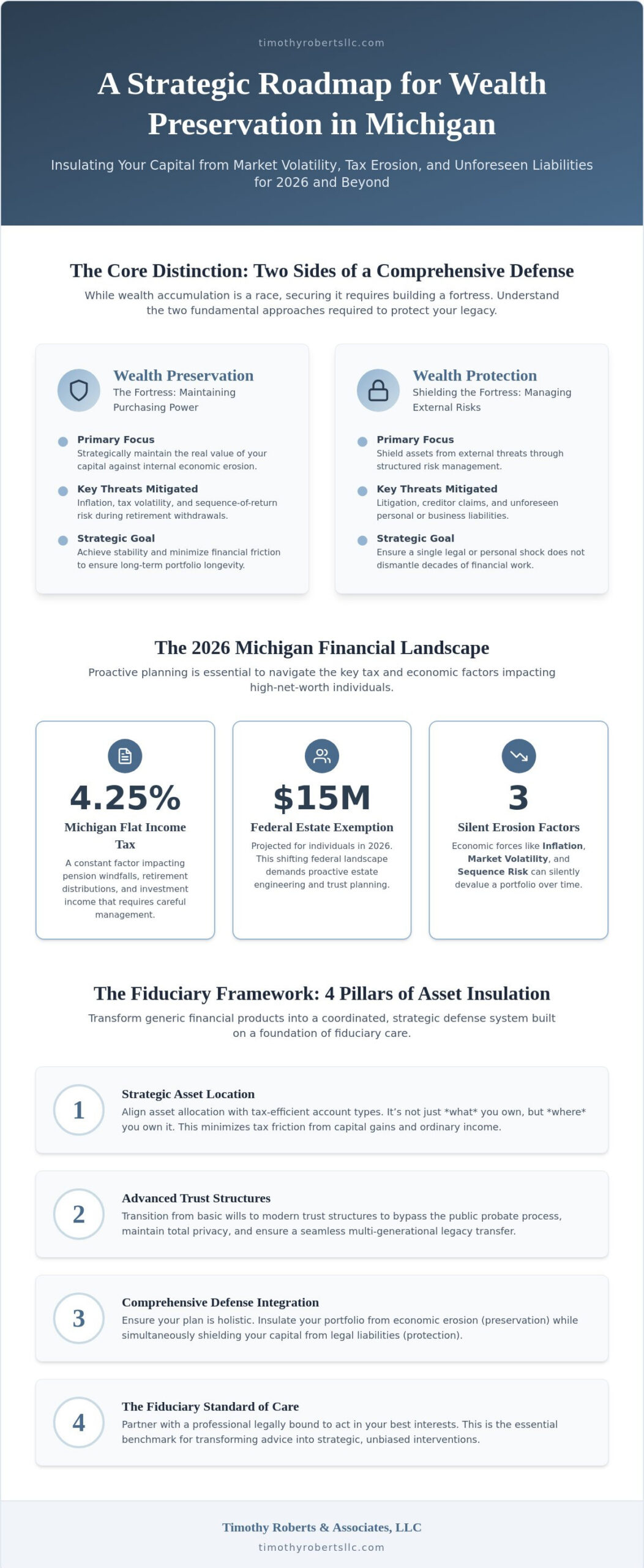
Legacy coordination is the final, most personal layer of a sophisticated wealth strategy. With the 2026 estate and gift tax exemption set at $15 million per person, the window for intentional wealth transfer is exceptionally clear. You can also utilize the $19,000 annual gift tax exclusion to reduce your taxable estate while supporting your heirs today. Structuring your portfolio to facilitate these transfers requires a craftsman’s precision. We invite you to explore our approach to Estate Planning in Farmington Hills to see how we bridge individual creative vision with structured corporate capabilities. This ensures that your investments near me search leads to a legacy that lasts for generations.
If you’re ready to move beyond fragmented advice and build a truly integrated strategy, contact us today for a comprehensive wealth analysis.
Elevating Your Wealth with Timothy Roberts & Associates, LLC
Expertise is not merely a collection of data points; it is the wisdom gathered through over 25 years of navigating diverse market cycles. At Timothy Roberts & Associates, LLC, we understand that your search for investments near me is ultimately an invitation for a trusted partner to join your journey. We move away from the aggressive sales tactics common in the industry, opting instead for a narrative of partnership and shared success. This longevity informs our visionary approach, allowing us to see beyond the immediate horizon to the legacy you wish to build. We don’t just manage portfolios; we steward the evolution of your financial life with professional stability.
Our philosophy prioritizes the relationship over the transaction. In a world of anonymous financial entities, we remain a human-led firm where personal attention and high-level expertise go hand in hand. Every interaction is designed to inspire trust through a blend of creative passion and business-minded rigor. We treat your wealth management as a specialized craft, ensuring that every strategic move is intentional and supported by detailed explanations. This deliberate pacing reinforces our commitment to understanding your complex problems rather than rushing to generic, off-the-shelf conclusions. It creates a rhythmic experience where big ideas are supported by disciplined execution.
A Personalized Financial Strategy
Your financial roadmap shouldn’t be a replica of someone else’s plan. We specialize in bespoke interventions that synthesize your individual creative vision with our structured corporate capabilities. Whether we are refining your Retirement Income Planning or conducting a deep risk management analysis, the focus remains on your upward progression. This human-led, results-driven identity distinguishes our firm as a specialized partner for those who value quality over superficiality. It is a process of customization where we act as both visionary strategists and reliable business advisors, ensuring your strategy is as unique as the legacy it protects. The Timothy Roberts & Associates, LLC philosophy is built on the belief that true wealth management is an art as much as a science.
Securing Your Financial Journey
The transition from a high-level vision to practical execution follows a steady and logical path. During a comprehensive financial roadmap session, we take the time to explore the practicalities of your organizational or personal evolution. We examine the intersection of aesthetics and functionality in your plan, ensuring your investments near me search concludes with a strategy that is as robust as it is elegant. This is the beginning of a dialogue that treats your development as a journey rather than a simple transaction. Our fiduciary-first model remains the gold standard, ensuring every recommendation is made with your best interest as the only priority. We invite you to begin this journey with us, securing a future built on intellectual curiosity and aspirational growth.
Architecting a Legacy of Aspirational Growth
The journey toward financial independence is an upward progression that requires both individual creative vision and structured corporate capabilities. We’ve examined why a fiduciary partnership is the gold standard for navigating the 2026 market and how integrated tax and investment management protects your capital from unnecessary erosion. When you search for investments near me, you’re seeking more than a local office; you’re seeking a visionary strategist who offers bespoke retirement income planning and over 25 years of fiduciary expertise.
This integrated approach transforms complex financial challenges into a spacious and deliberate roadmap for your success. It’s time to move beyond fragmented advice and embrace a narrative of shared growth and professional stability. Begin your strategic evolution with a fiduciary consultation. Your future deserves the craftsman’s touch of a dedicated advisor who values depth and intellectual curiosity.
Frequently Asked Questions
What is the difference between an investment broker and a fiduciary advisor?
A fiduciary advisor is legally bound to act in your best interest, while a broker often operates under a suitability standard focused on product transactions. This distinction is the cornerstone of a professional partnership. Fiduciaries eliminate the conflict of interest inherent in commission-based models, ensuring every recommendation supports your upward progression rather than a sales quota.
How do asset-based management fees work in 2026?
Asset-based management fees align the advisor’s success directly with your own. In 2026, this model remains the standard for those seeking a transparent, growth-oriented relationship. When your portfolio thrives, the firm thrives. This creates a natural incentive for meticulous oversight and proactive risk management rather than a focus on the frequency of trades.
Can a financial advisor help me minimize my capital gains taxes?
Strategic advisors utilize tax-loss harvesting and specific withdrawal sequences to mitigate the impact of capital gains. With 2026 federal income tax rates ranging from 10% to 37%, uncoordinated selling can result in significant fiscal leakage. A sophisticated intervention ensures you capture growth while remaining within the most efficient tax brackets for your specific income level.
Do I need a local investment advisor if I prefer digital communication?
Physical proximity is less important than strategic alignment in a digital-first era. While you might search for investments near me, the proximity that matters is how well an advisor understands your personal legacy. High-end firms use secure digital platforms to provide personal attention and high-level expertise regardless of your physical coordinates.
What should be included in a comprehensive investment portfolio review?
A comprehensive review should transcend simple asset allocation to include tax efficiency, risk analysis, and estate coordination. It’s a deep dive into how your current holdings align with your long-term wealth roadmap. We examine the intersection of your personal risk tolerance and the 2026 economic environment to ensure your development remains a journey of steady growth.
How does estate planning impact my current investment choices?
Estate planning dictates the titling and liquidity requirements of your current assets. In 2026, with a $15 million individual estate tax exemption, your investment choices must facilitate efficient wealth transfer. A visionary strategist ensures your portfolio is structured to support multi-generational goals while maintaining the flexibility needed for your current lifestyle.
Is it better to pay a fixed fee or a percentage of assets for financial planning?
The choice between a fixed fee and a percentage of assets depends on the complexity of your financial architecture. Percentage-based models are ideal for ongoing portfolio management, while fixed fees often suit specific, project-based financial planning. We offer both asset-based management and fixed-fee planning to provide the flexibility required for your unique organizational evolution.
What are the red flags to watch for when searching for “investments near me”?
Red flags include a lack of fiduciary commitment and a reliance on opaque commission structures. If a search for investments near me leads to a firm that offers off-the-shelf solutions without asking deep, strategic questions, it’s a sign of a transactional mindset. You should seek a partner who values intellectual curiosity and prioritizes your long-term peace of mind over quick product sales.